Every cleanroom depends on an air-handling system designed to maintain its required environmental conditions. Tucked away in a plant room or on the roof, the air handling unit (AHU) filters, conditions and supplies air to the GMP areas it serves. If it falters, room pressures can change, temperatures can drift and contamination control can be compromised.
This guide explains how AHUs operate in pharmaceutical facilities: what each component does, how air moves through the unit, when recirculation is allowed, and the design choices that support successful HVAC system design for pharmaceutical facilities qualification.
What Is a Pharmaceutical Air Handling Unit?
A pharmaceutical air handling unit is the part of the heating, ventilation and air-conditioning (HVAC) system that conditions and moves air. It takes in outside air, often mixes it with return air from the rooms, filters it, adjusts temperature and humidity, as required, and delivers it through ducts and appropriate final filtration to controlled or classified areas.
The World Health Organization (WHO) sees HVAC as central to GMP. Its guideline for non-sterile products (TRS 1010, Annex 8) states that HVAC plays an important role in ensuring quality products and that preventing contamination and cross-contamination is a design consideration for the whole system. It also notes that HVAC design shapes the building layout, so it should start at the plant’s initial design stage.
An AHU in a GMP plant supports five functions as part of the complete HVAC system:
- Filters airborne particles, including microorganism-carrying particles, from the supply air
- Controls temperature for product and process requirements and operator comfort
- Controls humidity for material and process requirements, including moisture sensitivity and electrostatic considerations
- Supplies the required airflow to support environmental control and the specified room classification
- Supports pressure control so air flows in the direction required for product protection and containment
A comfort AHU in an office serves different operational requirements, generally without the same pharmaceutical contamination-control and qualification expectations. Applicable GMP requirements, relevant ISO 14644 standards and regional regulations inform pharmaceutical AHU design and performance verification.
An AHU’s capacity or a room’s air-change rate alone does not establish cleanroom classification; the required performance must be demonstrated through appropriate testing.
AHU Components in Pharma
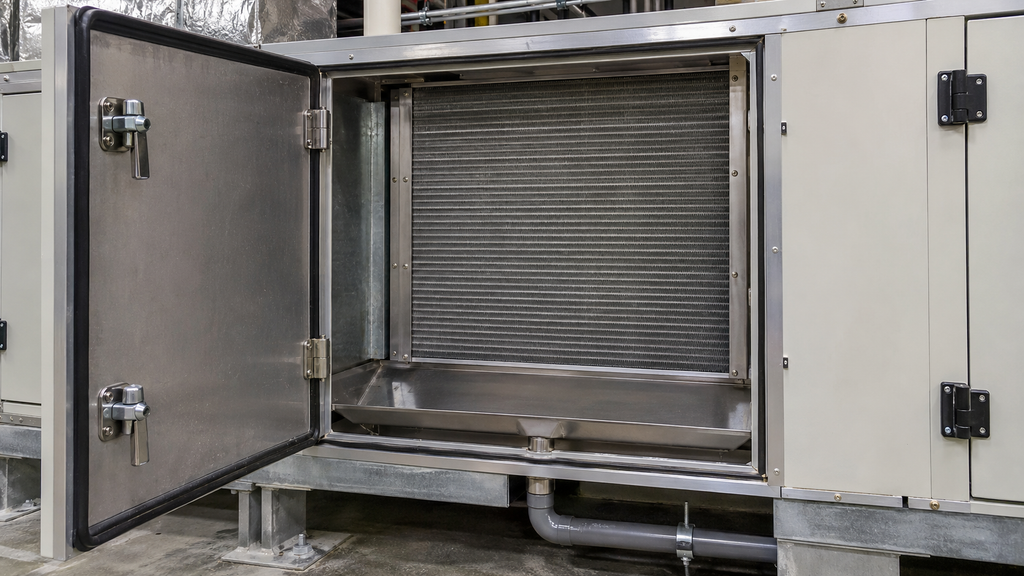
Most pharma AHUs are modular, with each section performing a defined function. The table lists the usual AHU components in pharma, in an illustrative arrangement that varies with the application:
| Component | What it does | GMP points to watch |
| Fresh air intake and louvre | Draws in outside air | Locate away from exhausts and dust sources |
| Mixing box with dampers | Blends fresh and return air in set proportions where recirculation is used | Fresh-air quantity should account for leakage, exhaust, occupancy and applicable legislation (WHO 6.4) |
| Pre-filter | Removes coarse dust, protects downstream parts | Select the appropriate ISO 16890 group and efficiency for the application |
| Fine filter | Captures fine particles and protects downstream components, depending on its position | Commonly ISO ePM1 or ePM2.5 filters, with the required efficiency specified; no direct equivalence to former EN 779 classes |
| Cooling coil | Cools and can dehumidify air when moisture condenses on the coil | Sloped, well-drained condensate pan to prevent condensate accumulation (WHO 5.6, 8.4) |
| Heating or reheat coil | Heats air or reheats it after dehumidification, where required | Hot water, steam or electric |
| Humidifier | Adds moisture when air is too dry for the specified conditions | Must not become a contamination source (WHO 8.3) |
| Supply fan | Moves air against the system resistance | EC fans with integrated speed control, or suitable AC-motor fans with variable frequency drives, allow airflow control |
| HEPA filter (where required, in the AHU, return path or room terminal) | Provides high-efficiency particulate filtration for the intended application | Select grade and location by application; WHO 6.2 specifies at least H13 or equivalent when HEPA filtration is used to prevent cross-contamination in recirculated air |
| Casing and access doors | Houses every section | Appropriately insulated panels, cleanable internal surfaces and sealed access doors, with suitable maintenance access |
| Sensors and controls | Measure temperature, humidity, pressure and airflow | Appropriate alarms and control functions; GxP automated monitoring systems should be validated (WHO 5.13) |
Pharmaceutical AHU specifications should define casing insulation, leakage performance, corrosion resistance, internal surface finish and drain-pan construction according to the application, rather than prescribe one panel thickness or stainless-steel grade for every installation.
How an AHU Works: Step by Step
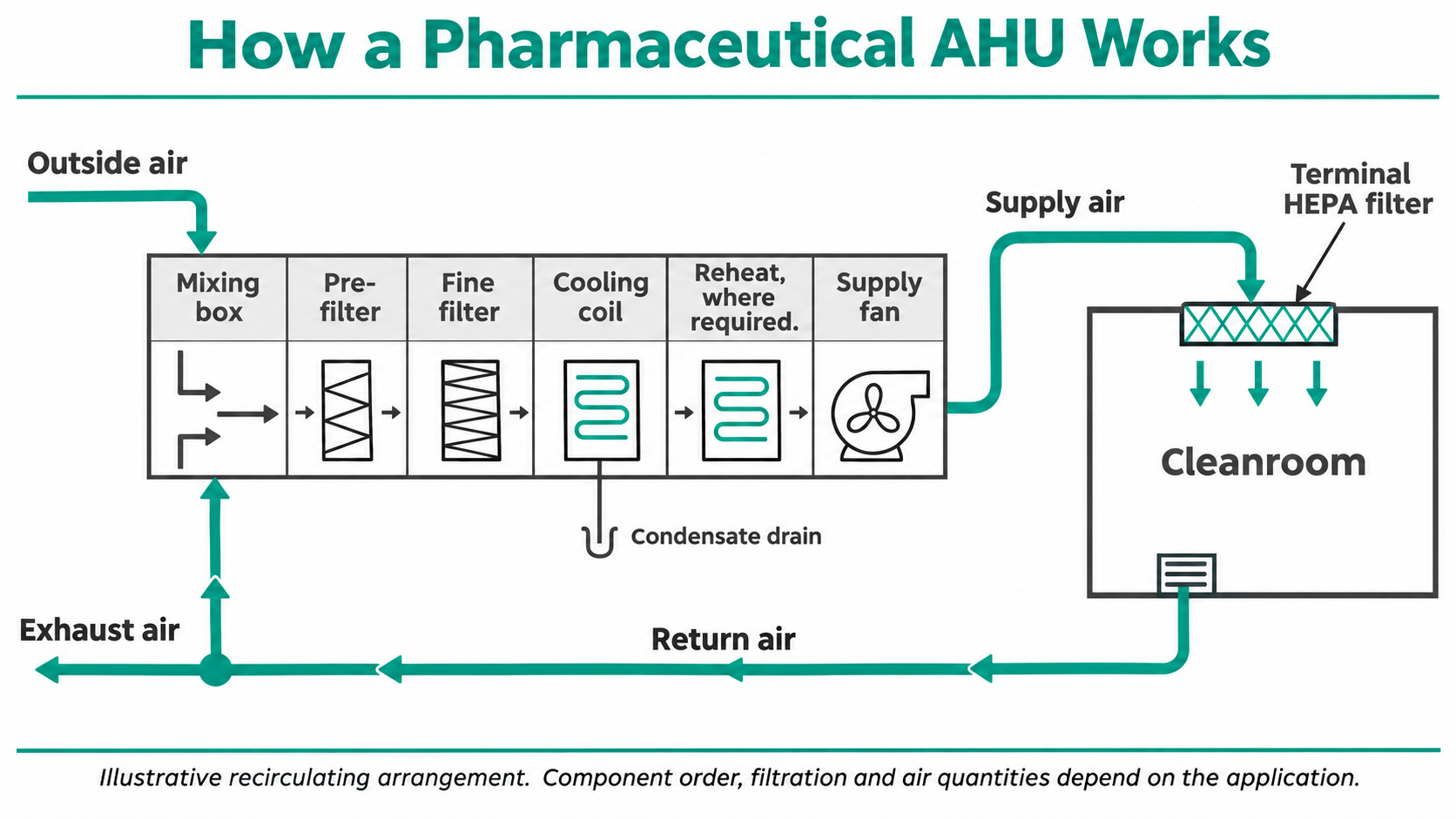
Air follows an application-specific path through a pharmaceutical AHU. Here is an illustrative sequence for a recirculating system; component positions and operating steps vary with the design:
- Intake and mixing: Outside air enters through the louvre and mixes with return air from the rooms in the mixing box.
- Pre-filtration: The coarse filter traps large dust, insects and fibres.
- Fine filtration: The fine filter removes smaller particles and protects downstream components in this arrangement.
- Cooling and dehumidification: When dehumidification is required, the cooling coil cools the air sufficiently for moisture to condense on its surface and drain away.
- Reheating: The heating coil brings the dry, cold air back up to the required supply temperature where necessary.
- Humidification, if needed: When required by the specified conditions, a humidifier adds moisture to reach the target relative humidity.
- Air movement: The supply fan pushes conditioned air into the ductwork at the design volume.
- Final filtration: HEPA filters, where specified in the AHU or at the room terminals, reduce airborne particles, including microorganism-carrying particles, at their rated efficiency.
- Room supply and return: Air moves through the room, removes airborne particles and heat, and leaves through return grilles, whose positions depend on the required airflow pattern and room layout.
- Recirculation or exhaust: Part of the return air goes back to the mixing box; the rest is exhausted, and fresh air replaces it according to the design air balance. .
Controls tie the steps together. Sensors in the supply duct and rooms provide feedback to controllers that adjust valves, damper positions and fan speed to hold the setpoints, while alarms warn staff of specified deviations or failures.
Once-through systems omit return-air mixing, while other arrangements may use different fan positions, filter locations or humidity-control technologies.
Recirculation vs Full Fresh Air
One of the first decisions in any AHU project is whether to reuse return air. WHO’s Annex 8 (Section 6) allows both approaches, with conditions.
| Factor | Recirculation system | Full fresh air (once-through) system |
| How it works | A proportion of return air is filtered and reused, with a fresh-air top-up | All supply air comes from outside and is exhausted after one pass |
| Energy use | Generally lower conditioning demand, since conditioned air is reused | Generally higher conditioning demand, depending on climate, operating conditions and energy recovery |
| Cross-contamination risk | Must be controlled; where HEPA filtration is used for this purpose, WHO specifies at least H13 or equivalent in supply or return air, with exceptions described in Section 6.3 | Avoids redistribution through recirculated air; other contamination pathways still require control |
| Typical use | Suitable non-sterile production areas and other applications where recirculation is justified by the process and contamination-control strategy | Areas where air may contain organic solvents or highly hazardous materials, for which WHO normally advises against recirculation |
The single-product exception in WHO Section 6.3 concerns HEPA filtration for preventing cross-contamination through recirculation; it does not remove other application-specific filtration requirements.
WHO adds that energy-recovery wheels in multiproduct plants need controls to stop cross-contamination, and that exhaust filtration depends on risk and local regulations.
Filtration Stages
A typical pharma HVAC arrangement may use three filter stages: coarse, fine and HEPA. ISO 16890 classifies general ventilation filters using particulate-matter efficiency groups and ISO Coarse ratings. The old G and F classes cannot be directly converted to ISO Coarse, ePM10, ePM2.5 and ePM1 groups, because the test methods and classification criteria differ. HEPA filters can be classified under EN 1822, where WHO’s Annex 8 table shows H13 at a minimum overall efficiency of 99.95% at the most penetrating particle size.
Pharmaceutical AHU Design Considerations
Good cleanroom AHU design starts long before fan selection. These are the pharmaceutical AHU design considerations that matter most, drawn largely from WHO’s Annex 8 for non-sterile products, with additional requirements determined by the application.
Capacity With Margin
WHO asks that the system be sized to hold performance in normal use, allowing for room leakage, duct leakage and filter loading (5.2). A unit sizedonly for clean-filter resistance may lose airflow as filter pressure drop increases.
Zoning
Group rooms by grade, product and risk, and determine whether separate AHUs are needed through the contamination-control and containment assessment. A shared unit across products raises the stakes on return-air filtration and recirculation controls.
Hygienic Construction
Materials must not shed or harbour contamination (5.3). Coil sections need adequate condensate drains (5.6), and cooling and dehumidification sections must drain well so condensate does not accumulate (8.4). Label ducts, pipes and sensors with appropriate identification and, where applicable, flow direction where possible (5.4).
Failure Planning
WHO asks designers to analyse failure modes of critical parts, including the room pressure changes caused by a fan failure, and to use a fan interlock failure matrix where appropriate (5.9, 5.15). Alarms should alert staff to critical failures such as a stopped fan (5.14).
Dust and Fume Control
WHO says the HVAC system should not normally be the main means of dust control; capture dust at source (9.1). Extraction should be interlocked with the relevant AHU where appropriate, and designed to prevent backflow and unintended contaminant transfer through extraction or return ducts (9.2 to 9.6).
Energy
WHO discourages switching AHUs off or cutting supply air outside production hours unless it is justified and demonstrated not to compromise material or product quality (5.16). Within those limits, appropriately assessed heat recovery, run-around coils, EC fans with integrated speed control and suitable AC fans with variable frequency drives can help reduce operating energy.
Commissioning, Qualification and Maintenance
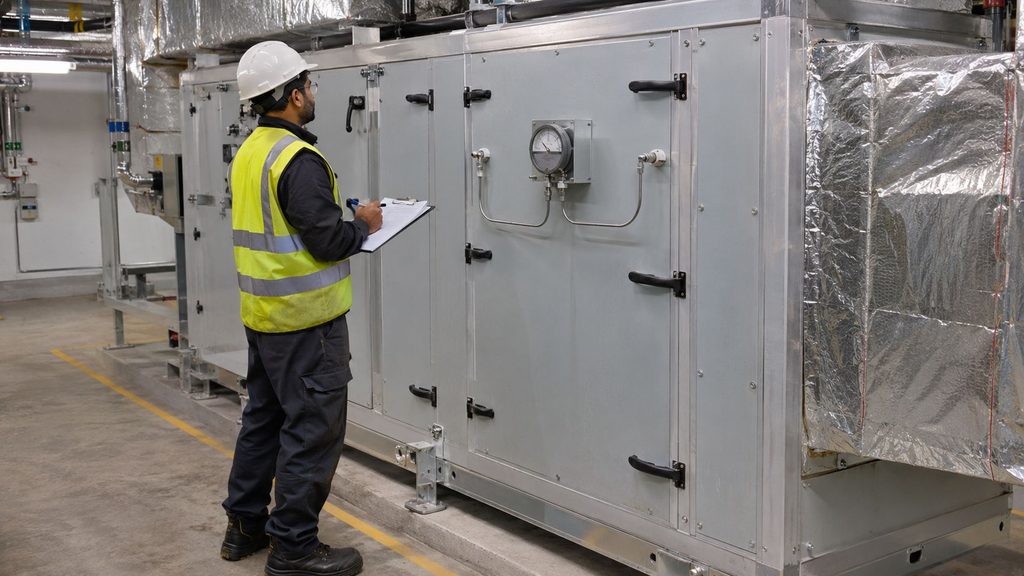
An AHU supports GMP operation when the relevant HVAC system has been appropriately qualified, and it maintains that performance through monitoring and maintenance. The key activities include:
Commissioning
WHO treats commissioning as the step before CQV pharma qualification, done to good engineering practice to confirm the installation matches its specification (Section 11). This is where airflows get balanced, dampers set and controls tuned.
Qualification
WHO asks that both recirculation and full fresh air systems be qualified on a risk basis, described in a qualification master plan (12.1 to 12.3). Test methods should follow the relevant parts of ISO 14644 and applicable WHO guidance where appropriate, and design conditions, operating ranges and alert and action limits should be defined, with alert limits based on system capability (12.4, 12.5). WHO also lists parameters for which SOPs should define responses to alert and action limits where relevant, including airflow, pressure, particle counts, HEPA penetration, duct leakage and microbial counts (12.8).
Qualification acceptance criteria should be established before testing, based on approved requirements and applicable standards; capability-based alert limits do not justify relaxing those criteria.
For sterile areas, EU GMP Annex 1 sets maximum requalification intervals of 6 months for Grade A and B and 12 months for Grade C and D, applicable to cleanrooms and clean air equipment under Section 4.32.
Monitoring
Automated monitoring systems should flag out-of-limit conditions for the parameters they monitor, and GxP-relevant monitoring systems should be validated (WHO 5.13).Alarm priorities, delays and response procedures should reflect the criticality of the monitored conditions.
Maintenance
WHO asks for current O&M manuals and drawings, and a preventive maintenance programme scaled to each component’s criticality, normally carried out outside production hours (13.1 to 13.5). A competent person should change HEPA filters, followed by an installed filter leak test (13.6). Changes go through change control, with the extent of requalification set by impact (12.10).
Why AHU Design Matters for Indian Facilities
India’s revised Schedule M, notified in December 2023, strengthens national GMP requirements. Eligible small and medium manufacturers with turnover below ₹250 crore could seek a conditional extension until 31 December 2025 through the prescribed application and upgrade-plan process. For Indian pharmaceutical facilities, AHU design should address zoning, recirculation, drainage and failure planning against applicable national requirements and those of intended export markets.
India’s climate adds its own load. Humid monsoon months can increase dehumidification demand, while dry northern winters can call for humidification where process requirements justify it, so coil, reheat and humidifier sizing deserve care. Pharma Access includes heat load calculations, zoning strategy, area classification, pressurisation plans, airflow diagrams and CFD analysis within its HVAC design scope, the inputs that shape an AHU specification. Pharma Access also offers CQV (commissioning, qualification and validation) services, linking design decisions to the tests that later prove them.
Final Thoughts
An AHU is a key component of pharmaceutical environmental control. In a GMP plant, it works with the wider HVAC system to maintain the required room classification, pressure, temperature and humidity during defined operating conditions. Size it with appropriate margin, zone it by risk, build it to hygienic standards, plan for failure, and qualify it against predefined acceptance criteria derived from approved requirements. Then maintain it through documented procedures that support sustained performance and product protection.
Frequently Asked Questions
1. What is the difference between an AHU and an HVAC system?
HVAC is the whole system for heating, ventilation and air-conditioning, including chillers, boilers, ducts, terminal filters and controls. The AHU is one part of it: the unit that filters, conditions and moves the air before it travels through ducts to the rooms.
2. Is recirculation allowed in pharma AHUs?
Yes. WHO’s Annex 8 allows recirculation for non-sterile applications where contamination and cross-contamination risks are controlled, with at least H13 or equivalent filtration where HEPA filters are used for that purpose, subject to the exceptions in Section 6.3. Air that may contain organic solvents or highly hazardous materials should normally not be recirculated.
3. Which filters does a pharma AHU use?
A common arrangement uses three stages: a coarse pre-filter, a fine filter and a HEPA filter where required by the application. ISO 16890 classifies general ventilation filters as ISO Coarse, ePM10, ePM2.5 or ePM1, while HEPA filters can be classified under EN 1822, such as H13 or H14.
4. Can a pharma AHU be switched off at night?
Only with justification. WHO’s Annex 8 discourages switching AHUs off or reducing supply air outside production hours unless it is justified and proven not to put materials or products at risk, with documented start-up and shutdown procedures and records.
5. What should cleanroom AHU design documents include?
They should cover heat load calculations, zoning, room data sheets, airflow and pressure diagrams, filter stages, fresh-air share, failure analysis and control logic. These documents feed the design qualification and help establish the approved requirements and acceptance criteria that subsequent qualification tests must verify.