If you are considering setting up a pharmaceutical factory in the UAE, the regulatory framework has recently undergone a significant change. A number of pharmaceutical licensing and GMP oversight functions have transitioned from the Ministry of Health and Prevention (MOHAP) to the Emirates Drug Establishment (EDE). If your compliance plan is still written on the old structure, now is the time to update it.
This guide provides a practical overview of the UAE pharmaceutical manufacturing requirements. It explains who regulates what, what a factory needs to get licensed, and what GMP looks like on the ground.
Meet the Emirates Drug Establishment (EDE)
The Emirates Drug Establishment (EDE), the UAE’s independent federal authority for pharmaceuticals and medical devices, was established in September 2023 under Federal Decree-Law No. 28 of 2023. Its scope covers all medical and pharmaceutical products manufactured in the country, including medical devices and other medical-product categories within its statutory mandate.
A further regulatory shift followed. Federal Decree-Law No. 38 of 2024 entered into force on 2 January 2025, replacing the older Federal Law No. 8 of 2019. As part of the implementation of this transition, MOHAP announced the full transfer of 44 core services to EDE, together with the partial transfer of 13 additional services, including pharmaceutical-facility licensing functions. EDE now administers medical-product factory licensing and GMP certification through its regulatory services.
MOHAP still exists. It continues to retain specific pharmaceutical-sector responsibilities, including licensing medical professionals and pharmacists supporting EDE-licensed establishments, as well as certain controlled-medicine functions. Abu Dhabi also maintains its own Approved Drug List and processes for certain non-registered medicines within the local healthcare system through the Department of Health (DOH); these are distinct from the federal EDE manufacturing-licensing process. So a manufacturer operating across emirates may need to coordinate with federal and relevant local authorities depending on the project and market pathway, rather than dealing with only one authority.
Why This Matters for Facility Planning
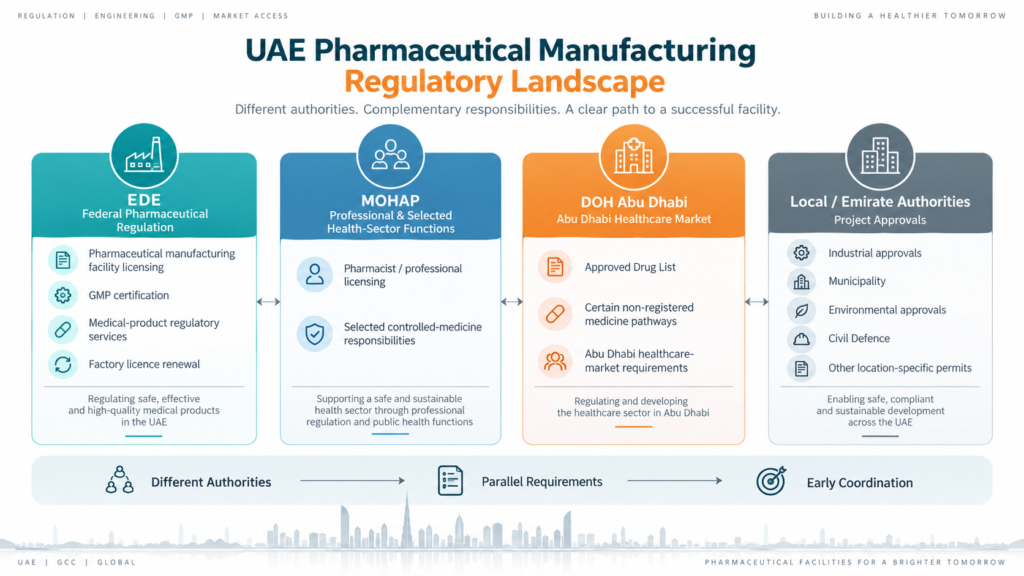
This is an important distinction during regulatory and facility planning. While pharmaceutical facility licensing and EU GMP approval in the UAE are processed at the federal level, specific healthcare-market requirements in Abu Dhabi are managed by the DOH. If your plant is in Dubai, you work with the EDE for manufacturing approval. Separate emirate-level requirements, such as industrial, environmental, municipality and Civil Defence approvals, may also form part of the overall project pathway. If your products are intended for specific Abu Dhabi healthcare channels, applicable DOH requirements become an additional local-market consideration.
This is not a sequence in which one approval leads automatically to the next. These are different regulatory and project-approval tracks and early planning saves a lot of back and forth later.
Core UAE Pharmaceutical Manufacturing Requirements
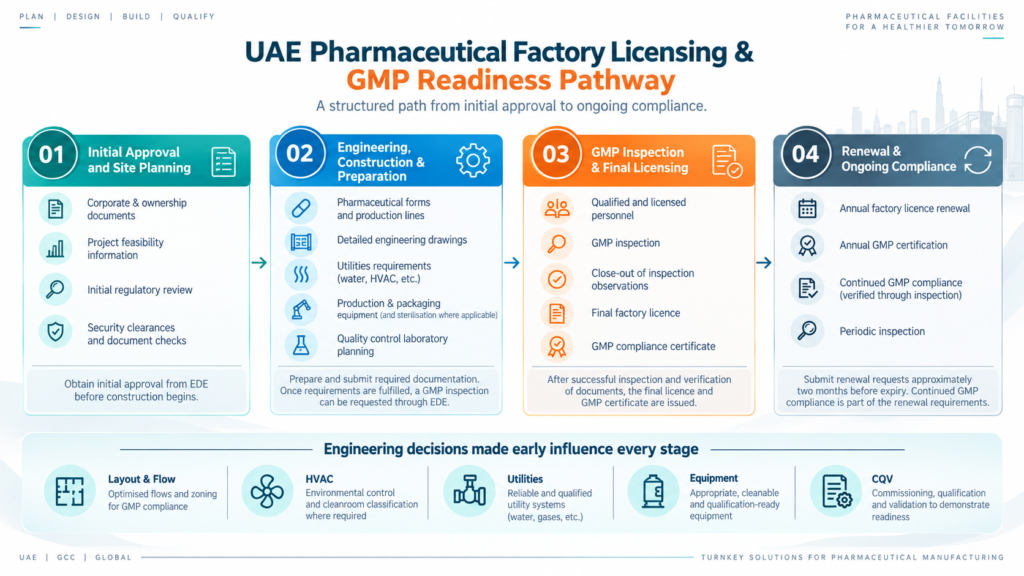
Whether you are setting up a new plant or expanding an existing one, the basic route to a pharmaceutical manufacturing licence in the UAE goes through a few stages.
Stage 1: Initial Approval and Site Planning
The applicant will provide company and site information for review before construction. This includes the ownership structure, corporate documents, project feasibility information and the documentation required for initial regulatory review. Current EDE requirements place the proposed pharmaceutical dosage forms and production lines under the subsequent construction and preparation stage rather than the initial-approval documentation.
Stage 2: Construction and Preparation
After the initial approval is obtained, the facility begins to build out the physical plant. Detailed engineering drawings, approval related to estimated water and electricity consumption where required, a list of the pharmaceutical forms and proposed production lines, the equipment and devices for each production, packaging, and sterilisation line where applicable, and an explanation of what the quality control laboratory needs to operate are required at this stage. Then, once these documents have been submitted and the relevant requirements fulfilled, the facility will be eligible to submit a GMP inspection request through EDE.
Stage 3: Final Licensing and GMP Certificate
The facility appoints appropriately qualified and licensed personnel to fill key positions, including production manager, quality assurance manager, and quality control manager, before final inspection. These positions require valid professional licences, with pharmacist and medical-professional licensing for the relevant roles handled through MOHAP. Personnel requirements for facilities limited to medical devices may differ from those applicable to pharmaceutical manufacturing facilities. After the inspection has been completed and the documents verified, the final licence and GMP certificate are issued after the facility has addressed the applicable requirements and inspection observations.
According to the current EDE service information, the government fee for final licensing of a pharmaceutical or medical device manufacturing facility is AED 50,000. EDE also currently lists an AED 100 application fee, AED 2,000 for engineering-plan approval and AED 3,000 for each final inspection. The separate GMP compliance certificate is currently listed at AED 2,000 per production line annually.
Stage 4: Renewal and Ongoing Compliance
In the UAE, a pharmaceutical factory licence must be renewed annually, and renewal is based on continued compliance with good manufacturing practices, confirmed through inspection. EDE states that requests to renew EDE-issued GMP certificates can be submitted approximately two months before expiry. Factory-licence renewal and GMP inspection therefore should not be treated as completely separate activities, because continued GMP compliance is part of the renewal requirements. This is not something to leave at the last minute, as failing to renew on time can have legal consequences.
What GMP Actually Covers Inside the Plant
UAE GMP certification requirements are not just paperwork exercises. Inspectors observe the real operation of the facility.
There are a few areas that crop up again and again:
- Facility layout and cleanliness. The building needs to be designed to allow materials and staff to pass through in a logical order, with appropriate segregation and controls to minimise contamination and cross-contamination risks.
- Facilities and utilities. The equipment used for production and packaging must meet the set standards. Utilities that directly or indirectly affect product quality, including pharmaceutical water, HVAC and process gases where applicable, require appropriate qualification, monitoring and maintenance.
- Documentation and quality system. Standard operating procedures, batch records, and deviation logs must exist and must match what is really happening on the floor.
- Personnel trained. Production staff need role-specific training, and that training needs a paper trail.
- Testing of products. Raw materials, in-process samples where applicable, and finished products should be tested against defined specifications.
This is nothing unique to the UAE. It is closely aligned with established international GMP principles, while manufacturers must also meet the specific UAE regulatory requirements applicable to their facility, products and processes.
How UAE Requirements Connect to GCC Drug Registration
It is rare that the UAE is the only market a manufacturer has in mind when building a plant in the UAE. A lot of companies are looking for broader GCC drug registration, so they use the UAE as a base to get to Saudi Arabia, Qatar, Oman, Bahrain, and Kuwait as well.
The UAE fits into this regional picture in two ways. First of all, a GMP certificate from the EDE can form part of the regulatory evidence supporting applications involving a UAE manufacturing site, but it does not by itself provide automatic regulatory approval in other GCC markets. The Gulf Health Council also operates a central drug-registration framework intended to harmonise registration of pharmaceutical companies and medicines across GCC member states. Secondly, UAE-based manufacturing can be a strategic entry point, thanks to the country’s logistics infrastructure and its position as a gateway to the wider Gulf market.
That said, Gulf Health Council central-registration requirements and country-specific regulatory requirements may still apply depending on the intended product and market pathway, so a UAE GMP certificate doesn’t automatically clear every hurdle elsewhere in the region.
Common Mistakes Manufacturers Make
A handful of patterns are common enough to be worth mentioning:
- Treating EDE and DOH requirements as one combined approval process. They cover different regulatory responsibilities, and confusing their roles can create unnecessary delays.
- Finalising engineering drawings before confirming the intended dosage forms, production lines and manufacturing scope. Once construction drawings are locked in, changing the product mix can mean expensive rework.
- Under-scoping the quality control laboratory. EDE requires manufacturers to define the equipment needed for laboratory testing of raw materials, in-process materials and finished products. An inadequately planned QC laboratory can create gaps in inspection readiness.
- Waiting too long to renew. EDE allows requests to renew its GMP certificates approximately two months before expiry, while continued GMP compliance remains part of the factory-licence renewal process.
- Assuming old MOHAP processes are still applicable across the board. EDE now administers key manufacturing licensing and GMP services, so older guidance should be checked against the current EDE process before it is relied upon.
Getting the Facility Design Right the First Time
Much of the above delay can be traced back to decisions made before one wall is built. Getting the layout of the building, the cleanroom classification,where required by the product and process, and the design of the utilities right at the drawing-board stage helps avoid the costly redesign work that rears up later when inspectors point out gaps. This is where Pharma Access comes in, working with pharmaceutical manufacturers at this very stage, designing facilities to meet GMP expectations from day one, rather than retrofitting compliance into a finished building.
Pharma Access also provides support for commissioning, qualification, and validation (CQV) work for projects that need assistance in linking engineering decisions to documented GMP requirements and inspection readiness. This is the stage at which a finished facility is tested against the approved requirements and intended operating conditions that support its qualified state and readiness for GMP manufacturing.
A Few Final Thoughts
The Emirates Drug Establishment is now the principal federal authority administering pharmaceutical manufacturing licensing and GMP certification in the UAE, MOHAP continues to perform specific responsibilities including professional licensing and certain controlled-medicine functions, and DOH Abu Dhabi has its own healthcare-market responsibilities within Abu Dhabi.
To obtain a licence for a plant, the process includes initial approval, construction and preparation, GMP inspection and qualified-personnel readiness, final licensing with a GMP certificate, and then annual renewal. Build the facility with GMP expectations integrated into the design from day one, and the risk of late-stage redesign can be reduced while inspection readiness is strengthened.
Frequently Asked Questions
What is the Emirates Drug Establishment (EDE), and how is it different from MOHAP?
The EDE is the UAE’s federal authority for the regulation of pharmaceuticals and medical devices, established in 2023. As part of the regulatory transition implemented during 2025, MOHAP transferred 44 core services fully and 13 services partially to EDE. EDE now administers key services involving medical-product manufacturing facilities and GMP compliance, while MOHAP retains responsibilities including professional licensing and certain controlled-medicine functions.
How much does a pharmaceutical manufacturing licence cost in the UAE?
According to current EDE service information, the final licensing fee for pharmaceutical or medical device manufacturing facilities is AED 50,000. EDE also currently lists an AED 100 application fee, AED 2,000 engineering-plan approval fee and AED 3,000 per final inspection. The GMP compliance certificate is listed separately at AED 2,000 per production line annually. Fees should always be reconfirmed with EDE before submission because regulatory charges can change.
How often does a UAE GMP certificate need renewal?
A pharmaceutical factory licence is renewed annually, and EDE’s GMP compliance certificate is also issued annually. EDE states that a request to renew an EDE-issued GMP certificate can be submitted approximately two months before expiry. Continued GMP compliance is verified through inspection as part of the regulatory requirements.
Does a UAE GMP certificate work for registration in other GCC countries?
Elsewhere in the GCC, a valid EDE GMP certificate may support the regulatory documentation for a UAE manufacturing site. The Gulf Health Council also operates a central registration framework for pharmaceutical companies and medicines. However, applicable central and country-specific regulatory requirements still need to be assessed for each target market, and a UAE GMP certificate does not provide automatic GCC-wide approval.
What documents does a manufacturing facility need before its GMP inspection?
Facilities usually need to submit detailed engineering drawings, information on the proposed pharmaceutical forms and production lines, a list of equipment for production and packaging, details on the sterilisation line where applicable, and documentation on the quality control laboratory set-up before a GMP certification inspection is requested. Current EDE requirements also identify information related to estimated water and electricity consumption as part of the construction and preparation stage.
Technical References
- UAE Legislation – Federal Decree-Law No. 28 of 2023, establishing the Emirates Drug Establishment https://uaelegislation.gov.ae/en/legislations/2122
- Emirates Drug Establishment – Issuance of a Medical Products Factory Licence https://www.ede.gov.ae/ar/w/issuance-of-a-license-for-a-medical-products-factory-and-contractual-companies-for-research-and-development
- Department of Health – Abu Dhabi Drug Authorisation / Approved Drug List https://www.doh.gov.ae/en/research/Dashboard/Drug-Authorization
- Gulf Health Council – Central Registration https://www.ghc.sa/en/central-registration/