If your facility fills sterile products, you’ve likely been faced with this decision at some point: RABS vs isolators. Both systems are designed to reduce contamination risks associated with personnel and direct human intervention during filling, but they get there in very different ways – and that difference shows up in your design and construction cost, your cleanroom grading, and how your facility gets qualified.
This post explains how the two technologies differ, what the current EU regulatory guidance requires of each, and what qualification looks like once the system is installed. We won’t dive deep into the engineering details; we’ll keep it simple.
What Are RABS and Isolators, in Plain Terms?
An RABS, or Restricted Access Barrier System, is effectively a physical barrier made around a filling line, with gloved ports through which operators can reach when needed. In normal production, the barrier is closed, but depending on the design, doors are rarely opened and only under strictly predefined conditions. It provides an enclosed, but not fully sealed, environment that separates the Grade A processing zone from the surrounding cleanroom.
An isolator is more. It’s a self-contained, enclosed system that provides continuous isolation of its interior from the surrounding environment, with a controlled Grade A work zone and a reproducible bio-decontamination process. Operators only interact with the process through glove ports or half-suits. The isolator provides continuous separation from the surrounding cleanroom, allowing lower background cleanroom grades where justified through risk assessment and the Contamination Control Strategy (CCS).
The main difference is that RABS provides an enclosed but not fully sealed barrier between the aseptic process and the surrounding cleanroom. Isolators provide continuous isolation of the internal Grade A environment from the external environment.
How EU GMP Annex 1 Treats RABS vs Isolators
The 2022 update to this guidance changed the expectation of how regulators want manufacturers to think about barrier technology. Cleanrooms, laminar flow hoods and open processing were common enough before this revision. The revised annex places greater emphasis on appropriate barrier technologies and contamination-control measures for protecting critical aseptic processing zones.
The use of RABS and isolators in the maintenance of the required conditions and reduction of microbial contamination associated with direct human intervention in the critical zone is described as beneficial in this guidance. It states that the use of these should be considered as part of the Contamination Control Strategy (CCS) and that any alternative approach needs justification. In practice, that means a manufacturer who chooses not to use one of these systems now has to justify the decision, rather than the other way around.
EU GMP Annex 1 RABS Requirements
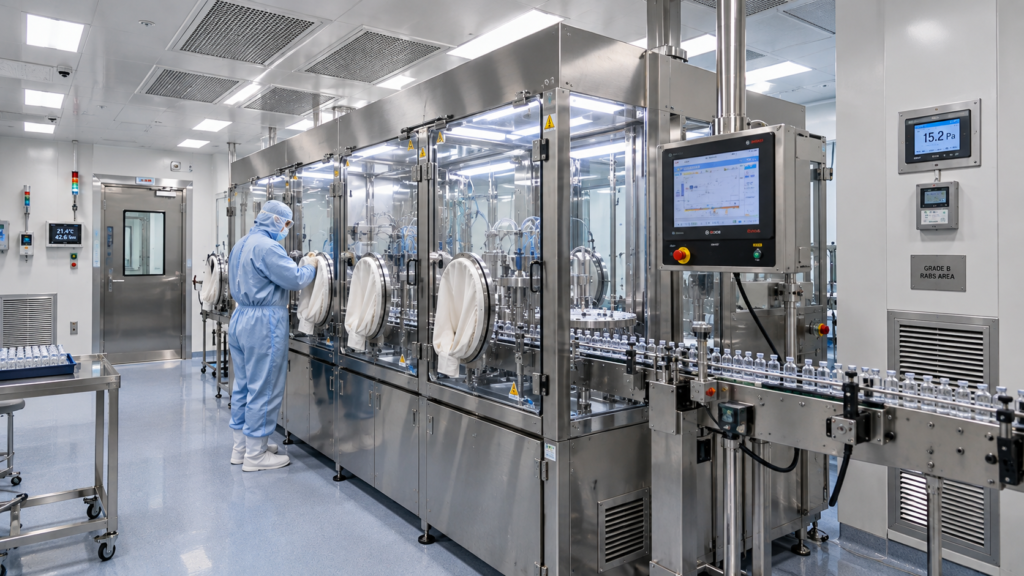
The annexe is specific as to what a RABS installation must show. It should be maintained at Grade A conditions with unidirectional airflow and first air protection in the critical zone, and the background environment around an RABS used for aseptic processing needs to be at least Grade B. That Grade B requirement is a big part of what makes RABS more expensive to operate than it might first appear, since the entire surrounding room has to be built and maintained to that classification.
What Annex 1 Says About Isolators
Isolators are handled differently because they provide continuous isolation of the interior from the external environment. Isolators provide continuous isolation of the interior from the external environment, and the annex describes two types of isolators: closed and open. The difference between the two is the manner in which materials move in and out during operation. The background classification requirements are different from those for RABS: the surrounding room for an open isolator is generally required to be at least Grade C, and for a closed isolator at least Grade D. The final background classification should be based on risk assessment and justified within the CCS, and a higher grade may be required where additional process risks are identified. That is a much lower background classification requirement than the Grade B environment a RABS installation requires.
Comparing RABS and Isolators Side by Side
Here’s a quick summary of the main differences that matter for facility design.
- RABS Grade: Minimum Grade B background required. Isolator background: Depending on the design, open isolators generally require a minimum Grade C background, while closed isolators require a minimum Grade D background, subject to risk assessment and CCS justification.
- Separation level: RABS has an enclosed but not fully sealed barrier, with doors rarely opened and only under strictly predefined conditions. Isolators provide continuous isolation of the internal Grade A work zone from the external environment.
- Air handling: RABS maintains Grade A conditions with unidirectional airflow, first air protection and positive airflow from the critical zone toward the supporting background environment. Isolators maintain Grade A conditions within the internal work zone, with airflow requirements depending on whether the isolator is open or closed and on the process design.
- Decontamination: Isolators require an automated, validated and controlled interior bio-decontamination process using a suitable sporicidal agent. RABS require validated routine sporicidal disinfection of the interior surfaces to ensure a suitable environment for aseptic processing.
- Cost of capital: Isolators are often more expensive to purchase up front because they are self-contained and automated. Although the initial cost of RABS might be lower, the continued operating costs of Grade B rooms could be higher.
- Flexibility: RABS systems are often easier to retrofit into existing filling lines. Isolators can require greater integration with the filling line, transfer systems, utilities, controls and facility design, although retrofit feasibility depends on the existing installation.
Aseptic Barrier Systems and Qualification: What Changes
RABS and isolators are both forms of aseptic barrier systems. However, the qualification of each is slightly different, based on the way each interacts with the surrounding facility.
RABS Qualification
To be able to qualify a RABS installation, the interaction between the barrier and the Grade B room surrounding it has to be considered. This means that airflow visualisation studies have to be performed to show that unidirectional flow is maintained and to demonstrate the absence of air ingress during interventions, including door openings where applicable. Since it is easy to transfer contamination between the RABS and the surrounding Grade B space, environmental monitoring needs to be performed within the RABS and the surrounding Grade B space as defined by the facility’s environmental and process monitoring strategy.
Isolator Qualification
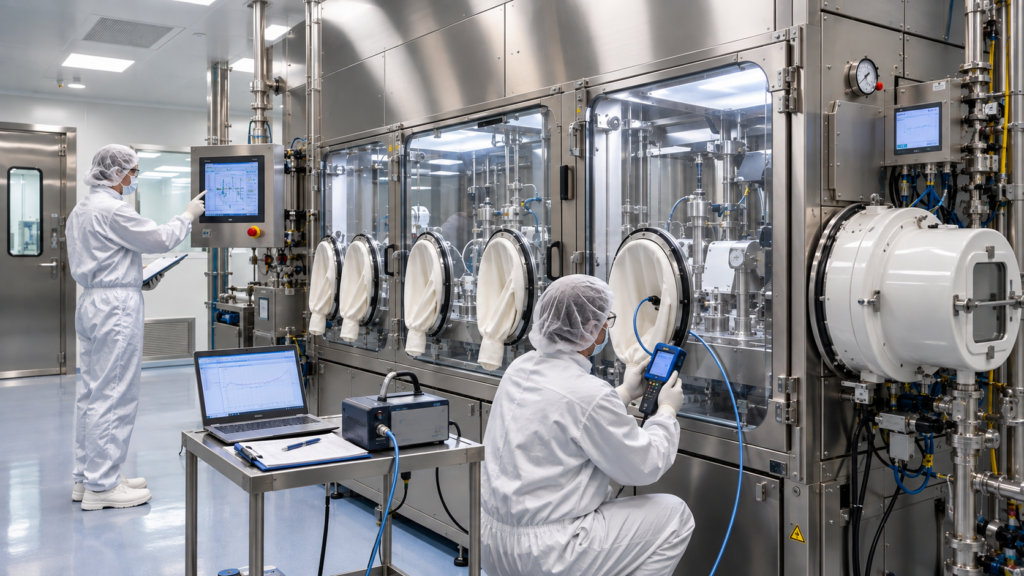
The qualification of an isolator is often more concentrated on the decontamination cycle, as this is the step that establishes the validated bio-decontaminated condition inside the unit before aseptic processing. Qualification protocols usually check that the vapour-phase decontamination cycle consistently achieves its predefined and validated acceptance criteria and include leak testing to confirm the isolator maintains its integrity at defined intervals. This qualification work places relatively less emphasis on the background room performance and more on the isolator’s own containment and decontamination systems because the surrounding room requirement is lower.
Glove-system integrity is also an important part of isolator control. Annex 1 expects leak testing of isolator glove systems at defined intervals and generally at the beginning and end of each batch or campaign, with additional testing where required by the validated campaign length.
Aseptic Process Simulations for Both Systems
With Annex 1, there are heightened expectations for aseptic process simulations across the board, no matter the barrier technology a facility uses. The updated guidance introduces a tighter action level for Grade A viable contamination, with the Grade A action limit defined as “no growth” and any growth requiring investigation. Initial qualification must be performed on RABS and isolator lines with at least three consecutive satisfactory simulations covering all working shifts in which the aseptic process may occur, followed by periodic revalidation, typically twice per year for each aseptic process, each filling line and each shift. Each operator should also participate in at least one successful APS annually.
Which System Should Your Facility Choose?
There is no single answer that fits all, and EU GMP Annex 1 does not establish a hierarchy that requires isolators to be selected over RABS. The appropriate barrier technology should instead be justified through the CCS and quality-risk-management approach. But the practical answer tends to boil down to a few things:
- New construction or retrofit? RABS can generally be added to an existing filling line with less extensive facility integration in some applications, although the feasibility depends on the existing line and cleanroom design.
- What is the risk level of your product? Processes involving complex or frequent interventions, challenging aseptic transfers or other elevated contamination risks may benefit from the greater degree of separation provided by isolator technology. However, product modality alone should not determine the barrier-system selection.
- What is the operational maturity of your team? The decontamination cycle and integrity of the gloves require more detailed management, and the training of the staff and procedures must be in line with this level of detail.
- What does your budget and schedule allow? Isolators tend to be more expensive initially, but they can reduce the ongoing costs of maintaining a Grade B environment.
For existing facilities, a phased barrier-technology strategy may be considered, with RABS retained or implemented where technically appropriate and isolator technology evaluated for new lines or major expansions based on the process and facility requirements.
Designing Your Facility Around the Right Barrier Choice
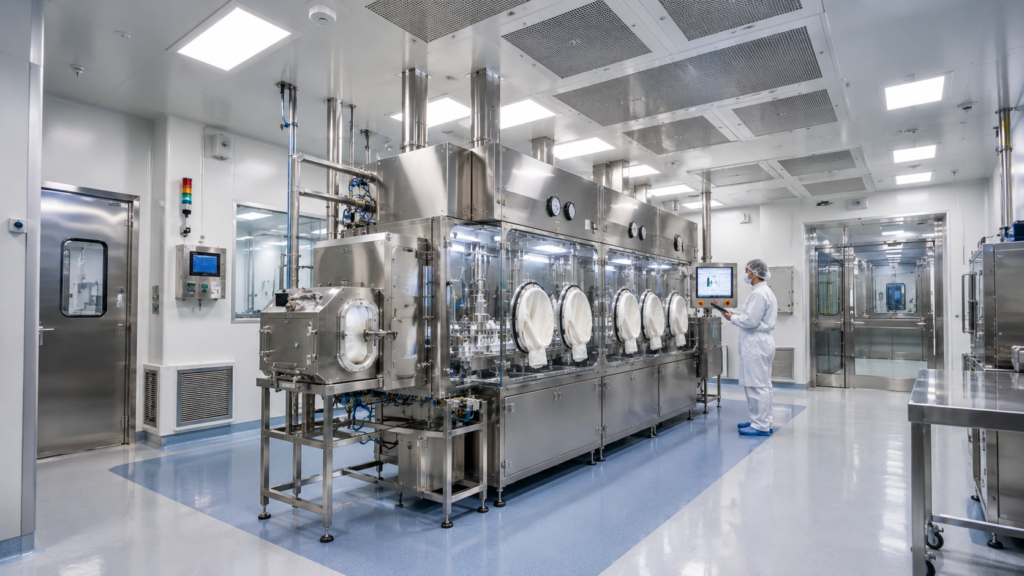
The decision to employ RABS or isolators is never isolated. It drives HVAC sizing, room classification, growing requirements, and even the square footage the aseptic suite needs.It can also influence material-transfer strategy, intervention design, environmental monitoring, decontamination systems and the overall CQV scope. Getting this decision right at the concept design stage saves the costly rework that comes from discovering mid-construction that the room was built for the wrong background grade.
At Pharma Access, our engineering design and CQV teams partner with clients through this decision from the earliest planning stage, considering product risk, facility layout, and long-term operational plans before committing to an isolator- or RABS-based approach. We make that decision and take it through cleanroom design, HVAC, and qualification as one connected process so the facility that’s built is aligned with the aseptic process it needs to support. Read more about our approach on the Pharma Access about page.
Wrapping Up
Both RABS and isolators are there to solve the same underlying problem, which is keeping people away from sterile products during filling. RABS can offer lower initial barrier-equipment cost and greater retrofit flexibility in suitable applications but still requires a Grade B background and careful qualification of the barrier system and its interaction with the surrounding environment.
Isolators provide continuous separation, lower background grade requirements, and qualification that is focused strongly on barrier integrity and validated bio-decontamination performance. Annex 1 makes clear that RABS or isolators should be considered as part of the CCS, while alternative approaches need to be justified.
FAQs
What is the main difference between RABS and isolators?
RABS is an enclosed but not fully sealed barrier system whose doors are rarely opened and only under strictly predefined conditions, and usually needs a Grade B background room. Isolators are enclosed systems providing continuous isolation of their internal Grade A work zone from the surrounding environment and can often operate in a Grade C or D environment depending on whether the isolator is open or closed and on the CCS risk assessment.
Does EU GMP Annex 1 require isolators over RABS?
Not exactly. Annex 1 states that RABS or isolators should be considered in the Contamination Control Strategy, with justification for alternatives. It does not establish isolators as a regulatory requirement over RABS; the selection should be based on process risk, barrier design and the CCS.
Why do isolators need a lower background cleanroom grade than RABS?
Isolators provide continuous isolation of their internal Grade A environment from the surrounding cleanroom, and so lower background grades can be justified based on the isolator design and risk assessment. RABS are enclosed but not fully sealed, so Annex 1 requires a minimum Grade B background for RABS used for aseptic processing.
What does isolator qualification focus on that RABS qualification does not?
Isolator qualification is very focused on the decontamination cycle, checking that the validated bio-decontamination process consistently operates within its defined cycle parameters and achieves established acceptance criteria, together with isolator and glove-system integrity testing. RABS qualification is more about maintaining Grade A conditions, airflow performance and demonstrating the absence of air ingress during interventions, including door openings where applicable, together with the required Grade B background.
Can an existing RABS line be converted to an isolator later?
It can be done, but typically at a cost, as isolators may require significant integration with the existing filling line, transfer systems, HVAC, utilities, automation and room configuration. Many facilities therefore evaluate isolator retrofit feasibility against installing the technology as part of a new line or major expansion.
Technical References
1. European Commission — EudraLex Volume 4, EU GMP Annex 1: Manufacture of Sterile Medicinal Products
2. European Commission — EudraLex Volume 4, Annex 15: Qualification and Validation