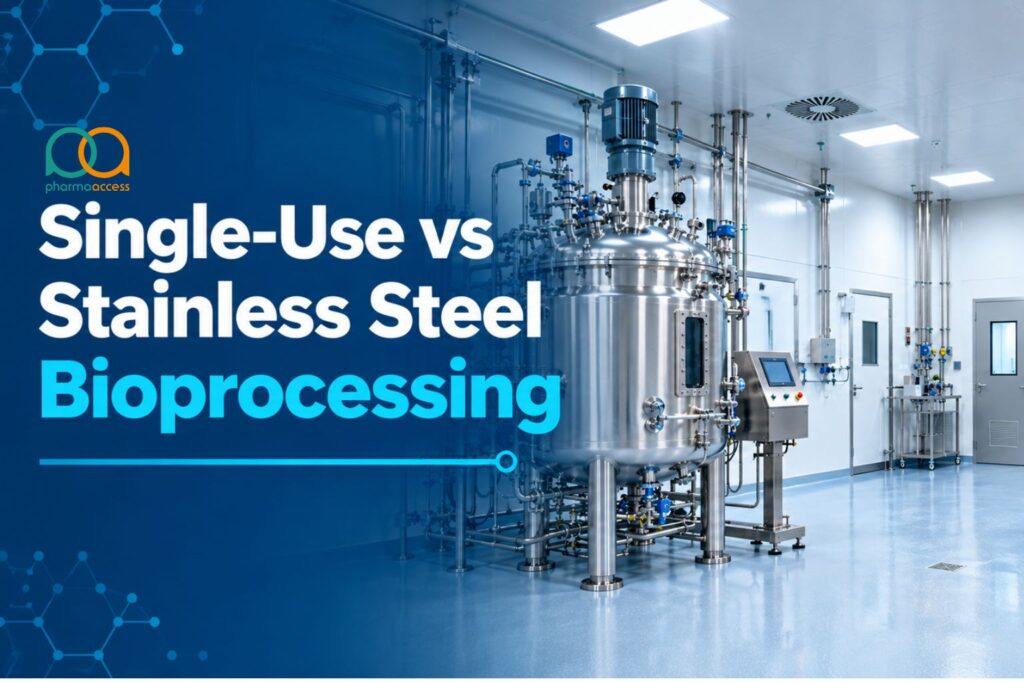
Ask an equipment vendor which option wins, and you’ll hear vessels and bags. Ask a facility engineer, and you’ll hear about pipes and steam and drains and room layouts. Both perspectives matter, and together they shape what you create, what you pay, and how easily you can change course later.
This guide explores single-use versus stainless steel bioprocessing as a facility decision, not an equipment swap. It compares cost, footprint, clean utilities, cleaning, HVAC, contamination risk, validation, waste, and expansion. First, the short answer. No method wins all the time. Let’s break it down.
What Each Approach Includes
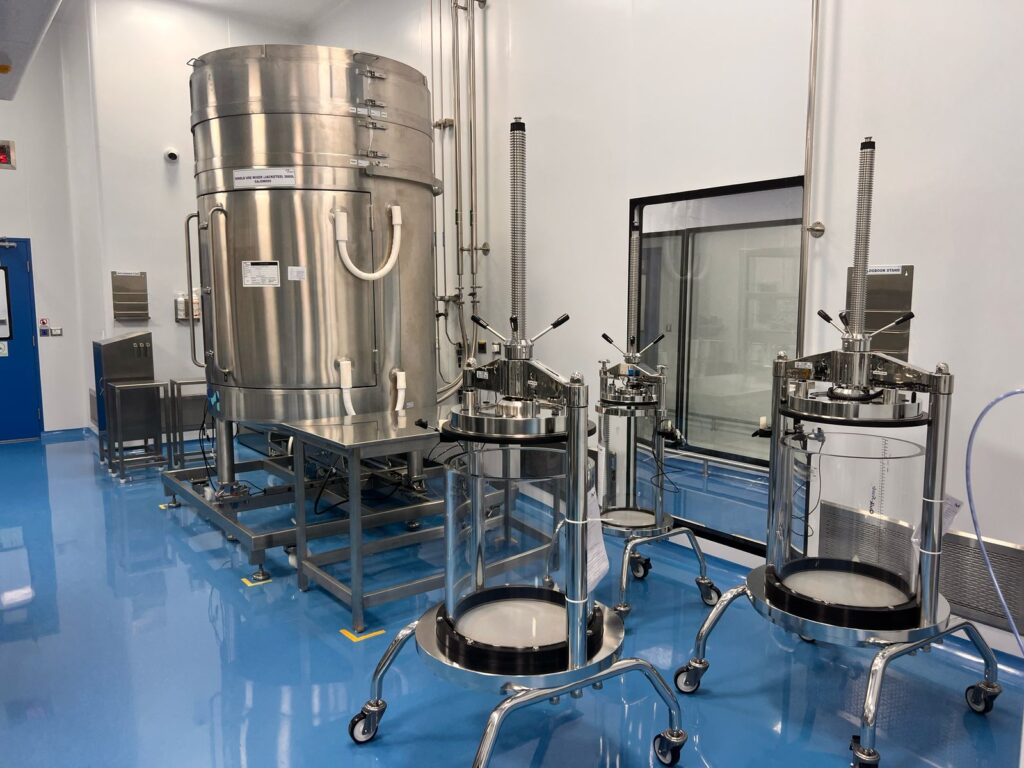
Stainless steel bioprocessing typically relies on fixed vessels, hard piping, and automated cleaning. At defined intervals, operators clean and, where required, sterilise reusable equipment using appropriate methods, which may include clean-in-place (CIP) and steam-in-place (SIP) systems.
Single-use systems replace all or part of the reusable product-contact path with disposable bags, tubing, connectors, and filters. The product-contact path is replaced after its defined use. Single-use systems in biopharmaceutical manufacturing now include cell culture, buffer and media handling, filtration, and storage.
The difference extends well beyond the process room. It can reshape the utility plant, the drains, the warehouse, and the waste route. That’s why the decision belongs in early biopharmaceutical facility design, alongside equipment selection.
CAPEX and OPEX: Where the Money Moves
The two options spread cost differently over time.
Stainless steel typically front-loads spending. A commercial-scale GMP stainless system, including the vessel, piping, CIP skid, SIP system, instruments, and installation, requires a project-specific capital estimate based on capacity, location and scope. Operating costs afterwards include utilities, cleaning, labour, maintenance, calibration, and qualification or validation activities, where required.
Single-use changes the pattern. Capital cost can drop, and consumables become a recurring expense. The capital cost for single-use systems can be lower than for conventional stainless, so lifecycle economics comes down to comparing total operating costs and capital investment over a defined period. The lifecycle cost of single-use applications can be higher or lower than stainless steel, because consumable costs must be weighed against cleaning, utilities, labour and production output.
Cleaning infrastructure also affects capital cost. Part of the capital saving comes from reducing the complex CIP and SIP piping and the automation that goes with it.
Utilisation is the swing variable. A suite that runs a few campaigns a year can favour single-use. A suite that runs one product at high, steady volume often favours stainless. Treat published cost figures as rough guides and model your own batch schedule.
Read More: What Drives Pharmaceutical Facility CAPEX?
Footprint, Construction Time, and Future Expansion
Fixed stainless steel installations often require more permanent piping and cleaning infrastructure. This can reduce layout flexibility and extend installation time. Single-use facilities often have shorter build times and can be more adaptable to future changes.
The layout requirements differ for a single-use bioreactor facility:
- Reduced CIP skid and CIP room requirements
- No steam distribution network for SIP of the disposable reactor path
- Reduced drainage requirements for process-cleaning effluent
- Additional space for bag handling, carts and consumables storage in production and warehouse areas
The same is true of expansion. A room built for single-use can be reconfigured for a new scale or product where the layout, utility capacity and qualification strategy allow it. Scaling either type of suite can require new equipment, new utility hook-ups and new qualification work.
Scale still counts. Commercial single-use bioreactors are available across a range of working volumes, including 2,000 L, with larger systems available at 5,000 L. Before you buy, check current vendor ranges for your product.
Pharma Access also offers its Modular Mobile Facility (MMF) pproach to support off-site fabrication and coordinated systems integration. It shows how the question of expansion and the method of construction are now linked.
Biotech Facility Utilities: PW, WFI, and Clean Steam
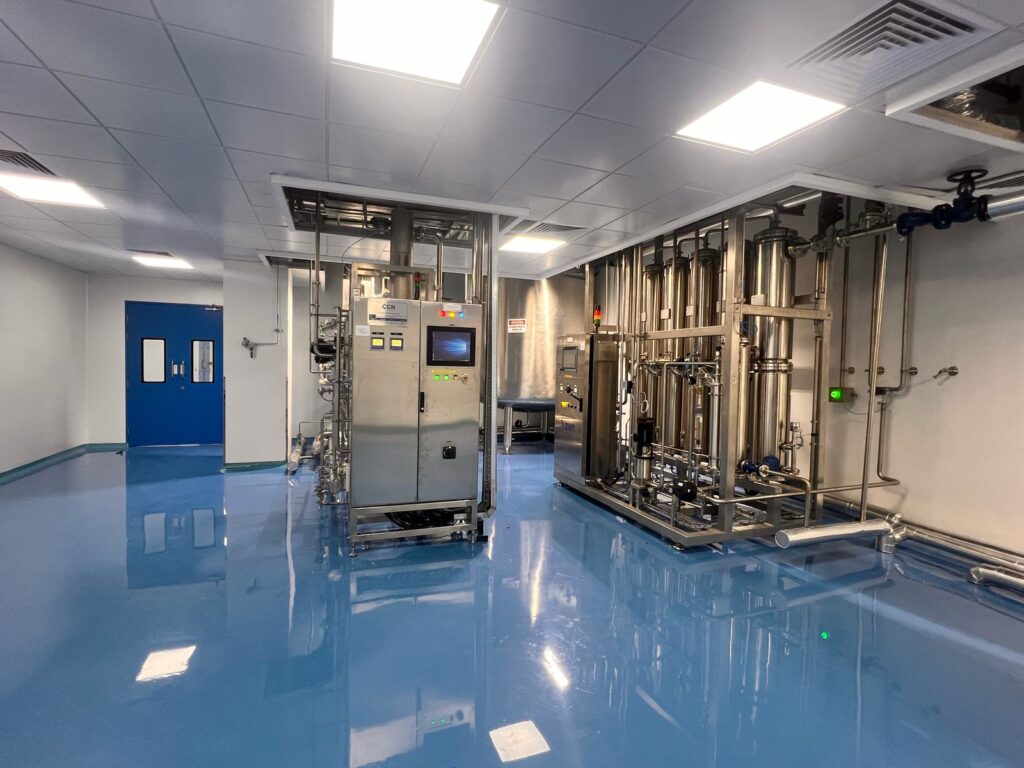
Utilities are the major difference between the two options and also where many comparisons end prematurely.
CIP can create substantial water demand. With single-use, purified water (PW), water for injection (WFI), and clean steam demand for cleaning and sterilising the replaced product-contact path is removed, and the burden on the utilities behind them can be lighter. This can reduce the demand for steam and WFI, which may reduce the required utility capacity.
The need for clean utilities does not disappear, however. Some mid-size installations still require WFI generation and distribution loops, together with clean-steam generation and distribution systems, according to their process and sterilisation duties. A facility may retain a bulk WFI system for its process water and any remaining equipment duties that require this grade.
So size the utility plant to what you really need:
- Water for media and buffer preparation: grade and demand remain process-specific.
- Peak demand: CIP can be a major contributor to peak flow. Its removal can reduce generation and storage requirements, depending on coincident process demand. Verify with a load calculation.
- Clean steam: needed where remaining equipment or autoclave duties require steam sterilisation.
- Effluent: Single-use can reduce cleaning chemicals and rinse water, which can simplify neutralisation without removing any required biological-waste treatment.
Good biotech facility utilities design is driven by the process choice, not the other way around. Pharma Access covers disciplines such as mechanical and utility system design, HVAC system design, process design, and piping and plumbing design. These are the details that make this decision.
CIP SIP Bioprocessing: What Stainless Steel Requires
CIP/SIP bioprocessing is not just skids. It can require cleaning-chemical dosing, spray devices, drains, wastewater treatment, and clean steam, depending on the system. CIP can use cleaning chemicals and rinse water, while SIP uses steam, adding to utility demand. Each cleaning and sterilisation cycle has to be developed, validated and routinely controlled.
The more products, the more cleaning-validation considerations. For each new product in shared stainless equipment, its impact on the existing cleaning-validation strategy must be assessed. This means a cleaning procedure, suitable residue testing, scientifically justified worst-case selection, and ongoing evaluation. Single-use avoids previous-product carryover within the discarded path, and so cleaning validation is not required for that path.
HVAC, Room Grade, and Energy
HVAC follows the process in several ways:
- Heat and Steam Loads: Stainless vessels, steam lines, and CIP skids add heat to process rooms. Removing them often reduces the cooling load and steam consumption.
- Open handling: closed single-use or stainless systems with demonstrated integrity can minimise open manipulations in some process steps and may support a lower-grade background room. This is justified through your risk assessment and, where applicable, contamination control strategy, against applicable GMP requirements.
- Number and layout of CIP rooms: Fewer CIP rooms can result in simplified pipe runs, while pressure cascades still follow the contamination and containment strategy.
Don’t take these as guaranteed savings, but rather design hypotheses to test. The grades and air change rates follow your process risk and required environmental performance, not the vessel material.
Contamination Risk, Validation, and Changeover
The potential benefits of single-use are clear here. Reasons companies choose it include lower previous-product carryover risk in the disposable path, faster changeover between campaigns, lower water and wastewater requirements, and no CIP or SIP validation for that path. Reusable equipment also requires effective cleaning, sterilisation where needed, and controlled connections to manage contamination risk.
Single-use also has its own risks:
- Extractables and leachables (E&L): Plastic can leach compounds into the product. Extractables are released under specified laboratory extraction conditions. Leachables are compounds that migrate under actual process conditions. The assessment should also consider material compatibility, product adsorption and particulate risks.
- Bag and connector integrity: a leak or faulty connection can lose a batch.
- Supply chain dependence: A facility can be unable to operate if critical single-use assemblies are unavailable. Qualify alternate vendors where feasible, with appropriate compatibility and change assessments. Track supplier change notices.
Validation does not disappear. It changes. BioProcess International describes a lifecycle approach: assess vendor packages and E&L data, conduct risk assessments of individual components, and then assess cumulative risk across the whole process. Validation costs for single-use and stainless steel depend on the process and scope, so neither should be assumed to be lower. Cleaning validation is unnecessary for the discarded path, while material suitability, integrity and supplier controls must be assessed alongside qualification and validation of the process, reusable equipment, utilities and automation. For sterile single-use systems, evidence of validated sterilisation and appropriate receipt checks is also required.
Waste and Environmental Impact
The strongest criticism of single-use is waste, and it is a valid one. Stainless equipment can last for decades. Many single-use bags contain multilayer polymer films. Single-use parts are discarded after their defined use. Controlled incineration, including waste-to-energy where available, is one possible end-of-life route subject to local treatment requirements.
Water and energy use also influence the comparison. One potential environmental advantage of single-use is reduced cleaning-water consumption. CIP and SIP can require substantial water and energy. A life-cycle assessment provides a more complete comparison than considering only the visible pile of plastic after a campaign.
So compare water, energy, chemicals, effluent, and plastic together. Add your local waste options. The answer changes if a site has no approved disposal route.
| Factor | Single-use | Stainless steel | What to check |
| CAPEX | Often lower; scope-dependent | Often higher; scope-dependent | Vessel, piping, CIP and SIP scope |
| OPEX | Consumables plus operating costs; total is project-specific | Cleaning, utilities and upkeep; total is project-specific | Utilisation, labour, utilities and output |
| Footprint | Potentially smaller process footprint; more consumables staging and storage | More fixed process and cleaning infrastructure | Warehouse and utility space |
| PW and WFI | Reduced cleaning demand; process-water needs remain | Cleaning and process demand; peaks depend on schedule | Peak load calculation |
| Clean steam | Reduced where SIP duties are removed | Required for applicable SIP duties | Remaining sterilisation duties |
| CIP and SIP | Not needed for the disposable path | Required and validated where applicable | Cycle count, effluent |
| HVAC and energy | Often lower heat and steam load | Process- and equipment-dependent heat loads | Room grade rationale |
| Changeover | Potentially faster | Includes cleaning, verification and any required sterilisation | Product mix |
| Contamination risk | Reduced carryover in discarded path; E&L and integrity risks | Depends on cleaning, applicable sterilisation and operational controls | Risk assessment |
| Validation | Process/system qualification and validation; material, integrity and supplier assessment | Process/system qualification and validation; cleaning and applicable sterilisation validation | Validation plan scope |
| Waste | Plastic waste; potentially less cleaning water | Reusable equipment; cleaning water, chemicals and effluent | Life-cycle view |
| Flexibility | Potentially high, within facility and process limits | More constrained by fixed infrastructure | Pipeline stability |
| Scale | Commercial platforms include 5,000 L; process-specific | Large-scale options; process and engineering limits apply | Working volume and process performance |
| Expansion | Reconfigure where capacity and qualification allow. | New equipment and utility tie-ins with qualification as needed | Master plan |
When Single-Use Fits
- One suite, multiple products
- Clinical programmes subject to change before launch
- Capital must be protected.
- First batch speed is important
- Volumes are within the selected single-use platform’s range
When Stainless Steel Fits
- One approved product goes at a steady, high volume
- Required scale or process conditions are beyond suitable single-use ranges
- The schedule is predictable
- Long-term economics favour reusable equipment
- Critical single-use assemblies cannot be sourced with acceptable supply resilience
Hybrid Approaches: Use Each Where It Performs Best
Facilities can combine both approaches. One possible hybrid is single-use upstream in seed trains and cell culture with stainless downstream in purification and bulk storage. Product changes and contamination risks affect both upstream and downstream, so flexibility should be assessed across the process. A fixed downstream train for one product can be appropriate where throughput and lifecycle economics support it.
The reverse hybrid arrangement, stainless upstream and single-use downstream, works for sites with existing stainless bioreactors. Single-use filtration and chromatography formats have evolved to the point that that option is a practical choice in some commercial programmes.
Hybrid bioprocessing and hybrid facility construction are separate decisions: the former combines process technologies, while the latter combines modular and conventional construction.
Hybrid design requires special attention at the boundary:
- Identify where each technology begins and ends and keep track of the interface.
- Don’t size clean utilities for an all-stainless top, but for the mixed load.
- Leave room for utility capacity and future connections.
- Plan procurement and vendor qualification for both technologies.
Next Steps: Make the Decision in Order
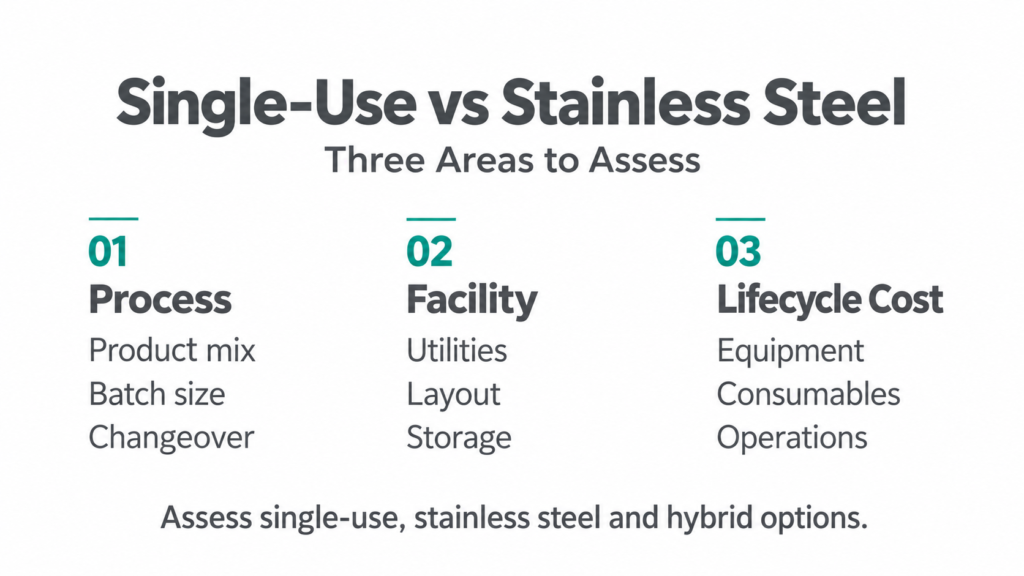
- Establish the product pipeline, batch counts and volume range for the agreed planning horizon.
- Develop a cost model for CAPEX, consumables, utilities, labour maintenance, waste treatment and validation.
- Scale clean utilities for each scenario with/without CIP and SIP.
- Check HVAC, drains, storage and waste routes for each scenario.
- Run single-use path E&L, integrity and supplier risk assessments.
- Try hybrid options with a clear boundary and plan for expansion.
- Document the decision in your contamination control strategy where applicable, and design basis.
Pharma Access supports biotechnology facilities for monoclonal antibodies, antibody-drug conjugates, cell and gene therapy, vaccines, peptides and insulin. Engineering informs equipment selection. This is a decision product teams face early in the development of those products.
Frequently Asked Questions
Is single-use cheaper than stainless steel?
Buying a single-use unit initially can be cheaper, but consumables add ongoing cost. High steady utilisation can make single-use more expensive than stainless over a lifetime. Where usage is low or variable, single-use can offer an economic advantage. Model own batch schedule.
Does single-use eliminate CIP and SIP?
It eliminates CIP and SIP for the disposable fluid path, reducing the associated cleaning infrastructure, cycle-validation activities and water demand. Any remaining reusable equipment requires cleaning and, where applicable, sterilisation in hybrid facilities.
What limits the scale of single-use bioreactors?
Commercial single-use platforms include systems up to 5,000 L, with suitability determined by the platform and process. If you need something outside your vendor’s range, stainless steel is one option to assess.
What is a hybrid bioprocessing facility?
It brings together both technologies. One possible design is single-use upstream for flexibility and stainless downstream for suitable purification and storage duties. Designers have to define the interface, size common utilities, and plan for expansion space.
Does single-use remove the need for WFI?
No. You may still need WFI or PW for media and buffer prep as specified by the process, and clean steam for remaining sterilisation duties. Single-use primarily reduces the demand for CIP and SIP, which can reduce the peak load and required utility capacity, subject to load calculations.