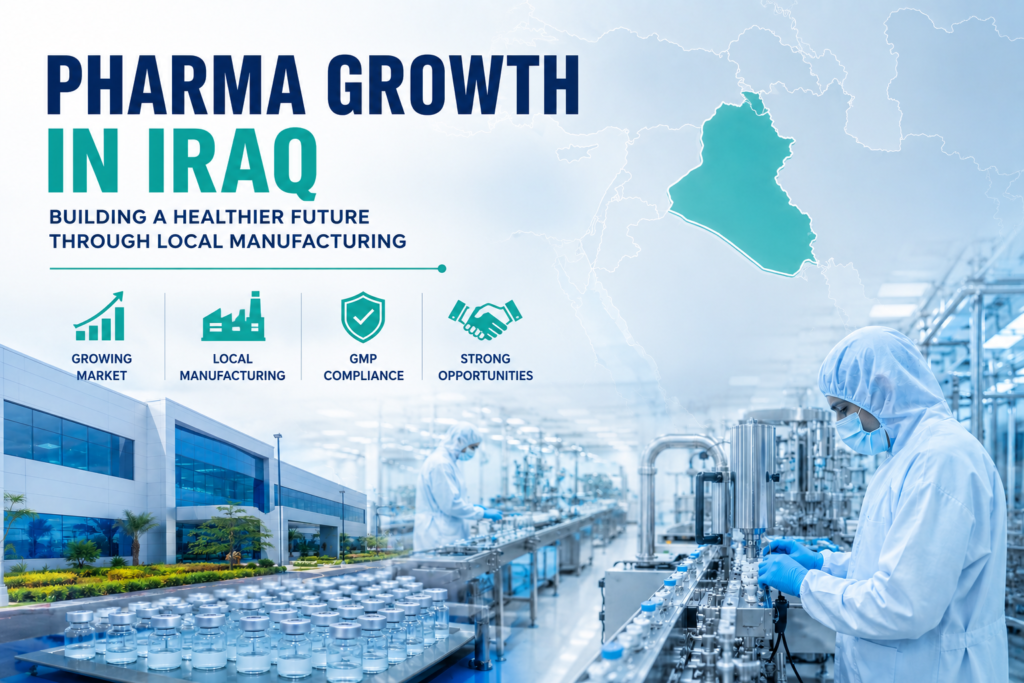
Iraq is emerging as one of the region’s important pharmaceutical growth opportunities. As recently as 1989, Iraq was spending more on healthcare than Saudi Arabia, Turkey, and Egypt combined. Years of war, sanctions, and instability have reduced that industry. Today, new policies, investment, and rising healthcare demand are bringing focus back to local pharmaceutical production. With local production struggling to keep pace with demand, the shortfall is driving genuine opportunity for manufacturers and turnkey developers who are willing to enter the market now.
Let’s take a look at what the numbers say and what they could mean for your company’s pharma turnkey solutions in Iraq.
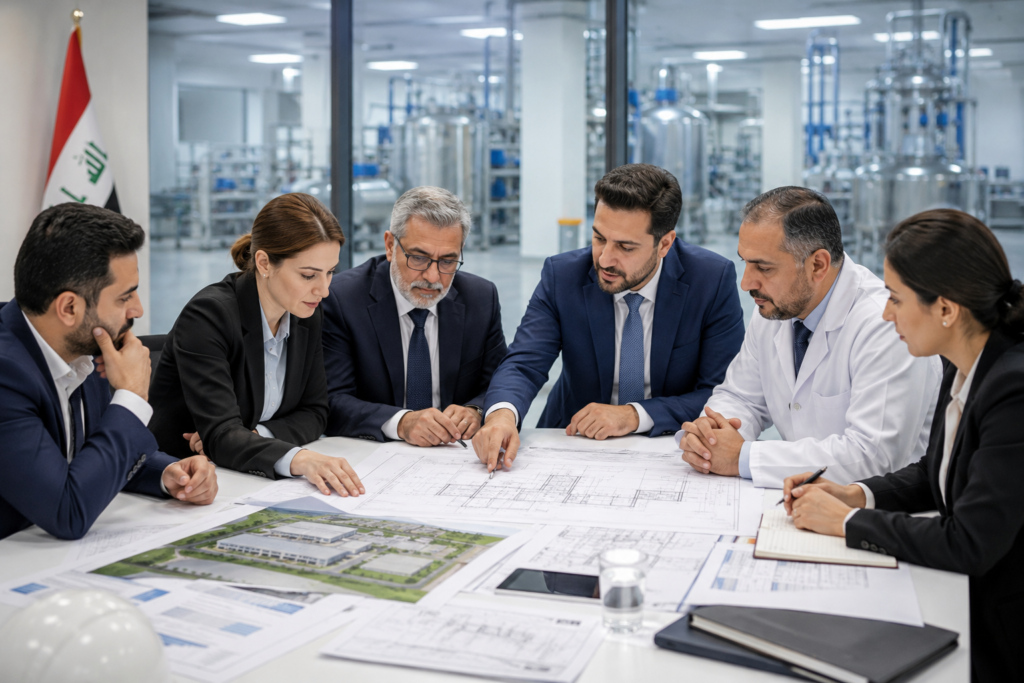
The Market: Size, Growth, and a Chronic Import Problem
Iraq’s pharmaceutical market is growing, with estimates varying depending on whether official, private, and informal sales channels are included. Publicly cited figures place the market in the multi-billion-dollar range, showing strong demand for medicines across the country.
The drivers of demand are evident. a population of around 46 million and a young demographic profile, Iraq is one of the youngest countries in the Middle East. As more citizens take up residence in urban areas, non-communicable diseases such as diabetes, hypertension, cardiovascular disease, and cancer are on the rise. According to the World Health Organization (WHO), more than 70% of all deaths in Iraq are attributable to non-communicable diseases and the increasing burden of chronic illness is fueling demand for long-term medicines and advanced therapies.
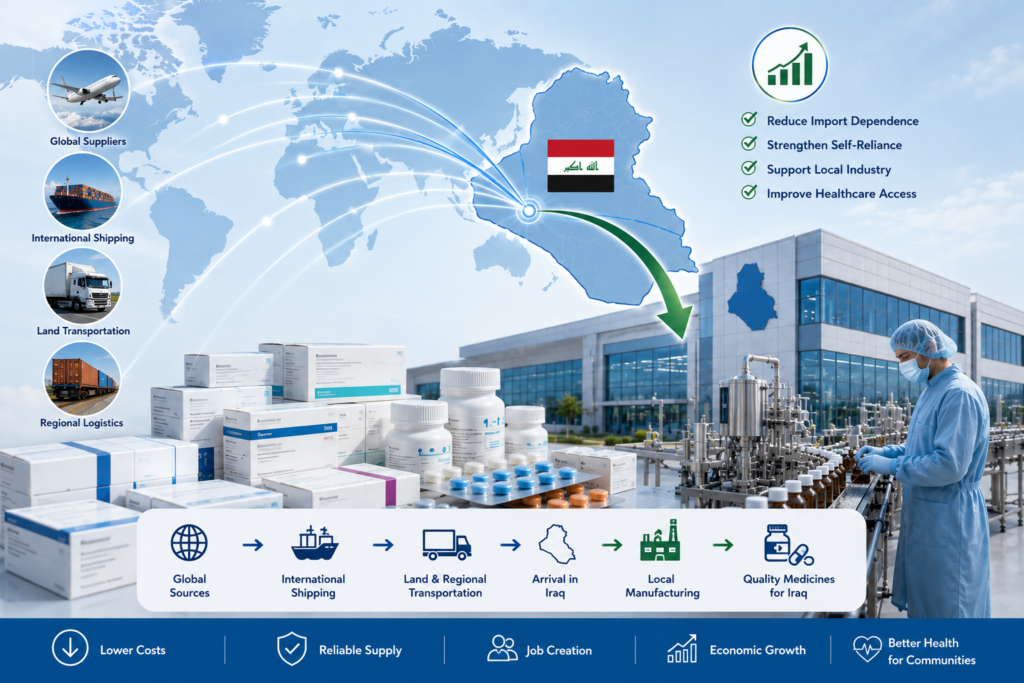
The issue: domestic production currently satisfies only a small percentage of this demand. Foreign markets supply the majority of medicines used in Iraq, with India, Jordan, Iran, and Turkey among the top exporters to Iraq.
This dependence on imported medicines is exactly what Iraqi policymakers are now trying to reduce. For pharmaceutical manufacturers and turnkey project partners, this creates a clear opportunity to support local production.
Government Policy: Why the Timing Is Right
Iraqi policy makers have gone beyond statements of support for local pharmaceutical production. At the government level, new decisions and incentives are encouraging both the expansion of existing pharma projects and the development of new factories.
These incentives include support for investors, easier financing options, and faster processes for companies bringing in technology and manufacturing know-how from outside Iraq.
Recent factory openings also show that this policy direction is becoming visible on the ground. The Mustaqbal pharmaceutical factory, for example, has been reported to have the capacity to produce hundreds of drug varieties, eye-drop solutions, and ampoules every year. It focuses on essential medicines and cancer treatment.
The government has also spoken about increasing procurement contracts for locally made medicines. This shows a clear push toward building a stronger domestic pharmaceutical manufacturing base.
There is a strong opportunity for investment. Companies that enter early, with the right facility design and compliance planning, are likely to be better positioned as the market develops.
The Regulatory Framework: What Manufacturers Need to Know
For manufacturers planning to build a pharmaceutical facility in Iraq, understanding the regulatory environment is essential. At the federal level, pharmaceutical policy is regulated by the Ministry of Health, which houses several technical units such as KIMADIA, State Company for Medicine Importation and Marketing.
KIMADIA affects manufacturers in two main ways. First, it is central to public-sector procurement and medicine importation. Second, it is closely connected to the system through which medicines are supplied to government healthcare institutions.
Registration of a manufacturing facility in Iraq requires a certificate of GMP. The easiest approval to obtain is that of a foreign GMP certificate issued by one of a handful of international reference agencies. The United States FDA, the European Medicines Agency, and the WHO are some agencies whose inspections will allow fast track registration in Iraq. This status enables manufacturers to receive temporary registration and an import license within roughly 30 days upon submission of 7 necessary documents.
Iraq’s pharmaceutical regulations follow WHO and ICH established GMP.For investors, this means the facility must be planned properly from the beginning. The building layout, manufacturing equipment process, clean areas, staff movement, production flow, and documentation all need to support safe and reliable medicine production.
As a general concern, manufacturers in Iraq have spoken about paperwork delays, raw material import challenges, payment delays in the public sector, and difficulty importing certain active ingredients. These are practical realities that every pharma project must plan for before construction begins.
The Manufacturing Gap: Where the Opportunities Are
Looking at this by therapeutic category:
Tablets/Capsules represent one of the most accessible near-term manufacturing opportunities. Generic drug manufacturing capability continues to expand, subsidized by the government, and has far fewer regulatory hurdles than sterile or biologic production facilities.
However, it still requires proper planning, clean production areas, controlled processes, and strong quality systems. Even simple medicines must be produced in facilities that are safe, organized, and inspection-ready.
Sterile injectables and ampoules continue to be an important focus area for the government. The decision to include ampoule production in new local facilities shows that Iraq is looking to strengthen domestic capacity in this category.
These products require higher levels of cleanliness, control, and expertise, which makes experienced facility planning even more important.
Cancer/Specialty have become a fast-growing segment. Despite announcing their intentions to fulfill locally the pharmaceutical needs for chronic and cancer diseases by mid-2025, the government continues to incentivize new facility construction to reach this goal.
APIs & Bulk APIs are a longer-term opportunity that are beginning to see regional interest. Iraq included importing, processing, and manufacturing APIs through regional partnerships as part of their identified opportunity set.
Within each of these segments, building out a fully GMP-compliant facility is the entry point for participation. Turnkey pharma construction allows investors to move from planning to production with one experienced team managing the complete journey.

The Infrastructure Challenge: Why Turnkey Delivery Matters
Constructing a pharmaceutical plant that meets GMP standards in Iraq isn’t easy. Site infrastructure will vary by region. The availability of utilities such as water, power, wastewater runoffs must be evaluated on a case by case basis. There are only so many construction contractors who have worked with pharma grade specifications.
This is where the pharmaceutical plant turnkey services Iraq concept shines. A turnkey partner brings design, advanced engineering solutions, procurement, construction, installation, commissioning, qualification, and validation under one coordinated team.
Instead of multiple vendors working separately, one team takes responsibility for the complete project. This reduces delays, avoids gaps between contractors, and helps keep the facility aligned with regulatory expectations from the start.
Cleanroom design, air handling, utility planning, equipment layout, material movement, and staff movement must all work together. When these elements are planned properly, the facility becomes easier to operate, easier to inspect, and better prepared for long-term production.
Designing and building the facility in line with WHO-GMP or EU-GMP expectations improves inspection readiness and strengthens the company’s ability to compete for public-sector tenders, private-market supply, and future export opportunities.
Pharma Access has completed pharmaceutical turnkey projects across 18 countries with over 25 years of experience, including projects throughout the MENA region. Our integrated approach includes engineering design and build, procurement and supplies, construction and installation, commissioning, qualification, and validation.
This is the kind of experience pharmaceutical turnkey projects in Iraq require, especially for investors entering a market where specialized pharma construction knowledge is still developing.
What Investors Are Getting Right
Successful entrants into pharmaceutical manufacturing Iraq have a couple of things in common.
They establish relationships with local partners and scientific offices early. Pharmaceutical companies looking to register and sell products in Iraq must do so through Iraqi scientific offices that are registered with the relevant authorities. Building these relationships while the facility is still being planned, rather than after construction is complete, can save valuable time.
They align their product plans with public-sector needs. When manufacturers understand what the country needs most, they can make better decisions about which medicines to produce.
They build to international GMP standards from the start. Cutting corners on things like cleanroom classification, HVAC design, or documentation during construction means you’ll be paying twice when those items need to be addressed prior to registration or export.
And they approach pharma turnkey projects in Iraq as a project management challenge, not merely a construction agreement. The difference between a facility that passes GMP inspection on first attempt and one that does not will invariably come down to project execution.
FAQs: Pharmaceutical Manufacturing Investment in Iraq
Q1: What is the current size of Iraq’s pharmaceutical market and how fast is it growing?
Iraq’s pharmaceutical market is valued in the multi-billion-dollar range, with demand continuing to grow. The market is supported by a large population, rising healthcare needs, and government focus on local medicine production.Despite this scale, Iraq still relies heavily on imported medicines. This creates a strong opportunity for domestic manufacturers who can produce quality medicines locally.
Q2: What GMP requirements apply to pharmaceutical manufacturing facilities in Iraq?
Iraq’s Ministry of Health requires manufacturing sites to comply with GMP guidelines aligned with WHO and ICH standards. Companies must hold a recognized GMP certificate, preferably from the US FDA, EMA, or equivalent agencies, for smooth registration. GMP audits cover facility design, equipment qualification, environmental controls, cleanroom standards where applicable, and personnel training. All documentation must meet the Ministry’s requirements for ongoing compliance.
Q3: How does KIMADIA affect pharmaceutical manufacturing investment in Iraq?
KIMADIA plays an important role in Iraq’s public-sector medicine supply. It is central to government procurement and medicine importation.For manufacturers, this means that understanding KIMADIA’s priorities can help align production with actual public-sector demand. Strong documentation, reliable quality systems, and GMP-ready facilities can improve a company’s position in the market.
Q4: What product categories offer the best manufacturing opportunities in Iraq right now?
Oral solid dosage generics, sterile injectables, ampoules, and specialty therapies for cancer and chronic disease are the strongest near-term opportunities. These categories match Iraq’s healthcare needs and the government’s focus on reducing import dependence. APIs and bulk ingredients may become a longer-term opportunity as local manufacturing develops further.
Q5: Why should a pharmaceutical manufacturer use a turnkey solutions partner for an Iraq project?
A pharma turnkey solutions partner manages the complete project from design to production readiness.
This means one experienced team handles facility planning, engineering, cleanroom requirements, procurement, construction, installation, commissioning, qualification, and validation.This reduces coordination issues, keeps the project aligned with quality requirements, and helps investors move faster from decision-making to a production-ready facility.
For a market like Iraq, where pharma manufacturing infrastructure is still developing, turnkey expertise can make the difference between a delayed project and a facility that is ready for inspection and operation.