If you work in pharmaceutical manufacturing, you’ve probably heard both terms tossed around in the same meeting, sometimes even used interchangeably. However, MES and QMS are not the same.
Why MES and QMS in Pharma Matters
The reason why MES and QMS in pharma matter is that these two systems solve different problems, even when they work alongside each other within the same manufacturing facility.
Let us put it simply: MES manages and records manufacturing execution at the shop-floor level, while QMS governs the broader quality processes required to maintain product quality, compliance and continual improvement.
It is also important to recognise that MES is generally a digital manufacturing application, while a QMS is the wider quality-management framework of an organisation. A QMS may be supported by electronic quality management software, commonly referred to as eQMS, but it is not limited to software alone.
Unclear system boundaries can result in duplicated workflows, disconnected records, incomplete traceability and gaps in validation. Understanding the role of each system is therefore important when planning pharmaceutical operations and digital infrastructure.
The ISA-95 framework places MES within manufacturing operations management, between enterprise-level business systems and lower-level plant automation and control systems. ICH Q10, in contrast, describes the broader pharmaceutical quality system across the product lifecycle.
What Is an MES System in Pharmaceutical Manufacturing?
A MES system in pharmaceutical manufacturing is software that operates between the plant floor and the enterprise resource planning (ERP) layer. It follows manufacturing activities as they occur on the production floor.
Imagine it as the nervous system of a manufacturing plant. It gathers data from equipment, operators, and materials in real time, then exchanges relevant data with enterprise applications and plant-floor automation systems.
This is what an MES usually does:
- Electronic batch records (EBR): replacing or supplementing paper batch records
- Managing the recipes, formulas and manufacturing instructions for each production run
- Monitoring equipment status and enforcing defined manufacturing-workflow requirements
- Material genealogy, to trace every ingredient to its source
- Scheduling and dispatching of work orders on the floor
- Recording and escalating manufacturing exceptions when a process departs from defined limits
Depending on the application’s scope and configuration, an MES may also support operator identification, electronic signatures, material-status checks and connections with ERP, LIMS and quality systems.
A manufacturing execution system is designed to capture and analyse data in real time and ensure that every step of the manufacturing process complies with good manufacturing practices and regulatory requirements, such as FDA 21 CFR Part 11, where the system creates or maintains regulated electronic records.
However, Part 11 does not apply simply because a system is called MES. Its applicability depends on whether electronic records and electronic signatures are being used to meet requirements under applicable FDA regulations.
That last point is important. And in pharma, a MES is more than efficiency. It is about proving with a record that is held digitally that each batch was produced the way it was supposed to be produced.
FDA requirements call for complete production and control records for every drug-product batch, but they do not require manufacturers to use a software application specifically called MES.
What Is a QMS in Pharma?
A Quality Management System (QMS) is the system that governs how a company manages quality across the whole company, not just on the production line. This includes documentation, training records, deviations, complaints, audits, corrective and preventive actions (CAPA), and supplier qualification, change control, management review and continual improvement..
MES is at the plant floor level, while QMS spans the entire enterprise. It answers questions such as these.
- Was this deviation properly investigated and closed out?
- Are all standard operating procedures up to date and approved?
- Is every employee trained on the most recent version of a document?
- Was the right root cause analysis triggered by a customer complaint?
- Was a change evaluated for its potential effect on product quality, validation and regulatory compliance?
- Was the effectiveness of a corrective or preventive action evaluated?
A QMS aligned with a framework such as ICH Q10 provides leadership visibility into whether the quality system itself is working, not just whether one batch passed inspection.
ICH Q10 describes a pharmaceutical quality-system model that includes process-performance and product-quality monitoring, CAPA, change management and management review.
MES and QMS in Pharma: The Core Difference
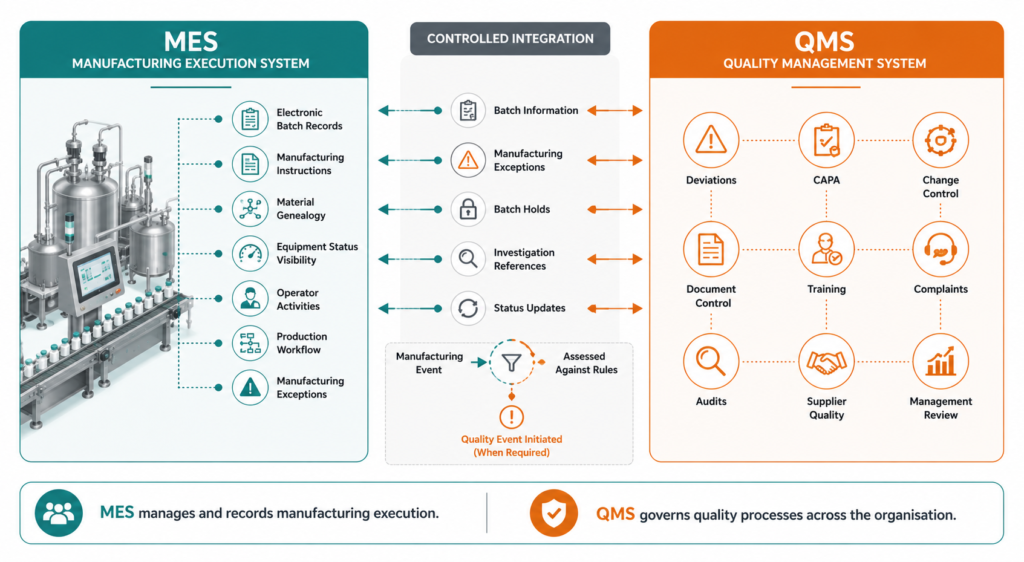
Here is the easiest way to differentiate between them:
- Manufacturing execution is managed and recorded through MES. It monitors what happens during manufacturing, step by step, in real or near-real time.
- QMS governs the wider quality processes. It manages quality events, procedures, investigations, approvals, corrective actions and continual improvement.
- An MES asks: Did this batch follow the approved recipe, and can I prove it?
- A QMS asks: “Is our quality system adequate overall, and are quality events being appropriately managed and resolved?”
Both systems can contain records that regulators will want to see during an inspection. Neither substitutes for the other.
However, QMS should not be viewed only as a software application. A pharmaceutical quality system also includes people, responsibilities, procedures, governance and management oversight.
Why Integration Between MES and QMS Matters
Challenges arise when these two systems do not communicate with each other.
When MES and QMS are disconnected, teams may have to manually transfer manufacturing information into quality workflows. This can create delayed deviation reporting, duplicate data entry, inconsistent records and incomplete links between batch information and quality investigations.
This is a familiar story throughout the industry. MES is positioned within manufacturing operations management under the ISA-95 framework.
Vendors are increasingly developing unified platforms where MES and QMS share data rather than being separate silos. If there is a deviation on the line, an integrated system can initiate or provide information to a quality event, depending on the approved workflow and configured business rules, rather than relying on someone to see it and log it manually later.
Not every equipment alarm or process exception should automatically become a formal quality deviation. The company must define which events require quality assessment, which system owns each record and how the connected workflow will be reviewed and validated.
ISA-95 provides models and terminology for defining system boundaries and information exchanges between manufacturing-control and enterprise functions.
This integration is not just a software choice for a facility. It changes how the plant is built from the ground up, how sensors are placed, how data moves from one system to another, and how validation is planned during construction. It may also affect equipment connectivity, instrumentation, OT networks, operator terminals, data ownership, cybersecurity and system-interface requirements. That’s the world of facility design and engineering, well before any software vendors are called in.”
How Facility Design Shapes MES and QMS Success
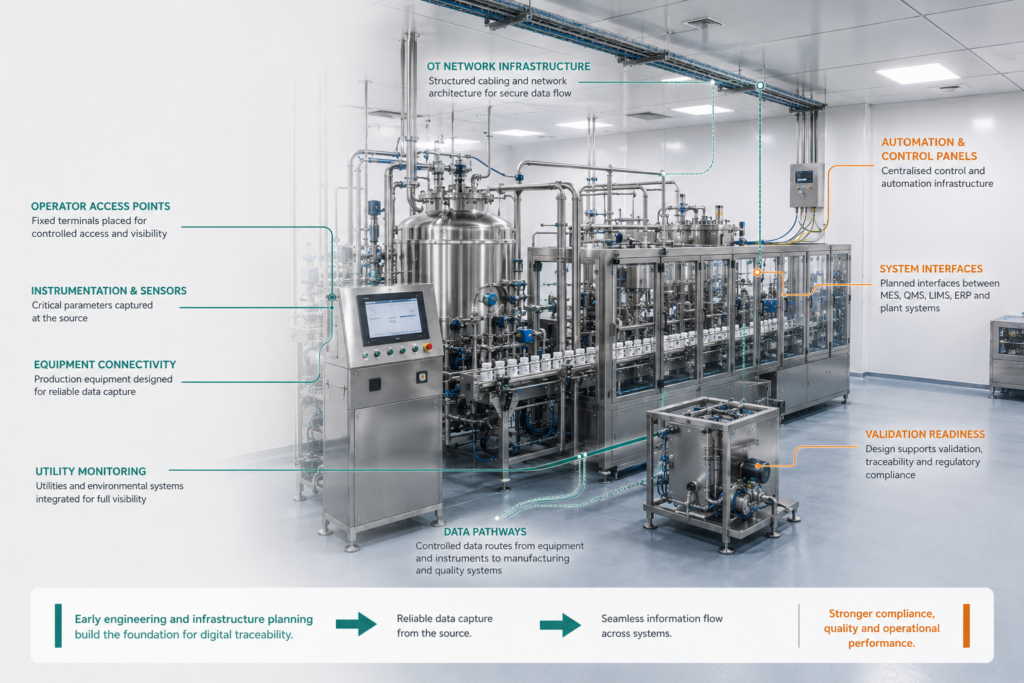
It’s a common mistake to think of MES and QMS as IT systems that can simply be added after the facility is built. It turns out that the engineering of a plant has a direct impact on how easily MES and other production-related systems can be connected and implemented later.
If equipment, utilities, and cleanroom layouts are not designed with data capture and traceability in mind, teams have to retrofit sensors and workarounds after the fact. That adds cost and leaves holes in the traceability that MES is supposed to provide.
However, the effectiveness of a QMS depends not only on facility design but also on quality governance, procedures, responsibilities, training, system ownership, change management and management oversight.
This is where a company such as Pharma Access comes into the picture.
Pharma Access is a turnkey pharmaceutical engineering partner offering engineering design, construction & installation, and commissioning, qualification & validation (CQV) for manufacturing facilities. Their project management & EPCMV services are focused on taking a facility from concept to operational readiness, which includes planning for the automation and data infrastructure that MES and QMS rely on later.
During concept, basic and detailed design, Pharma Access can support the engineering foundations needed for future digital-manufacturing systems. These may include equipment interfaces, instrumentation, OT infrastructure, utility monitoring, operator-access points, data pathways and validation responsibilities, depending on the agreed project scope.
The move to full digital traceability is a much easier process when a facility’s electrical, instrumentation, automation and cleanroom is built around these systems from day one.
This does not imply that Pharma Access supplies or configures MES or QMS software unless those activities are specifically included within its service scope.
EU GMP Annex 11 places computerised systems within the pharmaceutical quality system and addresses lifecycle risk management, validation and the qualification of IT infrastructure.
Practical Steps to Align MES and QMS in a Pharma Facility
Identify quality-critical process steps before selecting software.
- Determine what data should automatically flow from MES to QMS, such as deviations and manufacturing exceptions, nonconformances, batch holds and investigation references.
Laboratory out-of-specification results are generally managed through laboratory and quality processes. Where LIMS is used, the required interfaces among LIMS, MES and QMS should also be defined. - Involve engineering and facility design teams early—not after equipment is in place Quality, manufacturing, IT, automation, engineering and validation teams should agree on system boundaries and infrastructure requirements before the design is finalised. .
- Test the integration, not just each system in isolation, Testing should confirm data mapping, timestamps, electronic signatures, record ownership, audit trails, exception handling and system recovery across the connected applications..
- Train operators on how the two systems work together so that a batch record and a quality event are never two separate stories.
If any of these steps are not performed, it usually manifests later as a data gap during an audit and is much more expensive to fix than to plan for in the first place.
WHO data-integrity guidance addresses data governance, data transfer, training, good documentation practices and controls for computerised systems.
Regulatory Weight Behind Both Systems
MES and QMS are both of regulatory importance, but from different perspectives. FDA’s 21 CFR Part 11 covers electronic records and signatures, which are applicable where MES-generated electronic records or electronic signatures are used to meet requirements under applicable FDA regulations. Quality system regulations, in contrast, require a documented, auditable QMS that spans the life of the product, from raw material intake to post-market complaints.
Inspectors do not ask which system is ‘more important’. They assess whether the available records and quality processes demonstrate that a product was made safely, consistently, and in accordance with approved procedures? That proof only holds up if the shop floor data and the quality department data tell the same story.
For facilities supplying European markets, EU GMP Annex 11 should also be considered for GMP-relevant computerised systems. The current Annex 11 remains available through EudraLex Volume 4, while the European Commission has also undertaken consultation on proposed revisions.
Final Thoughts
MES and QMS in pharma are not competing systems. They are two sides of the same compliance and quality coin. In pharmaceuticals, real- or near-real-time visibility into and management of manufacturing execution, while a QMS provides the broader framework that keeps that process accountable.
Direct control of equipment and process conditions generally remains within equipment-control, PLC, DCS or SCADA systems.
The meeting of the two starts long before software implementation. It starts with how a facility is designed, wired, and validated. This is why companies that are planning new or upgraded facilities often bring in experienced engineering partners early in the process, as retrofitting data infrastructure after construction is much more difficult than planning for it from the start.
A QMS is fundamental to pharmaceutical quality governance. MES, by comparison, is a technology choice that can strengthen manufacturing execution, electronic traceability and data availability, but it is not mandated by name.
Frequently Asked Questions
1. What is the main difference between MES and QMS in pharma?
MES handles production data in real time, batch records, and equipment tracking on the shop floor. QMS provides you with the overall quality framework, including deviations, CAPA, training records, and document control across the entire company.MES manages and records manufacturing execution, while QMS governs the processes through which quality is managed, investigated and improved.
2. Can a pharma company use MES without a QMS, or vice versa?
A pharmaceutical company can operate without a software application specifically called MES, provided it maintains appropriate manufacturing controls, records, traceability, review and data-integrity measures. Without a QMS, there’s no framework for managing deviations and corrective actions. Without MES, a company may use controlled paper records, another validated electronic application or an appropriately managed hybrid system. MES is not the only method of maintaining batch records and traceability.
3. Why should MES and QMS be integrated in pharmaceutical manufacturing?
With integration, quality events can be initiated or supported using relevant production data, according to approved workflows and business rules. This fills gaps in traceability and speeds up finding and investigating deviations.Integration can also reduce duplicate data entry and improve the connection between manufacturing records and quality investigations.
4. Does facility design really affect how well MES and QMS perform later?
Yes. If sensors, utilities, and data infrastructure are not part of the facility design, teams are forced to retrofit systems after construction, which is costlier and often leads to gaps in traceability.This is particularly relevant to MES and its connections with equipment and automation systems. QMS performance also depends heavily on quality governance, procedures, training, system ownership and management oversight.
5. Who should be involved when planning MES and QMS for a new pharma facility?
Involve quality teams, IT, automation engineers, and the facility design or EPCMV partner early on. Manufacturing operations, validation, QC or laboratory representatives and equipment suppliers may also need to participate, depending on the project scope. Having these groups plan together from the start avoids costly rework later in the project.