
In a pharma facility, someone will eventually look at every batch record, every sensor reading, and every operator signature and decide whether or not to trust it. That trust has a name in industry: data integrity. It’s the foundation of ALCOA+ pharma programmes, and it should not be added only after a system is already up and running. It has to be built in from the start, through every automated process and GxP-relevant system that touches your product.
This post walks through what ALCOA+ really means, how it relates to the regulations that support it, and what “designing for data integrity” looks like day-to-day across the automation and GxP systems that run a modern pharma facility.
What Is ALCOA+, and Why Does It Matter So Much?
ALCOA is an acronym used across pharmaceutical data integrity guidance. It stood for Attributable, Legible, Contemporaneous, Original, and Accurate. As the industry developed, four additional attributes became widely recognised: Complete, Consistent, Enduring, and Available, giving us ALCOA+.
These underlying data-integrity principles are reflected across regulatory expectations and guidance from authorities including FDA, MHRA, WHO, PIC/S and within EU GMP requirements. ALCOA+ means that each data point on the ground at your facility must answer a simple set of questions: Who made the data? Is it readable? Was it captured at the time the activity was performed? Is it the original, unaltered capture? Is it accurate, complete, and available when needed throughout its required retention period?
In pharmaceuticals, the breakdown of data integrity is typically caused by a breach of one of the principles. A lost timestamp can undermine evidence that data was recorded contemporaneously. The Original and Complete attributes can be compromised by an overwritten value with no trace of the previously recorded information. This is not some theoretical fear. FDA guidance itself notes an increase in data integrity lapses identified during CGMP inspections. U.S. FDA
The Regulatory Backbone: 21 CFR Part 11, EU GMP Annex 11 and GAMP 5
ALCOA+ describes the attributes expected of trustworthy data. Regulations and industry guidance help translate those attributes into controls for the computerised systems that create, process and maintain it.
21 CFR Part 11 Requirements for Electronic GxP Records
21 CFR Part 11 pharma regulations detail the technical and procedural controls that applicable electronic records and electronic signatures must meet within its FDA-regulated scope. This includes audit trails that record the date and time of operator entries and actions that create, modify, or delete electronic records, protection of records throughout their retention period, and electronic signatures that are linked to one person and cannot be transferred to another. A system that meets Part 11 does not necessarily mean that all ALCOA+ expectations are automatically satisfied, and where electronic records fall within FDA-regulated predicate-rule requirements, Part 11 should be considered alongside the applicable GxP requirements.
EU GMP Annex 11 and Computerised Systems
For pharmaceutical operations subject to EU GMP, Annex 11 provides requirements for computerised systems used as part of GMP-regulated activities. It requires a risk-based approach across the system lifecycle, with appropriate validation, security, data management and controls based on the system’s impact on patient safety, data integrity and product quality.
GAMP 5 and Risk-Based Computerised System Validation
ISPE GAMP 5 takes a different approach. It does not simply prescribe a fixed list of record-keeping controls, but rather offers a framework for validating the computerised systems that create and maintain those records. GAMP 5 uses software categorisation as one input within a broader risk-based lifecycle approach, so a simple stand-alone instrument may require a different level of validation and assurance than a fully integrated manufacturing execution system, depending on intended use, GxP impact, complexity, novelty and risk. The goal is to apply proportionality to the validation effort based on the actual risk the system poses to patient safety and product quality, rather than applying the same level of assurance effort to every system.
Audit Trail Pharmaceutical Systems: The Evidence Behind Every Record

If ALCOA+ is the standard and Part 11 and GAMP 5 are part of the regulatory and good-practice framework, the audit trail is where the evidence actually resides. An audit trail pharmaceutical system generates a secure, computer-generated, time-stamped record of relevant operator entries and actions that create, modify, or delete electronic records within the system.\
A good audit trail is more than an activity log. Every change is attributed to a specific user, the original value is retained along with any edit, and where an audit trail is required, it should be protected so normal users cannot amend or disable it. During an inspection, audit trails can be reviewed to assess whether GxP-relevant data has been created, changed, or deleted with appropriate traceability. Audit-trail functionality alone is not sufficient; relevant audit trails should also be reviewed at a frequency and depth defined through risk assessment.
How Automation Helps Pharma Manufacturers Build Data Integrity In
And this is where automation makes sense. To understand how automation supports pharma manufacturers in fulfilling those expectations, we need to understand what manual, paper-based processes can get wrong when they are not appropriately controlled. Manual and paper-based records can depend on timely and accurate human entry, while poorly controlled processes increase the risk of delayed recording, transcription errors, or incomplete traceability.
Several of these risks can be reduced by automated systems by design:
- Data collection at the point of activity rather than having someone transcribe a reading later, which goes a long way to supporting the contemporaneous and original principles.
- Implementing role-based access to allow only authorised personnel to create or modify certain records.
- Automatically generating secure audit trails where configured and required, so relevant changes are recorded with appropriate traceability.
- Standardising data formats and units, reducing transcription errors when values are manually moved between systems.
- It flags out-of-range results in real time, catching problems during production rather than days later in batch review.
Just because a system is digital doesn’t mean data integrity happens automatically. A digital system not properly validated and configured does not resolve the data integrity problem. It can simply move the risk to a different medium where certain integrity issues may be less visible. European Commission
MES and QMS in Pharma: Where Data Integrity Lives Day to Day
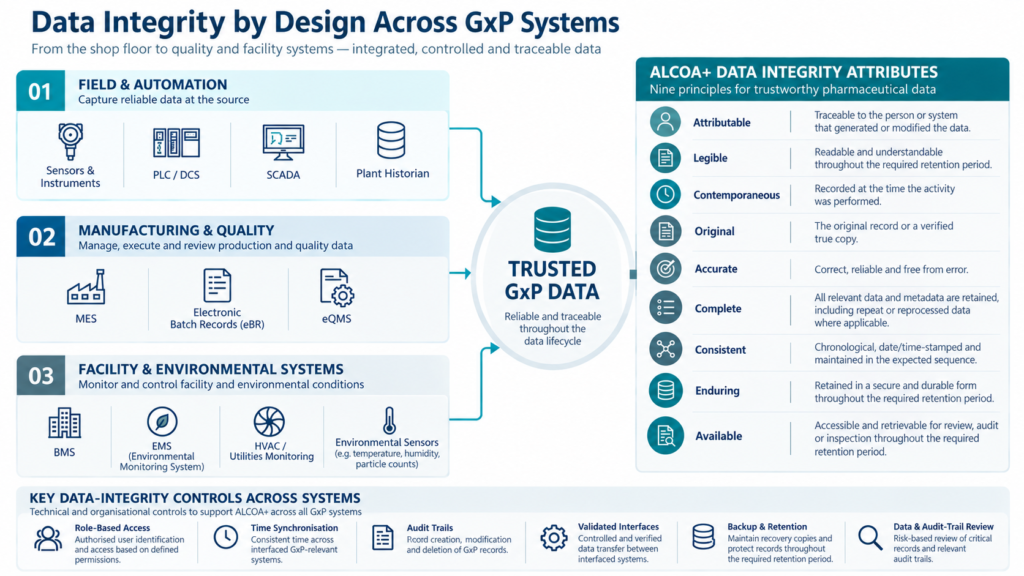
On a production floor, MES and QMS can carry a significant part of the day-to-day data integrity workload. In pharma facilities, MES and QMS can be integrated to connect the line activity to the quality decisions that are made about it.
A Manufacturing Execution System (MES) digitises work instructions, supports manufacturing workflows and electronic batch records, and can capture process data from shop-floor automation, decreasing the human error inherent in paper-based batch records. Quality Management Systems (QMS) and electronic QMS platforms support the broader quality processes that surround manufacturing itself, including things like deviations, corrective actions, and document control.
When MES and QMS are properly integrated, a quality event on the production floor can be transferred directly into the quality system, reducing the need for someone to re-enter data and the workload and transcription errors involved with the two systems.
Below and alongside the MES layer, PLC, DCS, SCADA and plant historian systems can also generate, process and retain GxP-relevant manufacturing data. Their architecture, access controls, time synchronisation, interfaces and data-retention strategy therefore form an important part of data-integrity-by-design.
BMS EMS Pharma: Data Integrity Beyond the Production Floor
Data integrity isn’t limited to manufacturing records. Building Management Systems (BMS) and Environmental Monitoring Systems (EMS) for pharma generate their own continuous stream of facility and environmental data, some of which may be GxP-relevant and therefore requires appropriate data-integrity controls.
A BMS is a control and data recording facility for conditions such as HVAC performance, pressure differentials, and utility status. An EMS can monitor, collect and trend environmental parameters such as airborne particle counts, temperature, relative humidity and other defined conditions, while viable microbiological monitoring data may also be incorporated according to the facility’s environmental monitoring strategy and applicable GMP requirements. GxP-relevant records generated by both systems should be managed in accordance with applicable ALCOA+ and data-integrity expectations because demonstrating that required cleanroom conditions were maintained depends on trustworthy monitoring data. MHRA
Designing for Data Integrity, Not Inspecting for It
The underlying message is that data integrity is best when built into a facility’s systems from the outset, not added in response to a warning letter. Adding audit trails, role-based access, or proper validation documentation to a system once it is live is far more disruptive and costly than building those controls into the system during the design and commissioning phases.
Common Data Integrity Failures and How Design Prevents Them
Across facilities, several common problems appear when systems and processes have not been designed with data integrity in mind from the start:
- Shared login credentials: Breaks attributability, because no one can prove who made an entry.
- Manual transcription from: one system to another increases the risk of errors and can compromise traceability to the original data if appropriate verification controls are not in place.
- Audit trails that are turned off or incomplete, often because the system was set up for convenience rather than compliance.
- Inconsistent time sync between systems – makes it hard to prove that records were actually contemporaneous.
- Insufficient planning of backup and recovery, risking the Enduring and Available attributes under ALCOA+.
- All of these can reflect weaknesses in design, configuration, procedures and data governance, not an inevitable consequence of using electronic systems.
Why This Matters at the Facility Design Stage
To get this right, automation, MES, QMS, BMS, and EMS design need to be considered alongside facility layout and HVAC planning, not an afterthought once construction and installation is complete. The engineering teams at Pharma Access manage the automation and building system design (BMS, EMS, and process automation) as part of the same coordinated project that encompasses HVAC, cleanrooms, and utilities. Building data integrity controls from the start can reduce the need for costly retrofits when gaps are identified after a facility has entered operation. Learn more about our approach on the Pharma Access about.
Wrapping Up
Data integrity ALCOA+ Pharma work is not a checklist to be completed before an inspection. It’s a design principle that should inform the way every automated system, from a simple sensor to a complete manufacturing execution system, captures, stores, and protects data from the moment it is generated. Facilities that bake these expectations into their automation and GxP systems from day one spend far less time explaining gaps to an inspector later and far more time trusting the data their own systems produce.
FAQs
What does ALCOA+ stand for?
ALCOA is an acronym for Attributable, Legible, Contemporaneous, Original, and Accurate. The “+” adds Complete, Consistent, Enduring, and Available to provide nine principles that define reliable data in a GxP environment.
How does 21 CFR Part 11 relate to ALCOA+?
21 CFR Part 11 describes the technical and procedural controls, including audit trails and electronic signatures, for electronic records and electronic signatures that fall within its scope. Those controls support data integrity and the broader ALCOA+ principles but do not, by themselves, establish that every ALCOA+ expectation has been met.
What is the difference between MES and QMS in a pharma facility?
MES captures and manages data from production activities and manufacturing workflows in real time. A QMS is responsible for quality processes like deviations, corrective actions, and document control. When appropriately integrated, the two can reduce manual re-entry and the associated risk of transcription errors.
Why do BMS and EMS systems need to meet data integrity standards too?
These systems produce the environmental and facility data that demonstrates that a cleanroom or storage area was maintained under the conditions needed for GMP manufacturing. Where this data is GxP-relevant, its integrity and traceability need to be appropriately controlled because decisions about facility and product conditions may depend on it.
Can data integrity be added to a system after it is already running?
It can, but it is far more disruptive and costly than building in controls such as audit trails, role-based access, and validation documentation at the beginning of a facility project.