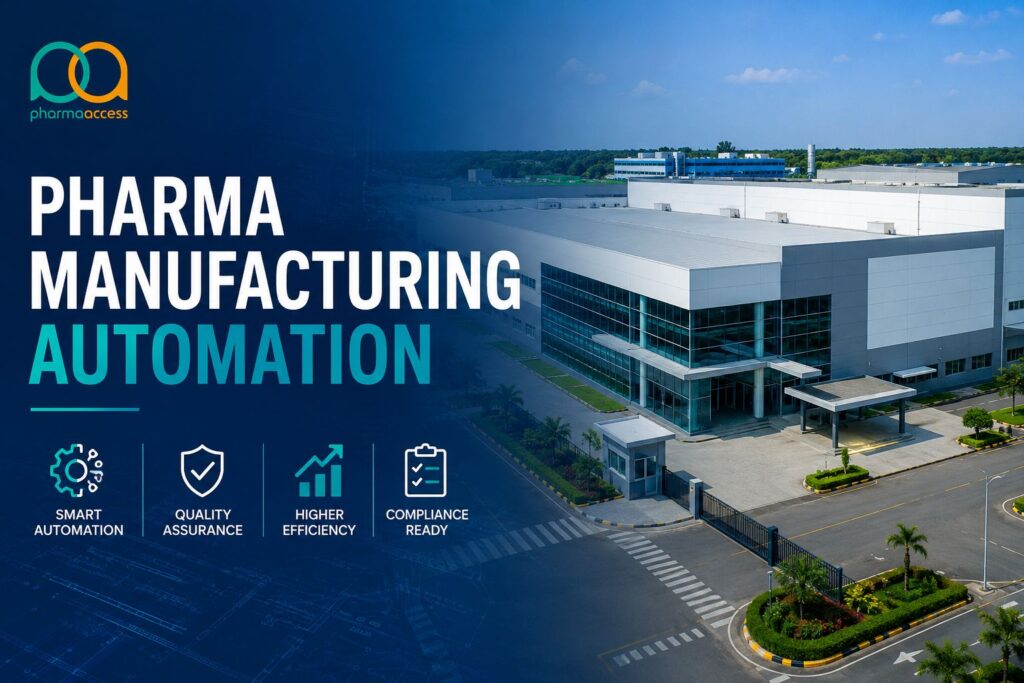
A tablet press that runs at 400,000 units an hour means nothing if the batch fails the quality check. A continuous filling line still wastes money if it needs continuous manual intervention to keep it in spec. Pharma manufacturing has always been about precision, not speed. Automation enables manufacturers to achieve both precision and productivity while maintaining compliance.
This article explores the reality of how pharma manufacturing automation works, what tangible improvements it provides in production output and product quality, and what facility design decisions will make or break an automation project.
What Pharma Manufacturing Automation Actually Means
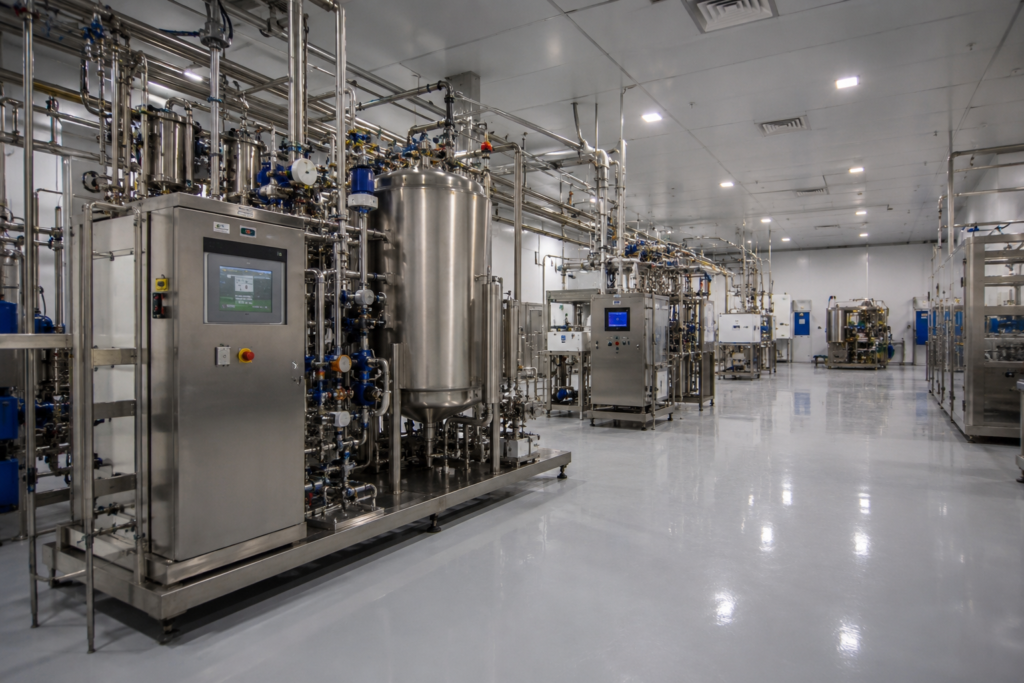
The term is used rather loosely. It’s a robotic arm on a packaging line in some conversations. In other cases, it means a fully integrated manufacturing execution system (MES) that links process equipment, quality testing, environmental monitoring, and batch documentation into a single data environment.
Here is the clearer definition:
Pharma manufacturing automation is the use of controlled, mechanized, electronic, and software systems to perform manufacturing tasks with reduced or no human intervention while producing the documentation necessary for regulatory compliance.
The last part is important. Automation in pharmaceutical manufacturing is more than a production tool. This is a compliance tool. FDA 21 CFR Part 11 establishes the criteria under which electronic records and electronic signatures can be used in place of paper-based records in a GMP environment. If any automated system deployed in a regulated pharma facility does not meet these requirements, it creates more regulatory problems than it solves.
Where Automation Creates the Biggest Gains
Batch Record Automation and Electronic Batch Records (EBR)
One of the biggest sources of error in pharmaceutical manufacturing is manual batch records. Batch failures and regulatory findings are the result of transcription errors, missing entries, incomplete logbooks, and illegible handwriting.
Electronic batch records use validated software systems, rather than paper, to capture process data in real time. Every step in a manufacturing process, from weighing raw materials to in-process checks to final release testing, is automatically recorded as it occurs. The system flags deviations immediately instead of waiting for a manual review at the end of a shift.
This results in less human error, faster batch release, and a complete audit trail that regulators can review during inspections. The FDA has long supported the use of electronic records in manufacturing, and electronic batch records are a key component of the agency’s guidance on pharmaceutical quality systems.
Process Analytical Technology (PAT) and Real-Time Monitoring
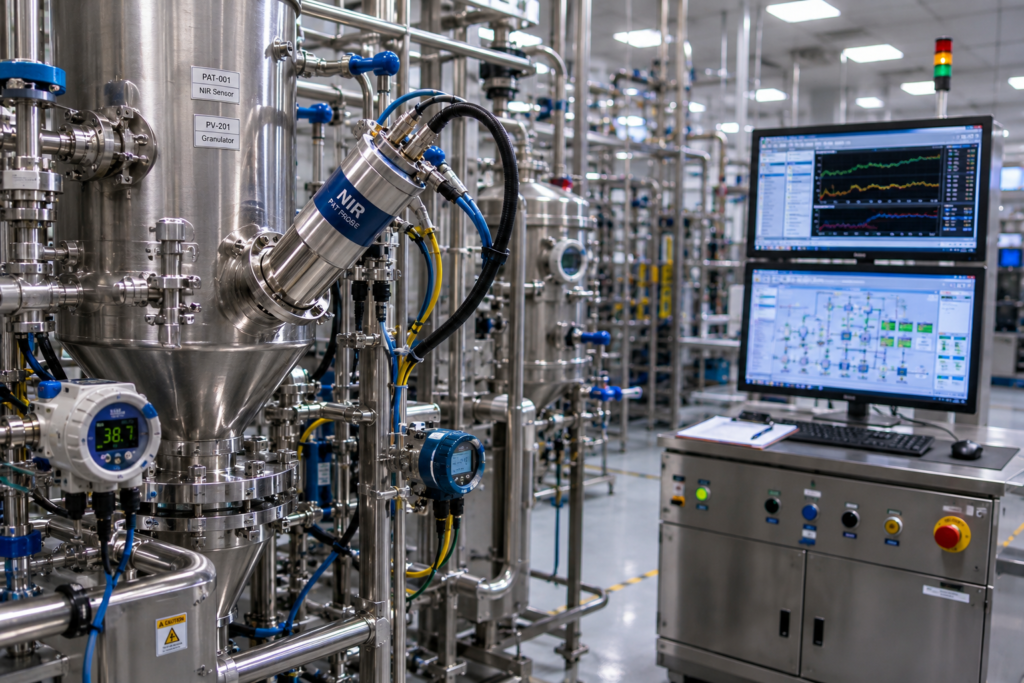
In traditional pharmaceutical manufacturing, samples are tested at the end of a batch. By the time a result comes back showing the product is out of spec, the entire batch may be rejected or need to be reprocessed.
PAT changes this model. Process analytical technology is the use of sensors in the manufacturing process itself to measure critical quality attributes in real-time. For example, NIR spectroscopy can be used to monitor the moisture content of granules during drying without sampling or process interruption. Inline viscosity measurement can follow a liquid formulation through a mixing step and alert operators if the product goes out of validated parameters.
The FDA issued its PAT guidance in 2004, describing PAT as a means to incorporate quality into manufacturing rather than test for quality at the end.
The use of PAT in combination with an automated feedback control allows the manufacturing system to self-correct. It compensates for drifts in the drying temperature. If blend uniformity is below the threshold, the blending step is extended automatically. These are not manual interventions, but automated process controls within validated ranges.
Read More: Pharmaceutical Facility Design and Construction
Automated Filling and Packaging Lines
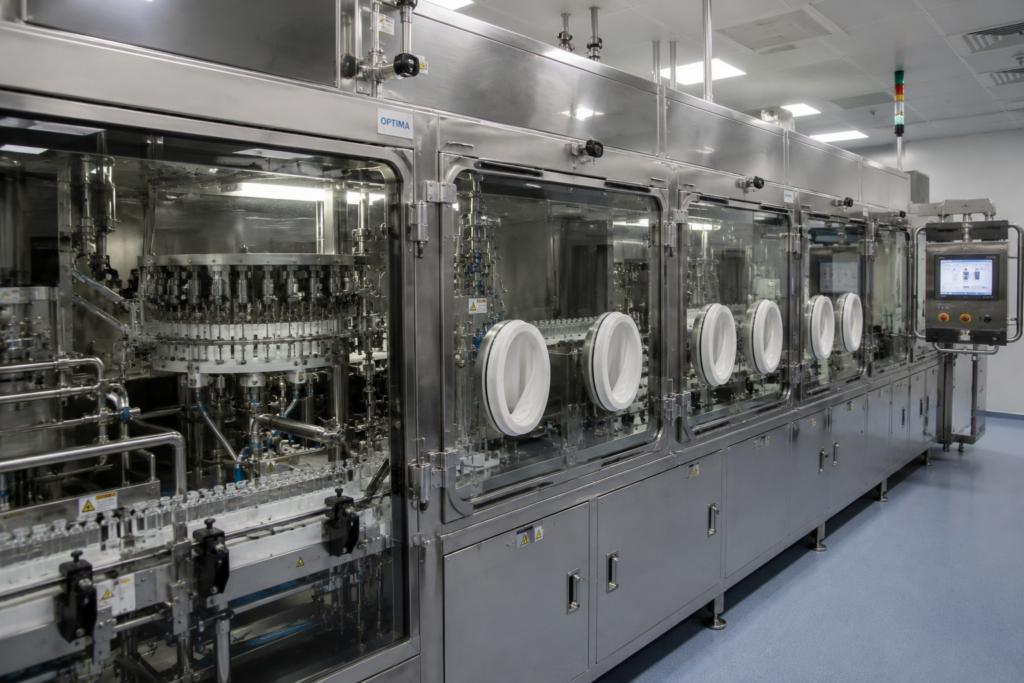
Aseptic filling is a contamination-sensitive operation in pharmaceutical production and is of utmost importance in sterile injectable manufacturing. There is a risk of contamination from human intervention in a cleanroom environment each time an operator enters a classified zone.
Automated filling lines with isolator technology or restricted access barrier systems (RABS) maintain a physical barrier between operators and the fill zone. Robotic systems are used for vial placement, filling, stoppering, and capping. This reduces contamination events directly and supports the contamination control strategies (CCS) emphasized under the revised EU GMP Annex 1.
Vision inspection systems replace manual visual inspection of fill volume, label placement, cap torque, and package integrity on packaging lines. These systems operate at line speed and provide objective, documented inspection records rather than subjective operator judgments.
Warehouse and Material Handling Automation
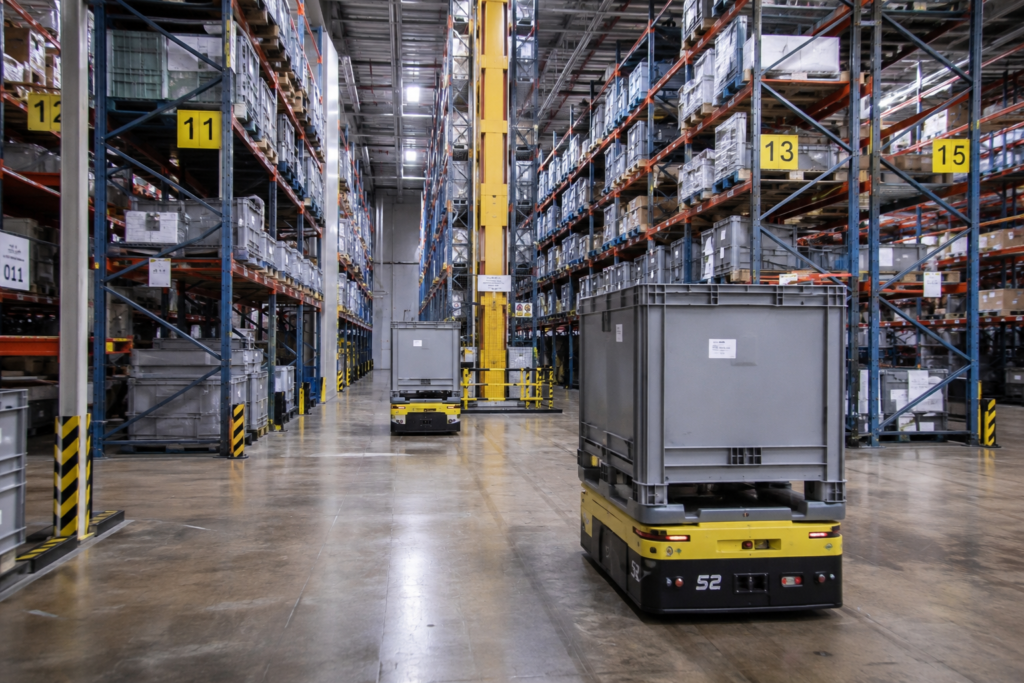
Raw material management in a pharmaceutical facility is not just a logistics activity; it is a compliance activity. Materials must be quarantined, sampled, tested, released, weighed, and dispensed with full traceability. Material identification or weighing errors can taint a batch or lead to a costly investigation.
Automated warehouse systems such as barcode and RFID-based inventory management, automated guided vehicles (AGVs), and dispensing systems with integrated label verification help to reduce the probability of the wrong material or the wrong quantity arriving at a manufacturing area. When these systems are integrated with the MES, every material movement is automatically included in the electronic batch record.
The Facility Design Connection
What many manufacturers miss is that automation is most effective when the facility is built with automation in mind. It is technically possible to construct a sophisticated automation system in a facility designed for manual operations, but it causes problems.
Let’s take it apart. A room must be built around a fully automated filling line: specific dimensions for the equipment footprint, ceiling heights to accommodate HEPA filter banks above the fill zone, conduit routing for control cables, utility connections at precise locations, and personnel access routes that do not cross the aseptic core. If the room were not designed with these requirements, the automation setup would be an expensive engineering hack.
Automation planning is included in the engineering design services of pharmaceutical facilities from the very beginning of the design At Pharma Access, this integrated approach is reflected in the Engicution methodology, where engineering design, automation planning, and project execution are developed together rather than as separate activities. . That is, not sequentially but in collaboration between process engineers, automation engineers, and facility designers. The design phase defines the architecture of the automation system (including PLC selection, SCADA layout, MES integration, and network topology) so that the facility is built to support it.
This thinking is central to what the team calls “Engicution” at Pharma Access—a combination of engineering and execution as one discipline that integrates facility design, automation planning, and project delivery from the outset. . When pharma turnkey project consultants in India and globally design and build a facility as a single integrated scope, automation needs to drive construction decisions, not the other way around.
Safety in Pharmaceutical Facility Design and Automation
Automation is also changing the safety equation in pharma manufacturing. And here’s why this matters directly.
Occupational exposure risks to production workers are present with many pharmaceutical products, including cytotoxic oncology drugs, hormones, and highly potent APIs (HPAPIs). Manual handling of these materials still presents residual risk, even with personal protective equipment.
Automated closed systems remove the worker from direct contact with hazardous materials. Robotic dispensing systems, automated weighing stations, and sealed transfer lines between process vessels minimizes operator exposure. Safety in pharmaceutical facility design is not a separate workstream from automation planning; it is the same conversation.
The National Institute for Occupational Safety and Health (NIOSH) guidance on occupational exposure to hazardous drugs supports the use of engineering controls (including automated closed systems) as the primary protective measure over administrative controls and personal protective equipment.
What a Phased Automation Approach Looks Like
Not every manufacturer can afford or needs full automation from day one. Facilities can develop automation capability over time through a phased approach, without impacting current production operations.
A practical series:
- Start with electronic batch records.” Substitute paper batch records with a validated EBR system. This delivers immediate compliance benefits and builds the data infrastructure upon which more sophisticated automation depends.
- Add automated environment monitoring. Replace manual particulate, temperature, and humidity sampling with continuous monitoring systems that report data directly to quality systems.
- Implement inline process monitoring (PAT). Start with installing sensors in the process steps that are the riskiest or most valuable, where the real-time data can impact the outcome of the batch the most.
- Automate the handling and dispensing of materials. Integrate warehouse and dispensing systems with the MES to automatically build material traceability into the electronic record.
- Move into robotic or automated fill-finish. This step provides the greatest reduction in contamination risk for sterile products, and generally, the investment is justified in reduced batch failure rates.
Each phase needs to go through the same qualification process as any other GMP system installation qualification (IQ), operational qualification (OQ), and performance qualification (PQ) with documentation to support regulatory submissions.
Choosing the Right Partner for Pharma Automation Projects
Pharmaceutical manufacturing automation is not a product purchased from a catalog. It is a system that must be designed, built, validated, and maintained within a cGMP manufacturing environment.
The best projects are those where process engineering, automation engineering, and facility design are brought together as one well-organized team. When these are siloed, the gaps between them create integration problems that are costly to address post-commissioning.
Pharma Access provides engineering design services for pharmaceutical facilities that include automation planning in the base design scope. With over 120 projects across 18+ countries and facilities ranging from oral solid dosage to biotech and sterile injectables, the team understands that every plant has unique automation requirements that must align with the product, regulatory market, and production model.
The goal is always a facility where equipment, automation layer, and quality systems work hand in hand from day one without major corrections after commissioning.
FAQs
1. What is pharma manufacturing automation, and why does it matter for compliance?
Pharma manufacturing automation involves mechanical, electronic, and software systems to execute manufacturing steps and collect records needed for GMP with minimal human intervention. This is important for compliance as automated systems, when validated correctly, generate documentation that is more consistent and complete than manual processes, thereby reducing the risk of regulatory findings during inspections.
2. How does automated batch record software differ from regular manufacturing software?
EBR software is specifically validated for use in GMP environments under 21 CFR Part 11 or equivalent regulations. It records process data in real time, enforces step sequences, prevents unauthorized changes, and maintains a complete audit trail. Standard manufacturing or ERP software doesn’t meet these requirements without additional validation.
3. Can existing pharmaceutical facilities adopt automation without a full rebuild?
Yes, but the scope of what is possible is dependent on the existing facility layout, utility infrastructure, and equipment. Most current facilities can implement a phased approach, beginning with electronic records and environmental monitoring. Robotic filling is typically fully automated and requires space modifications or new construction to accommodate equipment footprints, utility connections, and environmental control requirements.
4. What is Process Analytical Technology (PAT), and how does it help production?
PAT uses sensors directly embedded in the manufacturing process to measure product quality attributes in real time, such as moisture content, particle size, or blend uniformity. This enables the process to be monitored and adjusted during production, rather than waiting for end-of-batch testing, which reduces batch failures and accelerates release timelines.
5. How does safety in pharmaceutical facility design connect to automation decisions?
Closed automated systems reduce worker exposure by removing the need for manual handling of hazardous substances, for example, in facilities that handle hazardous materials such as cytotoxic drugs or highly potent APIs. Coordinating automation decisions with safety engineering during the facility design stage is significantly more effective and cost-efficient. Adding closed systems after construction is much more expensive than including them at the outset.