
If you have ever watched a site team review a piping drawing with an engineer, slope is usually one of the details that gets close attention. It sounds like a small detail, but in a pharmaceutical water system, the wrong slope can leave residual water in low points when the system is intentionally drained, increasing microbiological and sanitization risk. Getting this one detail right supports drainability and hygienic system performance.
This post explains what slope actually means for pharma piping, what guidance engineers commonly follow, and why it matters so much for water quality. We will keep the explanation simple and skip the heavy engineering language where we can.
Quick answer: WHO GMP guidance recommends that pharmaceutical Purified Water (PW) and bulk Water for Injection (BWFI) systems be installed to promote drainability with a minimum recommended slope of 1:100 where full drainage is required. That equals a 1% fall, or approximately 10 mm per metre of pipe. The final project requirement should still be defined in the approved design documents and specifications.
Why Slope Matters in a Pharmaceutical Water System
Slope is the gradient at which a pipe tilts downward so water can drain from the line instead of collecting at unintended low points. In a Purified Water (PW) or Water for Injection (WFI) system, that pooling is not just a maintenance headache. It is a potential microbiological-control risk. WHO specifically recommends hygienic design, minimization of dead legs, continuous circulation and installation that permits full drainage where required.
Here is why. Pharmaceutical water systems get sanitized according to defined procedures, which may use thermal and/or chemical sanitization depending on the system design. If a section of pipe cannot drain fully, leftover water may remain in low points when that part of the system is intentionally drained for sanitization, shutdown, maintenance or other activities. Standing water can create conditions that support microbial proliferation, which is why hygienic design aims to minimize stagnation. WHO identifies chemical and thermal sanitization, continuous circulation and prevention of stagnant water as important microbiological-control measures.
During normal operation, PW and BWFI distribution systems are generally designed as recirculating loops rather than systems that simply sit full of stationary water. WHO recommends continuous circulation for BPW and BWFI distribution systems unless a non-recirculating design is appropriately justified.
What Slope Do Pharma Water Systems Actually Need?
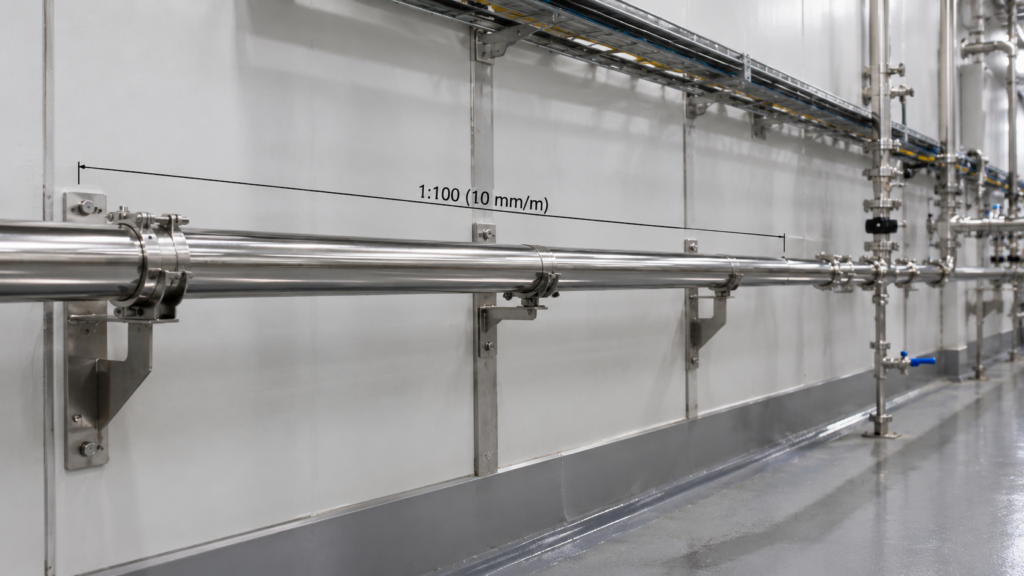
There is no single fixed number written into every pharmaceutical regulation worldwide, but WHO GMP guidance provides a clear drainability recommendation, while project-specific standards and specifications may add further requirements.
- WHO GMP guideline: WHO recommends that PW and WFI systems be installed to promote drainability with a minimum slope of 1:100. It also gives a guidance figure of not less than 1:100 where pipework needs to allow full drainage.
- Metric equivalent: A slope of 1:100 means a 1% fall, or 10 millimetres of vertical drop for every metre of horizontal pipe run.
- Imperial equivalent: A 1:100 slope is approximately equivalent to 1/8 inch of fall per foot. A 1/4-inch-per-foot slope is approximately 2%, so 1/8 to 1/4 inch per foot should not be described as a direct equivalent of 1:100.
- ASME BPE context: ASME BPE is an important hygienic-design standard used in bioprocessing and pharmaceutical applications. The current edition is ASME BPE-2026, and the slope criteria used on a project should be confirmed against the edition and design specification adopted for that project rather than treating 1/8 to 1/4 inch per foot as a universal ASME requirement.
The exact number your project uses will depend on the applicable standard, system layout, drainability requirement, equipment interfaces, pipe routing and the approved engineering specification. What stays constant across all of them is the goal: where full drainage is required, the piping should be installed so that unintended low points and trapped water are avoided. WHO explicitly identifies full drainage and a guidance slope of not less than 1:100 as water-system design considerations.
Steps to Confirm Correct Slope During Installation
Getting the slope right on paper is one thing. Confirming it on the actual installed piping is where problems often get caught. Here is a simple sequence most teams follow:
- Review the design drawings. Confirm the required slope is called out clearly for every relevant pipe run.
- Install with slope in mind. Fit hangers and supports at intervals that hold the intended drop, not just a level line.
- Measure the installed slope. Use the approved slope-verification method and suitable calibrated measurement equipment at multiple points along the run.
- Document the readings. Record actual slope values against the design specification for each section as part of the applicable construction, commissioning or qualification documentation..
- Flag and correct deviations. Any section that falls short of the specified acceptance criterion minimum slope gets adjusted before the system moves into qualification.
- Re-verify after any rework. Recheck slope any time a section of piping is modified, repaired, or replaced.
WHO requires pharmaceutical water systems to be appropriately qualified and validated, requires commissioning activities to be documented, and identifies drawings, on-site test records, weld records and other evidence of system qualification as important documentation.
Common Problems That Come From Poor Slope
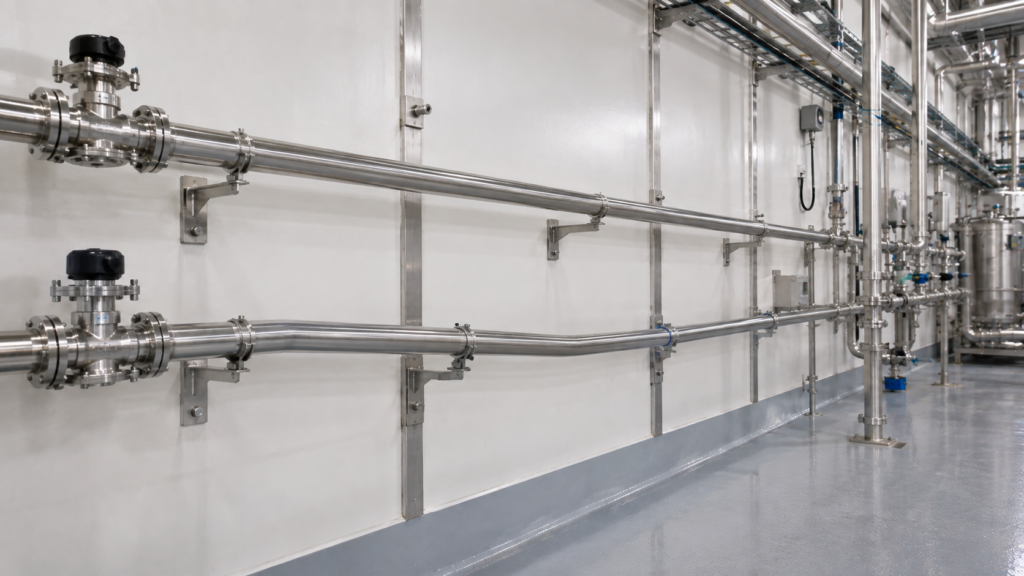
A handful of recurring issues show up when slope or the wider hygienic piping design gets overlooked during design or installation:
- Dead legs. Sections of pipe or branch arrangements with inadequate circulation, often near tees or valve branches, where water may stagnate. Dead-leg control is a separate hygienic-design requirement and should not be treated as something that slope alone can correct. WHO recommends zero-dead-leg diaphragm valves where possible and minimizing dead legs elsewhere.
- Low points and sags. Pipe runs that were not properly supported can sag over time, creating pockets that trap water even if the original slope was correct.
- Poor fitting selection. Standard fittings and valves are not always designed with drainability in mind, and the wrong choice or orientation can undo an otherwise correct slope.
- Rough interior surfaces. Poor internal surface condition can make hygienic cleaning more difficult and provide additional retention or attachment sites for contamination. It should not simply be described as slowing the bulk movement of water. WHO states that internal finishes for PW and BWFI systems should be smooth and gives specific sanitary-design considerations for sample valves and related components.
How Slope Connects to the Bigger Picture of Water System Design

Slope is one piece of a much larger design puzzle for a pharmaceutical water system. It works alongside pipe material selection, welding quality, valve placement, hygienic fittings, continuous circulation, sanitization strategy, instrumentation, and storage tank design to keep the whole distribution loop under microbiological control. Get the slope right but ignore dead legs, and you have only solved part of the problem.
Surface finish plays a supporting role too. A pipe with a poor internal finish can be more difficult to clean and can provide additional sites for material retention or microbial attachment, even when the pipe has been correctly installed for drainage. That is why most pharma piping specifications call out both a slope requirement and appropriate hygienic surface-finish requirements, since one without the other does not provide a complete hygienic-design strategy. WHO recommends smooth internal finishes and sanitary design for PW and WFI systems.
This is where sound Pharma Project Management Services make a real difference. Coordinating piping design, installation, and commissioning and qualification as one connected process, rather than as separate handoffs between contractors, cuts down on the rework that happens when a slope issue only gets caught after the system is already built and insulated.
Slope, Effluent, and the Full Water Lifecycle
Water in a pharma facility does not disappear once it leaves the purified water loop. Rinse water, cleaning water, and process water eventually need to go somewhere, and that is where pharma effluent treatment solutions come into the picture. A facility that gets its water generation and distribution piping right on the front end still needs a plan for treating and discharging wastewater responsibly on the back end.
Appropriate drainage gradients also matter in wastewater piping, although the design criteria are different from those used for hygienic PW and WFI distribution systems. Effluent lines with weak slope or hidden low points can back up or hold waste longer than intended, adding load to the treatment system downstream. Thinking about both sides of the water lifecycle at the design stage avoids costly retrofits later.
The 1:100 recommendation discussed in this article applies to pharmaceutical water-system drainability and should not automatically be copied into effluent-piping design. Wastewater gradients should be determined from the applicable hydraulic design, pipe characteristics, effluent properties, layout and project requirements.
Why Work with Experienced Pharma Consultants in India
Slope requirements sound simple on paper, but getting them right across a full facility, hundreds of meters of piping, dozens of branch connections, and multiple storage points, takes real design and construction experience. Working with established Pharma Consultants in India means your piping layout can be reviewed as part of the wider clean-utility and facility-engineering design instead of treating slope as an isolated installation detail.
At Pharma Access, our engineering design team handles mechanical and utility system design, including Purified Water, Water for Injection and associated clean-utility integration, as part of full facility projects across India and other markets. Pharma Access’s clean-utility capabilities specifically include PW and WFI systems. We build slope, drainability, and qualification considerations into the design from day one instead of treating them as an afterthought during construction. This integrated approach connects utility engineering with piping coordination, construction, project management and CQV requirements. Pharma Access’s wider project approach covers engineering and project-management activities across pharmaceutical facilities in India and international markets.
You can learn more about our approach to pharma facility projects on the Pharma Access about page.
Wrapping Up
Slope might sound like a minor detail on a piping drawing, but in a pharmaceutical water system, it directly affects drainability and the ability to avoid unintended water retention when the system needs to be drained. For PW and WFI systems where drainability is required, WHO recommends a minimum slope of 1:100, equivalent to a 1% fall or approximately 10 mm per metre.
Verify it during installation, and keep low points, poor valve orientation and stagnation-prone dead legs out of the design. Get those basics right, and the rest of your water system has a much better chance of moving efficiently through commissioning and qualification without avoidable piping rework.
FAQs
What slope is required for pharmaceutical water piping?
WHO GMP guidance recommends a minimum slope of 1:100 where pharmaceutical PW and WFI piping is intended to provide full drainage. This equals a 1% fall, or approximately 10 mm for every metre of pipe. The exact figure and acceptance criteria should always be confirmed against the applicable project design specification and adopted standards.
Why does slope matter so much in a purified water system?
Without proper slope, water can remain in unintended low points when the piping is drained instead of draining fully. Standing water can create conditions that increase microbiological risk, which puts water quality control at risk. During normal operation, circulation is also important; WHO recommends continuous circulation for BPW and BWFI distribution loops unless an alternative system is appropriately justified.
What is a dead leg, and why is it a problem?
A dead leg is a section of pipe, often near a valve or branch, where circulation is inadequate and water may stagnate. These spots are more difficult to maintain under effective microbiological control and therefore need to be minimized through hygienic design. WHO recommends the use of zero-dead-leg diaphragm valves where possible and minimizing dead legs elsewhere.
How is pipe slope checked after installation?
Technicians use an approved slope-verification method with suitable calibrated measurement equipment at several points along each run, then compare the readings against the design drawings and approved acceptance criteria to confirm the pipe meets the required drop. The verification should be documented according to the project’s construction, commissioning and qualification procedures. WHO requires documented commissioning and appropriate qualification of pharmaceutical water systems.
Does slope affect wastewater and effluent systems too?
Yes. Appropriate drainage gradients are also important for wastewater and effluent piping, but the design criteria are not automatically the same as the 1:100 guidance used for drainable pharmaceutical water systems. Poor slope in effluent lines can cause backups or incomplete drainage, adding strain to downstream treatment systems. The correct effluent-piping gradient should therefore come from the hydraulic and project-specific design requirements.