If your facility manufactures sterile products, EU GMP Annex 1 is probably the single document that shapes the most decisions on your design drawings. It touches your cleanroom layout, your air handling, your gowning rooms, and even how you validate filters. Getting it right at the design stage saves you from expensive rework once construction is already underway.
This post breaks down what the guideline actually requires, what changed in the 2022 revision, and what that means for how sterile facilities get designed and built today.
What Is EU GMP Annex 1?
EU GMP Annex 1 is the section of the European Union’s Good Manufacturing Practice guidelines that covers the manufacture of sterile medicinal products. It sits within EudraLex Volume 4 and sets out the expectations for cleanroom design, contamination control, aseptic processing, and environmental monitoring.
The annex was first published in 1971, but it went through a major rewrite that was finalized by the European Commission in August 2022 and came into operation on 25 August 2023, except for paragraph 8.123, which came into operation on 25 August 2024. This was the first full revision of Annex 1 following several partial revisions, and it substantially expanded the guideline, reflecting how much more detail regulators now expect from sterile manufacturers.
Why the 2022 Revision Changed So Much
Here is the shift worth understanding. The older version of Annex 1 leaned more heavily on prescriptive requirements and did not define the same holistic, risk-based contamination-control framework.The revised version asks manufacturers to prevent contamination before it happens, through a documented, facility-wide approach called a Contamination Control Strategy (CCS).
A few things stand out about this revision:
- It was developed jointly by the PIC/S and EMA Inspectors’ Working Group, in close cooperation with the European Commission and WHO, so the expectations now line up closely across EU, PIC/S, and WHO sterile-manufacturing guidance.
- It applies a Quality Risk Management approach, meaning contamination controls need to be built into the facility and process from the start, not bolted on afterward.
- Grade A areas now carry a stricter viable contamination limit, stated as “No growth,” with any microbial growth requiring an investigation.
The Contamination Control Strategy (CCS): The Core Requirement
If there is one concept to understand about this guideline, it is the CCS. A Contamination Control Strategy is a documented, facility-wide strategy that may reference several connected systems and explains how a facility identifies, prevents, detects, monitors, and controls contamination risks across the entire production process.
The CCS is not a paperwork exercise you complete after the facility is built. It needs to cover:
- Facility and equipment design. How the layout, airflow, and material flow reduce contamination risk from the ground up.
- Personnel practices. Gowning procedures, movement patterns, and training that limit human-sourced contamination.
- Environmental monitoring. Ongoing particle and microbial monitoring that provides evidence that the facility continues to perform as intended, not just on the day it was qualified.
- Process controls. Aseptic technique, filter integrity testing, and sterilization validation tied directly to the risk profile of each product.
The CCS should also address utilities, raw materials, product containers and closures, supplier and outsourced-activity controls, cleaning and disinfection, preventive maintenance, sterilization, process validation, CAPA, trend analysis, and continual improvement.
Because the CCS spans design through operation, it has to be considered from the earliest facility planning stage, not added as a compliance document once construction wraps up.It should also be actively reviewed and updated where appropriate, with its effectiveness forming part of periodic management review.
Cleanroom Grades Under the Guideline
The annex defines four cleanroom grades, A through D, based on particle and microbial limits. Each grade maps to a different level of risk in the manufacturing process.
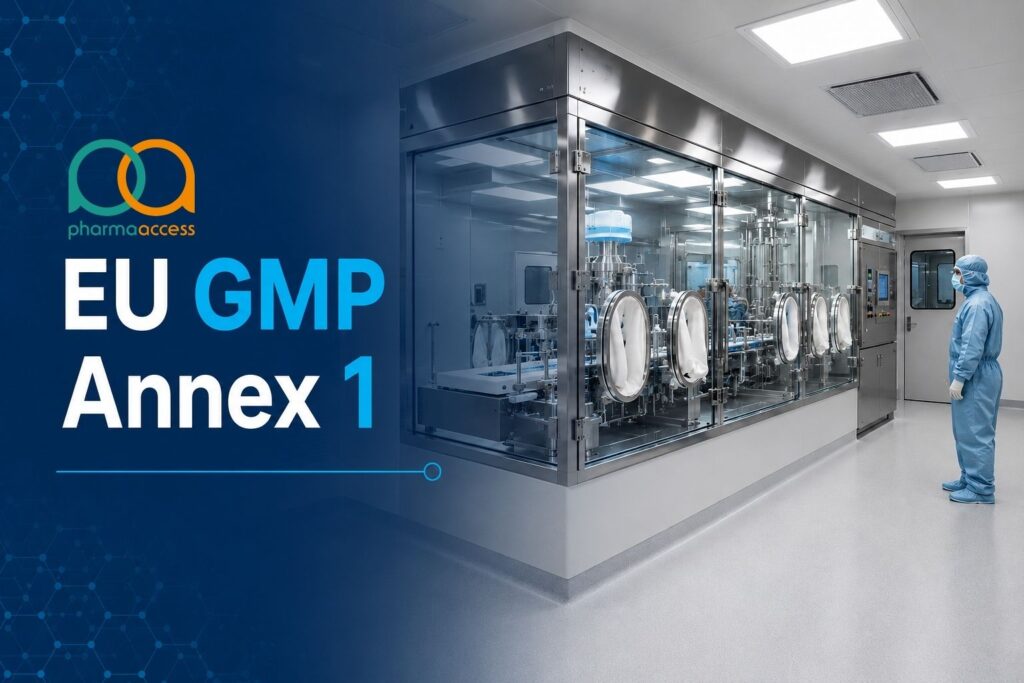
- Grade A: The critical zone. This covers aseptic filling lines, stopper bowls, open primary packaging, and any point where the product or its containers are directly exposed. First-air protection and appropriate airflow must be demonstrated over exposed sterile products, components, and critical surfaces. Unidirectional airflow is required for conventional Grade A zones, RABS, and open isolators, while airflow may not be fully unidirectional in closed isolators used for simple operations.
- Grade B: The background environment surrounding Grade A operations where an isolator is not used. Aseptic RABS normally require at least a Grade B background, while open isolators generally require at least Grade C and closed isolators at least Grade D, based on risk assessment and justification within the CCS.
- Grade C and D: Support areas for lower-risk stages, such as preparing solutions or components before they move into higher-grade zones. They can also be used for the preparation or filling of terminally sterilized products, depending on the operation and assessed risk.
Getting the grading right at the design stage determines nearly everything else downstream, from HVAC sizing to how many airlocks and gowning stages your layout needs.
The choice between terminal sterilization and aseptic processing should also be established early. Annex 1 expects finished products to be terminally sterilized wherever possible because a validated and controlled terminal sterilization process provides greater sterility assurance than sterile filtration or aseptic processing alone. This decision directly affects cleanroom grades, equipment selection, material flows, and the overall facility layout.
Designing a Facility Around the Guideline From Day One
A common mistake is treating the annex as a testing checklist to satisfy near the end of a project. The revision makes clear that contamination control has to start on the drawing board.
A few design principles carry real weight under the current guidance:
- Early barrier-technology evaluation: The annex places heavy emphasis on separating personnel from the product, requiring RABS, isolators, robotic systems, and other appropriate technologies to be considered to maintain the required conditions with less reliance on human intervention.
- Airflow modeling before construction: Using CFD and design-stage airflow studies to assess unidirectional airflow patterns and pressure cascades on paper, before pouring concrete, can help identify potential dead zones before the room is built. Airflow predictions must then be verified through physical airflow visualization studies during qualification, both at rest and in operation, including representative interventions, while pressure relationships must be verified through qualification testing and monitoring.
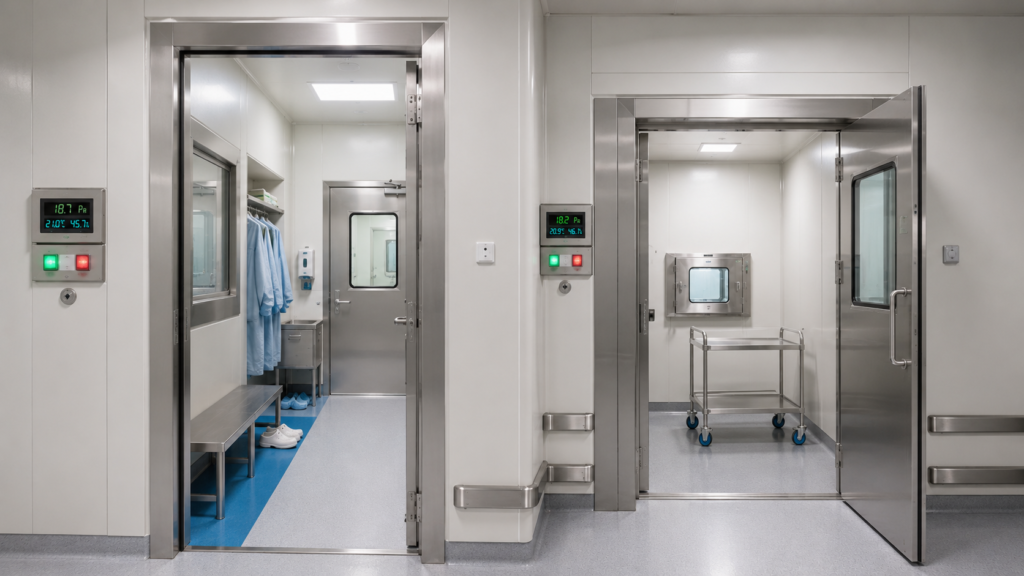
- Material and personnel flow separation: Layouts need clear, risk-based paths that minimize crossing and backtracking for people, materials, and waste to prevent contamination between clean and less-clean zones. Separate personnel and material airlocks should be provided wherever practicable, with unidirectional transfer arrangements used for materials entering and leaving Grade A and B areas. Where complete physical separation is not possible, risk-assessed time separation and procedural controls should be established.
- Built-in monitoring points: Continuous total-particle monitoring during critical processing and continuous viable air monitoring in Grade A, with a similar risk-based approach considered for Grade B, need sensor and sampling locations designed into the room, not retrofitted later.
An integrated pharmaceutical engineering design approach brings these principles together at the concept and detailed design stage, so the facility’s physical layout supports the CCS instead of working against it.
Where CQV Services Fit Into Compliance
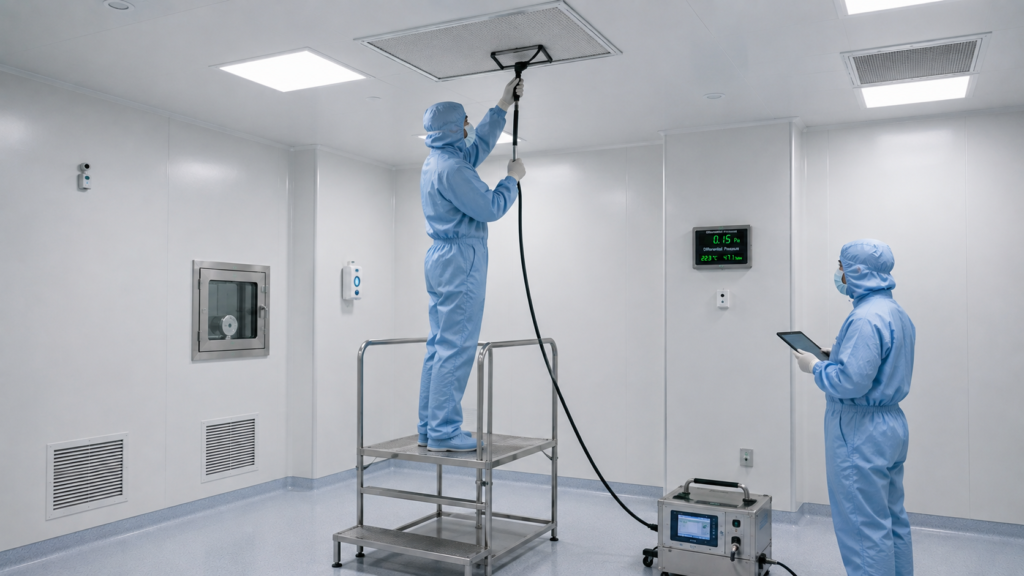
Design intent only matters if it can be proven. This is where CQV services for pharmaceutical facilities become part of the compliance story, not a separate afterthought. Commissioning confirms the systems work as installed. Qualification, beginning with Design Qualification and continuing through IQ, OQ, and PQ, provides documented evidence that the design is suitable, the systems are correctly installed, and the facility operates and performs as intended. Qualification, validation, environmental-monitoring trends, deviation investigations, and CAPA tie it all together with documented evidence that the controls defined within the CCS remain effective under routine production conditions.
Under the revised guideline, this evidence chain matters more than ever. Regulators expect to see aseptic process simulation records for aseptic processes, installed HEPA filter integrity test records, sterilizing-grade process-filter integrity test records where sterile filtration is used, and environmental-monitoring trend data that support the effectiveness of the controls described in the CCS. A facility that cannot produce this evidence, regardless of how well it was designed, will have difficulty demonstrating an effective state of control during inspection.
Common Pitfalls Facilities Run Into
A few issues show up again and again when facilities try to retrofit compliance instead of designing for it from the start:
- Underestimating airlock and gowning requirements, which forces awkward layout changes mid-construction.
- Treating the CCS as a document exercise instead of a living strategy tied to actual facility operation and monitoring data.
- Skipping early filter and barrier technology decisions, which then constrain HVAC and room layout choices later in the project.
- Insufficient personnel flow separation, leading to cross-contamination risks that only surface during environmental monitoring after startup.
Why Local Expertise Matters for Global Compliance
This EU guideline sets a widely used international benchmark, but applying it correctly depends heavily on local construction practices, climate conditions, and regulatory context. Working with experienced pharmaceutical engineering consultants in India means your facility design accounts for both the international standard and the practical realities of building and operating in your specific market.
Pairing that engineering expertise with project-specific input from quality, microbiology, and regulatory specialists who understand how EU, PIC/S, and WHO guidance is applied gives a facility a stronger position going into its first audit, rather than discovering gaps after the fact.
At Pharma Access, our engineering design and CQV teams work on sterile facility projects that need to meet this standard from the concept stage through validation. We handle cleanroom design, HVAC, utilities, monitoring requirements, and commissioning through one coordinated engineering and qualification approach, which helps facilities avoid the costly redesigns that come from treating contamination control as an afterthought. You can learn more about our approach on the Pharma Access about page.
Wrapping Up
The guideline asks manufacturers to think about contamination control as a design principle, not a final inspection hurdle. A facility built around a well-developed Contamination Control Strategy, with cleanroom grades, barrier technology, and monitoring points planned from the start, is better positioned to demonstrate consistent performance during qualification and maintain control over time. The earlier this thinking enters the design process, the less it costs to get right.
FAQs
What is the main change in the 2022 revision of EU GMP Annex 1?
The revision strengthens the move away from relying on monitoring or end-product testing alone and toward a proactive, risk-based Contamination Control Strategy that covers facility design, personnel practices, and ongoing monitoring together.
What is a Contamination Control Strategy (CCS)?
A CCS is a documented, facility-wide strategy that may reference several connected systems and explains how contamination risks are identified, prevented, detected, monitored, and controlled, spanning facility design, equipment, personnel, and monitoring, throughout the entire production process.
What are the cleanroom grades under this guideline?
The annex defines Grades A through D. Grade A is the critical zone with the strictest limits, Grade B normally the background for Grade A aseptic processing where an isolator is not used, and Grades C and D support lower-risk stages of production. RABS and isolator background grades depend on the selected technology, process risk, and justification within the CCS.
Does this guideline only apply to EU-based manufacturers?
No. EU GMP Annex 1 applies to sterile medicinal products manufactured under EU GMP requirements, including products manufactured outside the EU for supply to the EU or EEA market. PIC/S Annex 1 and WHO sterile-manufacturing guidance are closely harmonized with the EU text, but manufacturers must still consider the specific legal and regulatory requirements of every target market.
When should compliance be considered during a facility project?
From the earliest design stage. Retrofitting cleanroom grading, airflow, or barrier technology after construction is far more costly than building the Contamination Control Strategy into the original layout.
Note: This article provides a general engineering interpretation of EU GMP Annex 1. It should be read together with the official guideline and should not replace project-specific quality, microbiological, or regulatory assessment.