
Many pharma teams recognise this situation. Layout is set, equipment ordered, then a new vendor drawing shows a taller vessel or heavier load. Someone asks for “one small change”. Weeks later, ceiling coordination, ductwork and the project schedule may all require rework.
When the team agrees that scope, layout, and data stop moving without formal approval, that’s a pharmaceutical project design freeze. This is why timing matters: if you freeze too early, you lock in guesses. Freeze too late, and you’re paying for rework in steel, pipe, and time. Let’s go through it.
In practice, pharmaceutical facility design is rarely frozen in one step. The freeze normally progresses by decision, discipline, system or construction package, depending on what downstream work relies on that information.
Quick Answer: When to Freeze Pharma Facility Design
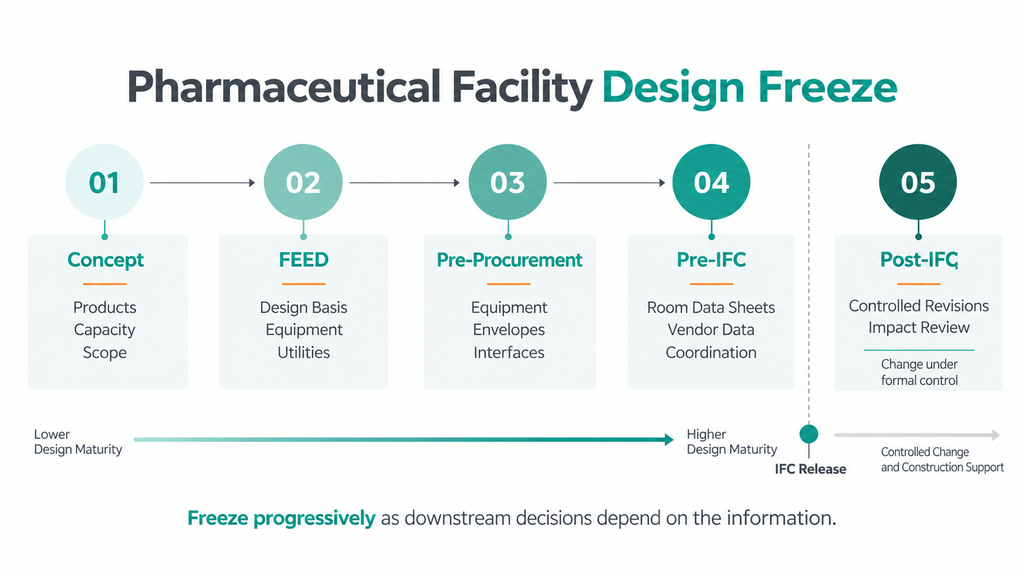
Freeze the design in layers, not all at once:
- Conclusion of concept: Baseline products, capacity, compliance requirements and overall scope.
- FEED: Baseline the design basis, equipment list, layout or plot plan concept and utility load estimates.
- Pre-major purchase orders: Confirm major equipment design envelopes, access requirements and key interfaces for long-lead items.
- Pre-IFC: Freeze room data sheets, relevant vendor data and multidisciplinary coordination for the package being released.
- After IFC: Changes only through formal project change control, with quality and GMP impact assessment where applicable.
This guide explains these layers and how each protects downstream execution.
Concept, FEED, Detailed Design, and IFC: What Each Stage Settles
Teams have different names, so start with common definitions.
- Conceptual design: This phase determines the project scope and cost. It concludes with a rough order of magnitude estimate and a report that typically recommends approval and funding of subsequent design phases. Industry project-management guidance links feasibility and concept work to a cost estimate of approximately plus or minus 30 percent.
- Front-end engineering design (FEED). This phase translates the idea into engineering data. It generates process flow diagrams, mass balances, equipment lists, P&IDs and instrumentation philosophy. Industry project-management guidance places a tighter estimate of around plus or minus 10 percent at the front-end design stage. Some firms call this stage by other names, but the content is the same.
- Design detail. This stage creates specifications, detailed designs, and drawings. This is what contractors price and build.
- IFC (issued for construction): IFC is the release of reviewed drawings and specifications to the contractors. For the package being released, changes after this point can affect work that is already priced, ordered, fabricated or in progress.
Pharma Access describes its own approach to engineering in similar terms. It describes three progressive phases: concept work that establishes the purpose, scale, and compliance framework; the middle phase that defines layouts, equipment, utilities, and P&IDs; and detailed engineering that generates final specifications and construction drawings.
Why Front-End Engineering Pharma Work Decides the Budget
Front-end engineering represents a relatively small part of overall project expenditure compared with downstream procurement, construction and installation. Its decisions, however, influence a disproportionate share of downstream project outcomes. Industry project-management guidance reflects this progression by showing increasing design and cost-estimate maturity between concept and front-end design.
The same principle applies across capital pharma projects. Better scope definition and front-end planning help teams identify gaps and reduce execution risk before detailed design and construction begin.
But the early stages tend to be crowded. Some projects move from a business idea and rough estimate into equipment procurement with only partially developed layouts. Those projects can face delays later when process, vendor and engineering data mature.
What the FEED Pharmaceutical Project Stage Should Settle
Firm inputs should be given to the detailed designers at the stage of the pharmaceutical project. Check that you can answer these questions before you close it:
- What will the building be used for in terms of products, batch sizes, and campaign patterns?
- What is the process flow? Where do the materials, people, and waste go?
- What equipment is required, and what are the approximate design envelopes of the major items?
- What are the defined utility demands and design margins?
- What room classes and pressure relationships are required for each space?
- How much is it estimated to cost, and what does that not include?
A well-done front-end package allows the user requirements to reflect real process conditions, such as defined design flow rates, material compatibility requirements, and utility connections. If your answers are still “to be confirmed”, the affected design package may not be ready for a freeze.
Pharmaceutical Project Design Freeze: When to Lock Each Item
Different data ages at different rates. Freeze each item when later work depends on it, and not until you have solid data.
Process Data
Define or baseline batch size, yield assumptions, cleaning approach, hold-time requirements and material flows to the level needed for detailed design, with remaining critical open items formally controlled. Those numbers determine everything else, such as room sizes, equipment capacity, and utility loads. A change in batch size may change vessel sizes, which can affect room sizes and utility or HVAC loads.
Equipment Layout
Stabilise the major equipment arrangement and design envelopes before placing major purchase orders, then update final vendor-specific interfaces as approved data is received. Wall positions and ceiling heights are influenced by footprints, heights, access zones, and service clearances. Hold space not only for the machine itself but also for maintenance and for material movement.
Utility Loads
Prepare and baseline a load schedule for electricity, chilled water, steam, process water, compressed air, and exhaust by the end of FEED. Apply documented design margins, and as vendor data comes in, revise the numbers through the agreed design-control process. A utility plant is expensive and slow to change, so a late load increase could mean a larger plant room, new feeders, or a new tie-in.
Room Data Sheets
Prepare and baseline a load schedule for electricity, chilled water, steam, process water, compressed air, and exhaust by the end of FEED. Apply documented design margins, and as vendor data comes in, revise the numbers through the agreed design-control process.
Vendor Information
Equipment vendors supply nozzle positions, weights, power requirements, drain points, and service connections.Before issuing an affected package for construction, obtain approved or sufficiently mature vendor data for major equipment that influences that package. Meanwhile, design for the best data you have and clearly flag the open items.
BIM Coordination
A coordinated model detects conflicts between the architecture, structure, HVAC, piping, and electrical trades. When design coordination clashes are missed, installers have to change systems to avoid each other, which can lead to delays and cost overruns down the line. Clash detection and multidisciplinary design coordination are important controls for reducing coordination errors before construction. Set coordination cut-off or model-freeze dates for the relevant construction packages. Ensure each package passes an appropriate clash review before IFC, with critical construction-impacting clashes resolved and accepted open items formally recorded.
What an IFC Pharmaceutical Project Package Must Contain

The pharmaceutical project package for the IFC should be so complete that a contractor can build without having to guess. Look for:
- Approved layouts and room numbers according to the room data sheets
- Approved P&IDs and equipment specifications applicable to the released package
- Utility drawings conforming to the approved load schedule
- HVAC drawings with room classes, pressures, and air flows
- Electrical, instrumentation, and control drawings
- A coordinated model and documented clash-review status, where BIM is used
- Reviewed and logged vendor drawings relevant to major equipment interfaces within the released scope
- A list of open items with an owner and a date for each
If things are left open, get it in writing. A known open item is a controlled risk. An undocumented open item can become an uncontrolled future change.
What Happens When Things Change After Procurement or Construction
The later you try to change something, the more it costs, because more work is based on the old decision. Here’s how that works, in practice:
- Equipment height or footprint changes. Rooms, slabs, supports, and ceilings may require revision. The vendor may charge for a redesign or a new order.
- Utility loads are increasing. Existing pumps, chillers, transformers, feeders or pipe sizes may no longer be adequate.They may have to be replaced with a shutdown and new tie-ins.
- Changes in room class or pressure. Redesigns of HVAC units, ducts, filters, and controls are required. Qualification tests may have to be repeated.
- Vendor data is not the design assumption. Pipe routes and electrical hookups change, often after the pipe is fabricated.
- A trade is made from an old model. Field conflicts arise, and crews wait as the team decides how the conflict will be resolved.
The scale of the impact varies from project to project, so there is no universal cost multiplier for a late design change. Once equipment has been ordered or construction has started, however, a design change can trigger redesign, refabrication, reinstallation and schedule disruption. This is why pharmaceutical project design changes after an IFC release need a controlled gate.
It makes schedule pressure worse. Compressing front-end design does not remove unresolved decisions; it can move them downstream, where changes are more disruptive to procurement and field execution.
Pharma Project Change Control: How to Handle Changes After the Freeze
Freezing a design doesn’t mean not ever changing it. It means it passes a gate. Good pharmaceutical project design change control has a short, repeatable path:
This project design-change process should also be distinguished from formal GMP change control. Where a proposed change could affect product quality, contamination control, qualification or the validated state, the appropriate quality assessment and GMP change-control pathway should also be applied.
- Submit a request: Explain why, who asked for it, and which areas are affected.
- Evaluate impact: Review layout, utilities, HVAC, room data sheets, vendor orders, qualification scope, cost, and schedule.
- Make a decision: The designated project authority or change-control board approves, rejects, or defers the change, with clear limits on approval authority.
- Refresh all documents: Update drawings, data sheets, models and vendor information as one controlled revision set.
- Inform the vendors and contractors: Send the revision and confirm receipt and implementation status.
- Close the record: Log cost and schedule effects for future lessons.
- Classify requests by reason and impact: Safety, regulatory and product-quality changes require appropriate action, while preference-driven changes should be evaluated against their cost and schedule impact. A visible log of cost and schedule effects also creates discipline around change decisions.
Measure Design Maturity Before You Freeze
Don’t go by a feeling that “the design is about done”. Use a checklist at each gate.Recognised project-definition approaches provide structured methods for assessing scope maturity, including an approach developed specifically for Manufacturing & Life Sciences projects. You don’t need that exact tool, but borrow the idea. Score individual items as defined, partly defined, or open.
A simple Pharma Gate checklist:
- Approved user requirements
- Process flow and mass balance issued at the agreed design status
- Vendor data available for major items that influence the package
- Utility load schedule issued with stated design margins
- Signed Room Data Sheets
- Approved and coordinated layout
- Cost estimate in the agreed-upon range
- Schedule shows procurement lead times and the critical path
- Agreed project design-change control procedure
Hold the gate if critical items remain open or the design-maturity assessment is insufficient. It’s cheaper to delay a little now than delay a lot later.
Practical Tips for a Smoother Freeze
- Freeze in packages: Lock structure and major process or equipment interfaces before downstream finishes where those packages depend on them. Prioritise long-lead items such as air handling units and process equipment only when the required design data is sufficiently mature for procurement.
- Protect margin: Include documented design allowances for utilities and space where justified, and manage their use through the agreed project change-control process.
- Hold early vendor data meetings: Before finalising rooms, ask vendors for loads, drawings, and connection points.
- At the gate, engage quality and production: Their review of room data sheets, flows and operational requirements helps prevent significant downstream changes.
- Keep the model up to date: Field changes need to be reflected in the model; otherwise, the next trade will be based on stale information.
- Develop a growth plan: Reserve expansion zones, future tie-in provisions and justified utility capacity based on the facility’s lifecycle and expansion strategy rather than automatically oversizing systems.
Delivery Model and Handoffs
Many late changes emerge at handoffs: concept to FEED, FEED to detailed design, design to procurement, and procurement to site. Within an EPCMV or turnkey delivery approach, engineering design, procurement, construction and installation, CQV and project management guide should operate as coordinated workstreams rather than isolated stages. No matter what delivery model you choose, make sure there’s one owner for each handoff, and demand a short written transfer of decisions and open items.
Common Mistakes to Avoid
- Ordering equipment before firm layout and loads
- Treating IFC as a date and not a maturity gate
- Vendor data coming in after drawings are released
- Allowing verbal changes outside of the change log
- BIM clash review omitted to save a week
- Freezing too early on bad data and covering up the gaps
Next Steps
Make a list of what to freeze and when each item freezes. Assign an owner for process data, layout, utility loads, room data sheets, vendor data, and the model. Then agree on the change control path before the first change request lands. For more insights on pharmaceutical facility planning, engineering and project execution, explore our engineering resources and project insights.
Frequently Asked Questions
When should pharma facility design be frozen?
Freeze the design progressively. Baseline scope after concept, process and design data through FEED, major equipment interfaces before dependent procurement, and room data sheets and coordinated design before the relevant IFC package is released. Changes after IFC should be routed through formal project change control, with quality impact assessment where applicable.
What does IFC mean in a pharma project?
IFC means issued for construction. It is the release status applied to reviewed drawings and specifications that are authorised for construction. Before IFC, revisions should still follow the project’s document-control, review and approval process. After IFC, changes affecting released, priced, ordered or installed work should be managed through formal change and impact review.
What should a FEED stage include?
The FEED stage should deliver process flow diagrams, mass balances, a list of equipment, P&IDs, layout concepts, estimates of utility loads, and a tighter cost estimate.Industry project-management guidance associates front-end design with a cost-estimate maturity of approximately plus or minus 10 percent, although the actual estimate class and accuracy range should follow the project’s estimating methodology.
How much do late design changes cost?
Costs will vary from project to project, so there is no one number that will do. Once equipment is ordered or pipes, ducts and other services are fabricated or installed, changes can require redesign and rework and may affect both cost and schedule.
How does change control work after the freeze?
A requester gives a reason for a change. The team evaluates impacts on layout, utilities, HVAC, qualification, cost, and schedule. The change is reviewed by the designated approval authority. The team then updates all documents and the model, notifies vendors, and records the outcome.