A tablet coating pan, a solvent dispensing room, and a reactor charging station have one thing in common. Each can, during normal operation or foreseeable process releases, generate a flammable atmosphere in or around the equipment. Hazardous area classification in pharmaceutical projects is the engineering process used to identify where, how frequently, and for how long an explosive atmosphere may be present.
Here’s why that matters. It influences electrical equipment selection, ventilation, room layout, process interfaces, and documentation requirements. The following sections explain how the classification is developed and applied in pharmaceutical facilities.
What Is Hazardous Area Classification?
Hazardous area classification is the process of identifying where a flammable gas, vapour, mist, or combustible dust may form an explosive atmosphere with air and then classifying these locations into zones. The zone depends on the likelihood, frequency, and duration for which the explosive atmosphere may be present.
The short version is:
- Begin with a list of flammable materials and all the places they might escape from.
- Create zone drawings that define equipment and design rules.
- Repeat the procedure each time the process, solvent, or layout is altered.
Hazardous area classification is one part of a wider explosion-risk assessment. It identifies where explosive atmospheres may occur and supports equipment selection and ignition-source control, but it does not replace the assessment of catastrophic failures, explosion consequences, fire protection, or emergency response.
Within the European Union, hazardous-area requirements are supported by two ATEX directives. One addresses equipment and protective systems used in potentially explosive atmospheres (2014/34/EU), while the other addresses the protection of workers potentially at risk from explosive atmospheres (1999/92/EC). In Great Britain, the worker requirements are implemented in national law through DSEAR regulations. IECEx is an international conformity-assessment system for equipment and services used in explosive atmospheres and is commonly applied alongside the IEC 60079 series of standards; applicable national legislation still needs to be considered. North American projects may use Class/Division or Zone-based classification depending on the applicable code and authority requirements.
The regulatory framework differs from country to country. The engineering principles remain consistent.
Where Flammable Solvents, Gases, Vapours, and Dusts Appear
Pharma plants bring liquids, powders, and cleaning routines under one roof. That combination creates more release points than many teams expect.
Solvent Handling in a Pharmaceutical Facility
Solvent handling is one of the most common reasons for hazardous-area assessment in pharmaceutical facilities. Evaporation of alcohol-based solvents used for granulation or cleaning may generate flammable vapours. Mixers and granulators can also introduce potential ignition sources through electrical equipment, mechanical friction, hot surfaces, or static discharge, so sources of release and sources of ignition should be assessed separately.
Cleaning deserves its own line on the list of hazards. Rooms and equipment cleaned with flammable solvents require hazardous-area assessment where the solvent use could generate an explosive atmosphere; classification is not automatically required for every use of a flammable cleaning solvent. This is missed by many teams because the cleaning is not on the process flow diagram.
Gases and Vapours
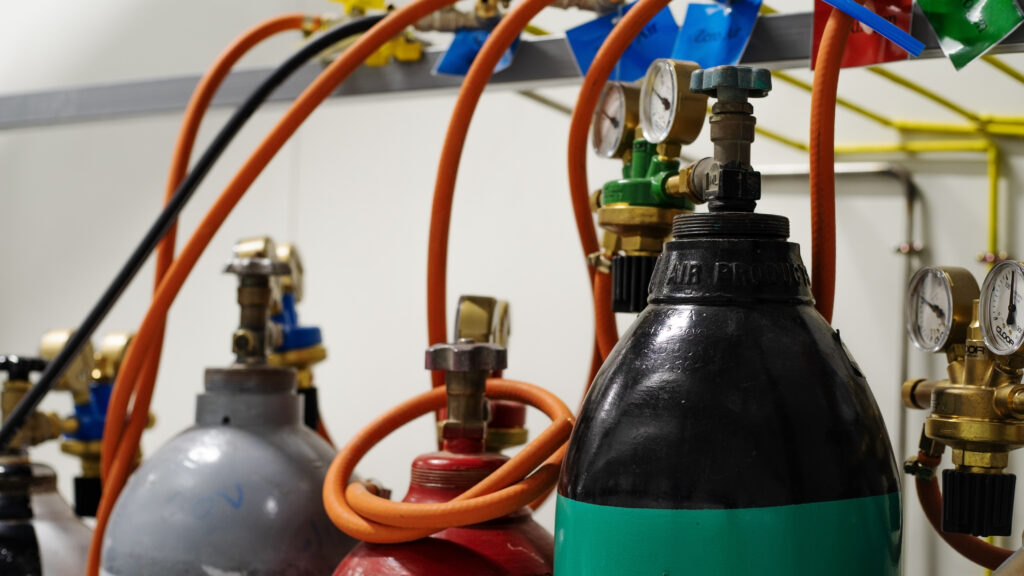
An explosive atmosphere may be formed by process gases, solvent vapours and vented tank headspace. Check properties that control behaviour:
- Flash point and flammable or explosive limits
- Vapour density – indicates whether vapours are likely to rise, disperse, or accumulate at lower levels
- Auto-ignition temperature – supports selection of the appropriate equipment temperature class
- Gas group – supports selection of equipment suitable for the relevant gas or vapour group
Many solvent vapours are heavier than air. Depending on ventilation and dispersion conditions, they may accumulate in floor drains, pits, trenches, and other low points. The hazardous-area assessment and zone drawings should consider these low-level spaces.
Combustible Dust
Combustible pharmaceutical powders may create dust hazardous areas where airborne dust clouds capable of forming an explosive atmosphere can occur. The dust zones have different numbers, which are explained in the next section.
Not every pharmaceutical powder presents the same explosion risk. Material properties, particle characteristics, process conditions, and the potential for dust-cloud formation must be assessed. Combustible dust layers also require consideration separately from airborne dust clouds.
Read More: Compressed Air Nitrogen System Pharma GMP
Zoning Principles: How Hazardous Areas Are Classified in Pharmaceutical Projects
Zones are assigned according to the likelihood, frequency, and duration of an explosive atmosphere. Gas and vapour areas use 0, 1, and 2. Zones 20, 21, and 22 are used for dust hazards.
Gas and vapour zones
- Zone 0: An explosive atmosphere is present for long periods of time or frequently or continuously.
- Zone 1: An explosive atmosphere is likely to occur in normal operation occasionally.
- Zone 2: An explosive atmosphere is not expected to occur in normal operation and, if it occurs, will only be present for a short time.
Dust zones
The same general probability-and-duration logic applies to Zones 20, 21 and 22 for combustible dust clouds. Same classification scheme, different numbers. Potential accumulation and disturbance of combustible dust layers should also be considered as part of the assessment.
Some industry guidance uses approximate time bands such as more than 1,000 hours per year for Zone 0, 10 to 1,000 hours for Zone 1, and less than 10 hours for Zone 2. These figures should only be treated as indicative guidance. The classification itself is based on the nature and grade of release together with ventilation and dispersion conditions, not simply on operating hours.
The Three Inputs That Set a Zone
The primary standard for gas and vapour area classification is IEC 60079-10-1. Key inputs include the grade of release, the degree of dilution, and the availability of ventilation.
Grade of release: Is the release continuous, expected periodically or occasionally during normal operation, or not expected during normal operation and only likely to occur infrequently and for a short period if it does occur?
- Dilution: Will the air movement dilute the vapour sufficiently quickly?
- Availability: Is that air movement continuous, or does it stop at times?
Depending on the release and ventilation conditions, the type and extent of the hazardous zone may be reduced and, in some cases, may become negligible in extent. That’s why ventilation design and classification should be done together.
How to Classify an Area: Step by Step
Repeat this sequence for each room. It’s also a checklist for a review meeting.
- Note the fuel substances: List the relevant flash point, flammable limits, gas group, auto-ignition temperature and applicable combustible-dust data for each solvent, gas, or powder.
- Find every discharge outlet: Check open vessels, charging ports, sample points, vents, seals, flanges, hose connections, drains, and cleaning stations.
- Assess each release: Classify the source as continuous, primary, or secondary grade of release as applicable.
- Evaluate ventilation and dilution: Note airflow rate and direction, dilution effectiveness, airflow distribution, and the availability and reliability of the ventilation system rather than relying on air-change rate alone.
- Select the zone type and the size of the zone: Draw plan and section views to show the vertical limits as well.
- Mark, sign, and record: Post warning signs where required by the applicable regulatory framework. Record the result.
- Review with every change: The answer can change if you use a new solvent or move the vessel.
Classified Areas in a Pharmaceutical Plant: Typical Locations
Pharmaceutical plant designers most often encounter the following areas that may require hazardous-area assessment:
- Solvent storage and dispensing rooms
- API reactor halls, centrifuge rooms, and dryer rooms
- Wet granulation and solvent coating suites
- Stations for washing equipment and cleaning using solvents
- Waste solvent collection points and drum stores
- Combustible powder handling areas for operations such as milling and blending
- Analytical laboratories with solvent work stations
The extent of any resulting zone depends on the material properties, release conditions, process arrangement, and ventilation. Classification is intended to define hazardous areas correctly and support suitable controls rather than unnecessarily classify an entire building.
ATEX Pharmaceutical Facility Requirements and Electrical Equipment
Equipment installed within an ATEX-classified area must be suitable for the applicable zone and equipment category. For Group II equipment, the general relationship is:
- Category 1 (1G or 1D): Zones 0, 20
- Category 2 (2G or 2D): Zone 1 and Zone 21
- Category 3 (3G or 3D) Zone 2 and 22
Electrical hazardous area decisions in pharma go way beyond light fittings. The list includes motors, junction boxes, switches, operator panels, cable glands, sensors and heaters. Each item should carry the appropriate Ex marking and conformity documentation for the applicable jurisdiction, zone or Equipment Protection Level (EPL), gas or dust group, and temperature requirements.
Types of protection differ. Intrinsic safety is one protection technique: Ex ia can provide the level of protection required for Zone 0 applications, while Ex ib can provide the level required for Zone 1 applications when the complete circuit is correctly designed. Other types include flameproof enclosures, increased safety, and pressurised enclosures. For intrinsically safe circuits, electrical and thermal energy is limited so that ignition cannot occur under the defined operating and fault conditions.
Cleanroom surfaces are challenging. In hygienic rooms, smooth, washable fittings are needed. A mixing room with stainless-steel surfaces may still require explosion-protected luminaires, safety switches, and operating terminals where the room or surrounding equipment is classified. Ex equipment should therefore satisfy both hazardous-area requirements and the cleanability, ingress-protection, and material requirements of the room.
Non-electrical equipment must also be assessed. The current ATEX equipment directive covers equipment and protective systems intended for use in potentially explosive atmospheres, including equipment with potential non-electrical ignition sources. Pumps, mixers, agitators, and so on must therefore be considered where they could introduce an effective ignition source. Static earthing and bonding should also be addressed as part of ignition-source control.
HVAC and Ventilation: Where Airflow Helps and Where It Hurts
Effective and reliable ventilation can reduce flammable concentrations and influence the type or extent of a hazardous zone. Poorly designed airflow can instead transport vapours and increase the area exposed to the hazard. HVAC and process-safety inputs should therefore be coordinated using the same classification basis.
- Safety precaution: Ventilation. Dilution thins out a release before it builds up. Where the hazardous-area classification relies on ventilation, its effectiveness and availability should be demonstrated. Airflow monitoring, alarms, or interlocks may be required where loss of ventilation could affect the hazardous condition.
- Single-pass air for solvent applications. Recirculation of solvent-laden air can increase accumulation risk unless appropriately engineered and controlled. For some solvent processes, once-through or single-pass air may therefore be selected. The hazard assessment determines whether once-through air is required for the particular process.
- Cascades of pressure. Pressure relationships in pharmaceutical facilities depend on the contamination-control and containment strategy. Product-protection areas may require positive pressure relationships, while solvent, containment, or other hazardous operations may require negative relationships to prevent migration into adjacent spaces. That interface can be managed through airlocks, door interlocks, airflow control, and pressure alarms. Define the pressure cascade early because it can influence the room arrangement.
- Extraction and piping. Locate extract points based on vapour density, source-of-release location, and airflow behaviour. Control airflow so that solvent-laden air does not migrate into undesignated areas. Fans used in potentially explosive atmospheres must be suitable for the applicable hazardous conditions. Where fan internals handle a potentially explosive atmosphere, the fan assembly and its potential ignition sources should also be assessed.
Process Equipment Interfaces
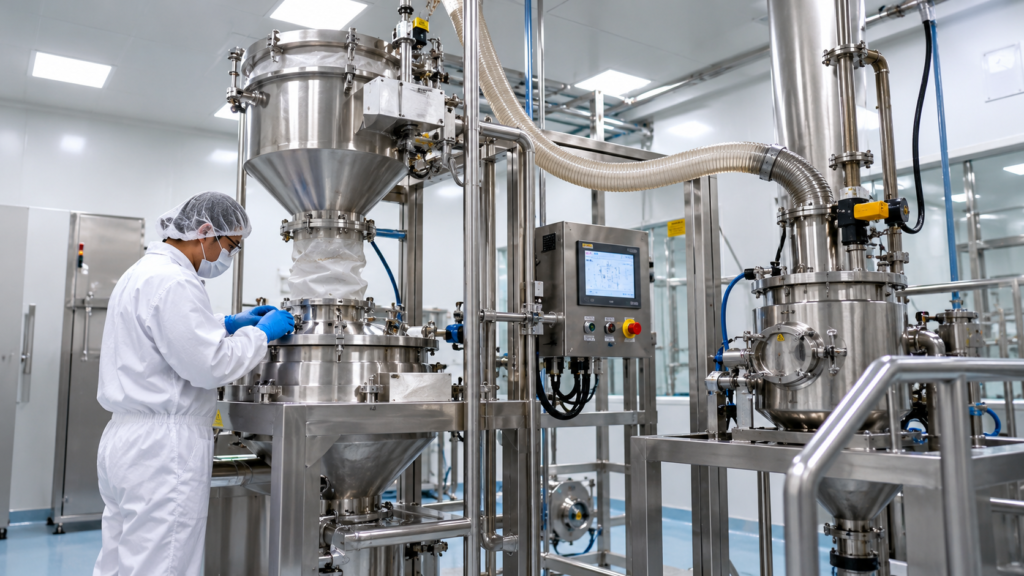
The interior of a process vessel may have a more severe hazardous condition than the room in which it stands. Interfaces between the vessel and the surrounding room therefore require careful assessment.
Verify these interface points:
- Charging ports and manways that open the vessel or process to the room
- Sample valves and drain points
- Vent lines and relief discharge points
- Hoses and couplings for transfer
- Cable and pipe penetrations through walls and floors
- Instruments mounted on the vessel or equipment skid
Vendor skids require the same level of review. Equipment suppliers should provide the hazardous-area design basis, applicable Ex ratings and markings, and relevant conformity documentation for components within their supply boundary. Request this information during procurement, not at the time of installation.
Documentation That Holds Up in an Audit
A zone drawing should be supported by a documented classification basis. Create a file with:
- Hazardous area classification report and its method
- Substance data covering relevant flammability or explosibility properties
- A list of release sources with their grades
- Plan and elevation zoning drawings
- An equipment register with the applicable Ex markings and conformity documentation
- Inspection and maintenance logs
- Records of staff training and applicable warning signage
Documentation forms an important part of the IEC 60079 area-classification approach. Applicable workplace regulations may also require warning signage where explosive atmospheres can occur.
The broader safety approach is to eliminate or reduce fire and explosion risk from hazardous substances wherever reasonably practicable. Hazardous-area classification supports this process but does not replace elimination, substitution, process containment, or other higher-level risk controls. Reducing or eliminating solvent use, where technically feasible, can reduce the hazardous-area requirement before additional equipment controls are considered.
How Classification Shapes Facility Layout and Engineering
Hazardous-area classification is also a layout tool. Decisions made at the concept stage are generally easier to integrate than corrective measures after construction.
- Room location: Solvent stores and dispensing rooms may be positioned toward external walls or suitably separated areas where justified by the process risk assessment, ventilation strategy, fire and life-safety requirements, and site arrangement.
- Electrical room location: Where practicable, maintain motor control centres and major electrical panels in unclassified areas. Run only the required circuits and interfaces into the classified zone.
- Pits and floor drains: Heavier-than-air vapours may accumulate at low levels. Drains, sumps and trenches may extend a zone below the floor.
- Limits of zones and doors: Zone boundaries should be coordinated with walls, doors and airlocks only where the physical separation and ventilation arrangement support the classification. The final zone extent must follow the release and dispersion assessment.
- Fire prevention: Fire detection, suppression, and life-safety systems must be compatible with the classified environment. Components located within a hazardous zone that could act as an ignition source must be suitable for that location.
At Pharma Access, hazardous-area inputs are coordinated across process, HVAC, electrical, automation, fire & life safety, and other relevant engineering designs disciplines. Zoning touches each of these disciplines, so one classification basis should feed consistently into the wider facility design.
Commissioning should also include verification and initial inspection of the Ex installation. Check that equipment markings match the hazardous-area equipment register, confirm that required airflow and ventilation functions operate correctly, verify alarms and interlocks, and examine relevant seals and interfaces at zone boundaries. Where these systems also fall within the GMP qualification scope, the applicable qualification activities should additionally verify their critical functional requirements.
Common Mistakes to Avoid
- Classifying only the process, without cleaning steps
- Ignoring vapour movement at floor level
- Taking credit for ventilation without confirming its availability, monitoring, or failure response
- Buying Ex equipment with the wrong gas group and temperature class
- Excluding vendor skids and packaged equipment from the hazardous-area review
- Not updating zone drawings after a process, solvent, equipment, layout, or ventilation change
- Assuming that every pharmaceutical powder automatically creates a combustible-dust hazardous zone
Next Steps
First, prepare the substance and release-source list for every room. Then, run the classification with process, HVAC, electrical, and safety engineers in the same review. Then lock the results into the layout and hazardous-area drawings before equipment orders are issued. If you would like to read more about facility design, the Pharma Access blog has more engineering topics on the website.
Frequently Asked Questions
What is hazardous area classification in a pharmaceutical plant?
It is a systematic study to identify where flammable gases, vapours, or combustible dusts could form an explosive mixture with air. The study assigns zones according to the likelihood, frequency, and duration of the explosive atmosphere. Those zones then inform equipment ratings, ventilation design, signage, and layout decisions.
Which zones apply to solvent vapours and which to dust?
Zones 0, 1, and 2 are used for solvent vapour and gases. Zones 20, 21 and 22 are used for combustible dust atmospheres. The zone number indicates the frequency and duration of the explosive atmosphere, ranging from continuous, frequent, or long-duration presence to conditions that are unlikely during normal operation and, if they occur, persist only briefly.
Does cleaning with solvents create a classified area?
Itcan. However, even if the process does not involve flammable solvents, the use of such solvents to wash rooms or equipment may create an explosive atmosphere. Engineers include cleaning steps and wash stations in the release source list and zone drawings where the assessment identifies a hazardous-area requirement. .
Can ventilation lower a zone classification?
Ventilation can influence the zone classification and/or its extent. The degree of dilution and the availability of ventilation are important considerations under IEC 60079-10-1. Effective dilution may reduce the extent or severity of a hazardous area, but credit should only be taken where the ventilation is sufficiently effective and reliable. Where loss of ventilation could affect the hazardous condition, appropriate monitoring, alarms, or interlocks may be required.
Who reviews the classification and how often?
It should be reviewed by a team of process, safety, HVAC, and electrical engineers. Re-check after any change of solvents, equipment, layout, or ventilation. Many sites also have a schedule for periodic reviews and inspections of Ex equipment.