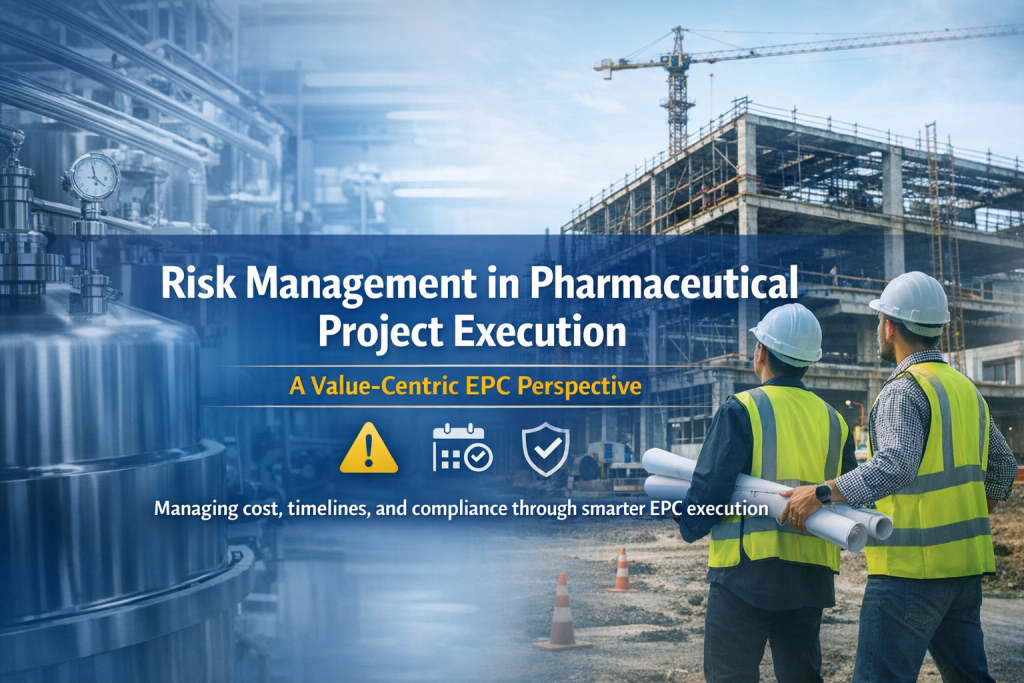
Pharmaceutical project execution is fundamentally different from conventional industrial projects. The risks involved go far beyond cost overruns or schedule delays. They directly affect regulatory compliance, validation success, audit outcomes, and time to market.
For decision-makers, the real challenge is not identifying risks. It is anticipating where they originate and preventing them early, before they surface during commissioning or regulatory inspections. This requires a structured, lifecycle-driven approach to risk management that is embedded into pharmaceutical engineering, installation, system integration, and qualification.
Why Risk Management Must Start Early in Pharma Projects
In many pharmaceutical projects, risks become visible only at the later stages. Delays during commissioning, repeated qualification failures, or audit observations often trace back to decisions made during concept design, vendor selection, or installation planning.
A value-centric risk management approach focuses on front-loading critical decisions. When risks are addressed early, projects benefit from smoother execution, predictable timelines, and reduced lifecycle cost. When risks are addressed late, corrective actions become expensive and disruptive.
Regulatory and Compliance Risk: From Guidelines to Readiness
Regulatory compliance is not achieved by meeting guidelines alone. It is achieved by ensuring that a facility is validation-ready and audit-ready at every stage of execution.
Common compliance risks include:
- Facilities designed without clear validation logic
- GMP and non-GMP areas not clearly segregated
- HVAC and cleanroom systems not aligned with contamination control strategies
- Gaps in documentation traceability across engineering and qualification phases
- Late design changes that impact validated systems
The value lies in designing for compliance, not correcting for it later. Integrating GMP principles, validation requirements, and audit expectations at the concept and basic engineering stages significantly reduces the risk of regulatory surprises during qualification or inspections.
Design and Engineering Risk: Decisions That Shape the Entire Lifecycle
In pharmaceutical projects, design-related risks have a cascading effect. A small oversight at the engineering stage can result in installation challenges, rework, delayed qualification, and extended validation timelines.
Key design risks include:
- Incomplete or evolving User Requirement Specifications
- Misalignment between process equipment and utility capacities
- Insufficient consideration for maintenance, access, and future expansion
- Lack of coordination between disciplines
A value-driven EPC approach mitigates these risks through multidisciplinary coordination, structured design reviews, and constructability assessments. This ensures that engineering decisions support not only execution, but also long-term operational reliability and compliance.
Installation and System Integration Risk: Where Execution Truly Matters
Installation and system integration are the phases where engineering intent becomes operational reality. In pharmaceutical facilities, this involves close coordination between process equipment, utilities, HVAC systems, cleanrooms, automation, and monitoring systems.
Risks commonly arise from:
- Poor sequencing between equipment installation and utility readiness
- Interface mismatches between vendor-supplied systems
- Inadequate contamination control during installation
- Late design clarifications affecting installed systems
- Safety incidents impacting productivity and compliance
The value lies in disciplined installation sequencing and interface management. When installation is planned with commissioning and qualification in mind, downstream disruptions are minimized, and systems are handed over in a state that supports smooth CQV execution.
Vendor and Supply Chain Risk: Beyond Cost and Delivery
Pharmaceutical projects rely heavily on specialized vendors. Selecting vendors based only on price or delivery timelines introduces significant risk.
Common vendor-related risks include:
- Incomplete or inconsistent FAT and SAT documentation
- Equipment not aligned with qualification protocols
- Delays caused by logistics or regulatory documentation gaps
- Variability in documentation formats across suppliers
Risk mitigation requires vendor qualification, documentation standardization, and proactive expediting. When procurement decisions are aligned with CQV and validation needs, projects avoid last-minute delays and rework.
Commissioning, Qualification, and Validation Risk: The Point of Truth
The commissioning and qualification phase are where accumulated risks surface. Delays here are rarely isolated incidents. They are often the result of earlier gaps in planning, execution, or documentation.
Common CQV risks include:
- Incomplete installation verification
- Equipment not installed as per approved drawings
- Unclear ownership of qualification activities
- Limited client readiness for validation execution
The value-centric approach is to plan CQV from day one. Clear protocols, defined responsibilities, and aligned documentation workflows ensure that qualification progresses smoothly rather than becoming a bottleneck.
Digital and Data Integrity Risk: Enabling Reliability, Not Complexity
Digital systems play an increasing role in modern pharmaceutical facilities. However, they also introduce new risks if not implemented within a GMP-compliant framework.
Risks include:
- Unvalidated digital tools
- Weak access control and audit trails
- Poor integration between automation, monitoring, and quality systems
When implemented correctly, digital tools such as IoT-enabled monitoring and analytics support predictive maintenance, equipment reliability, and controlled data management. Their value lies in enabling proactive decision-making without compromising compliance.
Integrated EPC Execution: Turning Risk into Predictability
Risk mitigation in pharmaceutical projects is most effective when single-point accountability exists across engineering, procurement, installation, system integration, and qualification. Fragmented responsibility often leads to misalignment, delayed decisions, and compliance gaps.
An EPC-led turnkey execution model delivers value by:
- Integrating GMP and validation requirements early
- Coordinating multiple vendors and systems seamlessly
- Managing interfaces and change control proactively
- Delivering facilities that are audit-ready at handover
This integrated approach transforms risk management from reactive problem-solving into predictable project execution.
Conclusion: Risk Management as a Business Advantage
Risk cannot be eliminated from pharmaceutical project execution. However, it can be anticipated, managed, and significantly reduced through disciplined planning and integrated execution.
Organizations that adopt a lifecycle-driven approach to risk management benefit from faster commissioning, smoother qualification, lower lifecycle costs, and greater regulatory confidence. More importantly, they gain predictability in an environment where uncertainty directly impacts business outcomes and patient access.
In pharmaceutical projects, effective risk management is not an operational safeguard. It is a strategic advantage.