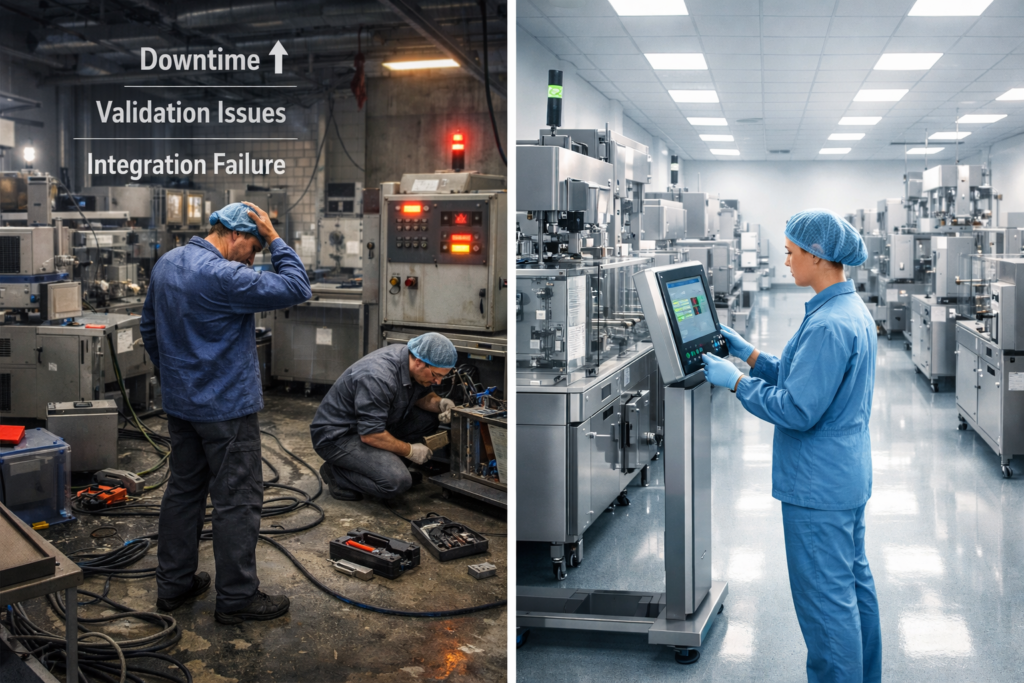
Pharmaceutical Procurement Consulting: Optimizing Equipment and Vendor Selection

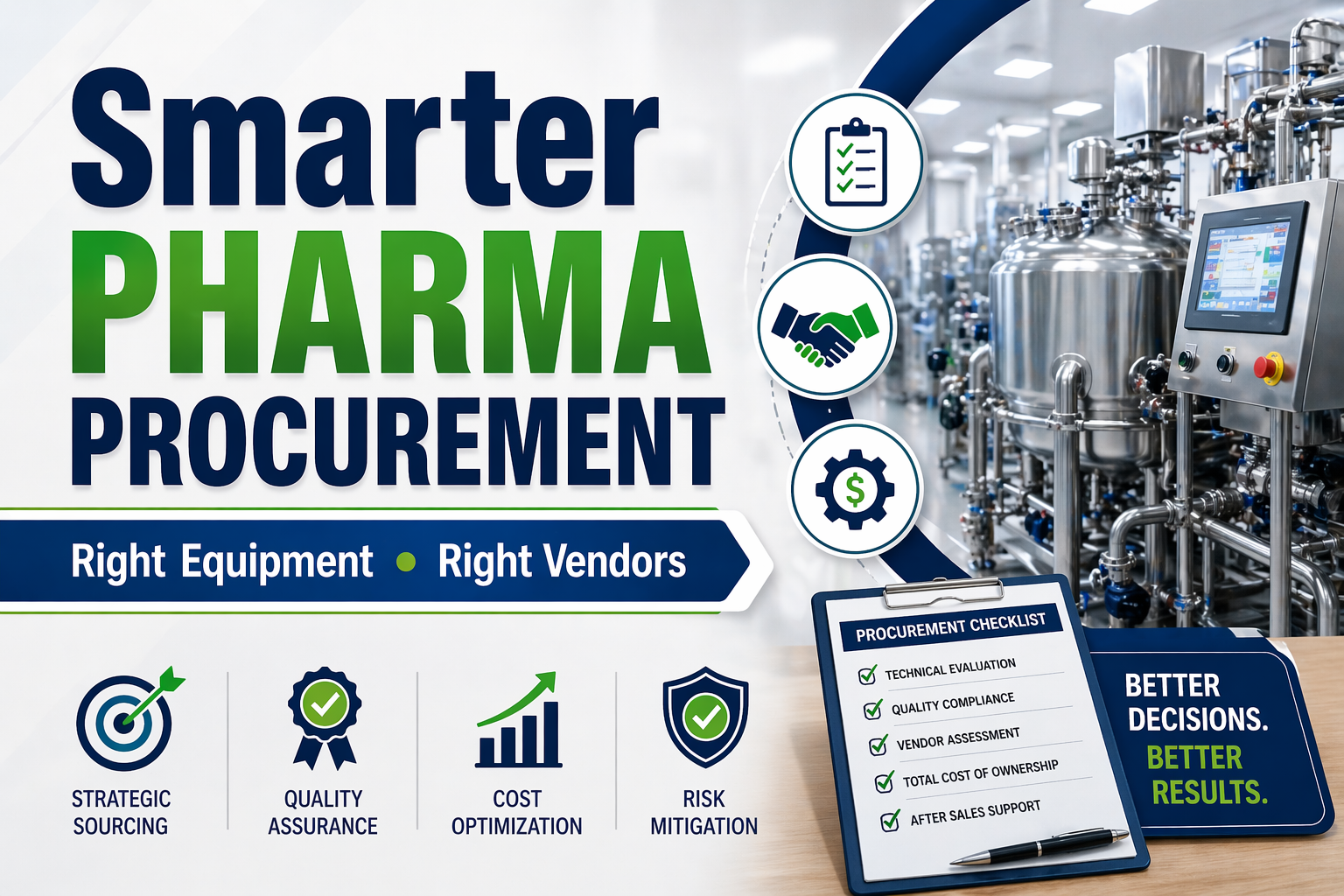
Smarter Pharma Procurement

Pharma projects continue to get bigger, faster, and more complex. Though engineering and construction often steal the spotlight, one aspect of pharma projects makes or breaks schedule adherence: procurement.

Procurement in today’s pharmaceutical project isn’t just about buying equipment or selecting vendors. Procurement plays a vital role in managing costs, keeping to your timeline, staying compliant with cGMP and global regulatory expectations, and realizing project success.

Pharmaceutical procurement consulting can help. Done right, procurement weaves your technical needs, vendor capabilities, regulatory compliance expectations, and project schedule into a seamless and executable plan aligned with facility engineering.

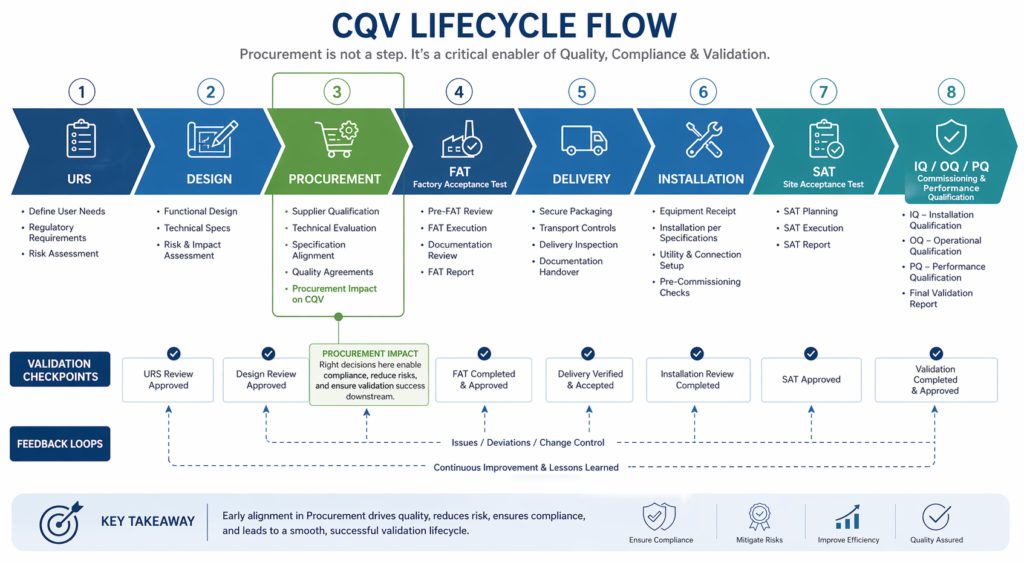
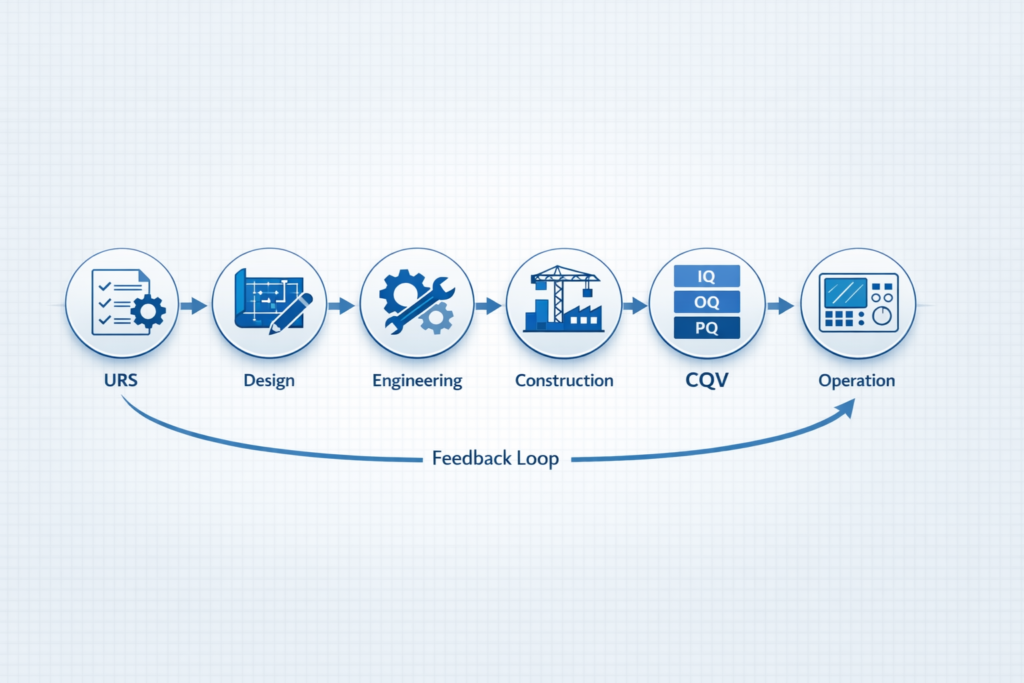
CQV Lifecysle

The Hidden Impact of Procurement Decisions

Procurement decisions are often made early in the project lifecycle, but their impact is felt much later during installation, integration, and qualification.

A misaligned procurement strategy can lead to:

  • Delays due to late or incomplete equipment delivery
  • Compatibility issues between equipment, clean utilities (PW/WFI), HVAC systems, and automation architecture.
  • Increased rework during installation and commissioning and qualification
  • Challenges in meeting compliance and validation requirements

These issues are rarely caused by a single decision. They are usually the result of fragmented procurement planning.

Moving Beyond Traditional Procurement Approaches

In many projects, procurement is treated as a transactional activity. Vendors are selected based on cost, availability, or previous relationships, with limited alignment to engineering and project requirements.

However, pharmaceutical projects require a more integrated approach. Modern pharma procurement consulting focuses on aligning procurement with:

  • Engineering design and process requirements
  • Project timelines and sequencing
  • Compliance and validation strategies
  • Long-term operational performance

This shift transforms procurement from a support function into a core driver of project success.

Where Procurement Strategy Creates the Most Value

The real value of procurement lies not just in cost savings, but in how effectively it supports engineering execution, compliance readiness, and lifecycle performance.

Equipment Selection with Context

Selecting equipment is not just about technical specifications. It requires understanding how the equipment fits within the broader facility design.

Key considerations include:

  • Alignment with process requirements and batch sizes
  • Compatibility with utilities and automation systems
  • Ease of installation, operation, and maintenance
  • Readiness for FAT, SAT, and downstream CQV activities

Well-informed procurement decisions ensure that equipment integrates smoothly into the facility.

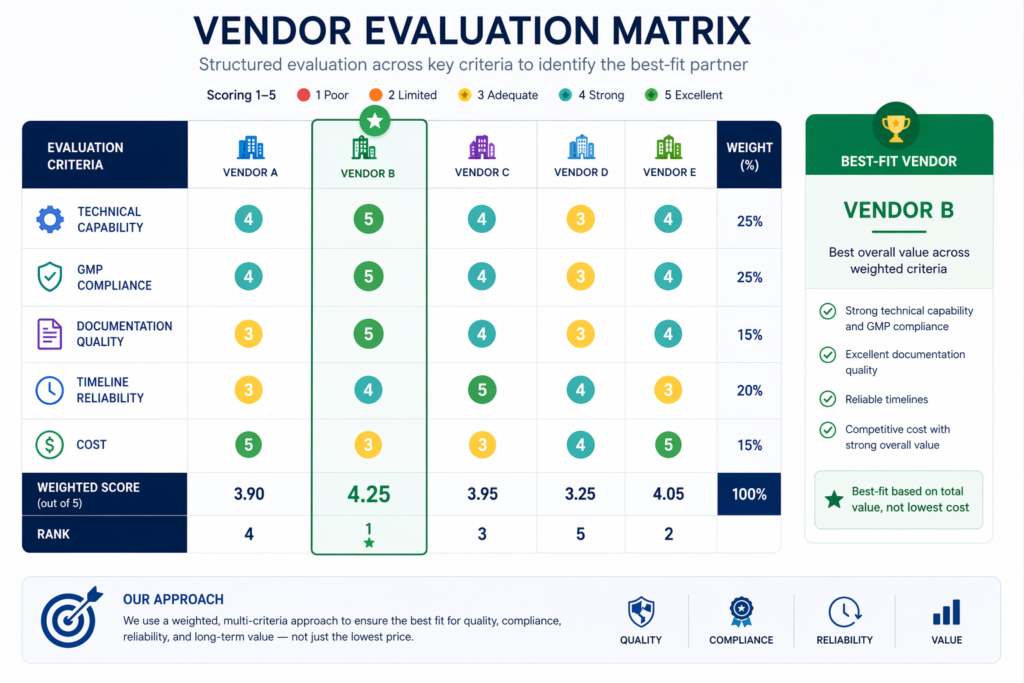
Vendor evaluation matrix

Vendor Evaluation Beyond Pricing

Choosing the right vendor is as important as selecting the right equipment. Instead of focusing solely on cost, effective procurement evaluates:

  • Technical expertise and industry experience
  • Ability to meet project timelines, FAT commitments, and delivery schedules
  • Quality of documentation and compliance support
  • After-sales service and long-term reliability

Strong vendor partnerships reduce project risk and improve execution quality, and support compliance throughout the facility lifecycle.

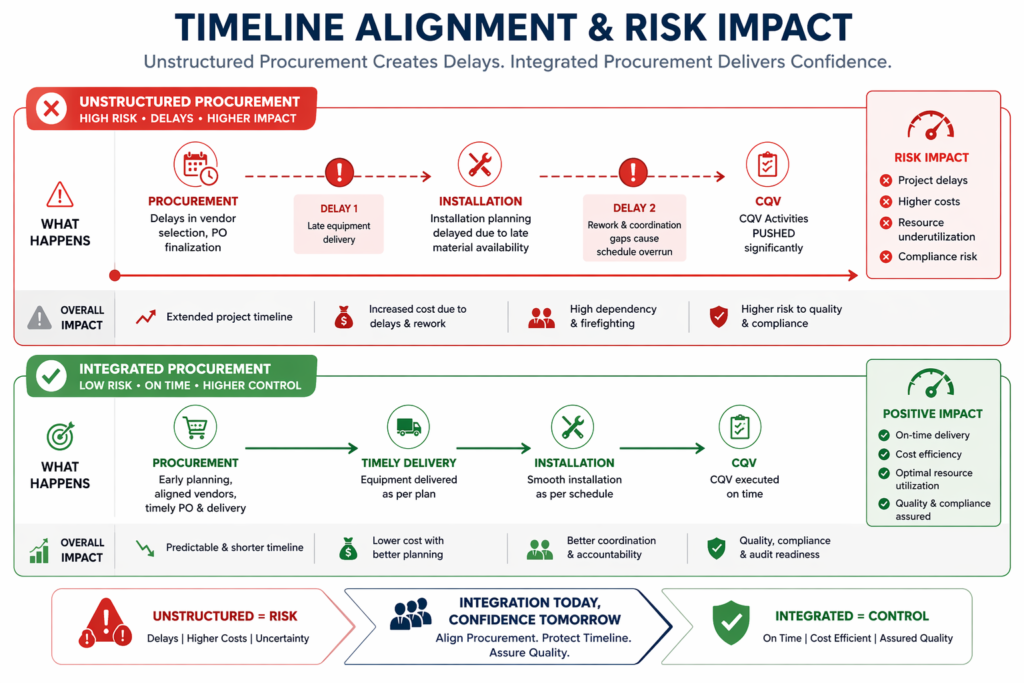
Timeline alignment

Timeline Alignment and Risk Reduction

Procurement plays a critical role in maintaining project timelines. Delays in equipment delivery or incomplete documentation can disrupt installation,commissioning and qualification schedules.

A structured procurement approach helps:

  • Align delivery timelines with construction and installation phases
  • Integrate FAT, SAT, and documentation review milestones into the project schedule
  • Identify potential risks early
  • Ensure readiness for commissioning and CQV activities

This alignment is essential for effective project management in pharmaceutical projects.

Compliance and Documentation Readiness

In pharmaceutical projects, procurement is closely linked to compliance.

Equipment and vendors must provide:

  • Complete and accurate GMP-compliant documentation
  • Support for validation activities including DQ, IQ, OQ, and PQ
  • Compliance with regulatory standards such as cGMP, FDA, and EU GMP

Procurement decisions that overlook these aspects often lead to delays during CQV.

Procurement as Part of Project Strategy

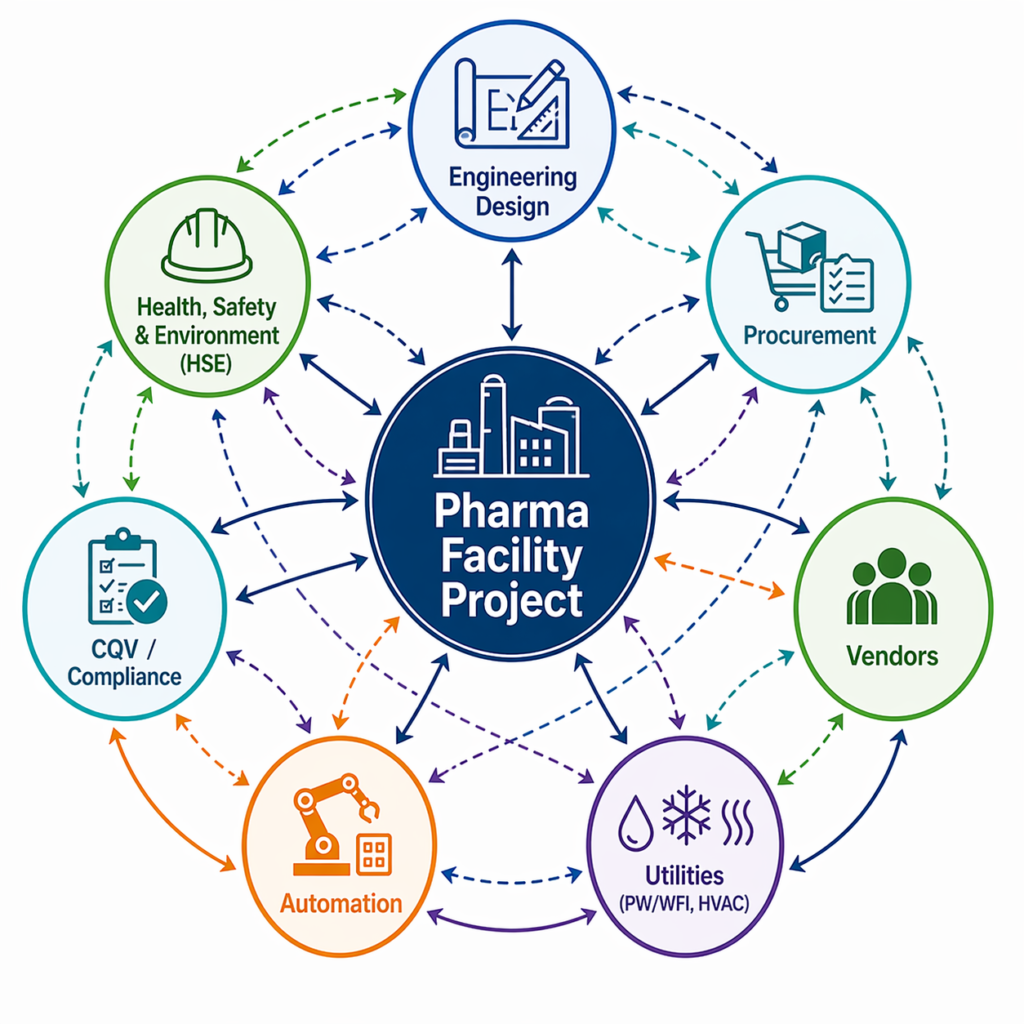
Procurement cannot operate in isolation. It must be integrated into the overall project strategy. This requires collaboration between:

  • Engineering teams defining technical requirements
  • Procurement teams managing vendor selection
  • Project management teams are overseeing timelines
  • Quality and CQV teams ensuring compliance and validation alignment

When these functions work together, procurement becomes a driver of efficiency rather than a source of risk.

integrated procurement

Why Fragmented Procurement Models Fall Short

Traditional procurement models often operate in silos, disconnected from engineering, CQV, and project execution. This leads to:

  • Misalignment between equipment and facility design
  • Reactive decision-making under timeline pressure
  • Increased coordination challenges during project installation, commissioning, and qualification

As pharmaceutical projects become more complex, these limitations become more pronounced. Integrated procurement approaches are now essential to ensure seamless project delivery.

Equipment Installed

Delivering Procurement Excellence from Day One

Optimizing procurement requires a structured and proactive approach. This includes:

  • Defining clear technical and compliance requirements early
  • Evaluating vendors based on capability, not just cost
  • Aligning procurement timelines with project schedules, FAT/SAT milestones, and CQV readiness
  • Ensuring documentation and validation readiness

When procurement is planned strategically, it reduces uncertainty and improves overall project performance.

How Pharma Access Approaches Procurement Consulting

Pharma Access views procurement as an extension of of engineering and project execution, not a standalone function.

With collaborative pharmaceutical procurement consulting and sourcing services, we work to ensure equipment specifications, vendor assessments, FAT/SAT planning, and project schedules are aligned with your engineering and regulatory needs.

Leveraging deep technical expertise and execution-focused thinking, we guide clients to mitigate risk, reduce cost inefficiencies, and deliver facilities that are ready for seamless commissioning and compliant operation.

Conclusion

Procurement is often an overlooked function within pharmaceutical projects. Yet its impact can be profound. 

It determines not only what gets purchased but also how quickly and successfully a facility is built, integrated, and commissioned.

Done right, procurement is a powerful enabler of efficiency, compliance, and on-time delivery.

In the new world of pharmaceutical project success, projects are not only engineered – they’re procured.

FAQs

1. What is pharmaceutical procurement consulting?

It involves optimizing equipment selection, vendor evaluation, and procurement strategies for pharmaceutical projects.

2. Why is procurement important in pharma projects?

It directly impacts cost, timelines, compliance, and project execution.

3. What factors should be considered in vendor selection?

Technical capability, experience, documentation quality, timeline reliability, and after-sales support.

4. How does procurement affect project timelines?

Delays in procurement can disrupt installation, commissioning, and qualification schedules.

5. What is the role of procurement in compliance?

Procurement ensures that equipment and vendors meet regulatory requirements and provide necessary documentation.


Designing Pharmaceutical Facilities for Regulatory Compliance and Operational Efficiency

Pharma facility design and compliance

Pharmaceutical manufacturing is entering an era defined by lean production, zero-defect expectations, and just-in-time delivery models. At the same time, regulatory scrutiny from agencies such as USFDA, EU GMP, and WHO continues to intensify.

Facility design is one method to help gain and maintain this delicate balance. The way a facility is laid out impacts how well the plant runs and how well it can perform to regulatory standards years down the road.

That’s where pharmaceutical facility engineering can make all the difference. The choices you make during design will impact everything else.

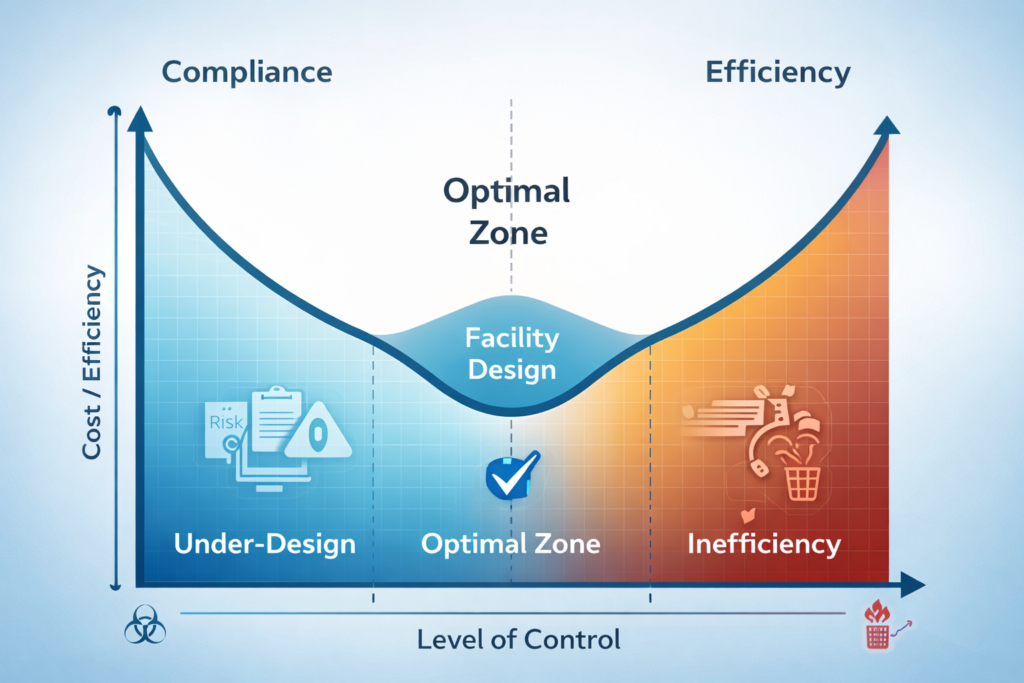
The Balancing Act: Compliance vs. Efficiency

There has long been a misconception that compliance and efficiency are at odds with one another. One requires checks, controls, and documentation aligned with cGMP guidelines. The other requires agility, throughput, and operational continuity.

But the best pharmaceutical facilities have both, built into their architecture from day one.

By designing compliance into the fabric of the facility, operational friction is minimized. By designing efficiency into the facility, the operational overhead of compliance is minimized.

The art is doing both right from the beginning.

Where Facilities Typically Fall Short

Many facilities are designed with a primary focus on meeting immediate regulatory requirements. While this ensures initial compliance, it often introduces inefficiencies that surface later during operations.

Common issues include:

  • Over-engineered cleanroom spaces exceeding required ISO/GMP classifications, increasing capital and operational costs
  • Complex workflows that slow down production
  • Systems that meet compliance but lack flexibility
  • Difficulty in scaling or adapting to new products

These are not failures of compliance. There are gaps in how design decisions are made.

Facility Design

Rethinking Facility Design as a System

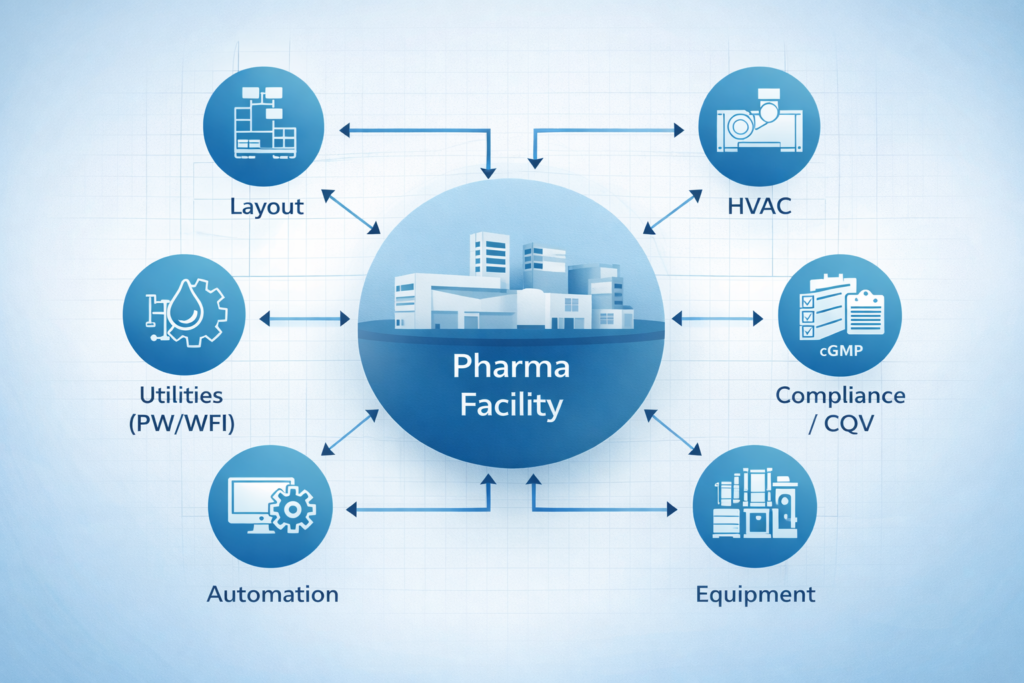
A pharmaceutical plant does not operate as a series of silos. It operates as a system. Layout, utilities, equipment, and processes all must work in unison.

Good pharmaceutical engineering services understand this. 

We don’t design and optimize each system independently. We optimize how systems work together. This includes considering: 

  • Facility layout with process flow
  • Utilities with equipment requirements
  • Automation with operational needs
  • Compliance strategy with execution

When these elements are aligned early, facilities perform more predictably and efficiently.

Design Decisions That Drive Long-Term Performance

Designing for both compliance and efficiency requires a shift in how key decisions are approached.

Layout as a Driver of Efficiency

The layout is more than a spatial arrangement. It defines how people and materials move, how processes are executed, and how contamination risks are controlled in line with GMP zoning principles.

A well-designed layout:

  • Minimizes unnecessary movement
  • Supports logical process sequencing
  • Reduces cross-contamination risks

Poor layout decisions, on the other hand, create inefficiencies that persist throughout the lifecycle of the facility.

compliance

Utilities and Infrastructure as Enablers

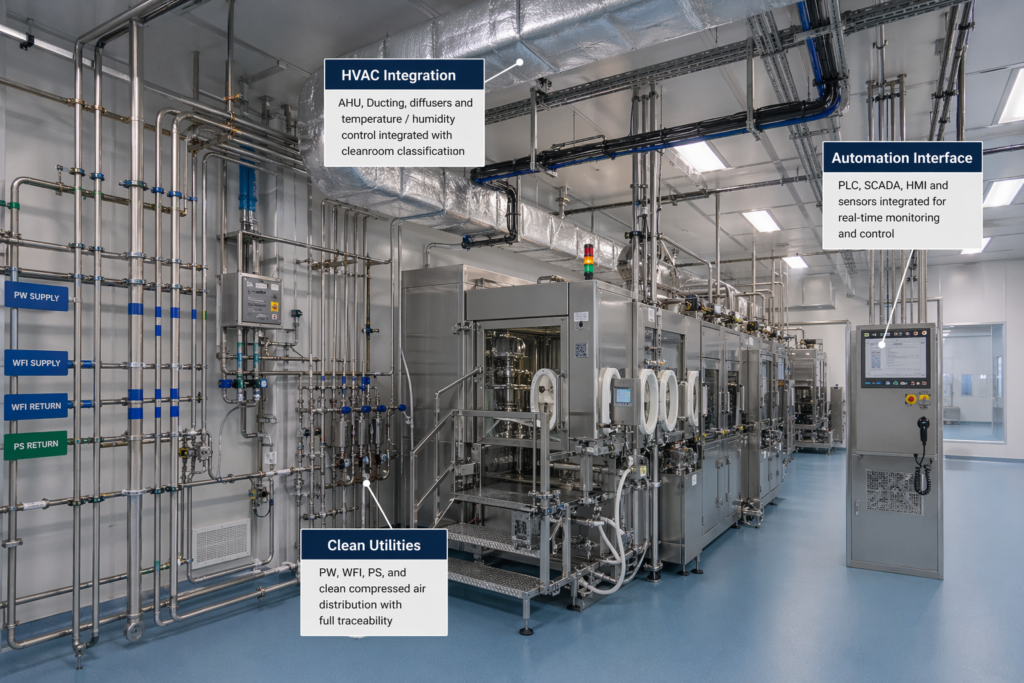
Utilities such as water systems, and clean utilities are often viewed as support systems. In reality, they are critical systems that directly impact product quality, compliance, and operational stability.

Designing these systems requires:

  • Alignment with process requirements
  • Scalability for future expansion
  • Energy-efficient configurations

When utilities are overdesigned, operating costs increase. When underdesigned, compliance risks emerge.

Equipment Integration and Flexibility

Equipment should not be selected in isolation. It must be integrated into the facility in a way that hat supports process efficiency, cleanability, and regulatory compliance.

This involves:

  • Aligning equipment with process flow
  • Ensuring accessibility for maintenance and cleaning
  • Supporting flexibility for different batch sizes

Leading pharmaceutical plant design consultants increasingly prioritize flexible and modular approaches to equipment integration.

Automation and Data-Driven Operations

Automation is no longer optional in modern pharmaceutical facilities. It plays a key role in maintaining consistency, ensuring data integrity, and improving efficiency.

A well-designed automation strategy:

  • Reduces manual intervention
  • Improves process visibility
  • Supports regulatory compliance

The focus is not just on implementing automation, but on integrating it effectively into the overall facility design.

Designing for Future Adaptability

One of the most important shifts in pharmaceutical facility design is the move toward adaptability.

Facilities are no longer built for a single product or process. They must support changing portfolios, new technologies, and evolving regulatory requirements.

This requires:

  • Scalable infrastructure and utilities
  • Flexible layouts and zoning strategies
  • Modular design approaches for faster modification

Future-ready facilities are not defined by their size, but by their ability to adapt without major disruption.

Integrated engineering

The Role of Integrated Engineering

Traditional project models often separate design, execution, and validation. This creates gaps that become visible during later stages of the project.

Integrated approaches, on the other hand, bring together engineering, quality, and execution teams from the beginning.

This alignment ensures that:

  • Compliance is built into design decisions
  • Systems are easier to qualify and validate
  • Projects move forward with fewer delays

This is where strong pharmaceutical facility engineering capabilities create a measurable impact.

How Pharma Access Approaches Facility Design

At Pharma Access, facility design is approached as a balance between compliance, efficiency, and long-term performance, aligned with global regulatory expectations and practical execution realities.

By combining advanced pharmaceutical engineering services with execution expertise, facilities are designed to:

  • Meet regulatory expectations from day one
  • Operate efficiently under real conditions
  • Adapt to future requirements without major redesign

This integrated approach ensures that projects are delivered with greater predictability and performance.

Conclusion

Pharma plant design isn’t just about designing to comply anymore. Today’s leaders are looking for facilities that will operate reliably, efficiently, and effectively year after year.

Exceptional facilities don’t just barely comply at the lowest cost. They build compliance into the design and efficiency into the execution.

Facility design has evolved from being a purely engineering endeavor to a business strategy that defines the pharmaceutical organization.

FAQs

1. What is pharmaceutical facility engineering?

It involves designing and developing pharmaceutical manufacturing facilities that meet regulatory (cGMP, USFDA, EU GMP) and operational requirements.

2. Why is facility design important in pharma manufacturing?

It directly impacts efficiency, compliance, scalability, and long-term performance.

3. What role do pharmaceutical plant design consultants play?

They help design facilities that balance regulatory requirements with operational efficiency and future adaptability while ensuring smooth execution and validation.

4. How can facilities achieve both compliance and efficiency?

By integrating compliance into design decisions and aligning all systems from the beginning.

5. What is the key to future-ready pharma facilities?

Flexibility, scalability, and integrated engineering ligned with evolving regulatory expectations.

CQV in Pharma Projects: Commissioning, Qualification and Validation Explained

CQV in Pharma Projects

Today’s pharmaceutical projects are delivered under ever-increasing pressure. Requirements are mandated in shorter and shorter timelines. Designs are becoming more complex. Expectations from global regulatory agencies such as the US FDA and EU GMP are continuously increasing. Building the facility is just the beginning. The true test comes when you have to demonstrate that the facility will consistently operate safely and within regulatory expectations.

That’s where CQV pharma practices play an important role.

Commissioning, Qualification, and Validation bridge the gap between construction and compliant operations. Simply building a facility without a defined, lifecycle-driven CQV strategy will leave you struggling to achieve audit-ready operations.

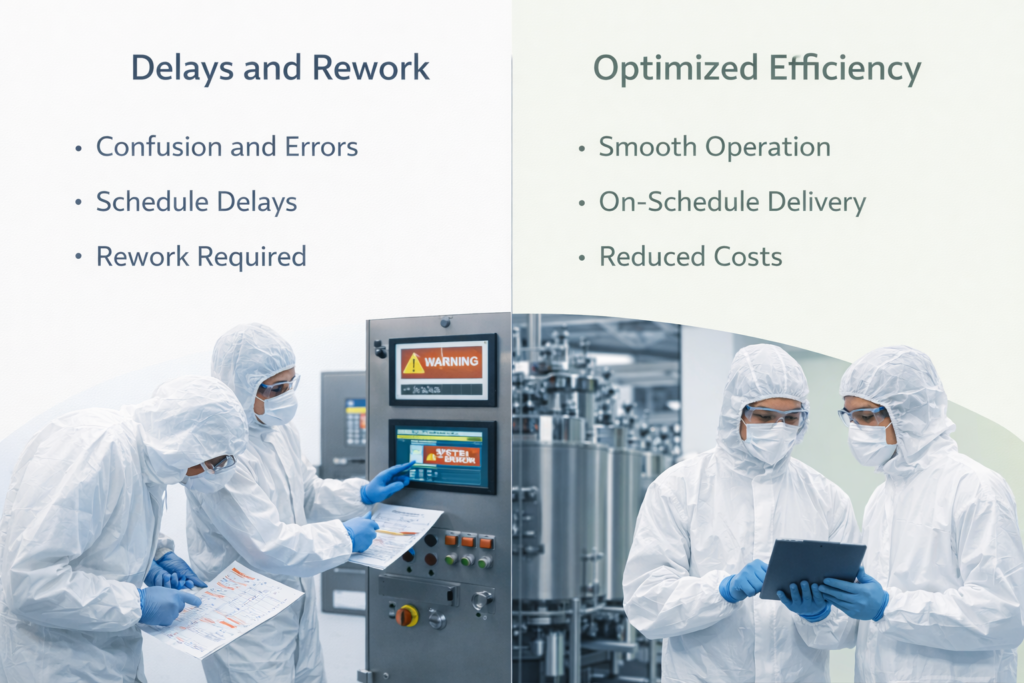
off track

Where Most Projects Go Off Track

Many projects still treat CQV as a phase that begins after construction is complete. At first glance, this seems logical. Build the facility, install the systems, and then validate them. But in practice, this approach often leads to delays and inefficiencies.

As systems begin testing, gaps start to appear:

  • The equipment does not perform as expected
  • Documentation is incomplete or inconsistent
  • Integration issues emerge between systems
  • Compliance requirements were not fully considered during design

At this stage, every correction becomes more expensive and time-consuming. The issue is not CQV itself. It is when and how it is introduced into the project lifecycle.

What CQV Really Means in Practice

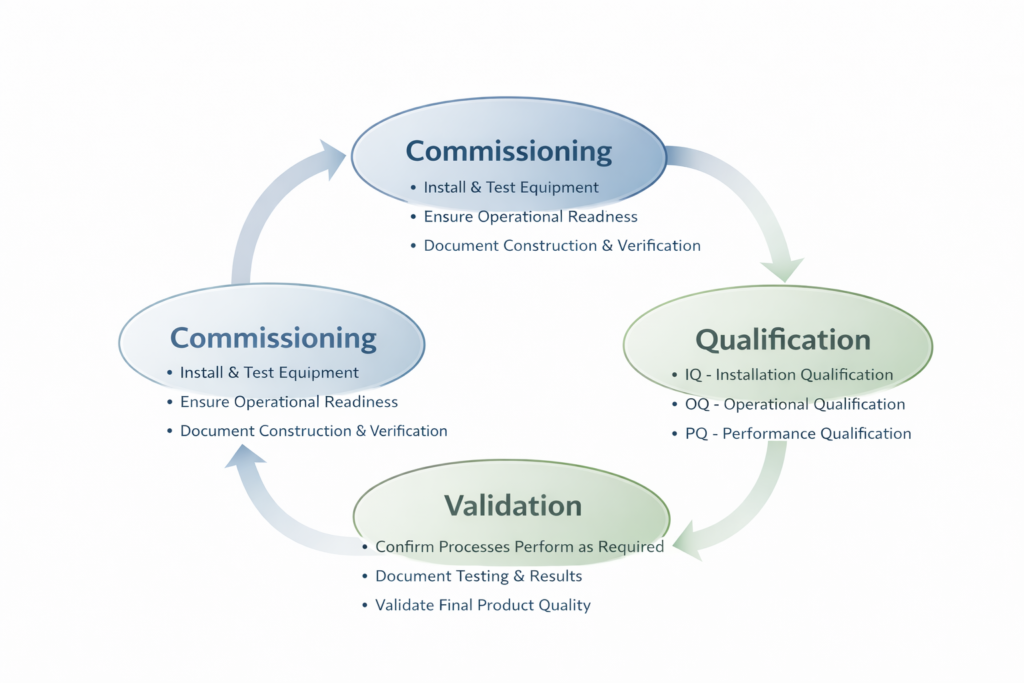
People tend to describe CQV as three distinct tasks. In reality, CQV is a lifecycle-driven, integrated process aligned with risk-based principles. Commissioning ensures that certain systems are installed properly and functioning correctly. Qualification confirms systems meet established requirements.  Validation ensures processes will reliably produce the expected result.

CQV activities work together to ensure that the facility is not just built, but is fully prepared for compliant and sustainable operations. These checkpoints have evolved with current CQV services. They are involved from the beginning of design and continue through project completion.

What is cqv

Breaking Down the CQV Lifecycle

Instead of viewing CQV as a single phase, it is more effective to understand how it evolves across the project lifecycle.

Commissioning: Proving Systems Work

Commissioning focuses on verifying that systems and equipment are installed and operating correctly.

This includes:

  • Verifying installation against design specifications
  • Testing system functionality
  • Ensuring utilities and equipment operate as expected

At this stage, the goal is to identify and resolve issues before formal qualification begins.

Qualification: Verifying Compliance

Qualification builds on commissioning by ensuring that systems meet regulatory, user, and operational requirements under GMP conditions.

This is typically divided into stages such as:

  • Installation Qualification (IQ), confirming systems are installed correctly
  • Operational Qualification (OQ), verifying that systems operate within defined limits and ranges
  • Performance Qualification (PQ), confirming consistent performance under actual operating conditions

Installation qualification is particularly critical, as it establishes the baseline for all subsequent validation activities.

Validation: Proving Consistent Performance

Validation focuses on process performance. It ensures that processes, utilities, and supporting systems can consistently produce results that meet predefined quality standards.

This includes:

  • Process validation
  • Cleaning validation
  • Ongoing process verification and monitoring

Validation is what ultimately demonstrates that the facility is ready for commercial production.

project validation

Why CQV Is More Than a Compliance Requirement

There is a common perception that CQV is only about meeting regulatory expectations. In reality, it plays a much broader role in project success.

When implemented effectively, CQV:

  • Reduces rework and late-stage corrections
  • Improves alignment between design, construction, and operations
  • Accelerates time to market
  • Enhances overall project predictability and audit readiness

Well-executed qualifications and validation processes are not just about compliance. They are about ensuring operational readiness.

The Shift Toward Integrated CQV Approaches

Traditional project models treat engineering, construction, and CQV as separate activities.

This separation often leads to:

  • Late identification of issues
  • Misalignment between design intent and operational requirements
  • Increased pressure during final project stages

Modern pharmaceutical projects are moving toward integrated CQV approaches.

In this model:

  • CQV teams are involved early during design and engineering phases
  • Documentation is developed in parallel with system design
  • Systems are evaluated continuously, not only at the end

This reduces risk and improves overall project outcomes.

Designing process

Designing with CQV in Mind

The most successful projects do not wait for CQV to begin. They design it.

This means:

  • Aligning system design with qualification validation requirements from the outset
  • Ensuring documentation is developed from the start
  • Considering validation needs during equipment selection and layout planning

When CQV is built into the design process, the transition from construction to operation becomes significantly smoother.

How Pharma Access Approaches CQV

Here at Pharma Access, we don’t view CQV as a separate phase of a project. We incorporate it throughout the project lifecycle.  By aligning engineering, execution, and CQV practices from day one, facilities are designed with qualification, validation, and compliance built in. This approach ensures stronger traceability, reduced compliance risk, minimized rework, and faster transition to validated operations.

conclusion

Conclusion

CQV is often treated as the last phase of your pharma project. But it’s actually the phase that validates if your facility is ready for business.

When treated as an afterthought, it leads to delays, inefficiencies, and compliance challenges. When implemented from the beginning, it ensures speed, regulatory alignment, and operational reliability. Done as an afterthought, it creates delays & frustrations. Done right from day one, it ensures speed, compliance, and reliability.

In today’s competitive pharma market, it’s not enough to just build factories. You have to demonstrate they run compliantly, day in and day out.

That’s where CQV comes in. 

FAQs

1. What is CQV in pharma?

CQV stands for Commissioning, Qualification, and Validation. It ensures that pharmaceutical facilities and systems are ready for compliant operations.

2. What is installation qualification (IQ)?

It verifies that equipment and systems are installed according to design specifications and requirements.

3. Why is CQV important in pharma projects?

It ensures compliance, reduces risks, and confirms that systems perform reliably before production begins.

4. What is the difference between qualification and validation?

Qualification verifies systems meet requirements, while validation ensures processes consistently deliver expected results.

5. When should CQV start in a project?

CQV should begin during the design phase to ensure alignment with regulatory expectations and to minimize downstream risks.

Pharmaceutical Process Equipment Selection: Key Factors for Efficient Manufacturing

Pharmaceutical Process Equipment Selection

Making medicine is no longer just about scale. It’s about delivering flexibility, precision, and consistency while adhering to increasingly stringent cGMP and global regulatory requirements. A lot rides on one decision: pharmaceutical process equipment selection. Equipment isn’t just there to perform a process. It impacts product quality, operating efficiencies, readiness to comply, and future scalability. The wrong equipment can bake inefficiencies into your facility for years to come. Equipment selection should be treated as a core engineering and design decision, not a downstream procurement activity.

When Equipment Selection Goes Wrong

In many projects, equipment is selected based on initial cost, vendor familiarity, or isolated process requirements. While this may seem efficient in the short term, it often creates long-term challenges across operations, validation, and compliance.

Facilities may experience:

  • Frequent process interruptions due to mismatched equipment capacity
  • Difficulties in cleaning, validation, and maintenance
  • Integration challenges with utilities and automation systems
  • Reduced operational flexibility when product requirements change

These issues are not always visible during installation. They emerge during operations, when the cost of correction is significantly higher.


Rethinking Equipment Selection in Modern Pharma Facilities

Effective design of modern facilities requires engineered equipment selection aligned with process and regulatory intent, not just adding more assets. Equipment selection needs to consider project goals around efficiency, compliance and flexibility.

That includes how the equipment works within the context of:

  • Process flow 
  • Plant layout 
  • Utilities 
  • Automation/data integrity 
  • Future manufacturing capacity 

Equipment selection should be part of your overall pharma engineering strategy, not a separate task.

equipment

Key Factors That Define the Right Equipment Choice

Selecting the right pharma manufacturing equipment requires balancing multiple considerations. These factors must work together to support both immediate production needs and long-term operational goals.

  • Process Compatibility and Performance

The first and most fundamental question is whether the equipment aligns with the intended process.

Equipment should:

  • Support required batch sizes and process conditions
  • Maintain consistency and repeatability
  • Deliver reliable performance under varying production demands

Mismatch at this level often leads to inefficiencies that cannot be corrected through adjustments later.

flexibility ability
  • Flexibility for Changing Production Needs

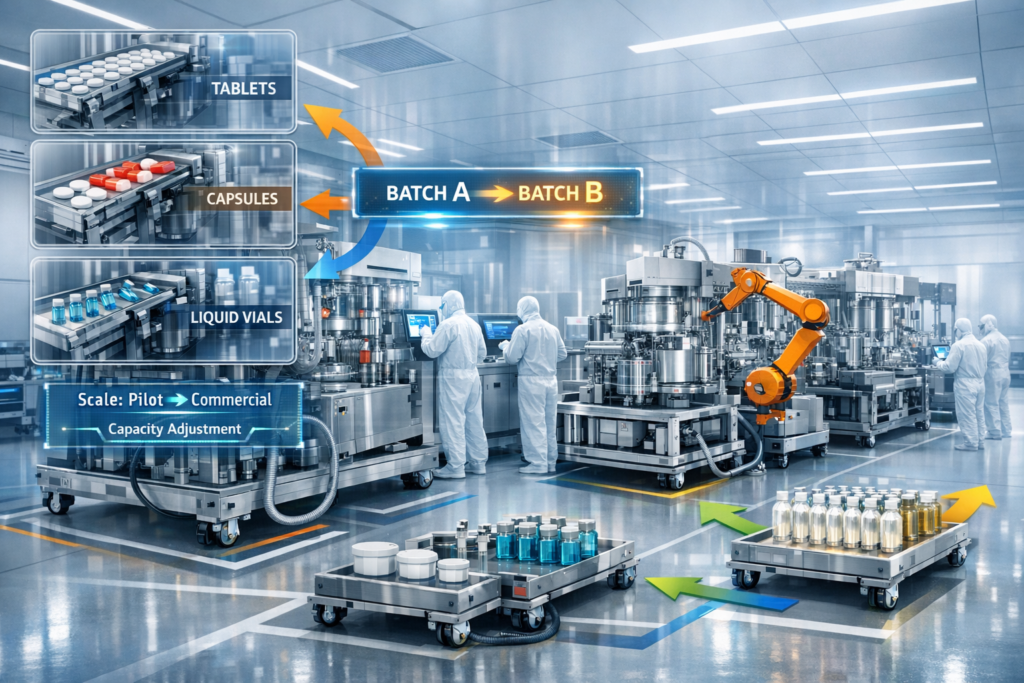
Pharmaceutical manufacturing is becoming increasingly dynamic especially with the rise of multi-product facilities and biologics.. Facilities must be able to adapt to new products, varying batch sizes, and evolving market demand.

Flexible equipment allows:

  • Faster changeovers between products
  • Scalability without major capital investment
  • Reduced downtime during transitions

Rigid systems may meet current requirements but limit future growth.

  • Ease of Cleaning and Validation

In regulated environments, equipment must be designed for compliance as much as performance.

Key considerations include:

  • Cleanability and hygienic design
  • Compatibility with cleaning and sterilization processes
  • Ease of validation and documentation

Equipment that is difficult to clean or validate can slow down operations and increase compliance risk and increase compliance risk under GMP guidelines.

system Integration
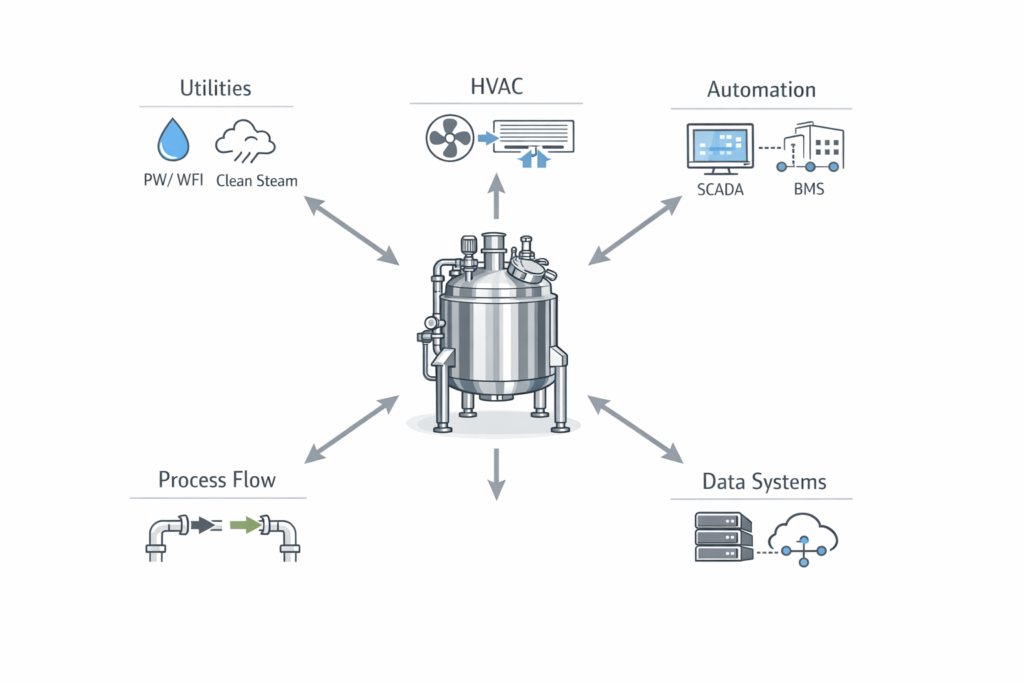
  • Integration with Facility and Utilities

Equipment does not operate independently. It must integrate seamlessly with the overall facility.

This includes:

  • Alignment with process flow and layout
  • Compatibility with utilities such as water, steam, and compressed air
  • Integration with automation and control systems

Poor integration often leads to operational inefficiencies and increased project complexity.

  • Automation and Data Integrity

Modern pharmaceutical facilities rely heavily on automation for both efficiency and compliance.

Equipment should support:

  • Data capture and monitoring
  • Integration with SCADA, BMS, and other systems
  • Audit trails and traceability

This ensures alignment with regulatory expectations and supports consistent operations.

  • Lifecycle Cost, Not Just Capital Cost

Focusing only on upfront cost often leads to higher expenses over the lifecycle of the facility.

A better approach considers:

  • Maintenance requirements
  • Energy consumption
  • Downtime and reliability
  • Spare parts availability

The goal is to select equipment that delivers value across its entire lifecycle.

  • Vendor Capability and Support

Equipment performance is also influenced by the capability of the vendor.

Important factors include:

  • Technical expertise and industry experience
  • After-sales support and service
  • Availability of documentation and compliance support

Strong vendor partnerships reduce risk and improve long-term reliability.

equipment selection

Equipment Selection and Manufacturing Efficiency

The right equipment selection has a direct impact on manufacturing efficiency.

When aligned correctly:

  • Processes run more consistently
  • Downtime is minimized
  • Changeovers are faster
  • Compliance requirements are easier to maintain

Efficiency is not achieved by adding more equipment. It is achieved by selecting the right equipment and integrating it effectively.

Why Traditional Selection Approaches Fall Short

Traditional approaches often treat equipment selection as a procurement-driven activity.

This leads to:

  • Decisions made without full visibility of the process and facility requirements
  • Limited coordination between engineering and operations teams
  • Challenges during installation, integration, and validation

As pharmaceutical projects become more complex, this approach is no longer sufficient. Integrated, engineering-led selection processes are essential for ensuring that equipment supports both compliance and efficiency.

Delivering the Right Equipment Strategy from Day One

To ensure optimal outcomes, equipment selection must be approached strategically.

Engineering teams should:

  • Evaluate equipment within the context of the full facility design
  • Align selection with process, utilities, and automation systems
  • Consider long-term operational and compliance requirements
  • Involve stakeholders across engineering, quality, and operations early

This approach reduces risk and ensures smoother project execution.

How Pharma Access Supports Equipment Selection

Equipment selection at Pharma Access is never made in isolation. It is part of the overall project plan. By combining pharma engineering expertise with execution experience, we ensure that process equipment aligns with process requirements, facility design, and global regulatory expectations. Helping clients realize efficient, scalable, and future-proof manufacturing.

conclusion

Conclusion

Choosing appropriate equipment is one of the most critical decisions during facility design. The impact reaches far beyond day-to-day operations and into overall facility performance. Strategic equipment selection and integration enable efficiency, compliance, and scalability. Success in today’s pharmaceutical manufacturing is measured by quality, not by how much equipment you have.

FAQs

1. What is pharmaceutical process equipment?

It refers to equipment used in manufacturing processes such as mixing, granulation, filtration, and packaging.

2. Why is equipment selection important in pharma manufacturing?

It directly impacts efficiency, product quality, compliance, and operational flexibility.

3. What factors should be considered when selecting equipment?

Process compatibility, flexibility, cleanability, integration, automation, lifecycle cost, and vendor support.

4. How does equipment impact manufacturing efficiency?

The right equipment reduces downtime, improves consistency, and enables faster changeovers.

5. What is the biggest mistake in equipment selection?

Focusing only on initial cost instead of long-term performance and integration.

The Importance of HVAC Validation in Pharmaceutical Manufacturing Facilities

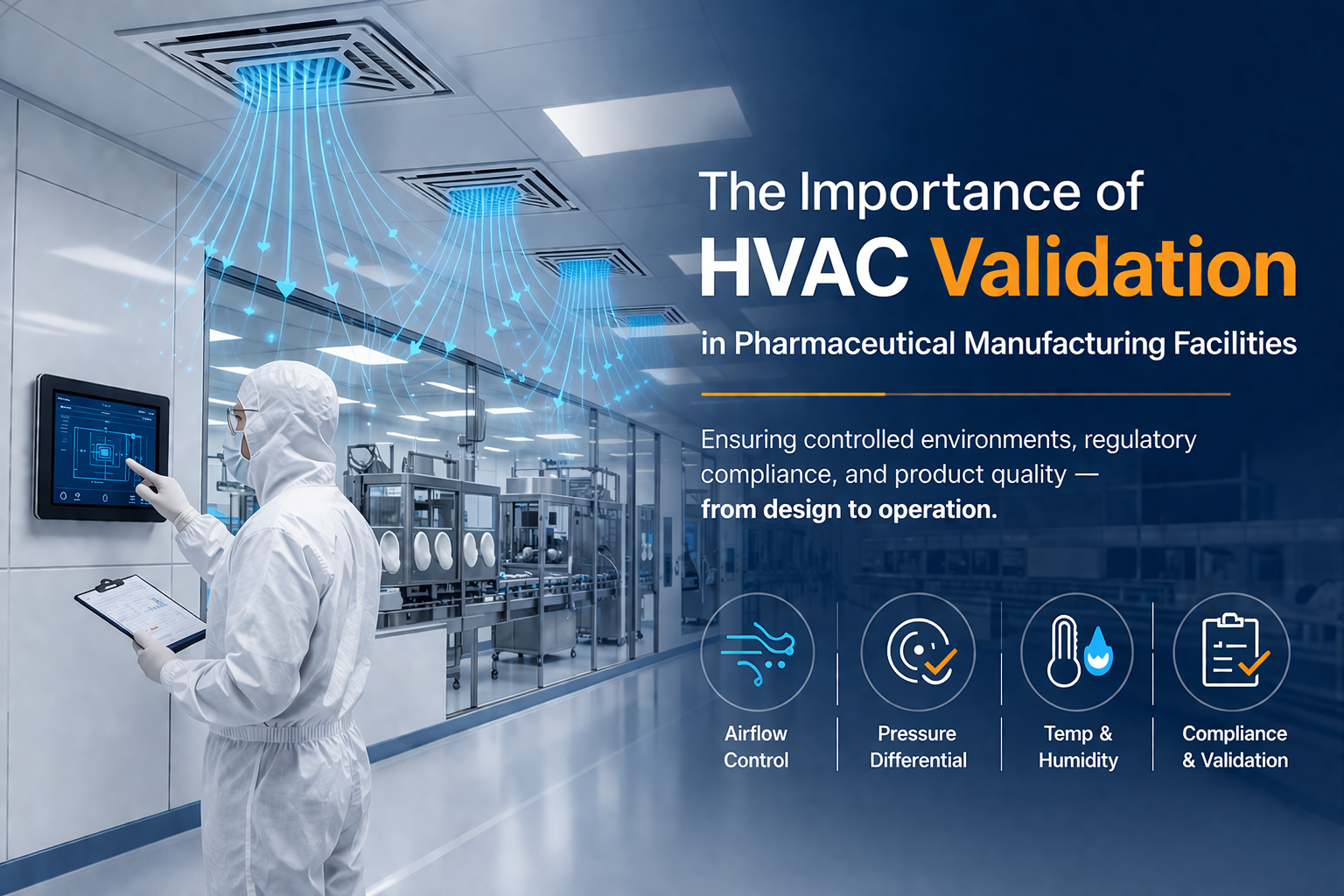
Hvac validation

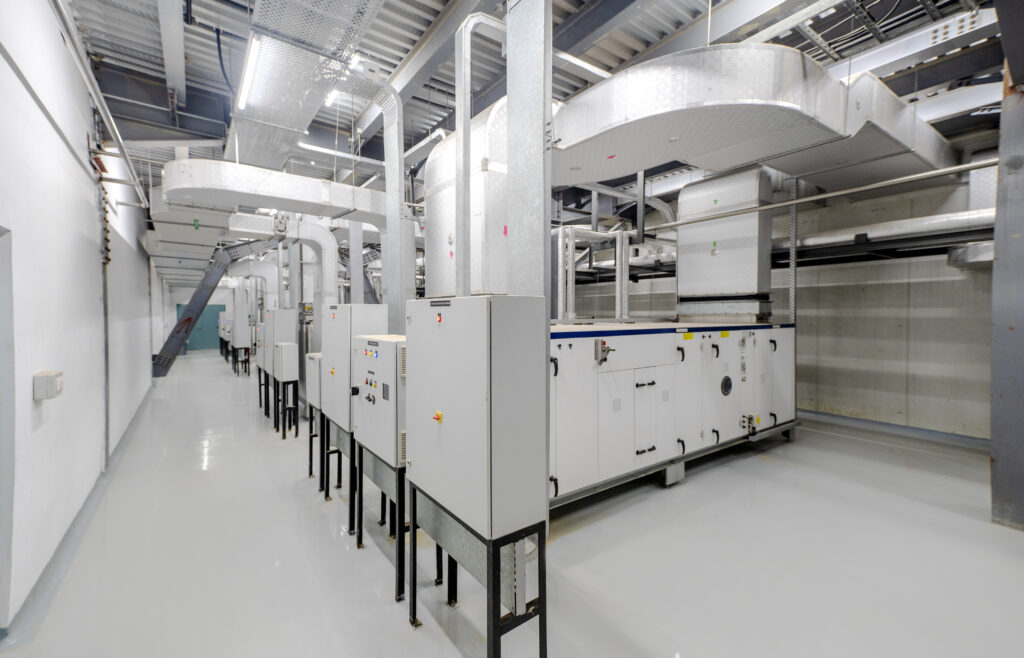
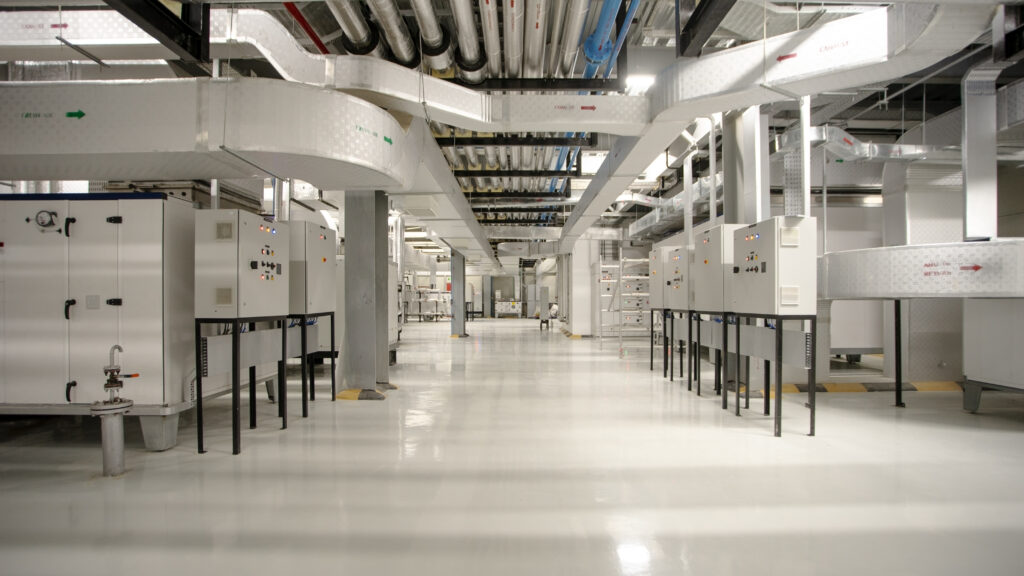
Cleanrooms for pharmaceutical production are more complex, highly regulated, and performance-focused than ever before. Not only do facilities need to maintain product quality standards, but they also need to ensure compliance under rigid timelines.

HVAC systems are no longer just operational components of your facility: They’re critical to your products’ quality, contamination issues and overall compliance.

HVAC validation is the process that guarantees your pharmaceutical HVAC systems will perform when it matters most. Without validation, even the most well-engineered systems can fall out of compliance.

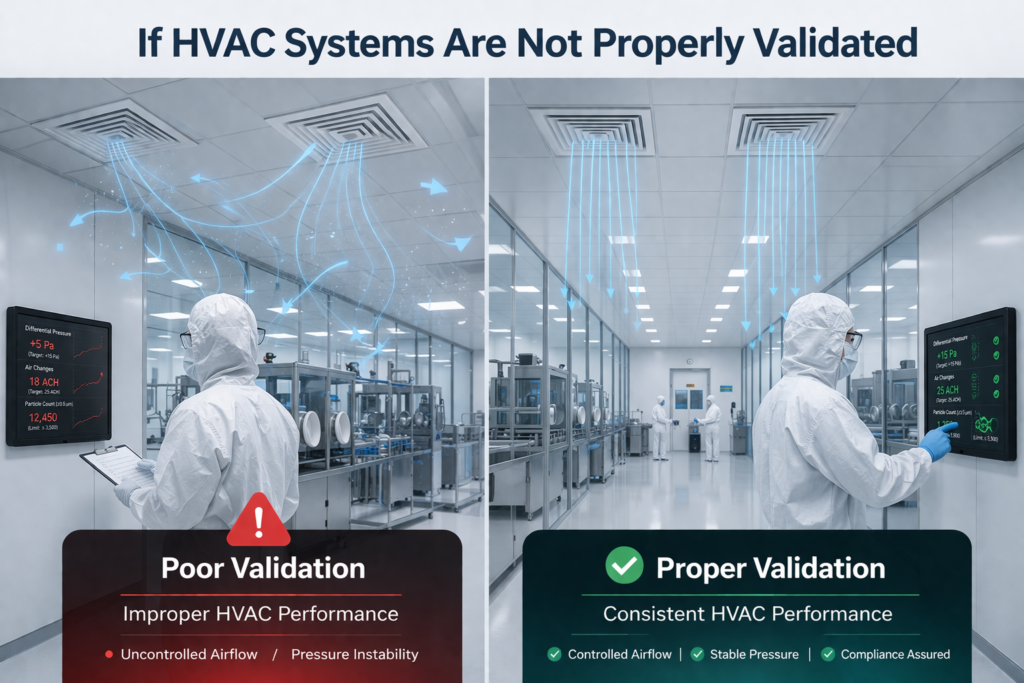
If HVAC Systems Are Not Properly Validated…

Many projects focus heavily on HVAC design and installation, but underestimate the importance of validation.

As a result, systems that appear compliant during design may not perform as expected during actual operations.

This can lead to:

  • Inconsistent cleanroom conditions
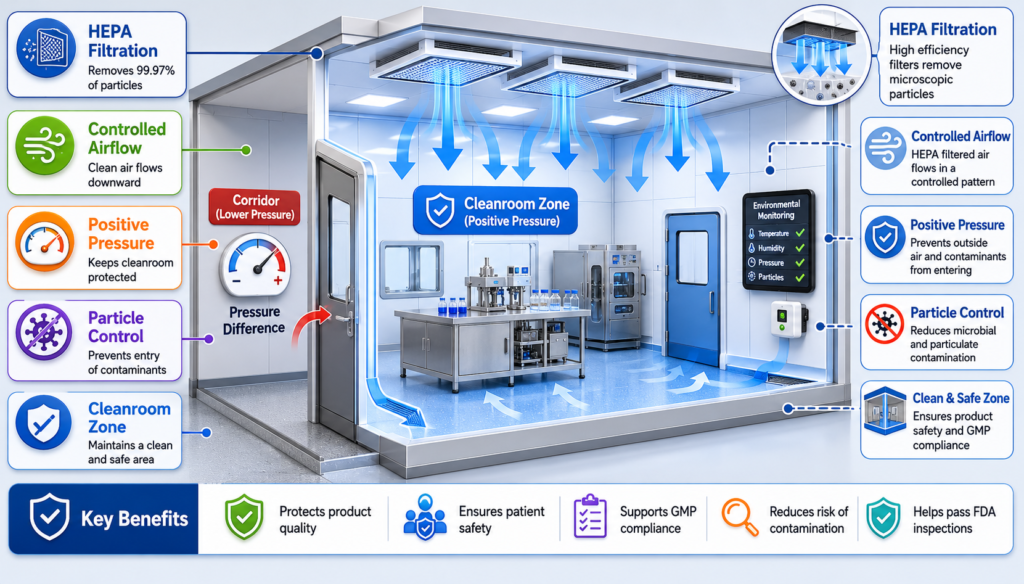
  • Failure to maintain pressure differentials
  • Airflow imbalances affecting contamination control
  • Delays in commissioning and qualification

HVAC systems are not proven to be compliant by design alone. They are proven through validation.

if hvac not properly validated

Why HVAC Validation Matters More Than You Think

HVAC systems in pharmaceutical facilities are responsible for maintaining controlled environments across cleanrooms, production areas, and support spaces.

These systems directly influence:

  • Particulate and microbial control
  • Temperature and humidity conditions
  • Pressure cascades between rooms

In pharmaceutical HVAC systems, even small deviations can impact product quality and regulatory compliance.

For example:

  • Incorrect airflow can lead to contamination risks
  • Poor pressure control can disrupt cleanroom integrity
  • Temperature fluctuations can affect sensitive processes

Validation ensures that HVAC systems perform as intended, consistently and reliably in line with cGMP expectations.

Critical Aspects of HVAC Validation

HVAC validation is not a single activity; it is a structured process that verifies system performance across multiple parameters and typically includes Design Qualification (DQ), Installation Qualification (IQ), Operational Qualification (OQ), and Performance Qualification (PQ).

  • Airflow and Air Change Rates

Airflow is one of the most critical parameters in cleanroom environments.

Validation ensures that:

  • Air change rates are sufficient to support required cleanroom classifications as per ISO 14644 and GMP guidelines.
  • Airflow patterns support contamination control
  • Air distribution is uniform across the space

Improper airflow can compromise the entire controlled environment.

  • Pressure Differential Verification

Maintaining correct pressure differentials between rooms is essential to prevent cross-contamination.

During validation, teams must confirm:

  • Pressure cascades are maintained consistently from higher-grade (cleaner) areas to lower-grade areas
  • Transitions between rooms function as designed  
  • Any pressure loss is quickly detected and controlled

This is a key requirement in maintaining GMP compliance.

  • Temperature and Humidity Control

Temperature and humidity are critical for both product stability and process consistency.

Validation ensures that:

  • Environmental conditions remain within specified limits
  • Systems respond effectively to load variations
  • Seasonal changes do not impact performance

Uncontrolled environmental conditions can directly affect product quality.

  • HEPA Filter Integrity Testing

HEPA filters play a vital role in removing particulate contamination.

Validation includes:

  • Leak testing of filters using PAO (or DOP) methods
  • Verification of filtration efficiency
  • Ensuring proper installation and sealing

Any failure in filtration can compromise the entire cleanroom environment.

  • System Integration and Controls

Modern HVAC systems are integrated with automation and monitoring platforms, such as Building Management Systems (BMS) or Environmental Monitoring Systems (EMS).

Validation ensures:

  • Systems are properly integrated and responsive
  • Data is accurately captured and recorded
  • Alarms and controls function correctly

This integration is essential for maintaining compliance and operational visibility.

  • Equipment Qualification

HVAC consists of multiple subsystems, such as air handling units, ductwork, filters, and sensors.

Validation that all HVAC equipment and subsystems operate correctly under actual operating conditions and function as an integrated system.

Each subsystem should work properly within the system.

  • Documentation and Compliance

Validation is only complete when it is properly documented.

This includes:

  • Test results and performance data
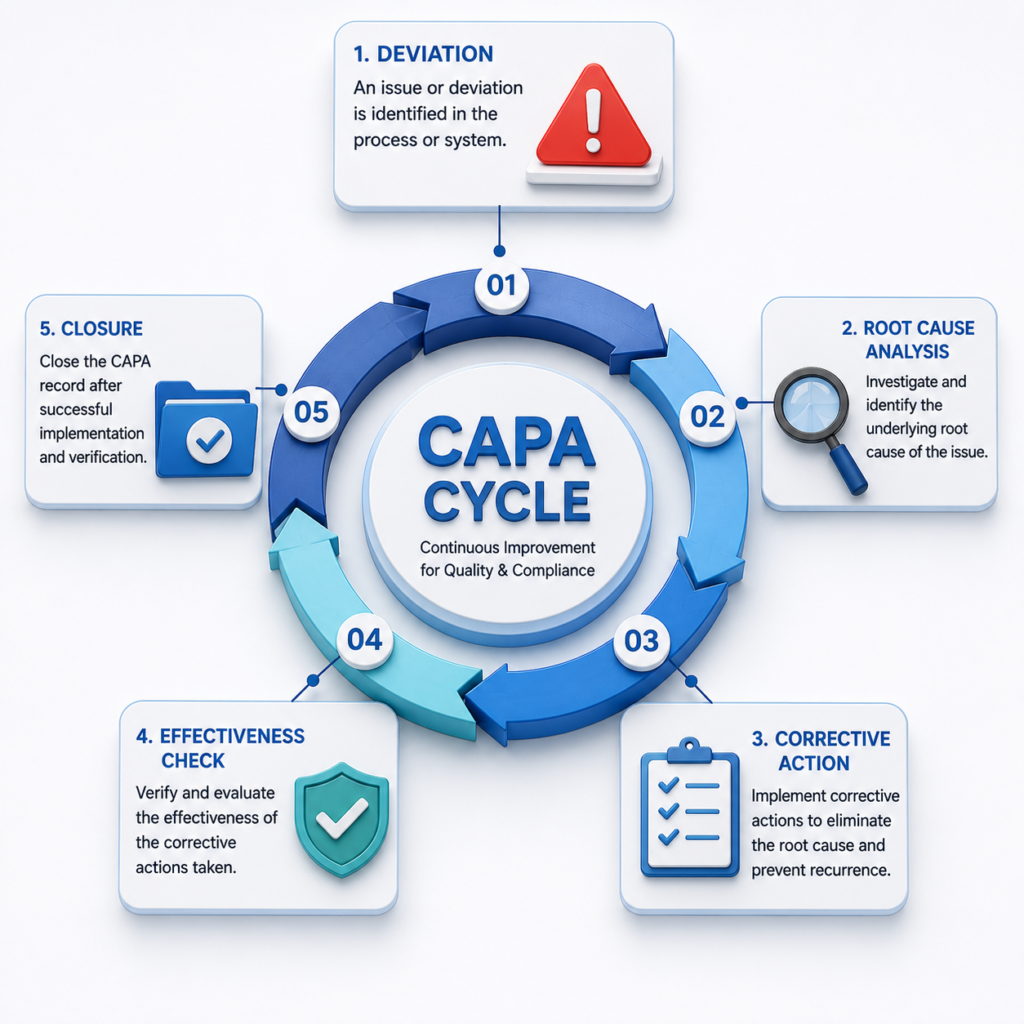
  • Deviations and corrective actions
  • Alignment with regulatory requirements such as US FDA, EU GMP, and WHO guidelines

Robust documentation supports audits, inspections, and long-term compliance.

HVAC Validation and Manufacturing Efficiency

There is a common assumption that validation is only about compliance. In reality, it plays a significant role in operational efficiency.

When HVAC systems are properly validated:

  • Cleanroom conditions remain stable
  • Production interruptions are minimized
  • Maintenance issues are reduced
  • Energy usage is optimized

Efficient HVAC performance directly contributes to consistent manufacturing output.

Why Traditional Approaches Fall Short

In many projects, HVAC validation is treated as a final step after installation.

This creates challenges such as:

  • Late discovery of system performance issues
  • Delays in commissioning and qualification
  • Increased rework and cost

Without early alignment between design, installation, and validation teams, HVAC systems may not perform as intended.

Modern pharmaceutical projects require validation to be considered throughout the design and execution phases.

Delivering Validated HVAC Systems from Day One

To ensure reliable performance, HVAC validation must be integrated into the project lifecycle.

Engineering teams should:

  • Align design with validation requirements from the beginning
  • Involve CQV teams early in the project
  • Ensure integration with automation and monitoring systems
  • Validate systems under real operating conditions

This approach reduces risk and improves both compliance and efficiency.

How Pharma Access Approaches HVAC Validation


HVAC validation at Pharma Access is approached as part of the overall project execution plan.

Engineering HVAC pharmaceutical systems with CQV considerations from the design stage enables systems to be qualified and validated for performance, operability, and regulatory compliance.

This approach minimizes rework, reduces commissioning delays, and supports stable operations from the start.

Conclusion

HVAC systems are central to pharmaceutical manufacturing facilities. Product quality, compliance, and operational efficiencies depend on HVAC performance.

Validating your HVAC ensures they perform as required under real operating conditions.

You can have the best-designed system in the world, and without validation, it will fall short. With validation, facilities can run steadily, compliantly, and efficiently.

HVAC validation in pharmaceutical manufacturing is no longer optional. It is a fundamental requirement.

FAQ

  • What is HVAC validation in pharmaceutical facilities?

It is the process of verifying that HVAC systems perform as intended under actual operating conditions.

  • Why is HVAC validation important?

It ensures controlled environments, supports compliance, and maintains product quality.

  • What parameters are checked during HVAC validation?

Airflow, pressure differentials, temperature, humidity, and filtration efficiency.

  • What role does HVAC play in pharma manufacturing?

It maintains cleanroom conditions and prevents contamination.

  • How does HVAC validation impact efficiency?

It reduces downtime, improves stability, and ensures consistent production conditions.


How Cleanroom Classification Impacts Pharmaceutical Manufacturing Efficiency

cleanroom standards in Pharma manufacturing

Pharma manufacturing is scaling faster than ever—but many facilities are still designed with outdated cleanroom assumptions.
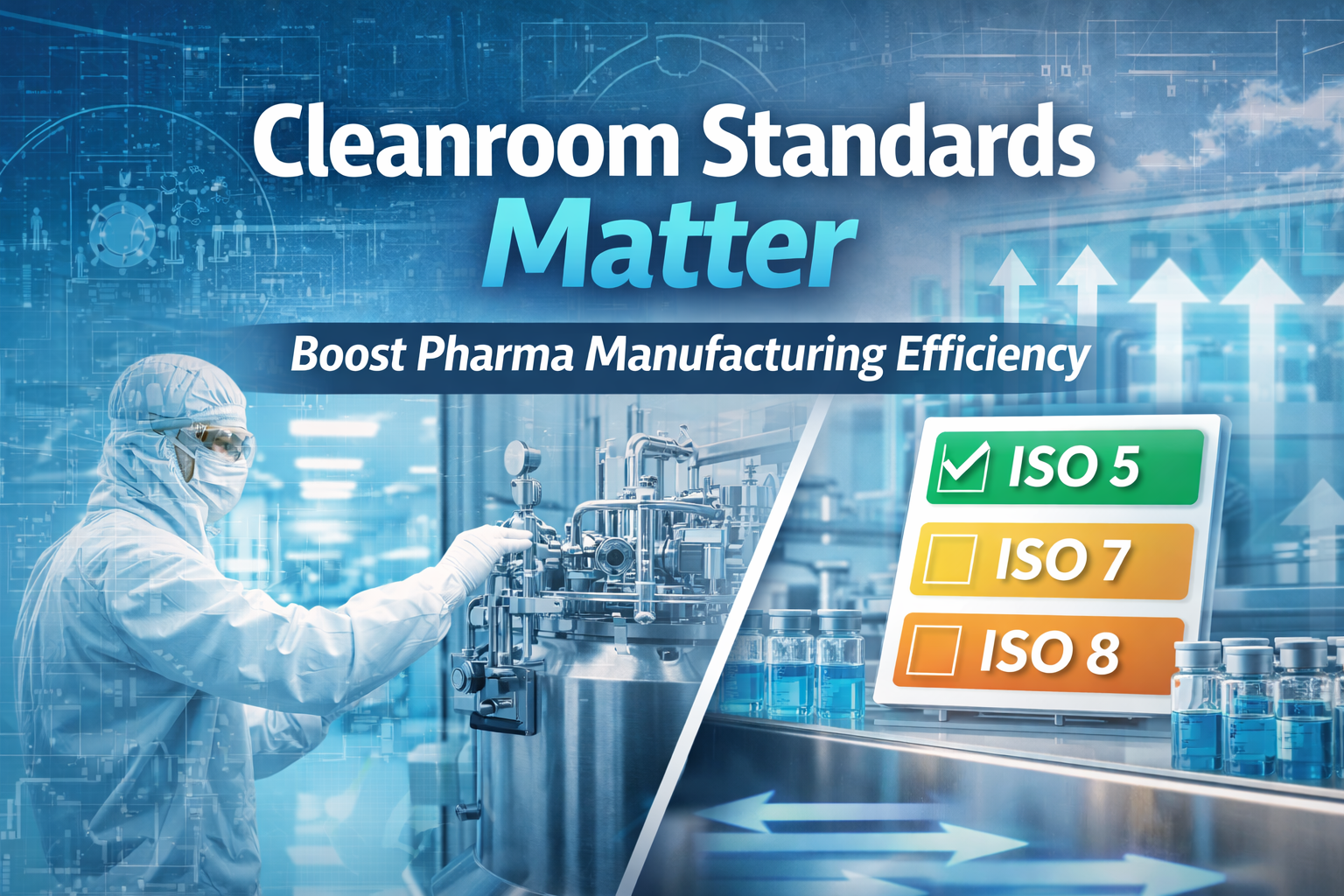
As products become more complex and compliance expectations tighten, cleanroom classification is no longer just a regulatory requirement—it is a defining factor in how efficiently your facility operates.

Your cleanrooms have never just been controlled environments. They are where product quality, compliance, and operations converge.

If you want to design pharmaceutical facilities that produce consistent results without compromising compliance standards, collaborating with experienced cleanroom manufacturers and prioritizing cleanroom classification should be among the first considerations. It will affect how efficiently your facility runs, how easily it stays compliant, and how fast it can scale.

cleanroom

If Cleanroom Classification Is Not Considered Properly…

Projects often focus heavily on equipment and process design while underestimating the impact of cleanroom classification. However, incorrect classification decisions can create long-term operational inefficiencies. Facilities may appear compliant on paper, but struggle in real operations.

This typically results in:

  • Higher operating costs due to over-designed environments
  • Inefficient workflows and unnecessary restrictions
  • Increased energy consumption and maintenance effort
  • Delays during validation and regulatory approvals

Cleanroom classification is often treated as a compliance requirement. In reality, it is a core engineering decision that defines how efficiently a facility will operate.

Why Cleanroom Classification Matters More Than You Think

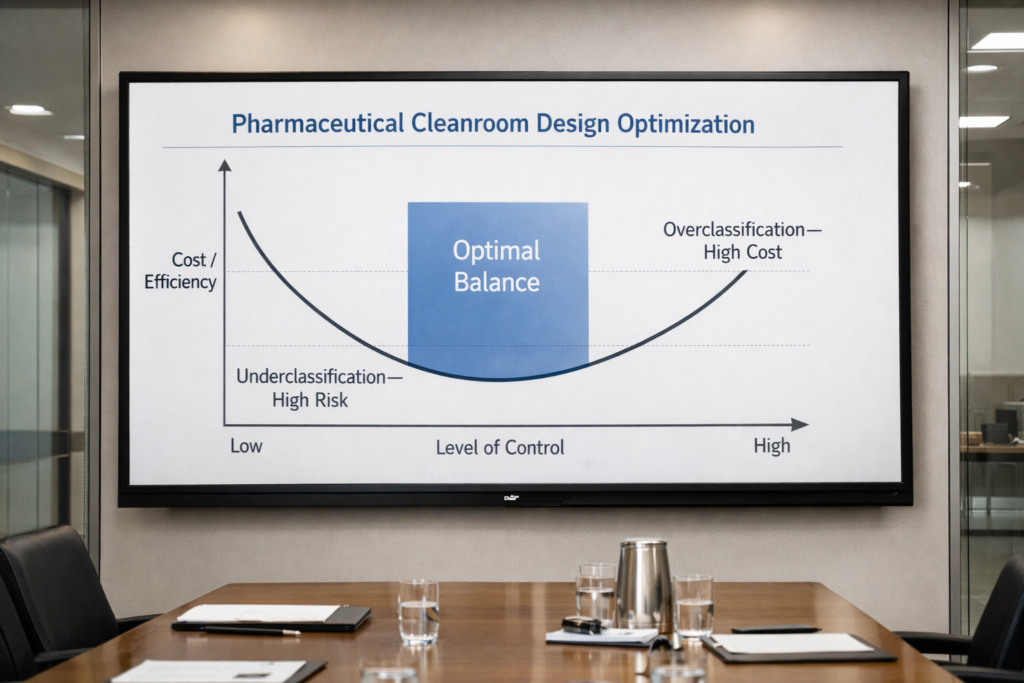
Cleanroom classifications determine the amount of particulate/microbial control necessary in different areas of the facility. Classification drives many facets of pharma engineering, such as HVAC design, material flow, personnel flow, operating procedures, etc. Classification levels that are too high result in costly facilities to operate. Too low and you risk non-compliance. 

cleanroom classification

For example:

  • Overclassification leads to higher HVAC loads and increased energy consumption
  • Underclassification increases contamination risks and impacts quality control in the pharmaceutical industry
  • Poor zoning disrupts workflow and reduces productivity

Finding the right balance is critical. Cleanroom classification should align with process needs, not assumptions.

Critical Considerations for Cleanroom Classification

While cleanroom classification is driven by regulatory requirements, its real impact is seen when translated into engineering and operational decisions.

  • Aligning Classification with Process Requirements

Applying the same level of environmental control across all process steps leads to overdesign, increasing both capital investment and operational costs.

To ensure efficiency:

  • Classify spaces based on actual process risk
  • Avoid applying higher classifications where not required
  • Align cleanroom zones with process criticality

A well-balanced classification strategy improves both compliance and efficiency.

  • HVAC Design and Energy Impact

Cleanroom classification directly impacts HVAC system design.

Higher classifications require:

  • Increased air changes per hour
  • Advanced filtration systems
  • Strict pressure control

Optimized classification reduces HVAC load while maintaining GMP compliance—making it a critical lever in pharmaceutical facility design decisions.

  • Workflow and Operational Efficiency

Cleanroom classification affects how people and materials move through the facility.

Improper classification can create:

  • Unnecessary movement restrictions
  • Complex gowning procedures
  • Bottlenecks in production flow

Efficient cleanroom design ensures smooth workflow without compromising contamination control.

contamination control
  • Contamination Control Strategy

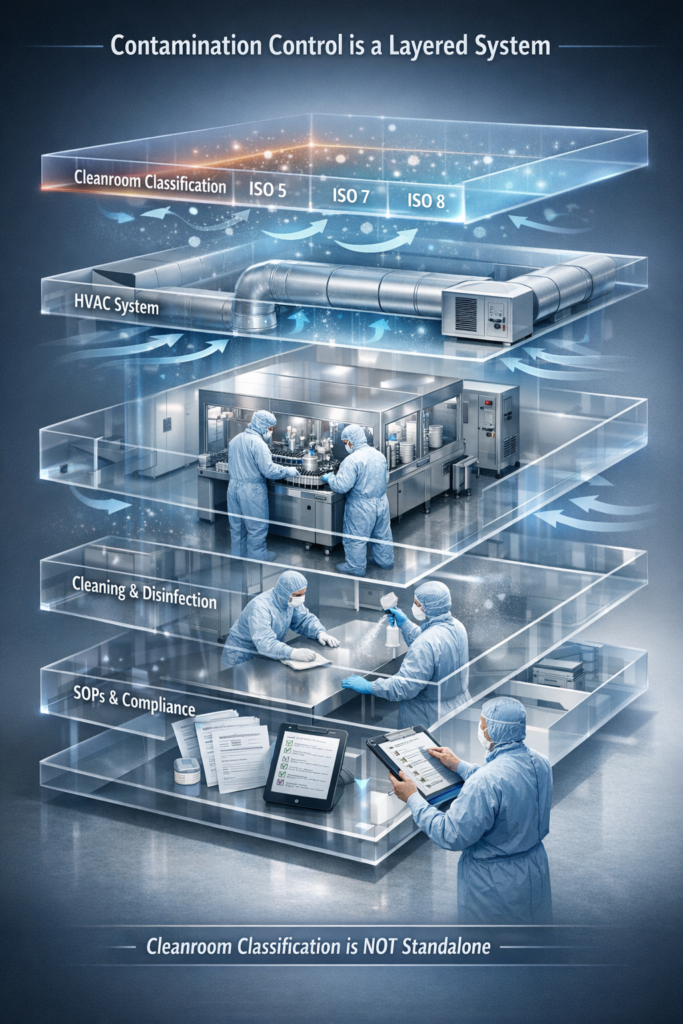
Cleanroom classification is a core component of contamination control, but it cannot function in isolation.

It must be aligned with:

  • Facility layout
  • HVAC airflow patterns
  • Cleaning and sanitization processes

In high-risk environments such as aseptic manufacturing, classification decisions become even more critical for maintaining product integrity.

  • Cost vs. Compliance Balance

One of the biggest challenges is balancing compliance with cost efficiency.

Overclassification leads to:

  • Higher capital investment
  • Increased operational expenses
  • More complex maintenance

Underclassification, on the other hand, risks compliance failures. A well-designed facility finds the optimal balance between cost, compliance, and performance.

  • Integration with Quality Systems

Cleanroom classification plays an important role in supporting the overall quality management system that pharma environments depend on.

It impacts:

  • Monitoring systems
  • Validation strategies
  • Standard operating procedures

Classification decisions must align with quality systems to ensure consistency and compliance.

  • Documentation and Validation

Every cleanroom classification decision must be supported by proper documentation.

This ensures:

  • Clear justification of classification levels
  • Alignment with regulatory expectations
  • Faster validation and approval processes

Strong documentation reduces delays and improves overall project efficiency.

About Efficiency vs. Compliance

There is a common assumption that higher cleanroom classifications automatically result in better compliance. In reality, efficiency is achieved when classification levels are appropriate, not excessive.

When classification is optimized:

  • HVAC systems operate more efficiently
  • Operational workflows become smoother
  • Maintenance and energy costs are reduced

Leading EPC companies understand that the goal is not to design the most stringent environment, but the most appropriate one.

Why Traditional Design Approaches Fall Short

In many projects, cleanroom classifications are driven by conservative assumptions rather than process requirements, leading to overdesigned, inefficient facilities.

This results in:

  • Higher costs without proportional benefits
  • Reduced operational flexibility
  • Increased complexity in EPC construction projects

Without early integration of process, engineering, and quality teams, cleanroom classification decisions are often made in isolation.

Modern projects require integrated approaches where classification is aligned with actual process requirements and long-term operational goals.

cost vs Control

Delivering Efficient and Compliant Cleanroom Designs

To design cleanrooms that support both compliance and efficiency, engineering teams must:

  • Define classification based on process needs, not assumptions
  • Integrate HVAC, layout, and workflow design early
  • Balance cost, compliance, and operational efficiency
  • Align the cleanroom strategy with the overall EPCM project execution

This approach ensures that facilities are not only compliant but also optimized for performance.

How Pharma Access Approaches Cleanroom Design

At Pharma Access, we see cleanroom classification as a design choice, not simply compliance-driven.
Employing Pharma Engineering best practices with seamless execution, facilities are engineered to allow you to properly balance compliance, efficiency, and scalability.

Delivering GMP-compliant facilities that “just work” for our clients day one.

Conclusion

Cleanroom classification shouldn’t just be about compliance. It should drive manufacturing efficiency. 

Doing more than what is needed wastes money. Doing less than what is needed risks non-compliance. Designing correctly creates balance. 

Cleanrooms that are properly classified to meet process needs and tied into the overall design strategy enable facilities to perform better, operate more efficiently, and scale with ease.

Efficient design in today’s pharmaceutical manufacturing isn’t about doing more. It’s about designing smarter. 

FAQs

  • What is cleanroom classification?

It defines the level of particulate and microbial control required in a controlled environment.

  • Why is cleanroom classification important in pharma manufacturing?

It ensures product quality, regulatory compliance, and efficient operations.

  • How does cleanroom classification impact efficiency?

It affects HVAC load, workflow, operational cost, and maintenance requirements.

  • What happens if cleanroom classification is too high?

It increases energy consumption, operational cost, and complexity without added benefit.

  • How is cleanroom classification linked to GMP?

It supports contamination control and is a critical part of GMP-compliant facility design.


GMP Compliance in Pharmaceutical Facility Design: What Engineering Teams Must Consider

GMP Compliance

Pharma manufacturing is changing faster than ever. Therapies are becoming more complex. Product lifecycles are shrinking. Regulatory expectations are intensifying—while approval timelines continue to compress.  And regulators are expecting faster approval timelines than ever. The modern pharma facility is no longer just a production space. It is a controlled environment where quality, compliance, and efficiency must work together at every step. When designing facilities that consistently manufacture quality products, compliance and speed must both be considered from the start. GMP can no longer be limited to operations and validation. It needs to be considered at the design stage itself.

When Compliance Becomes the Bottleneck

Projects today are moving quickly to build pharmaceutical manufacturing facilities. Products are expected to be commercialized faster than ever before. At the same time, regulations are becoming more rigorous. When compliance is treated as a late-stage hurdle, projects often reach commissioning phases only to discover issues that were built into the design much earlier. At that point:

  • Layouts need to be reworked
  • Systems require redesign
  • Qualification timelines start stretching significantly
    Projects are not delayed because of GMP itself—they are delayed because GMP was not integrated early enough.

Why GMP Cannot Be Retrofitted

Most EPC construction projects follow a linear approach: engineering is completed first, procurement sources materials, and construction executes the build. In many cases, compliance is only considered toward the end during commissioning and qualification. But what if GMP compliance was treated as part of the engineering scope instead of a checkbox at the end? In reality, it should be. What makes GMP unique is that once key design decisions are locked, such as facility layout, HVAC zoning, and utility routing—any modification creates cascading impact. For example:

  • Changing room classification can impact airflow and pressure cascades
  • Incorrect material flow may require major layout redesign
  • Missing utilities can delay validation and qualification
    Simply put, GMP cannot be added later. It must be built into the design from day one.

Key GMP Design Considerations

Its effectiveness depends on how well it is translated into coordinated design decisions across systems. These decisions span across multiple systems but must work together as one integrated strategy. GMP itself is a regulatory framework. It does not prescribe exact engineering solutions. However, when translated into design decisions, GMP compliance becomes more practical and structured.

  • Facility Layout and Workflow

How people, materials, and waste move through a facility defines its workflow. To ensure compliance, facilities should be designed with:

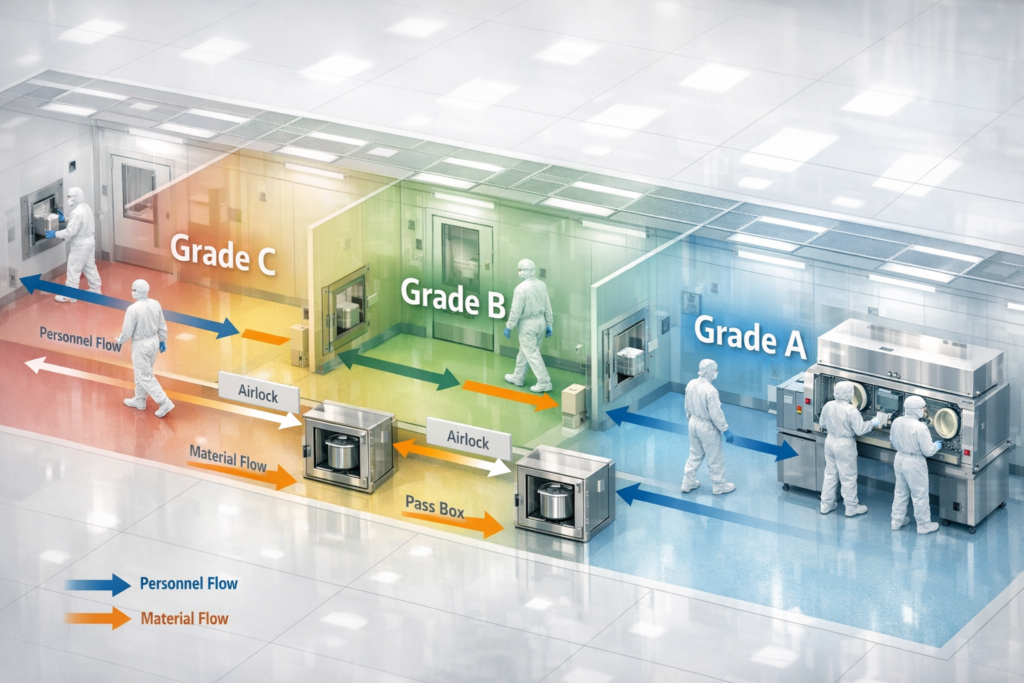
  • Unidirectional flow of personnel and materials wherever possible
  • Clear separation between clean and non-clean areas
  • Properly designed airlocks and entry/exit points

This becomes especially critical in aseptic manufacturing, where even minor contamination risks can compromise product integrity.

  • HVAC and Room Environmental Design

HVAC is one of the most critical systems in a GMP facility. It maintains controlled environmental conditions required for consistent product quality. An effective HVAC design must account for:

  • Room classifications
  • Pressure differentials between spaces
  • Airflow direction and filtration

    Any instability in environmental control can directly impact quality control in the pharmaceutical industry, making HVAC one of the most critical design elements.
  • Utility System Design and Clean Utilities

Utilities that come into contact with the product such as purified water (PW), water for injection (WFI), clean steam, and clean/process compressed air must be designed carefully. Key considerations include:

  • Hygienic storage and distribution
  • Continuous circulation to prevent stagnation
  • Ease of cleaning and validation

    These systems form a core part of the quality management system pharma facilities rely on to maintain consistency and compliance.
  • Contamination Control Strategy

Contamination control is not driven by a single system—it is the outcome of how layout, HVAC, utilities, and operations work together. Important considerations include:

  • Cross-contamination risks between products
  • Interaction between personnel and material movement
  • Cleaning and decontamination processes

    A weak contamination control strategy can compromise an otherwise well-designed facility.
  • Equipment Design and Process Flow

Equipment should not be treated as standalone assets. It must align with the overall process and facility design. Poor integration often leads to inefficiencies. Key questions to consider:

  • Does the equipment align with overall process flow?
  • Is it easily accessible for maintenance and cleaning?
  • How well is it integrated with utilities and automation systems?
  • Automation and Data Integrity Systems

Automation systems are now essential in modern pharmaceutical facilities. They not only improve operational efficiency but also support compliance. These systems support compliance by:

  • Capturing and storing reliable data
  • Maintaining audit trails and traceability
  • Restricting user access to sensitive systems
  • Documentation and Traceability

All design decisions should be traceable back to initial user requirements. Strong documentation ensures:

  • Alignment between design intent and requirements
  • Readiness for validation and audits
  • Faster and smoother CQV processes
    Documentation should not be an afterthought. It must be built into the design process.
  • Designing for Compliance and Speed

There is a common misconception that GMP compliance slows projects down. In reality, projects are delayed when compliance is addressed too late. When GMP is considered from the beginning:

  • Fewer design changes are required
  • Rework is significantly reduced
  • Commissioning and qualification timelines improve

    Leading EPC companies are now integrating engineering, quality, and execution teams early in the project lifecycle. When everyone is aligned from the start, projects move faster with fewer delays.
  • Where Traditional Delivery Models Fall Short

Traditional project delivery separates engineering, construction, and validation into different phases. While structured, this approach often creates gaps Common challenges include:

  • Late involvement of quality teams
  • Compliance efforts pushed to the end
  • Decisions made without full project visibility

    As projects become more complex, these gaps make compliance harder to achieve. This is why pharmaceutical projects increasingly require integrated, CQV-focused delivery approaches.
  • Building GMP-Ready Facilities from Day One

Clients today expect more than just regulatory compliance. They want facilities that perform efficiently, remain compliant, and adapt to future needs. To achieve this, engineers should:

  • Consider GMP at the conceptual design stage
  • Align design with qualification requirements
  • Involve engineering, quality, and operations teams early
  • Partner with experienced pharmaceutical engineering firms

How Pharma Access Integrates GMP into Design

At Pharma Access, GMP is embedded into every stage of the project from day one. By combining precision execution with an integrated design approach, we consistently deliver facilities that meet the highest standards of compliance, efficiency, and predictability.

Final Word

GMP compliance should be addressed during the design stage, not during validation. Treating GMP as an afterthought leads to delays, rework, and inefficiencies. When considered from the beginning, it enables faster execution and better outcomes. GMP is only as strong as when it is introduced into the design process.

Frequently Asked Questions (FAQs)

1. What does GMP stand for?

Good Manufacturing Practice. It is a set of guidelines and regulations that pharmaceutical manufacturers must follow.

2. Why does GMP matter during design?

If addressed late, GMP can delay projects. When considered early, it helps maintain timelines and ensures compliance.

3. What are key GMP design considerations?

Facility layout, HVAC, utilities, contamination control, equipment integration, automation, and documentation.

4. How does HVAC impact GMP?

HVAC maintains controlled environments. Poor design can affect product safety and compliance.

5. What utilities are critical in GMP design?

Utilities such as PW, WFI, clean steam, and compressed air must be hygienic and continuously circulating.

Modular vs Traditional Pharma Facility Construction: What Should Investors Really Consider?

Modular vs Traditional Pharma Facility Construction

The pharmaceutical industry is operating in an increasingly high-pressure environment. Becoming more stringent, Product lifecycles are shortening. There is an increasing focus on biologics and specialty therapies. Investors want faster commercialization and higher returns. Constructing a manufacturing plant in this setting is not a construction project. It is a strategic capital choice which influences valuation, scalability and long term competitiveness. To pharma investors, new company founders, CMOs, and expansion-oriented leadership teams, time-to-market, risk exposure and prospective returns on investment directly depend on the decision to build in a modular or traditional way. This paper compares the two models using a strategic and financial approach to enable decision-makers to consider what really matters.

Understanding Traditional Pharma Facility Construction

Traditional Pharma

The conventional pharmaceutical building process follows a sequential execution model. The whole facility is constructed on site. begin only after the previous stage is completed.

The typical stages include:

  • Civil work and land development
  • Structural construction
  • Cleanroom installation
  • Integration of the HVAC systems and utilities
  • Process equipment setup
  • Validation and regulatory compliance

This has been the dominant approach to pharmaceutical facility development for decades. decades. It is highly customised and flexible. It is however both time and capital intensive.

Typical Timelines

The average time to construct a GMP-compliant pharmaceutical facility using traditional methods takes 18 to 36 months. In the case of complex sterile and biologics plants, the schedule may run even longer. Revenue generation is postponed in this period and capital remains tied up.

Key Challenges in Traditional Construction

  • Sequential dependency

A delay in one stage automatically delays the following stages.

  • Risks in contractor coordination.

There can be several contractors working simultaneously and this can result in gaps in communication and duplication of work..

  • Design modifications during implementation

In case of regulatory feedback or process variation occurs in the middle of the project, the changes may be costly and time consuming.

  • Supply chain exposure

Global material shortages or supply chain disruptions can halt project progress.

  • Validation overlap risk

Commissioning and qualification are also initiated later in the project cycle, which extends the timeline before commercial operations can begin.

Investment Risks

In the perspective of an investor, the risks in the traditional construction are primarily three:

  • Delays in Recovery of Investments.

 Revenue starts only after the facility is completed and validated.. A six-month delay can significantly affect projected cash flows..

  • Capital Lock-In

High initial investment levels reduce  financial capacity and increase the vulnerability if market conditions change.

  • Raise in Change Management Costs.

Any late-stage design revisions , changes in regulations or process changes are very expensive.

When Traditional Construction Makes Sense

Regardless of such risks, traditional construction is suitable when:

  • Very large, long-term production facilities are required
  • Installation of large or highly complex fixed process equipment is necessary
  • Demand is predictable and manufacturing volumes are high
  • Customer engineering requirements exceed modular design capabilities

Traditional builds can still be useful for established pharmaceutical companies with stable capacity planning.

What Is Modular Pharma Construction?

Modular Pharma Construction

Modular construction significantly changes the traditional execution model. Components (especially large and routine parts) are assembled in a controlled factory environment  rather than  being constructed entirely on site  in a sequential process. These modules are later delivered and assembled at the project site.

Modules may include:

  • Cleanroom pods
  • Utility skids
  • Process equipment rooms
  • Mechanical and electrical modules
  • Ready-prepared laboratory rooms

The distinguishing benefit is a parallel execution. Site preparation, foundation work occur simultaneously with off-site module fabrication, reducing the overall project timeline.

  • Timeline Advantage

Modular strategies can be used to deliver a facility that would otherwise normally require 24 months. The effect of the reduction of 8 to 12 months is of significant impact. Complete sooner implies complete regulatory filing, complete production and complete revenue generation.

Quality and Control

The consistency is enhanced in those factory-controlled conditions. The modules are assembled in a standardized manner and thus eliminate variation and rework Time losses caused by weather are reduced. TWorkforce productivity in controlled manufacturing settings is generally higher than productivity on open construction sites.

Strategic Advantages of Modular Construction for Investors

1. Faster Time-to-Market

    In pharmaceutical manufacturing, time is directly proportional to the revenue. In most cases, parallel execution saves up to 40-50 percent of the total project time. Prior experience in operations will result in faster commercialization and a better net present value of the project.

    2. Improved Cost Predictability

       Costs can be controlled better in factory production environments.. Exposures to weather, congestion of the site and labor inefficiencies are minimized. It makes the budget forecasting more reliable thus enhancing investor confidence.

      3. Phased Capital Deployment

      Building modular facilities can be done in stages. Companies do not need to develop full capacity at the beginning but can increase capacity as demand grows. This will minimize overbuilding and will safeguard capital whenever there are uncertainties in markets.

      4. Reduced Compliance Risk

      Documentation, traceability and standardization are supported by controlled module fabrication environments. This eases validation and GMP compliance. A lesser number of uncertainties on site results in smoothly conducting inspections and has less regulatory risk.

      5. Expansion Without Major Disruption

      In brownfield projects, the units may be modularized and installed with minimal or no interruption to the current production. This safeguards the continued revenue streams.

      Situations Where Modular May Not Be Ideal

      Modular construction is not always the best. It may not be optimal when:

      • Large-scale process equipment that is heavy cannot be transported
      • Highly customized engineering requirements exceed modular design flexibility
      • Module transportation is complicated by site logistics
      • Not planning for integration poses interface problems

      Modular planned construction can only succeed with an experienced EPCM planning and feasibility assessment in its initial stages.

      Capital Strategy Perspective

      The real distinction between traditional and modular construction lies in capital strategy. Conventional building involves a massive capital investment. Investors have to wait longer to make returns and face greater schedule uncertainty. Modular construction allows more agile project execution. Capital deployment can occur in stages. Revenue can begin earlier, and risk exposure is reduced due to more predictable schedules. This flexibility may enhance valuation and investor attractiveness tfor emerging pharma companies and CMOs operating in competitive markets.

      Industry Evolution Toward Flexible Manufacturing

      The drug market is shifting to small and specialized manufacturing. Requirements of biologics, cell and gene therapies and personalized medicine require:

      • Flexible production lines
      • Smaller batch sizes
      • Quick reconfiguration of the system
      • Adaptive infrastructure

      Large, inflexible facilities designed for decades-long production cycles may be less compatible with the pace of pharmaceutical innovation today. Modular construction supports flexibility and adaptability, making it attractive for growing companies.

      Comparative Overview

      Parameter Traditional Construction Modular Construction
      Timeline 18 to 36 months 10 to 14 months
      Capital Commitment Large upfront Phased investment
      Flexibility Limited post-build High scalability
      Change Cost Expensive More manageable
      Risk Exposure Higher schedule risk Controlled execution risk
      ROI Speed Slower Faster

      Key Questions Investors Should Ask

      The decision-makers need to consider:

      • What is the volatility of expected market demand?
      • Is speed to commercialization critical?
      • Is it possible to deploy capital in stages?
      • How customized must the facility design be?
      • What level of schedule risk is acceptable?

      These questions help determine which model aligns best with the company’s growth strategy.

      Final Perspective

      The choice between the modular and traditional pharma construction is not about the possibility of finding a better method. It is about alignment.

      • Alignment with capital strategy.
      • Alignment with development schedules.
      • Alignment to regulatory objectives.
      • Alignment  with risk appetite.

      In the case of large, stable, long-term capacity projects, traditional construction may still work. Modular construction will be particularly strategic to the investor who wants to achieve agility, rapid time-to-market, and gradual scalability. The construction of facilities is no longer an engineering decision in the competitive pharmaceutical environment today. It is a financial decision which forms the basis of profitability, valuation, and long-lasting resilience. The actual dilemma is not as to which of the methods is superior. The real question is which model best supports growth while protecting capital in a rapidly evolving industry.


      Smarter Pharma Facilities: Lean, Flexible, and Built for the Future

      Smarter Pharma Facilities: Lean, Flexible, and Built for the Future

      Pharma manufacturers today operate in one of the most demanding business environments. Every strategic decision is shaped by two critical performance indicators: Cost Per Thousand units (CPT) and Overall Equipment Effectiveness (OEE). These ultimately define profitability and operational efficiency in modern pharma facility design.

      The challenge is that the market does not wait. It expects higher quality, lower costs, and faster delivery, all while avoiding excess inventory. Demand patterns swing drastically. A product may require a very small batch one month and massive volumes the next.

      This unpredictability creates a dilemma. Adding more equipment may seem like an easy solution, but it lowers OEE and increases depreciation directly impacting profitability. On the other hand, under-preparedness risks delays, compliance pressure, and lost market opportunities.

      This is why pharma manufacturing facilities must evolve. They need to be lean enough to minimize waste and capital burden, yet flexible enough to adapt to demand shifts without compromising quality- a core principle of lean pharma manufacturing.

      To overcome these challenges, modern pharma facilities should be designed with the following four aspects in mind:

      • Building Facility Lean
      • Equipment Selection with Flexibility
      • Single-use Systems
      • Automation and Industry 4.0

      1. Building a Lean Pharma Facility

      Quality is simply conformance to requirements. A lean pharma facility must be compact, focused, and designed with both capital investment and operating costs in mind. This is the foundation of effective pharma turnkey solutions.

      Facilities should be planned with at least 10 years of visibility, as regulatory requirements, customer expectations, and processing technologies evolve rapidly. Without this foresight, organizations risk costly revamps far sooner than anticipated.

      Key principles of lean facility design include:

      • Keeping facilities compact and requirement-driven to control both capital expenditure and operating expenses
      • Focusing on core manufacturing activities while outsourcing non-core functions such as warehousing, pharma engineering services, and selected quality activities to reduce total cost of ownership (TCO)
      • Placing only essential equipment inside cleanrooms and shifting support equipment to service areas to minimize cleanroom footprint and operating costs
      • Challenging design tolerances wherever possible reducing unnecessary overengineering (for example, tighter tolerances beyond ±2%) directly lowers capital and lifecycle costs

      A lean facility design reduces depreciation impact, improves OEE, and helps manufacturers keep CPT competitive in a dynamic and unpredictable market.

      Article content

      2. Flexible Equipment Selection for Variable Batch Sizes

      Variation in batch size is one of the biggest operational challenges in pharmaceutical manufacturing. Very small production runs and large-scale volumes cannot be efficiently addressed by simply adding more equipment, as this approach reduces OEE and increases depreciation.

      Instead, manufacturers should focus on flexible equipment strategies, including:

      • Selecting equipment capable of efficiently handling both small and large batch sizes
      • Prioritizing shorter changeover times to improve operational efficiency without compromising quality or compliance
      • Investing only in essential options initially, while keeping the ability to scale or upgrade as product and market needs evolve
      • Evaluating equipment not just on output capacity and cost, but also on flexibility, reliability, and quality performance

      Flexible equipment enables pharma manufacturers to remain agile, respond to demand fluctuations, and align capital investment with actual business needs.

      3. Single-Use Systems in Modern Pharma Facilities

      Single-use systems have transformed how pharmaceutical facilities are designed and operated, especially in environments where product changeovers, batch variability, and contamination control are critical.

      Traditional stainless-steel systems demand extensive cleaning, validation, and downtime. In contrast, single-use technologies significantly reduce these burdens while improving operational flexibility.

      Key advantages of single-use systems include:

      • Eliminating cleaning-in-place (CIP) and sterilization-in-place (SIP) requirements, resulting in faster changeovers and higher equipment availability
      • Reducing cross-contamination risks, which enhances product quality and regulatory confidence
      • Enabling rapid scale-up or scale-down without major capital investment
      • Lowering water, energy, and utility consumption, supporting both cost reduction and sustainability goals

      Single-use systems are particularly effective for multi-product facilities, clinical manufacturing, and operations with highly variable demand. When applied strategically, they help manufacturers improve OEE while keeping capital expenditure aligned with real production needs.

      4. Automation and Industry 4.0 in Pharma Manufacturing

      Automation and Industry 4.0 are no longer optional upgrades they are foundational elements of future-ready pharma facilities. When implemented correctly, automation improves consistency, compliance, and operational visibility across the manufacturing lifecycle.

      Modern automation strategies go beyond basic control systems. They integrate data, equipment, and people to enable smarter decision-making through pharma automation solutions.

      Core benefits of automation and Industry 4.0 include:

      • Reducing manual interventions, thereby minimizing human error and improving batch consistency
      • Enabling real-time monitoring of critical process parameters, equipment performance, and quality attributes
      • Improving OEE through predictive maintenance and data-driven performance optimization
      • Strengthening data integrity and compliance with regulatory expectations such as ALCOA+ principles

      A key consideration is scalability. Automation systems should be designed in modular layers, allowing facilities to start with essential controls and expand toward advanced analytics, digital twins, and artificial intelligence as maturity increases.

      When aligned with lean facility design and flexible equipment strategies, automation becomes a powerful enabler of efficiency rather than an added cost burden.

      Where Pharma Access Fits In

      At Pharma Access, we help manufacturers design and build pharma facilities that are lean, flexible, and future-ready. From smart equipment selection and modular facility concepts to Industry 4.0 enabled solutions, we support our clients in reducing costs, improving OEE, and maintaining long-term regulatory compliance.

      In today’s pharmaceutical industry, success is not about building bigger facilities it is about building smarter, faster, and more adaptable operations.

      And that is exactly what we deliver.