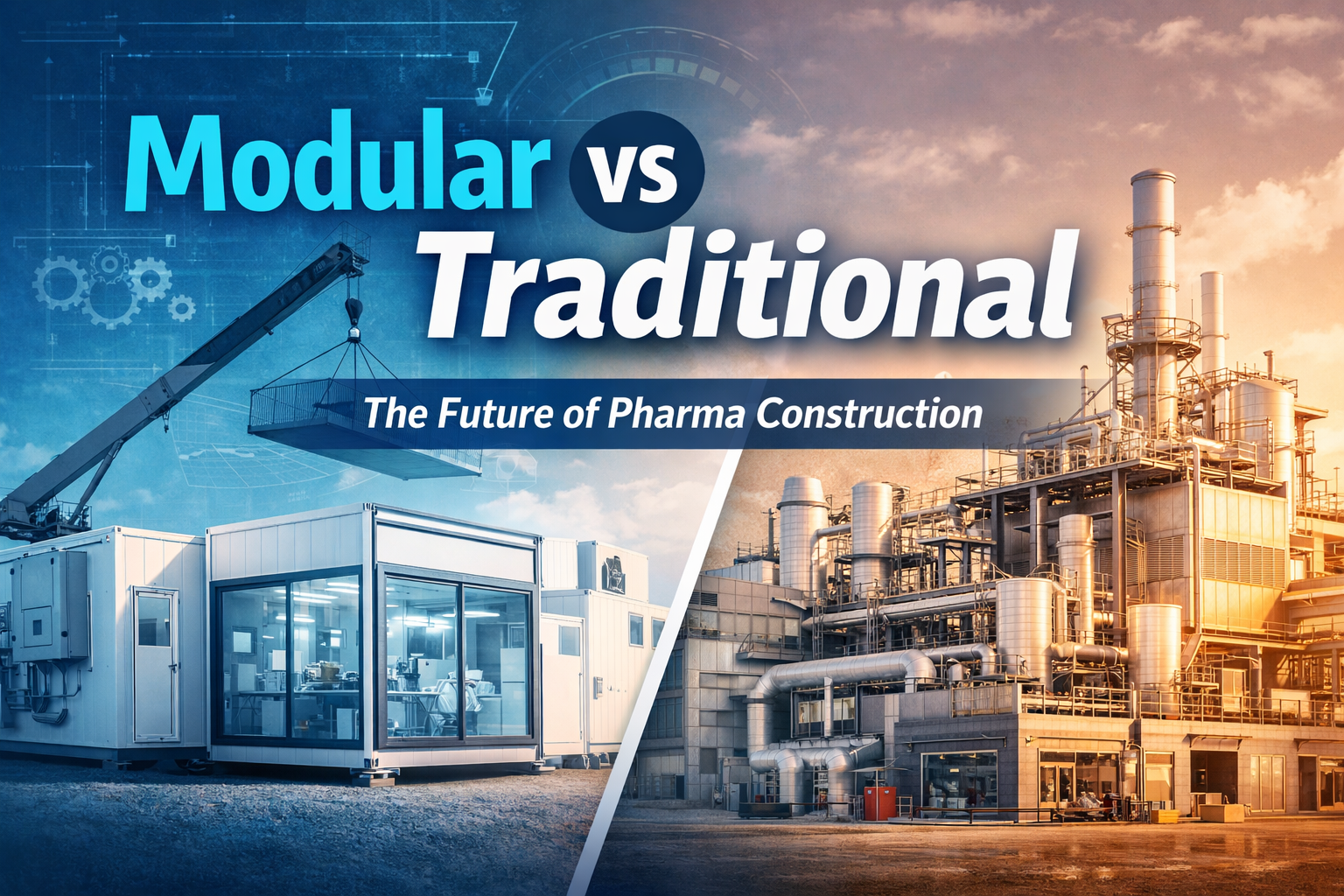
Modular vs Traditional Pharma Facility Construction: What Should Investors Really Consider?

Modular vs Traditional Pharma Facility Construction

The pharmaceutical industry is operating in an increasingly high-pressure environment. Becoming more stringent, Product lifecycles are shortening. There is an increasing focus on biologics and specialty therapies. Investors want faster commercialization and higher returns. Constructing a manufacturing plant in this setting is not a construction project. It is a strategic capital choice which influences valuation, scalability and long term competitiveness. To pharma investors, new company founders, CMOs, and expansion-oriented leadership teams, time-to-market, risk exposure and prospective returns on investment directly depend on the decision to build in a modular or traditional way. This paper compares the two models using a strategic and financial approach to enable decision-makers to consider what really matters.

Understanding Traditional Pharma Facility Construction
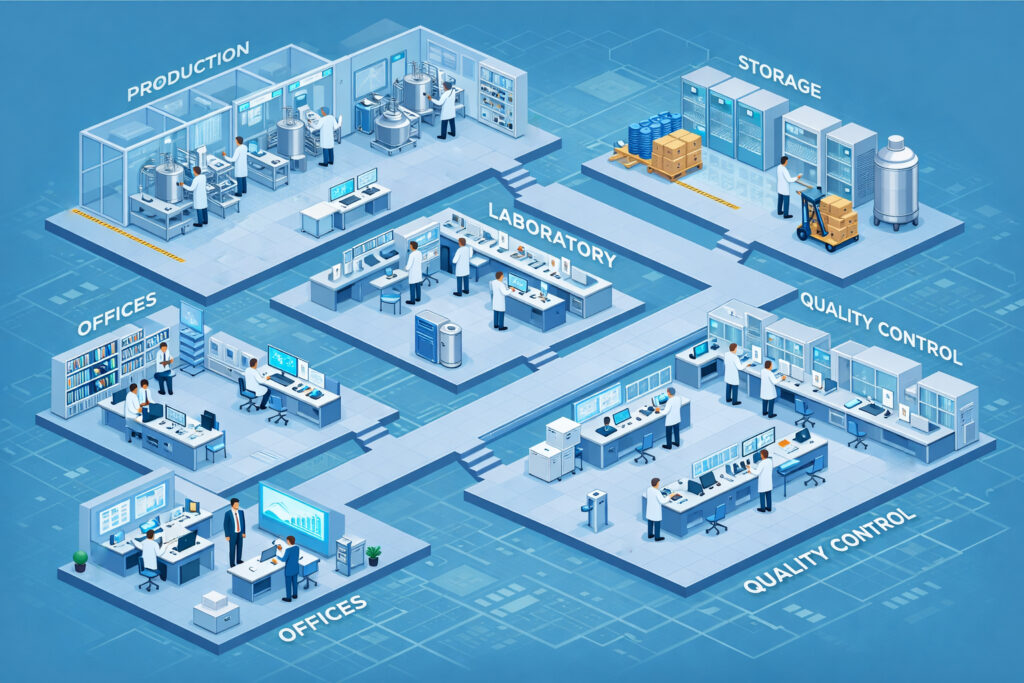
Traditional Pharma

The conventional pharmaceutical building process follows a sequential execution model. The whole facility is constructed on site. begin only after the previous stage is completed.

The typical stages include:

  • Civil work and land development
  • Structural construction
  • Cleanroom installation
  • Integration of the HVAC systems and utilities
  • Process equipment setup
  • Validation and regulatory compliance

This has been the dominant approach to pharmaceutical facility development for decades. decades. It is highly customised and flexible. It is however both time and capital intensive.

Typical Timelines

The average time to construct a GMP-compliant pharmaceutical facility using traditional methods takes 18 to 36 months. In the case of complex sterile and biologics plants, the schedule may run even longer. Revenue generation is postponed in this period and capital remains tied up.

Key Challenges in Traditional Construction

  • Sequential dependency

A delay in one stage automatically delays the following stages.

  • Risks in contractor coordination.

There can be several contractors working simultaneously and this can result in gaps in communication and duplication of work..

  • Design modifications during implementation

In case of regulatory feedback or process variation occurs in the middle of the project, the changes may be costly and time consuming.

  • Supply chain exposure

Global material shortages or supply chain disruptions can halt project progress.

  • Validation overlap risk

Commissioning and qualification are also initiated later in the project cycle, which extends the timeline before commercial operations can begin.

Investment Risks

In the perspective of an investor, the risks in the traditional construction are primarily three:

  • Delays in Recovery of Investments.

 Revenue starts only after the facility is completed and validated.. A six-month delay can significantly affect projected cash flows..

  • Capital Lock-In

High initial investment levels reduce  financial capacity and increase the vulnerability if market conditions change.

  • Raise in Change Management Costs.

Any late-stage design revisions , changes in regulations or process changes are very expensive.

When Traditional Construction Makes Sense
Regardless of such risks, traditional construction is suitable when:

  • Very large, long-term production facilities are required
  • Installation of large or highly complex fixed process equipment is necessary
  • Demand is predictable and manufacturing volumes are high
  • Customer engineering requirements exceed modular design capabilities

Traditional builds can still be useful for established pharmaceutical companies with stable capacity planning.

What Is Modular Pharma Construction?
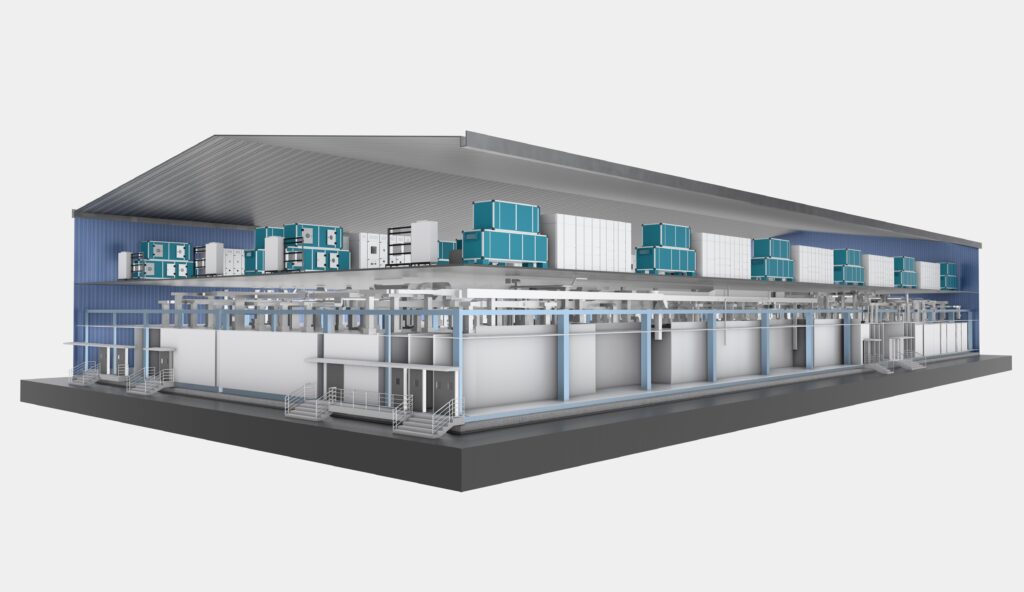
Modular Pharma Construction

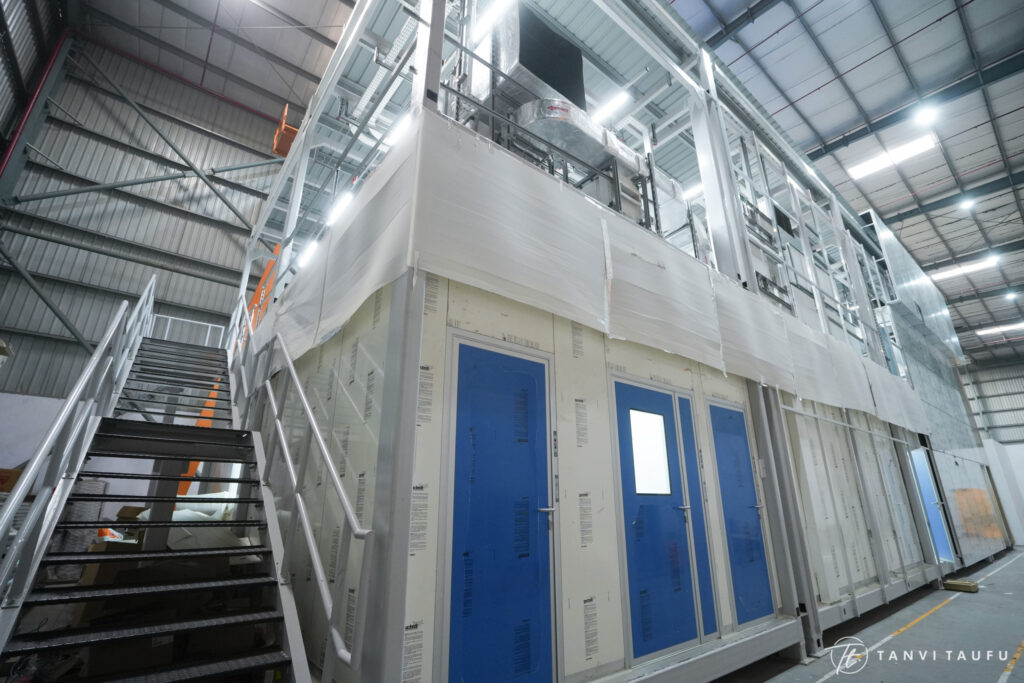
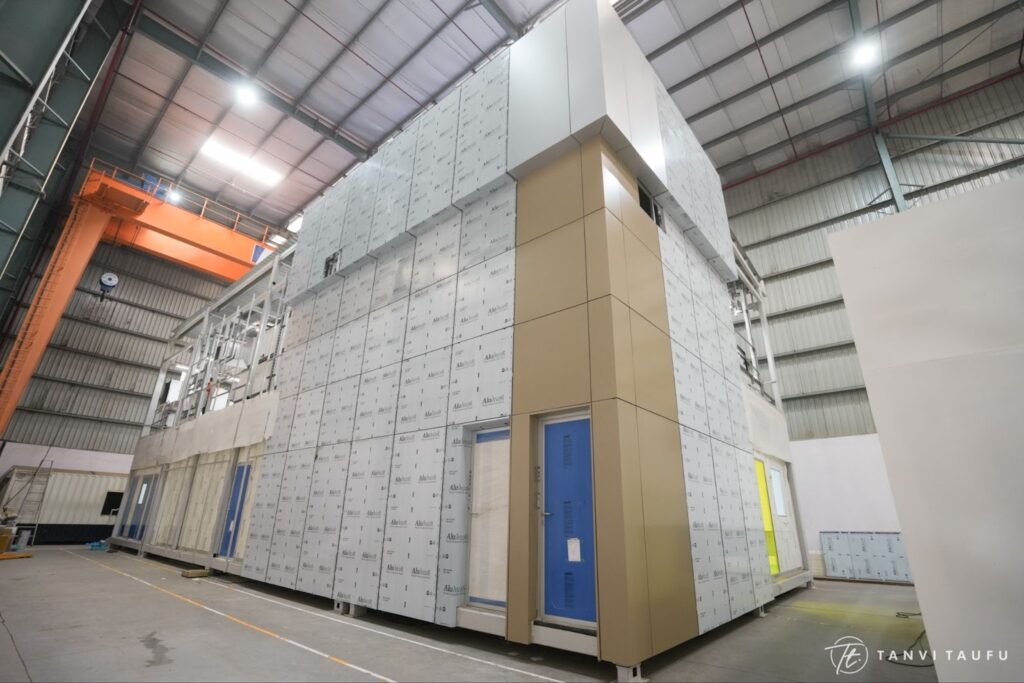
Modular construction significantly changes the traditional execution model. Components (especially large and routine parts) are assembled in a controlled factory environment  rather than  being constructed entirely on site  in a sequential process. These modules are later delivered and assembled at the project site.

Modules may include:

  • Cleanroom pods
  • Utility skids
  • Process equipment rooms
  • Mechanical and electrical modules
  • Ready-prepared laboratory rooms

The distinguishing benefit is a parallel execution. Site preparation, foundation work occur simultaneously with off-site module fabrication, reducing the overall project timeline.

  • Timeline Advantage

Modular strategies can be used to deliver a facility that would otherwise normally require 24 months. The effect of the reduction of 8 to 12 months is of significant impact. Complete sooner implies complete regulatory filing, complete production and complete revenue generation.

Quality and Control

The consistency is enhanced in those factory-controlled conditions. The modules are assembled in a standardized manner and thus eliminate variation and rework Time losses caused by weather are reduced. TWorkforce productivity in controlled manufacturing settings is generally higher than productivity on open construction sites.

Strategic Advantages of Modular Construction for Investors
1. Faster Time-to-Market

    In pharmaceutical manufacturing, time is directly proportional to the revenue. In most cases, parallel execution saves up to 40-50 percent of the total project time. Prior experience in operations will result in faster commercialization and a better net present value of the project.

    2. Improved Cost Predictability

       Costs can be controlled better in factory production environments.. Exposures to weather, congestion of the site and labor inefficiencies are minimized. It makes the budget forecasting more reliable thus enhancing investor confidence.

      3. Phased Capital Deployment

      Building modular facilities can be done in stages. Companies do not need to develop full capacity at the beginning but can increase capacity as demand grows. This will minimize overbuilding and will safeguard capital whenever there are uncertainties in markets.

      4. Reduced Compliance Risk

      Documentation, traceability and standardization are supported by controlled module fabrication environments. This eases validation and GMP compliance. A lesser number of uncertainties on site results in smoothly conducting inspections and has less regulatory risk.

      5. Expansion Without Major Disruption

      In brownfield projects, the units may be modularized and installed with minimal or no interruption to the current production. This safeguards the continued revenue streams.

      Situations Where Modular May Not Be Ideal

      Modular construction is not always the best. It may not be optimal when:

      • Large-scale process equipment that is heavy cannot be transported
      • Highly customized engineering requirements exceed modular design flexibility
      • Module transportation is complicated by site logistics
      • Not planning for integration poses interface problems

      Modular planned construction can only succeed with an experienced EPCM planning and feasibility assessment in its initial stages.

      Capital Strategy Perspective

      The real distinction between traditional and modular construction lies in capital strategy. Conventional building involves a massive capital investment. Investors have to wait longer to make returns and face greater schedule uncertainty. Modular construction allows more agile project execution. Capital deployment can occur in stages. Revenue can begin earlier, and risk exposure is reduced due to more predictable schedules. This flexibility may enhance valuation and investor attractiveness tfor emerging pharma companies and CMOs operating in competitive markets.

      Industry Evolution Toward Flexible Manufacturing

      The drug market is shifting to small and specialized manufacturing. Requirements of biologics, cell and gene therapies and personalized medicine require:

      • Flexible production lines
      • Smaller batch sizes
      • Quick reconfiguration of the system
      • Adaptive infrastructure

      Large, inflexible facilities designed for decades-long production cycles may be less compatible with the pace of pharmaceutical innovation today. Modular construction supports flexibility and adaptability, making it attractive for growing companies.

      Comparative Overview

      Parameter Traditional Construction Modular Construction
      Timeline 18 to 36 months 10 to 14 months
      Capital Commitment Large upfront Phased investment
      Flexibility Limited post-build High scalability
      Change Cost Expensive More manageable
      Risk Exposure Higher schedule risk Controlled execution risk
      ROI Speed Slower Faster

      Key Questions Investors Should Ask

      The decision-makers need to consider:

      • What is the volatility of expected market demand?
      • Is speed to commercialization critical?
      • Is it possible to deploy capital in stages?
      • How customized must the facility design be?
      • What level of schedule risk is acceptable?

      These questions help determine which model aligns best with the company’s growth strategy.

      Final Perspective

      The choice between the modular and traditional pharma construction is not about the possibility of finding a better method. It is about alignment.

      • Alignment with capital strategy.
      • Alignment with development schedules.
      • Alignment to regulatory objectives.
      • Alignment  with risk appetite.

      In the case of large, stable, long-term capacity projects, traditional construction may still work. Modular construction will be particularly strategic to the investor who wants to achieve agility, rapid time-to-market, and gradual scalability. The construction of facilities is no longer an engineering decision in the competitive pharmaceutical environment today. It is a financial decision which forms the basis of profitability, valuation, and long-lasting resilience. The actual dilemma is not as to which of the methods is superior. The real question is which model best supports growth while protecting capital in a rapidly evolving industry.

       

      Smarter Pharma Facilities: Lean, Flexible, and Built for the Future

      Smarter Pharma Facilities: Lean, Flexible, and Built for the Future

      Pharma manufacturers today operate in one of the most demanding business environments. Every strategic decision is shaped by two critical performance indicators: Cost Per Thousand units (CPT) and Overall Equipment Effectiveness (OEE). These ultimately define profitability and operational efficiency in modern pharma facility design.

      The challenge is that the market does not wait. It expects higher quality, lower costs, and faster delivery, all while avoiding excess inventory. Demand patterns swing drastically. A product may require a very small batch one month and massive volumes the next.

      This unpredictability creates a dilemma. Adding more equipment may seem like an easy solution, but it lowers OEE and increases depreciation directly impacting profitability. On the other hand, under-preparedness risks delays, compliance pressure, and lost market opportunities.

      This is why pharma manufacturing facilities must evolve. They need to be lean enough to minimize waste and capital burden, yet flexible enough to adapt to demand shifts without compromising quality- a core principle of lean pharma manufacturing.

      To overcome these challenges, modern pharma facilities should be designed with the following four aspects in mind:

      • Building Facility Lean
      • Equipment Selection with Flexibility
      • Single-use Systems
      • Automation and Industry 4.0

      1. Building a Lean Pharma Facility

      Quality is simply conformance to requirements. A lean pharma facility must be compact, focused, and designed with both capital investment and operating costs in mind. This is the foundation of effective pharma turnkey solutions.

      Facilities should be planned with at least 10 years of visibility, as regulatory requirements, customer expectations, and processing technologies evolve rapidly. Without this foresight, organizations risk costly revamps far sooner than anticipated.

      Key principles of lean facility design include:

      • Keeping facilities compact and requirement-driven to control both capital expenditure and operating expenses
      • Focusing on core manufacturing activities while outsourcing non-core functions such as warehousing, pharma engineering services, and selected quality activities to reduce total cost of ownership (TCO)
      • Placing only essential equipment inside cleanrooms and shifting support equipment to service areas to minimize cleanroom footprint and operating costs
      • Challenging design tolerances wherever possible reducing unnecessary overengineering (for example, tighter tolerances beyond ±2%) directly lowers capital and lifecycle costs

      A lean facility design reduces depreciation impact, improves OEE, and helps manufacturers keep CPT competitive in a dynamic and unpredictable market.

      Article content

      2. Flexible Equipment Selection for Variable Batch Sizes

      Variation in batch size is one of the biggest operational challenges in pharmaceutical manufacturing. Very small production runs and large-scale volumes cannot be efficiently addressed by simply adding more equipment, as this approach reduces OEE and increases depreciation.

      Instead, manufacturers should focus on flexible equipment strategies, including:

      • Selecting equipment capable of efficiently handling both small and large batch sizes
      • Prioritizing shorter changeover times to improve operational efficiency without compromising quality or compliance
      • Investing only in essential options initially, while keeping the ability to scale or upgrade as product and market needs evolve
      • Evaluating equipment not just on output capacity and cost, but also on flexibility, reliability, and quality performance

      Flexible equipment enables pharma manufacturers to remain agile, respond to demand fluctuations, and align capital investment with actual business needs.

      3. Single-Use Systems in Modern Pharma Facilities

      Single-use systems have transformed how pharmaceutical facilities are designed and operated, especially in environments where product changeovers, batch variability, and contamination control are critical.

      Traditional stainless-steel systems demand extensive cleaning, validation, and downtime. In contrast, single-use technologies significantly reduce these burdens while improving operational flexibility.

      Key advantages of single-use systems include:

      • Eliminating cleaning-in-place (CIP) and sterilization-in-place (SIP) requirements, resulting in faster changeovers and higher equipment availability
      • Reducing cross-contamination risks, which enhances product quality and regulatory confidence
      • Enabling rapid scale-up or scale-down without major capital investment
      • Lowering water, energy, and utility consumption, supporting both cost reduction and sustainability goals

      Single-use systems are particularly effective for multi-product facilities, clinical manufacturing, and operations with highly variable demand. When applied strategically, they help manufacturers improve OEE while keeping capital expenditure aligned with real production needs.

      4. Automation and Industry 4.0 in Pharma Manufacturing

      Automation and Industry 4.0 are no longer optional upgrades they are foundational elements of future-ready pharma facilities. When implemented correctly, automation improves consistency, compliance, and operational visibility across the manufacturing lifecycle.

      Modern automation strategies go beyond basic control systems. They integrate data, equipment, and people to enable smarter decision-making through pharma automation solutions.

      Core benefits of automation and Industry 4.0 include:

      • Reducing manual interventions, thereby minimizing human error and improving batch consistency
      • Enabling real-time monitoring of critical process parameters, equipment performance, and quality attributes
      • Improving OEE through predictive maintenance and data-driven performance optimization
      • Strengthening data integrity and compliance with regulatory expectations such as ALCOA+ principles

      A key consideration is scalability. Automation systems should be designed in modular layers, allowing facilities to start with essential controls and expand toward advanced analytics, digital twins, and artificial intelligence as maturity increases.

      When aligned with lean facility design and flexible equipment strategies, automation becomes a powerful enabler of efficiency rather than an added cost burden.

      Where Pharma Access Fits In

      At Pharma Access, we help manufacturers design and build pharma facilities that are lean, flexible, and future-ready. From smart equipment selection and modular facility concepts to Industry 4.0 enabled solutions, we support our clients in reducing costs, improving OEE, and maintaining long-term regulatory compliance.

      In today’s pharmaceutical industry, success is not about building bigger facilities it is about building smarter, faster, and more adaptable operations.

      And that is exactly what we deliver.

      Lifecycle Costing & Capital Budgeting

      Life cycle costing is the process of assigning all costs that the owner of an asset will incur over its lifespan from acquiring the asset to get rid of the asset. These costs include the initial investment, operation and maintenance cost, cost of poor quality (COPQ) interest on investment, minus any salvage value at the end of life of asset.

      Return on Investment (ROI) should be the criteria for evaluating the asset based on Life Cycle Costing (LCC) and Overall equipment Effectiveness (OEE) not merely on the capital cost and output parameter. Often capital investments are done considering the asset cost and the output parameters likes volumes / hour, but we forget to account for energy cost, environment impact cost, quality cost (COPQ) operation personnel cost, maintenance cost etc which are part of operational cost.

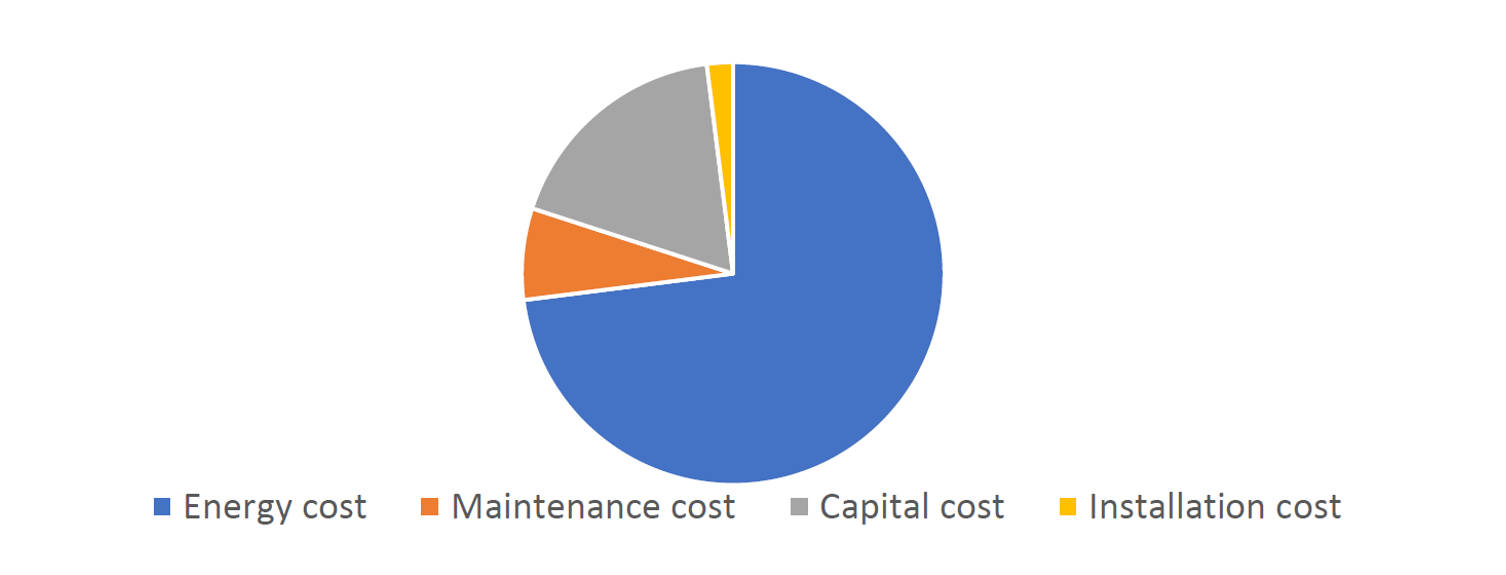
      A study by Carbon Trust mentioned that for an Air compressor, a common asset used across industries for a 10-year life span the energy cost is 73%, capital cost is 18% maintenance cost is 7% and installation cost is 2%. So only basis of the capital cost and output without looking at the energy cost and maintenance could be a wrong decision.

      Life Cycle Cost

      Similarly, for industry asset OEE is very critical which is a KPI of plant productivity that bring efficiency to operation. OEE of an asset depends on the availability ratio (A), Quality ratio (Q) and performance ratio.

      • Availability Ratio – The share of the actual production time and the planned production time. All planned stops and breakdowns will reduce the availability ratio, including set up times, preventive maintenance, breakdowns and lack of operators. The only time that you may choose to deduct from the availability ratio is lack of orders.
      • Performance Ratio – Loss of production due to under utilization of the machinery. In other words, losses are incurred when the equipment is not run with full speed. Short, unregistered, stops may affect the performance ratio as well.
      • Quality Ratio – The amount of the production that has to be discharged or scrapped.

      All the three ratios are important for taking decision on LCC. Let us discuss each parameter in terms of LCC.

      Availability ratio:
      If the asset is on reliable, breakdown frequently may be due to hardware or software issue then the availability of the asset reduces to the planned run hours. This will impact the overall output planned Service support from the asset supplier is very important. Many a times it is observed that due to poor service support asset remains under unavailable condition to operation.

      Performance Ratio:
      When the asset is under utilized or when it is not run to its full capacity the performance ratio reduces and that impact the productivity.

      Quality Ratio:
      Asset are supposed to make 100% acceptable quality product but due to inherent design property they produce rejected product as well. The more the reject the less the productivity.

      The Lifecycle Cost Curve

      Let us take one example to understand the effect of OEE on LCC for an asset which is operating at 90% availability, Performance at 93% and quality at 91% verses a higher capital cost but better A, P&T of 95%, 98% and 97%.

      OEE of Asset with Low capital cost A x P x Q = 0.90 x 0.93 x 0.91 = 0.76 (76%)

      OEE of Asset with higher capital cost= A x P x Q = 0.95 x 0.98 x 0.9 = 0.83 (83%)

      Therefore, we can see 7% improve in overall effectiveness or productivity which is substantial and should be considered as an evaluation criterion of asset.

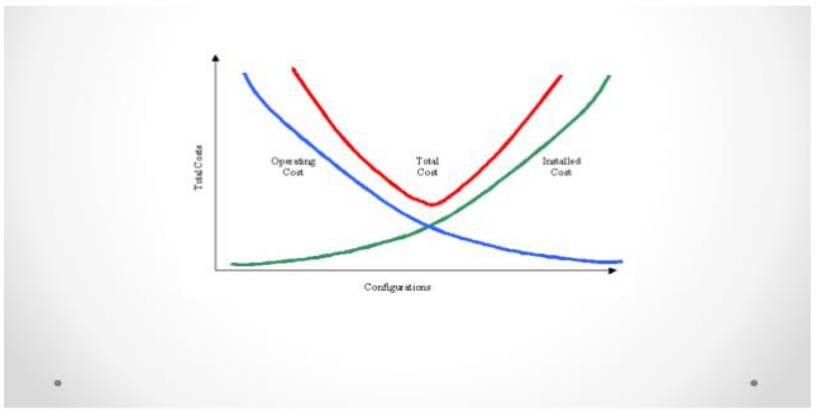
      The life cycle costing estimates help in the decision making process where the mutually exclusive option is available. As shown in the above figure it is a trade-off between operating cost and capital or installed cost of the asset. Also, the management can plan on how to reduce the overall cost of the item through the extension of useful life, efficient utilization, or other similar cost.

      Upcoming Multiproduct Facility in North Africa

      Project Fact Box

      Forms:

      • Oral Solid Dosage (Tablets, Capsules)
      • Oral Liquid Dosage
      • Ointments

      Total Project Area: 4,015 sqr. Mt

      Pharma Access Scope:

      • Heating Ventilation & Air Conditioning
      • Building Management System
      • Access Control System

      Our Value Additions

      • Accurate designs with the use of Revit 3D models
      • European makes for modern automated systems
      • Scheduling, Tracking, monitoring & reporting of the project plan
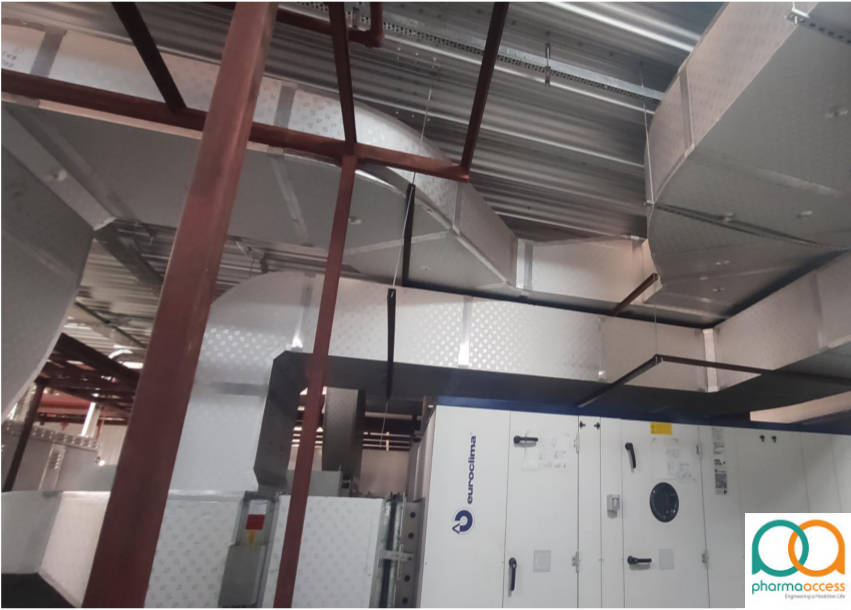
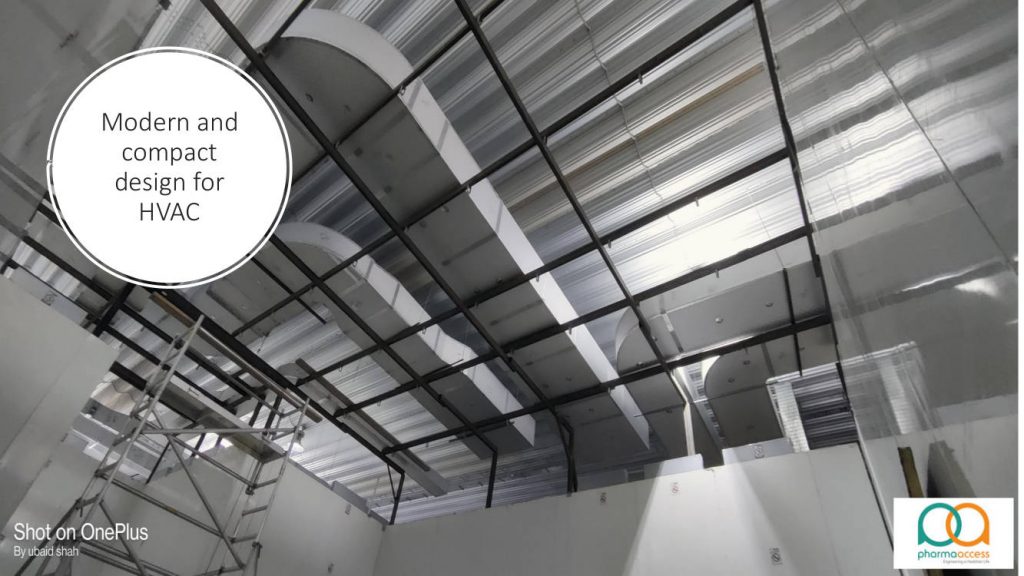
      • Efficient and compact design for HVAC
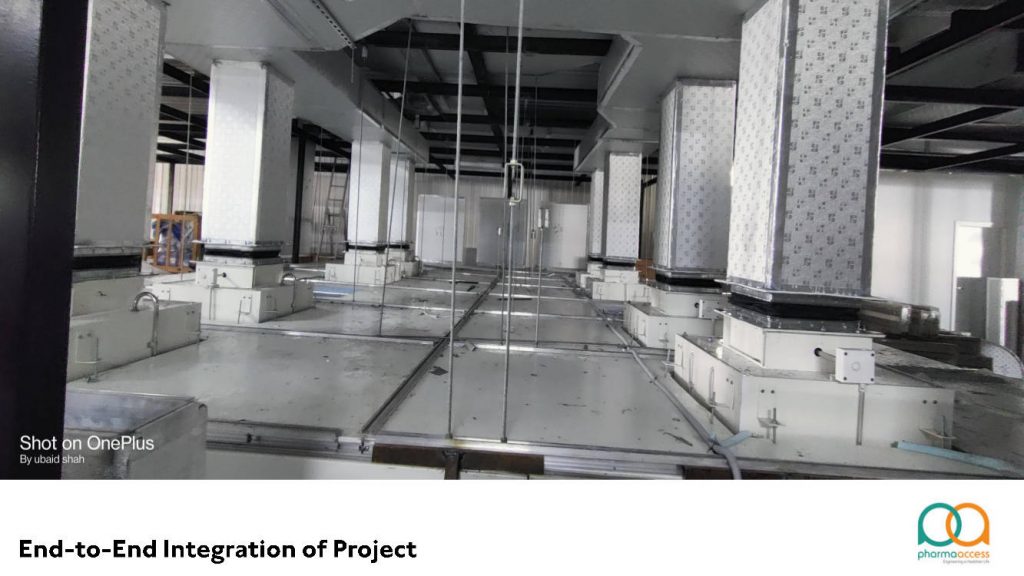
      • Pre installed skids installed to save up on execution time

      EPC vs EPCM vs EPCMV vs Turnkey in Pharmaceutical Projects: Which Model Fits Your Project?

      Turnkey in Pharmaceutical Projects

      A pharmaceutical facility is more than a construction project. Process equipment, cleanrooms, HVAC, utilities, automation, material and personnel flows, commissioning and qualification must ultimately function as one integrated system.

      This makes the choice of pharmaceutical project delivery model an important early project decision.

      When comparing EPC vs EPCM in a pharmaceutical project, the key difference is not simply who performs engineering or construction. The selected model determines contractual responsibility, owner involvement, procurement control, interface management, commercial risk, schedule accountability and the integration of commissioning and qualification.

      EPC, EPCM, EPCMV and turnkey models can all be appropriate. The right choice depends on project scope, complexity, internal capabilities, desired level of control and risk allocation.

      For organizations evaluating these routes, Pharma Access supports pharmaceutical projects from engineering and design through procurement, construction and installation, project management and CQV, allowing the delivery strategy to be developed around the requirements of the project rather than a single predefined model.

      EPC in Pharmaceutical Projects

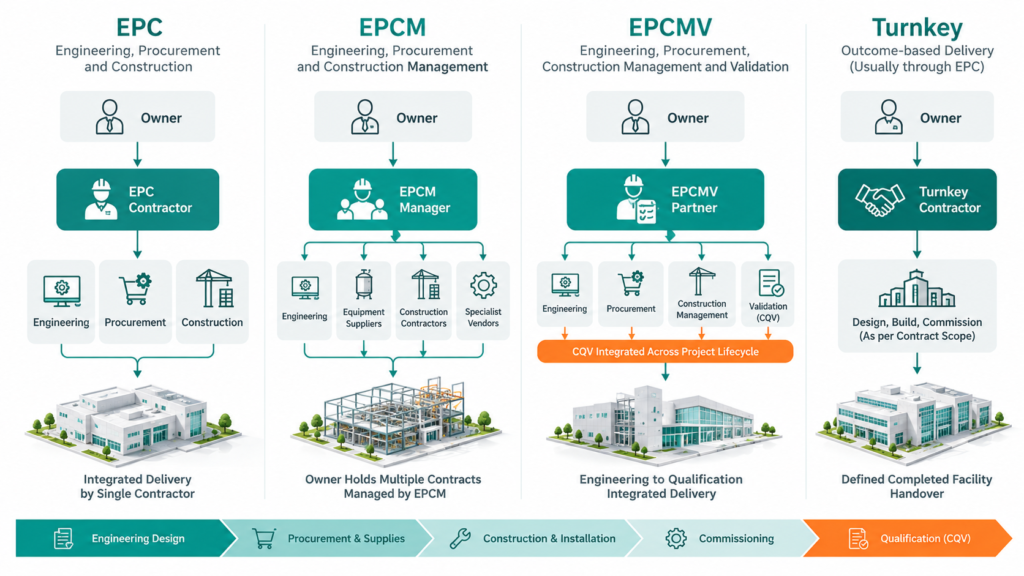
      EPC stands for Engineering, Procurement and Construction.

      Under an EPC structure, the owner appoints a principal contractor to execute the defined engineering, procurement and construction scope. The EPC contractor typically manages its suppliers and subcontractors and serves as the primary contractual interface for the agreed scope.

      A key advantage is the concentration of responsibility. This can simplify coordination and provide stronger single-point accountability for delivery.

      However, EPC does not mean every project risk automatically transfers to the contractor. The actual allocation depends on the contract. Owner changes, incomplete requirements, site conditions, permits, access constraints and defined relief events can still affect cost and schedule.

      EPC is generally better suited to projects where:

      • Scope and process requirements are relatively mature
      • Major equipment and facility interfaces are understood
      • Performance requirements can be clearly defined
      • The owner wants fewer contractual interfaces
      • Greater delivery accountability is preferred

      In pharmaceutical projects, requirements such as production capacity, GMP zoning, cleanroom classification, utilities, equipment interfaces and automation philosophy should therefore be sufficiently developed before major EPC commitments are made.

      EPCM in Pharma

      EPCM stands for Engineering, Procurement and Construction Management.

      Under an EPCM model, the EPCM organization performs or manages engineering and procurement while managing construction on behalf of the owner.

      The key distinction from EPC is usually the contractual structure. In a typical EPCM arrangement, the owner holds contracts directly with equipment suppliers, construction contractors and specialist vendors, while the EPCM partner coordinates the packages and manages their technical and schedule interfaces.

      This can provide greater owner control over:

      • Vendor selection
      • Equipment procurement
      • Package strategy
      • Design development
      • Project changes

      EPCM can also support fast-track execution. Long-lead equipment or selected construction packages may be released once the relevant engineering has reached sufficient maturity, rather than waiting for every element of detailed design to be completed.

      The trade-off is greater owner involvement and greater exposure to interfaces between the individual packages.

      EPCM is therefore often appropriate when the owner has an experienced project team, wants direct procurement control or is managing a complex brownfield project where design and operating interfaces continue to evolve.

      EPCMV in Pharmaceutical Projects

      EPCMV stands for Engineering, Procurement, Construction Management and Validation.

      This model is particularly relevant to pharmaceutical and biotechnology projects because project completion does not end with construction.

      Facilities, utilities and equipment must ultimately be commissioned and qualified for their intended use, while validation requirements must be addressed within the manufacturer’s quality system.

      The value of EPCMV is therefore not simply adding validation activities at the end of a project. It is about considering commissioning and qualification requirements while engineering and procurement decisions are still being made.

      For example, selection of a process equipment package may need to consider not only capacity, price and delivery but also:

      • Materials of construction
      • Instrumentation and calibration
      • Automation requirements
      • Vendor documentation
      • FAT and SAT requirements
      • Traceability
      • Qualification documentation

      EPCMV is not one universal contract form. Commercial responsibility for suppliers, construction contractors, schedule, CQV and final handover can differ between projects.

      These responsibilities should therefore be clearly established at the start.

      Turnkey in Pharmaceutical Projects

      EPC and turnkey are often used together, but they describe slightly different concepts.

      EPC describes the scope of Engineering, Procurement and Construction.

      Turnkey describes the intended delivery outcome, where a contractor is expected to hand over the project at an agreed stage of completion.

      For pharmaceutical projects, that handover point needs to be clearly defined.

      Construction Complete → Mechanical Completion → Commissioning → Qualification → Manufacturing Readiness

      These are not interchangeable milestones.

      A turnkey contract may include construction and commissioning, while another may extend into qualification support, training and documentation turnover.

      The important question is therefore not simply whether a project is described as turnkey, but what the contract defines as the completed outcome.

      EPC vs EPCM vs EPCMV vs Turnkey: Decision Matrix

      EPC vs EPCM vs EPCMV vs Turnkey: Decision Matrix
      Decision FactorEPCEPCMEPCMVTurnkey
      Primary structureEngineering, procurement and construction under a principal contractorEngineering and procurement with construction management on behalf of ownerEPCM-type delivery integrated with validation/CQ activitiesDelivery against a defined completed outcome
      Owner involvementGenerally lowerHigherModerate to highGenerally lower
      Procurement controlPrimarily contractor-ledGreater owner controlDepends on contractPrimarily contractor-led
      Direct vendor contractsUsually contractor-heldOften owner-heldCan varyUsually contractor-held
      Cost visibilityCan be greater where scope is matureDevelops as packages are awardedDepends on commercial modelCan be greater where outcome is clearly defined
      Flexibility for changesLower after awardHigherModerate to highUsually lower
      Interface managementConcentrated with EPC contractorManaged across multiple packagesIntegrated across project and CQV interfacesConcentrated with turnkey contractor
      CQV integrationMust be specifically includedCan be included separatelyCore considerationMust be clearly defined
      Best fitMature scope and consolidated responsibilityGreater flexibility and owner controlRegulated projects requiring early CQV integrationClearly defined final delivery outcome

      How to Choose the Right Model

      There is no universally superior project implementation strategy in pharma. The decision should be based on the characteristics of the project.

      Scope Maturity

      A mature scope with defined capacity, process requirements and interfaces can support EPC or turnkey delivery.

      Where significant design development is expected during execution, EPCM may provide greater flexibility.

      Owner Capability

      EPCM requires greater owner participation. The owner may need internal resources capable of technical decision-making, procurement oversight and commercial management.

      Organizations seeking fewer contractual interfaces may prefer EPC or turnkey arrangements.

      Procurement Strategy

      Pharmaceutical manufacturers may want direct involvement in the selection of critical equipment such as filling lines, isolators, lyophilizers, bioprocess equipment, utility systems and automation platforms.

      The delivery model should reflect how much procurement control the owner wants to retain.

      Risk and Interfaces

      Project risk should be allocated to the party best positioned to manage it.

      This includes risks associated with long-lead equipment, vendor delays, scope changes, brownfield shutdowns, utility limitations, construction interfaces and qualification documentation.

      Schedule

      Fast-track projects frequently require engineering, procurement and construction activities to overlap.

      The chosen model should support early package release while maintaining adequate design maturity, interface control and change management.

      How Pharma Access Supports Pharmaceutical Project Delivery

      How Pharma Access Supports Pharmaceutical Project Delivery

      We approach project delivery as an integrated engineering and execution process rather than treating design, construction and CQV as isolated phases.

      Depending on project scope and delivery strategy, our capabilities cover:

      Engineering Design
      Concept, basic and detailed engineering across process, cleanrooms, HVAC, mechanical and utility systems, electrical systems, automation and associated facility infrastructure.

      Procurement & Supplies
      Technical specifications, vendor coordination, bid evaluation, procurement support and management of equipment and project packages.

      Construction & Installation
      Coordination and execution of facility systems, cleanrooms, utilities, mechanical, electrical and associated installation works.

      Project Management & Control
      Planning, scheduling, coordination, cost and progress monitoring, interface management and project controls across disciplines and contractors.

      Commissioning, Qualification & Validation
      CQV planning and execution support, including requirements and risk assessments, FAT/SAT strategy, commissioning, qualification and documentation.

      This allows us to support projects from concept and engineering through execution and CQV, while defining the delivery structure around project requirements, owner capabilities and the required level of responsibility.

      The objective is not to apply EPC, EPCM or EPCMV simply as a label. It is to establish a project structure in which engineering decisions, procurement packages, construction interfaces and qualification requirements remain connected throughout delivery.

      CQV Considerations

      CQV Considerations

      For regulated pharmaceutical facilities, CQV should influence project planning from the beginning.

      EU GMP Annex 15 establishes a qualification lifecycle that can include:

      URS → DQ → FAT/SAT → IQ → OQ → PQ, where applicable

      Engineering and procurement decisions made early in the project can therefore affect qualification later.

      If CQV requirements are introduced only near construction completion, projects may encounter missing vendor documentation, unclear acceptance criteria, incomplete testing records or systems that require additional work before qualification.

      This does not mean every pharmaceutical project must use EPCMV. It means that whichever delivery model is selected should establish clear interfaces between engineering, procurement, construction, commissioning and qualification.

      The manufacturer’s Quality Unit also retains its responsibilities within the pharmaceutical quality system. These responsibilities cannot simply be transferred to an EPC or EPCMV partner.

      Conclusion

      EPC, EPCM, EPCMV and turnkey are not competing labels where one model is always better than the others.

      They represent different approaches to responsibility, control, contractual interfaces and risk allocation.

      EPC can consolidate delivery responsibility. EPCM can provide greater owner control and flexibility. EPCMV can bring CQV considerations into project delivery earlier. Turnkey can provide a clearly defined delivery outcome when the handover criteria are established properly.

      At Pharma Access, the focus is on aligning the project delivery strategy with the manufacturing requirement, technical complexity, owner organization and route to operational readiness.

      The right question is therefore not:

      Which delivery model is better?

      It is:

      Which delivery model places each project responsibility and interface with the party best positioned to manage it?

      Frequently Asked Questions

      1. What is the main difference between EPC and EPCM in a pharmaceutical project?

      Under EPC, a principal contractor typically takes responsibility for engineering, procurement and construction of the agreed scope. Under EPCM, the EPCM organization manages these activities on behalf of the owner, while the owner often retains direct contracts with vendors and contractors.

      2. Is EPC always a fixed-price contract?

      No. EPC is often associated with lump-sum or defined-price contracts, but the term describes the delivery scope rather than one mandatory commercial structure. Pricing and risk allocation depend on the individual contract.

      3. What is the difference between EPCM and EPCMV?

      EPCM covers Engineering, Procurement and Construction Management. EPCMV integrates validation and CQV considerations more directly into project delivery, which can be particularly relevant to regulated pharmaceutical and biotechnology facilities.

      4. Does turnkey mean a pharmaceutical facility is ready for commercial manufacturing?

      Not necessarily. The turnkey handover point must be defined contractually. It may cover mechanical completion, commissioning, qualification support or another agreed stage. Commercial manufacturing can require additional quality, process-validation and regulatory activities.

      5. What project delivery models can Pharma Access support?

      Pharma Access supports pharmaceutical projects across engineering design, procurement and supplies, construction and installation, project management and CQV. The appropriate delivery approach is developed according to scope maturity, project complexity, owner involvement, procurement strategy and the required level of integration.