All drug products reaching patients are based on Good Manufacturing Practice (GMP). Getting it right inside a pharmaceutical facility means controlling the air, the water, the surfaces, and every utility that touches your process. One of the most effective methods manufacturers are using today to meet these needs is modular clean rooms for pharmacy and biotech production.
Let’s examine how modular cleanrooms support GMP compliance in pharmaceutical manufacturing.
What Are Modular Clean Rooms for Pharmacy?
A modular pharmacy cleanroom is a pre-fabricated and pre-engineered controlled environment made from factory-manufactured panels, frames, HVAC modules, and accessories that are assembled on site. Unlike traditional stick-built construction, which assembles raw building materials piece by piece to create clean spaces, modular systems are delivered as finished components ready to install.
The cleanliness of air in the cleanroom is classified by the International Organization for Standardization according to ISO 14644-1:2015. The standard specifies nine classes of air cleanliness according to the maximum allowed number of airborne particles per cubic meter of air. The most relevant classes to pharmaceutical manufacturing are ISO 5, 7, and 8, which are commonly used alongside EU GMP Annex 1 Grades A through D depending on the process and contamination control requirements. For example, ISO Class 5 allows no more than 3,520 particles (≥0.5 µm) per cubic meter — about 100,000 times cleaner than normal room air.
Modular systems can be designed to meet ISO Class 3 through Class 8, with the most common for pharmaceutical applications being Class 5 through 7.
References:
- ISO 14644-1:2015, International Organization for Standardization, 2015, https://www.iso.org/standard/53394.html
- Particle Measuring Systems through Aimil Corporate Blog, January 16, 2026, “Cleanroom Classification Explained: ISO 14644-1:2015 vs EU GMP Annex 1” https://www.aimil.com/blog/cleanroom-classification-explained
Why GMP Compliance Starts With the Room Itself
Current Good Manufacturing Practice (CGMP) requirements for the manufacture of pharmaceuticals are codified by the U.S. FDA in 21 CFR Parts 210 and 211. Section 211.42 states that buildings shall be of suitable size, construction, and location to facilitate cleaning, maintenance, proper operations, and contamination prevention. The requirements are mirrored in the EU GMP Annex 1, updated in 2022, and are directly mapped to ISO cleanroom classifications.
Here’s why that matters in terms of room design: Regulatory inspectors frequently focus on environmental control deficiencies during inspections, which can result in FDA Form 483 observations, warning letters, and production interruptions. Getting your clean room architecture right from day one is not optional; it plays a critical role in whether your facility can successfully withstand a regulatory audit.
This is where modular pharmacy clean rooms come into play, providing manufacturers with a design that is built and tested to specification before it ever reaches the job site. Panel flatness, joint sealing, surface finish, and HVAC integration have all been confirmed as part of the factory quality control process before installation.
Clean Utilities vs. Black Utilities: Why Both Matter in a Modular Setup
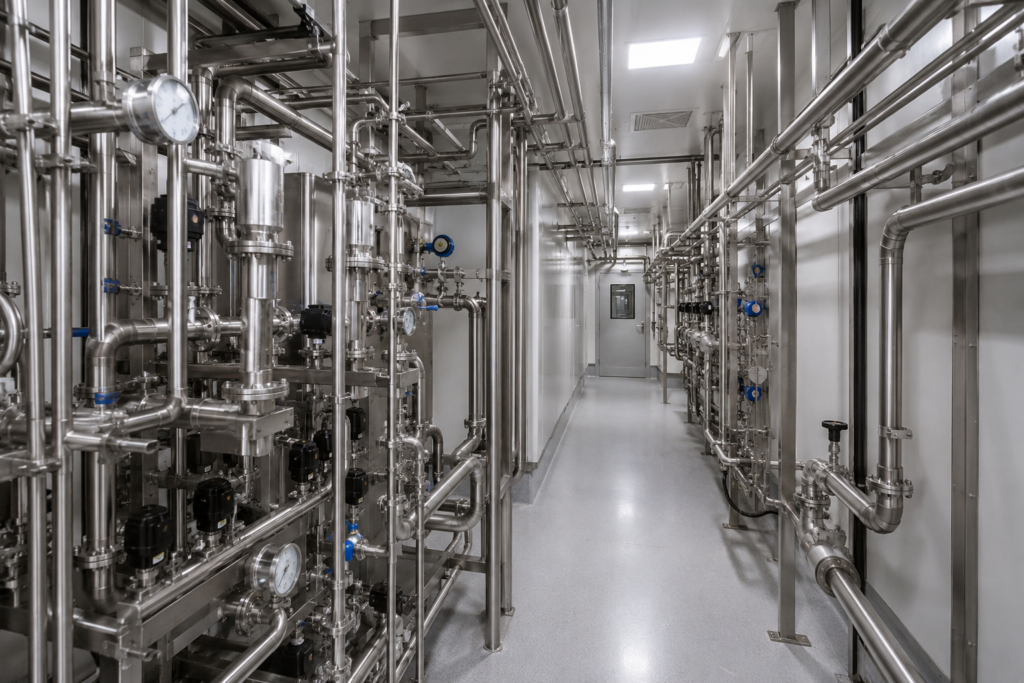
One of the key considerations in pharmaceutical facility design is the distinction between clean and black utilities. This separation, inside a modular clean room, supports GMP compliance and contamination control objectives rather than being solely a design preference.
Clean utilities are utility systems that come into direct contact with the product or the product-contact environment. These include purified water (PW), water for injection (WFI), clean steam, process gases, and compressed air. “Each of these must meet rigid purity specifications, be qualified by qualification protocols, and be continuously monitored throughout the product life cycle.”
Black utilities are infrastructure systems that do not come into direct contact with the product but support facility operations. These include potable water, steam from a standard boiler, chillers, HVAC supply, electrical feeds, fire suppression, and more. Although the black utilities are outside the direct GMP boundary, their reliability has a direct impact on the performance of the clean side. A bad chiller disrupts HVAC temperature control; a boiler outage disrupts sterilization.
In a modular pharmacy clean room system, the clean and black utility zones are physically separated as part of the architecture, from the ground up. The modular wall system pre-designs the routing of WFI loops, clean steam lines, and process gas distribution, eliminating the dead legs and contamination risk points that often occur when improvising utility runs on site with traditional construction.
Modular Cleanroom Accessories That Support Regulatory Performance
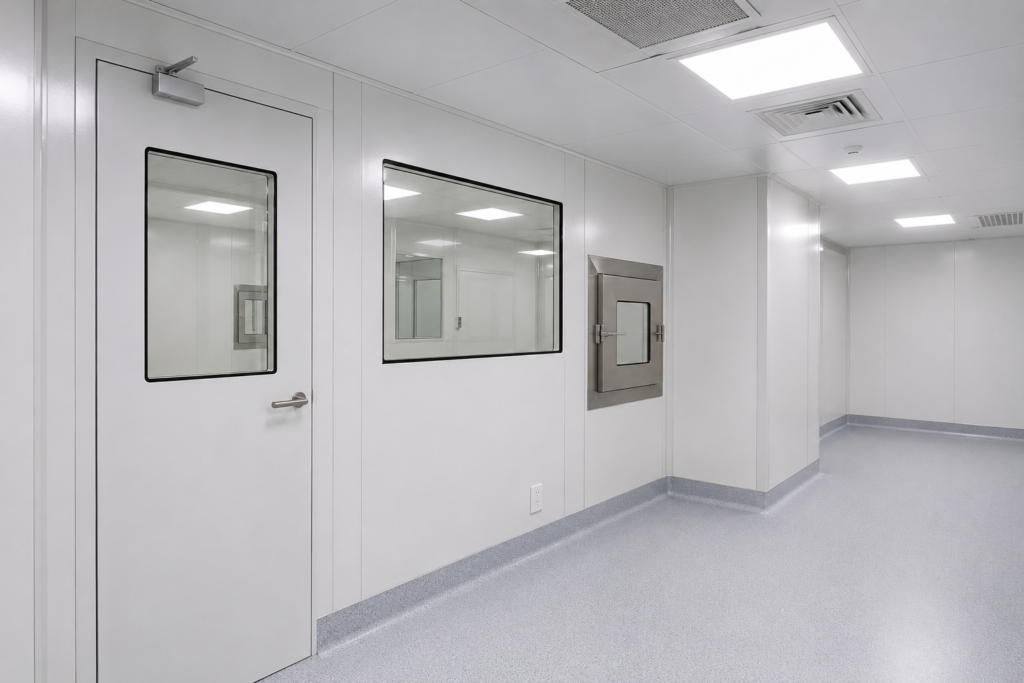
Modular cleanroom panels and frames are just the tip of the iceberg. The accessories that fit into the system have a direct impact on ISO classification and GMP compliance. Here’s what a well-specified modular arrangement typically includes:
- HEPA and ULPA filtration units are built flush into ceiling grids, providing the necessary airflow and air change rates required to maintain room classification based on the facility’s contamination control strategy and HVAC design requirements.
- Flush-mounted cleanroom lighting eliminates particle-trapping ledges and meets photometric requirements for production and inspection tasks.
- Pressure differential pass-through chambers and airlocks between clean zones and adjacent spaces to prevent cross-contamination.
- GMP-rated doors and windows with smooth, non-porous surfaces and gasket seals to keep classification boundaries at entry points.
- Cove flooring transitions eliminate the 90-degree angles where particles and microbes can collect.
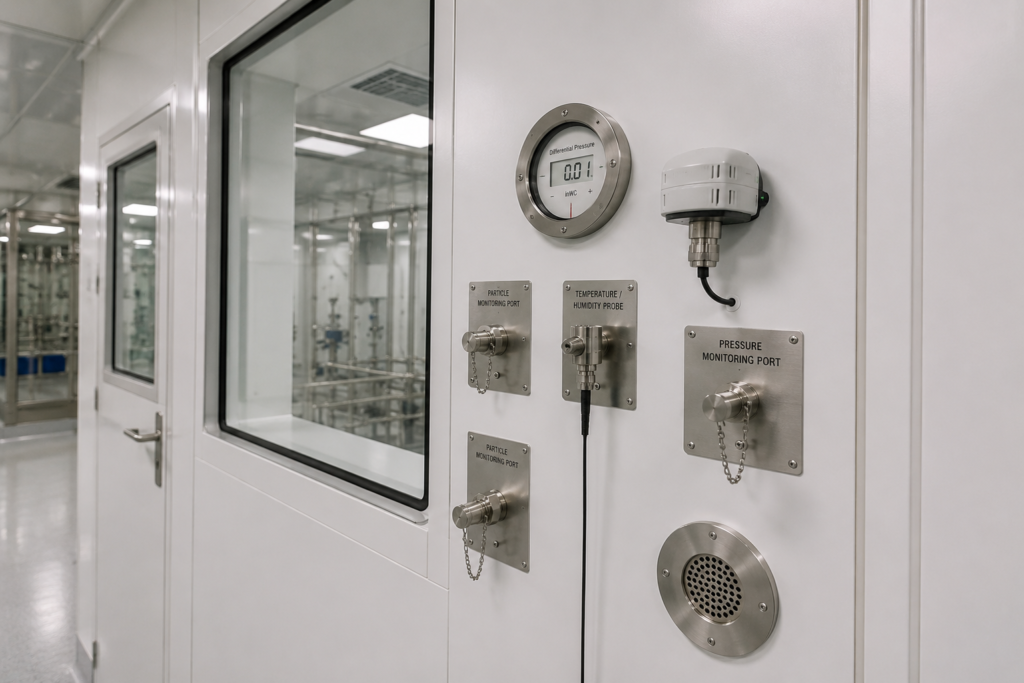
- Wall panels with pre-installed environmental monitoring ports for particle counters, temperature probes, and pressure sensors without breaking the cleanroom envelope.
Panel surfaces in GMP-compliant designs should be smooth, non-porous, easy to clean, and resistant to cleaning and disinfection agents. Many manufacturers provide low-surface-roughness finishes to support cleanability and contamination control objectives. The modular panel manufacturers specify these values at the factory level, eliminating the ambiguity of site-applied coatings on traditionally built walls.
The Construction Advantage: Speed, Quality, and Less Risk
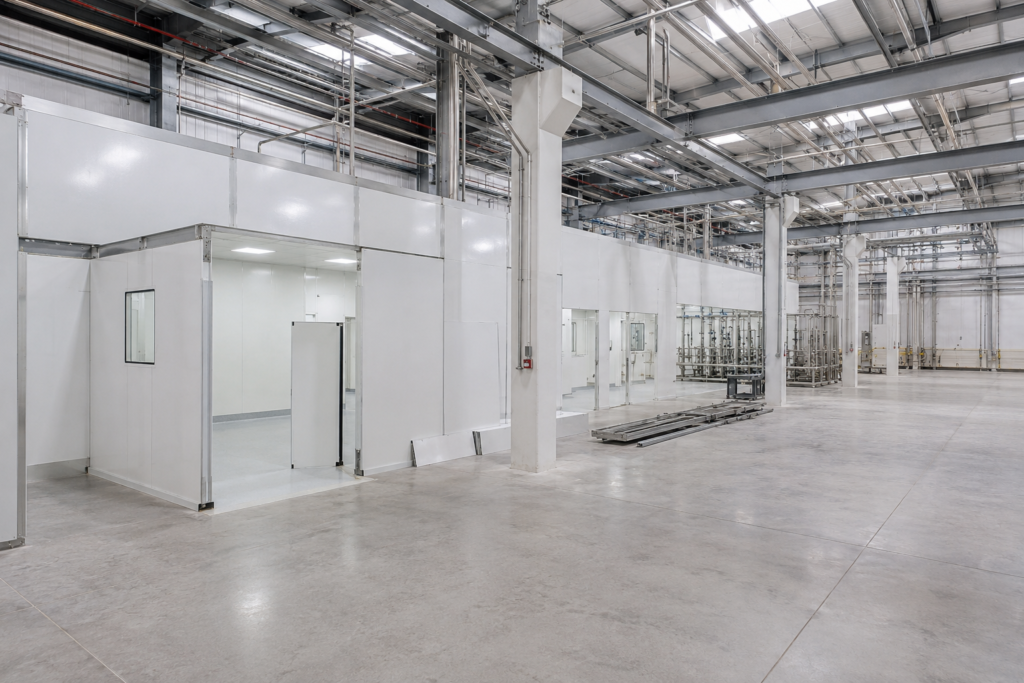
The speed of installation is one of the most practical reasons pharmaceutical manufacturers prefer modular pharmacy clean rooms over traditional construction. Studies show that modular systems can be significantly faster to deploy than traditional stick-built equivalents, depending on project scope and site conditions. Typical installation periods for modular cleanrooms can range from several weeks to a few months, whereas traditional construction projects often require substantially longer schedules.
Next steps from a project perspective also become clearer. Off-site fabrication in a factory reduces on-site labor hours—a lean manufacturing case study showed a 41% reduction in field hours for a modular facility with more than 85% of project hours completed off-site.
This is important for GMP compliance, as construction activity can introduce contamination risks that require additional controls and monitoring. In a pharmaceutical facility that’s active every day, a traditional cleanroom build is performed, which creates dust, particles, and moisture that need stringent controls. A modular approach significantly reduces that on-site exposure window.
Compliance also has another underrated benefit: reconfigurability. As regulations change or product lines shift, cleanroom modular panels can be moved, expanded, or upgraded without tearing down the entire space. This protects the long-term capital investment and can simplify future modifications and requalification activities when facility requirements or regulatory expectations evolve.
Pharmaceutical Procurement Consulting: Why Expertise Matters
Specifying and procuring a modular clean room system for a pharmaceutical facility is fundamentally different from purchasing conventional construction materials. The specifications are for structural panel performance, HVAC capacity calculations, filter grades, utility interface requirements, surface material certifications, fire ratings, and documentation packages for commissioning, qualification, and validation.
This is where consulting on pharmaceutical procurement can be a real differentiator. The right consulting partner bridges the gap between design intent and qualified vendors, verifies vendor documentation against applicable GMP and industry requirements, and manages the documentation trail that inspection teams will review. In procurement on a cleanroom project, getting it wrong means spending too much on specifications you didn’t need or underspecifying in areas that will lead to observations during a regulatory audit.
Organizations often benefit from working with experienced engineering and project delivery partners that can integrate design, procurement, construction, installation, and CQV activities under one coordinated approach. Pharma Access provides these capabilities through its turnkey project delivery model. Pharma Access’s team has 25+ years of experience on 120+ pharmaceutical projects in 18+ countries, managing everything from modular clean room design and engineering to procurement, construction, installation, and CQV (commissioning, qualification, and validation). The modular cleanroom design capability is one of a wider turnkey offering that encompasses HVAC system design, piping and plumbing, clean utility routing, and environmental monitoring integration.
Pharma Access also offers project management for facilities planning, sterile manufacturing, OSD, biotech, or API production that keeps regulatory timelines, construction progress, and quality milestones in sync from start to commissioning.
Commissioning, Qualification, and Validation in a Modular Clean Room
A modular clean room that meets the criteria of ISO classification is not necessarily GMP compliant. The qualification process includes Design Qualification (DQ), Installation Qualification (IQ), Operational Qualification (OQ), and Performance Qualification (PQ) to demonstrate that the facility and its systems consistently perform as intended.
ISO 14644-2 recommends retesting of ISO Class 5 spaces at a maximum of 6 monthly intervals and ISO Classes 6 through 9 spaces at 12 monthly intervals. In addition to classification testing, GMP requires integrated environmental monitoring of particulates, temperature, humidity, differential pressure, and microbial load mapped against defined alert and action limits.
Manufacturers can benefit from working with experienced teams such as those at Pharma Access, whose CQV services include qualification of both clean and black utilities, to provide a structured path from completion of construction to the first validated batch. Their CQV-centric design methodology is engineered in, not added on at the tail end, closing the gap between design intent and qualified reality.
Frequently Asked Questions
1. What is a modular clean room for pharmacies, and how does it differ from a traditional clean room?
The modular cleanroom for a pharmacy is made up of wall panels, a ceiling system, and integrated HVAC components that are factory-produced and installed on-site. Traditional clean rooms are constructed on-site from raw materials. Modular systems offer faster installation times (typically 4 to 12 weeks versus 6 to 18 months), better quality control during fabrication, and are more easily reconfigured over time as regulatory requirements or product lines change.
2. Which ISO classification do pharmaceutical modular clean rooms typically need to meet?
Most pharmaceutical manufacturing applications are ISO Class 5 through 8 or EU GMP Annex 1 Grades A through D. Aseptic filling and other critical sterile operations require ISO Class 5 (Grade A). The non-sterile formulation and support areas usually run at ISO Class 7 or 8. The precise classification depends on the dosage form, type of process, and applicable regulatory guidelines.
3. What is the difference between clean utilities and black utilities in a pharmaceutical facility?
Clean utilities include purified water, water for injection, clean steam, and process gases. They are in direct contact with the product or the environment in which the product is prepared and must comply with GMP purity specifications and be fully validated with documentation. Black utilities include steam boilers, chillers, potable water, and the HVAC supply air that supports the facility but does not contact the product. While clean utilities generally carry stricter regulatory and qualification requirements, both clean and support utilities must operate reliably to maintain GMP compliance.
4. How do modular cleanroom accessories contribute to GMP compliance?
Accessories such as flush-mounted HEPA filters, pre-installed environmental monitoring ports, pressure-rated pass-through chambers, and GMP-rated doors all contribute to maintaining the classification boundary and contamination controls as specified by ISO 14644-1 and EU GMP Annex 1. The panel surface roughness, coved flooring transitions, and airtight joint systems also directly reduce particle accumulation and microbial risk, all of which are factors that inspectors are trained on in site audits.
5. When should a pharmaceutical company engage a pharmaceutical procurement consultant for a clean room project?
Preferably at the beginning of the engineering design phase. Procurement consulting converts facility design requirements into vendor specifications, checks vendor compliance documentation with current GMP and ISO standards, and manages the documentation package necessary for qualification. The longer you wait to get involved, the more likely you will have specification gaps, rework, or qualification delays that push out product launch timelines significantly.