If you work anywhere near a pharma manufacturing floor, you have heard these three letters thrown around constantly: IQ, OQ, PQ. They sound like alphabet soup until you actually need to install a new tablet press or bring a filling line online, and suddenly they are the only thing standing between your equipment and production. No one involved in facility projects can afford not to understand IQ, OQ, and PQ pharmaceutical industry requirements. That’s the core of how manufacturers demonstrate that equipment, facilities, utilities and systems are suitable for their intended use and regulators assess the documented evidence supporting that qualification.
This post goes through what each stage covers, how they work together, and what real IQ, OQ, and PQ HVAC pharmaceutical industry work looks like on the ground. We’ll try to keep it simple and avoid dense regulatory language where possible.
What Do IQ, OQ, and PQ Actually Mean?
Qualification is the documented process that verifies that equipment, systems, or utilities are fit for their intended use. It provides documented evidence that the equipment or system is ready to perform its intended function, not just sitting in the room looking good.
The three core stages are as follows:
- Installation Qualification (IQ): Verifies that the equipment is installed properly, utilities are connected correctly, and all documentation and components agree with the approved engineering drawings and specifications.
- Operational Qualification (OQ): Tests machine functions like speed, temperature, alarms, interlocks, and control systems to confirm proper operation within defined limits.
- Performance Qualification (PQ): Demonstrates that the facility, utility, equipment, or system performs effectively and reproducibly under representative normal operating conditions.
Each step builds on the one before. You can’t skip IQ and go right to OQ, because testing how a machine works isn’t meaningful if it was never verified to be installed properly in the first place. Depending on equipment complexity and the approved qualification strategy, however, IQ and OQ may be performed as a combined IOQ.
DQ: The Step Before IQ
All this happens after most facilities have been through a Design Qualification (DQ) stage.DQ itself is normally preceded by a User Requirements Specification (URS), which defines what the facility, utility, equipment, or system is expected to achieve. DQ makes sure the equipment or system is designed to meet GMP and user requirements before you buy it or before the design is finalised. . For instance, before buying a tablet compression machine, a facility will confirm that the design matches the intended production speed, batch size, and cleaning needs. Getting DQ right early reduces downstream redesign and qualification rework. Catching a design mismatch on paper is much cheaper than catching it after the equipment is already installed.
DQ IQ OQ PQ Equipment Qualification in Pharma: The Full Sequence
The full sequence for DQ, IQ, OQ, and PQ equipment qualification that pharma teams follow typically progresses from URS and DQ through FAT/SAT, where applicable, followed by IQ, OQ, and PQ. Each stage is logically connected and should be appropriately documented before progression, although stages may be combined or conditional progression may be authorised where scientifically justified and documented.
Installation Qualification (IQ) is the first step. It confirms that:
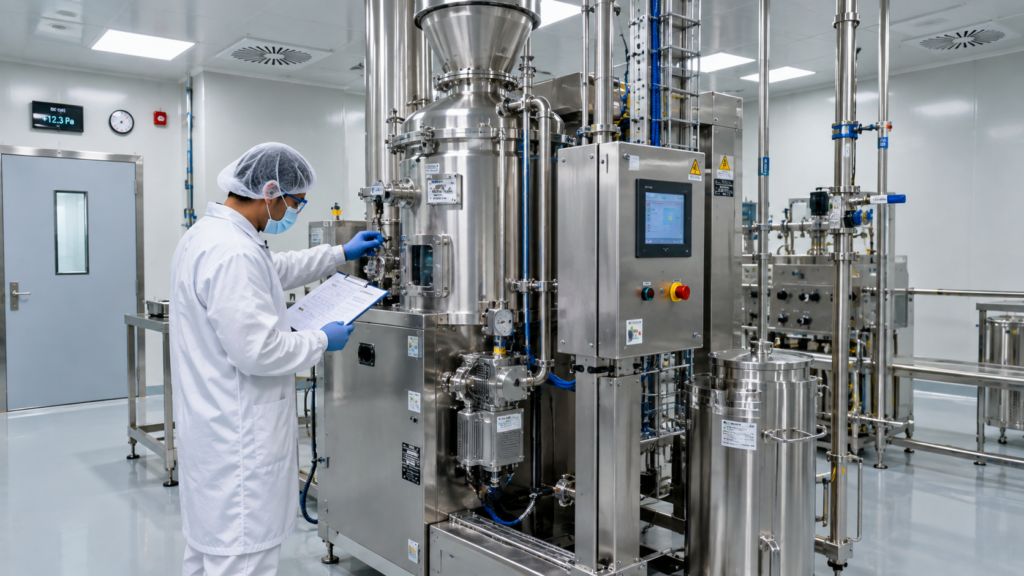
- The equipment conforms to approved engineering drawings and specifications, purchase requirements, and vendor specifications.
- Utilities: power, water, and compressed air are connected correctly.
- All manuals, drawings, and calibration certificates are available and correct.
- The equipment is physically situated in an environment which satisfies its intended operating conditions.
- If careful documentation is skipped here, problems may not show up until much later, particularly when records are requested during review or inspection.
Operational Qualification (OQ): OQ tests the actual functions of the equipment. In this stage, it checks things like:
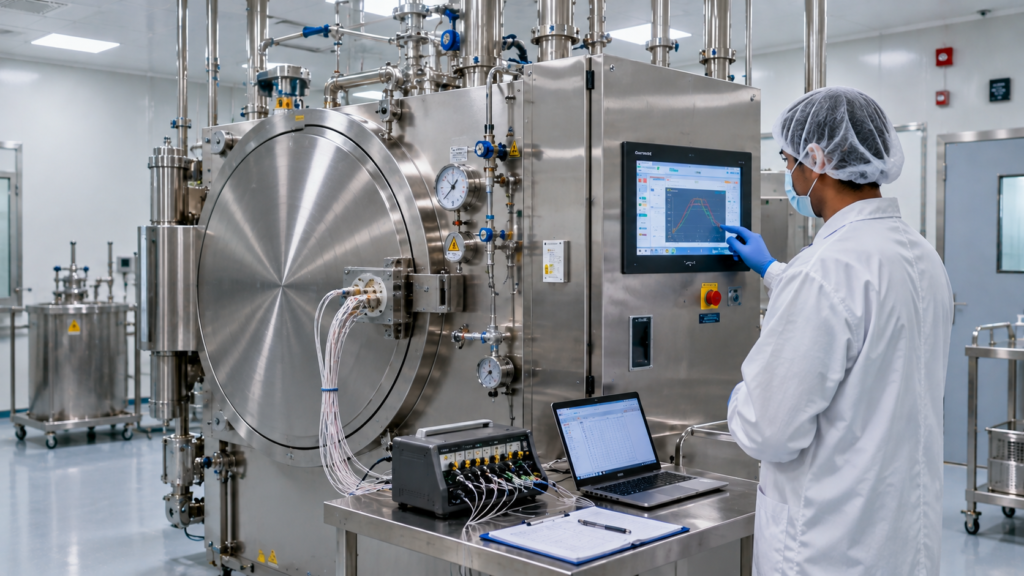
- Speed and timing controls are within their specified ranges.
- Alarms will fire correctly when conditions are out of range.
- Interlocks and safety systems operate as intended.
- Control systems maintain set points under varying loads.
- Relevant upper and lower operating limits and worst-case conditions are challenged where appropriate.
A lot of real problems get caught at OQ. A machine could be installed perfectly but still not hold temperature within spec, or its alarm could activate outside the specified set point or tolerance. The whole point of the exercise is to find that during OQ, not during a live production run.
Performance Qualification (PQ)
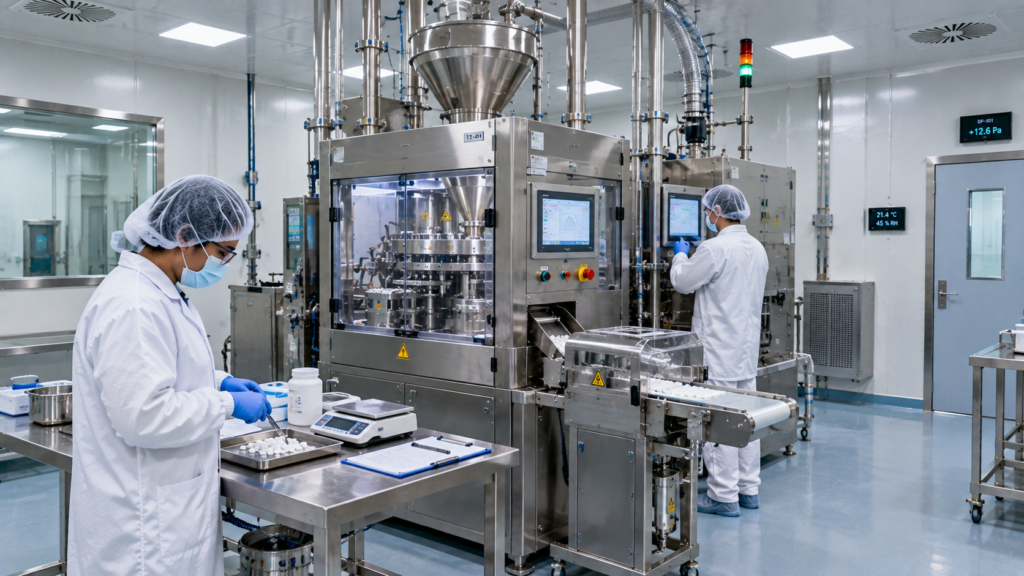
It is the last step and should normally begin when IQ and OQ are both complete. Through PQ, a facility demonstrates with real evidence that its equipment or system performs effectively and reproducibly under representative normal operating conditions and across the intended operating range. For example, a PQ for a tablet press may involve production of full-scale batches or representative production runs, with justified sampling used to evaluate relevant equipment-performance, in-process and product-quality parameters, as applicable.
PQ should not be confused with Process Performance Qualification (PPQ). Equipment PQ demonstrates that a facility, utility, equipment item or system performs as intended under representative operating conditions. PPQ is part of process validation and evaluates whether the commercial manufacturing process, using qualified facilities, utilities and equipment together with trained personnel and established controls, can reproducibly manufacture products meeting its predetermined quality requirements.
IQ OQ PQ Examples: What This Looks Like in Practice
Reading about IQ, OQ and PQ in the abstract is only so helpful. Here are a few concrete IQ OQ PQ examples that illustrate how this plays out for common pharma equipment:
- Autoclave: IQ verifies correct installation and utility connections. OQ tests include cycle controls, temperature distribution, pressure control, alarms and interlocks. PQ confirms reproducible cycle performance and heat penetration across defined load configurations, with appropriate biological challenge where applicable.
- HVAC system: IQ verifies ductwork, filters, instrumentation and controls installed to specification. OQ checks airflow rates, pressure differentials, environmental controls and alarm response. PQ verifies that the system maintains the required environmental conditions and cleanroom performance under representative operating conditions, as applicable.
- Filling line: IQ confirms mechanical installation and utility hookups. OQ tests fill accuracy, speed settings, alarms, interlocks and reject mechanisms across the intended operating range. PQ confirms that under representative production conditions, the line performs consistently over an appropriate operating period, including personnel changes and routine operating interventions where relevant.
- Stability chamber: IQ verifies installation and calibration records. OQ verifies temperature and humidity control over the defined operating range. PQ confirms the chamber holds these conditions reliably over an extended period with an appropriate representative load.
Every piece of GMP-impacting pharma equipment gets this same basic treatment, with the scope and depth of qualification scaled according to its risk, complexity, criticality and intended use.
Facility Qualification vs Equipment Qualification
There is a distinction that trips up a lot of people new to this subject, and it’s worth being clear about. Qualification of equipment is specific to individual machines, such as a tablet press or an autoclave. Facility qualification is broader, covering GMP-relevant facilities and supporting systems that support all that equipment together, things like HVAC, water systems, clean utilities, and the overall cleanroom environment.
A successful programme in this area confirms that the building itself, not just the individual pieces of equipment inside, meets the conditions needed for GMP manufacturing. Both approaches have the same DQ, IQ, OQ, and PQ logic, but qualifying the whole building usually takes more time and involves more interconnected systems, as a change in one utility can impact several rooms and processes at the same time.
Why IQ, OQ, and PQ in the Pharmaceutical Industry Matter So Much
Without documented evidence across DQ, IQ, OQ, and PQ, regulators cannot verify that your equipment and facility consistently support GMP manufacturing. This is not a paperwork formality. A pharmaceutical product made using inadequately qualified GMP-critical equipment or systems may introduce real risks for patients, whether it’s inconsistent dosing, contamination, or inadequate control of a sterilisation process.
Regulatory bodies, including the FDA, consider qualification as one of the key activities that must be completed before equipment and utilities are used for commercial-scale Process Performance Qualification and before routine commercial distribution begins.
Common Mistakes Facilities Make With IQ, OQ, and PQ
During qualification work, a handful of recurring issues show up again and again:
- You start OQ before IQ is adequately completed or formally released, without a documented combined IOQ or conditional-progression strategy, forcing teams to retest functions once installation gaps are identified late.
- Weak or absent DQ documentation, meaning there is no clear baseline against which equipment can be tested during later stages.
- Treating PQ as a formality rather than a genuine test under realistic production loads and shift patterns.
- Bad change control, where a mid-project equipment substitution or design tweak never makes it back into the qualification protocols.
- Disconnected facility and equipment qualification, where HVAC or utility qualification is on a separate track from equipment qualification, creating gaps at the interfaces between them.
Where This Fits Into the Bigger Picture: Commissioning Qualification Validation
IQ, OQ and PQ do not happen in isolation. They sit within the broader commissioning qualification validation framework that governs how a pharma facility is built and brought online. Commissioning provides engineering evidence that systems have been installed, tested and operated in accordance with approved design requirements and design intent. Qualification (DQ, IQ, OQ, and PQ) provides the documented GMP evidence that applicable facilities, utilities, equipment and systems are suitable for their intended purpose. Validation demonstrates that the manufacturing process can consistently deliver product meeting predetermined quality requirements.
Seeing these as one connected lifecycle (rather than three separate handoffs between different teams) is what prevents a facility from finding out about gaps after production has already begun.
How This Connects to Facility Design and Construction
Qualification results are determined well in advance of anyone executing a single IQ protocol. The design and construction of a facility will determine the ease with which qualification proceeds. For a more detailed look at how design and construction decisions flow into qualification, our guide to facility design & construction spans the full lifecycle from concept through commissioning and pairs well with the qualification concepts covered here.
Our teams at Pharma Access take design intent through construction and into CQV, so validation protocols are written against decisions made by our own engineers, not recreated after the fact from someone else’s drawings. A big part of that continuity is why DQ, IQ, OQ, and PQ equipment qualification pharma work can maintain clearer traceability from design intent through commissioning and qualification while reducing the risk of late-stage documentation and system-interface gaps. You can read more about our approach on the Pharma Access about page.
Getting IQ, OQ, and PQ Right the First Time
Facilities that treat design and construction decisions, the kind covered in our guide to facility design & construction, as part of the qualification story from day one tend to move through IQ, OQ and PQ with far fewer surprises.
A handful of habits distinguish teams that do well in qualification from those that get stuck:
- Write the URS and DQ documentation before finalising equipment procurement so that IQ has a clear approved specification to test against.
- Instead of running stages in parallel without a justified qualification strategy, close out each stage or formally authorise progression before starting the next one.
- Build realistic PQ scenarios covering an appropriate operating period and representative conditions, including adjustments, stoppages, personnel changes and material replenishment where relevant, not just a single best-case run.
- Keep facility and equipment qualification linked, so utility and HVAC qualification corresponds to the equipment schedules that depend on them.
- Maintain tight change control throughout the project so that any equipment or design change is reflected immediately in the qualification protocols and associated documentation.
Wrapping Up
Good IQ OQ PQ pharmaceutical industry practice is not a bureaucratic hoop to jump through in manufacturing. They are the structured trail of evidence that proves that your equipment and facility actually do what they were designed to do, consistently and safely. Get the sequence right, document thoroughly, and treat facility and equipment qualification as one connected process, and your project is better positioned for inspection readiness while reducing the risk of qualification-related rework.
FAQs
What is the difference between IQ, OQ, and PQ?
IQ verifies the equipment is installed correctly. OQ tests that it runs within defined limits. PQ confirms that the equipment or system performs effectively and reproducibly under representative operating conditions. The stages normally progress logically, although qualification activities may be combined or progression may be conditionally authorised where appropriately justified and documented.
What does DQ mean, and why does it come before IQ?
DQ is Design Qualification. It ensures the equipment’s design conforms to GMP and the approved URS before procurement or design finalisation, providing IQ with a clear specification to check installation against later.
Can any of these qualification stages be skipped for simple equipment?
The rigour can scale with risk, but qualification activities may be combined or simplified where justified by risk, complexity and criticality. What should not be omitted for GMP-impacting equipment is adequate documented evidence that the equipment is suitable for its intended use.
What is the difference between equipment qualification and facility qualification?
Equipment qualification is done on a per-machine basis. The qualification of the facility is the qualification of the broader building systems, such as HVAC and utilities, that support all the equipment as a whole. They both follow the same DQ, IQ, OQ, and PQ approach, just at a different scale.
How long does IQ OQ PQ typically take for a new facility?
There is no universal duration for IQ, OQ and PQ on a new pharmaceutical facility. The timeline depends on facility size, the number and complexity of systems, equipment criticality, FAT/SAT strategy, documentation readiness, qualification sequencing, deviations and the overall CQV execution plan.
Technical References
1. European Commission — EudraLex Volume 4, Annex 15: Qualification and Validation.
2. U.S. FDA — Process Validation: General Principles and Practices, Guidance for Industry.
3. Pharmaceutical Inspection Co-operation Scheme (PIC/S) — PI 006-4: Recommendations on Qualification and Validation.