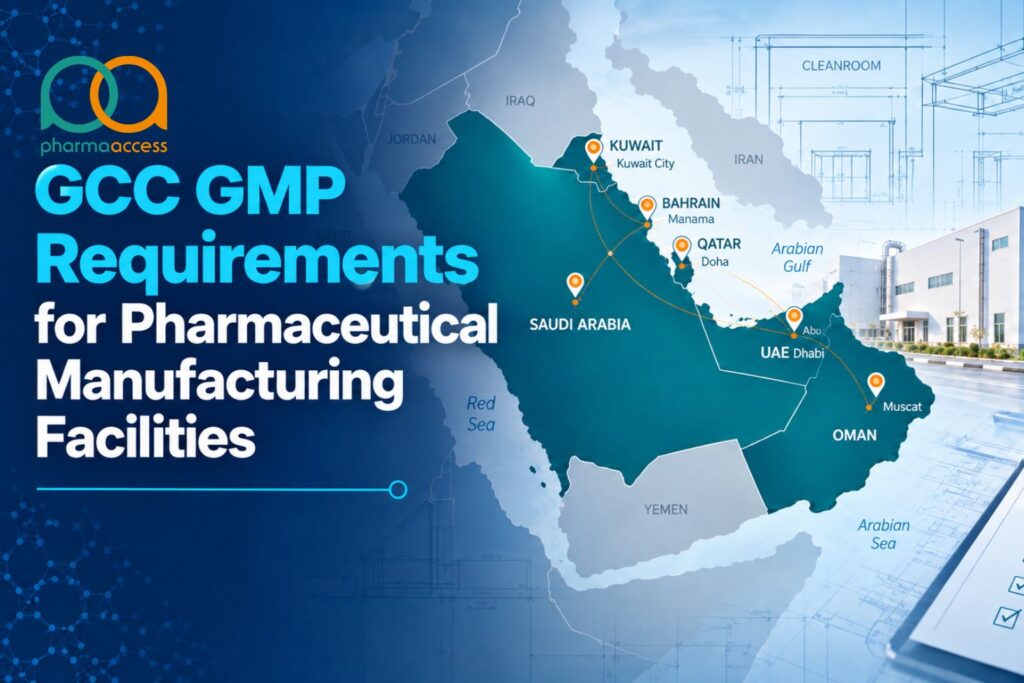
If you are building or upgrading a pharmaceutical plant in Saudi Arabia, the UAE, Qatar, Oman, Bahrain, or Kuwait, you’ve probably come across the term ‘GMP’ more times than you can count. It is what you hear on every registration form, every inspection report, and every conversation with regulators. But what does this mean for a factory floor?
This guide gives a simple-to-understand overview of the GCC GMP requirements for pharmaceutical manufacturing. No dense legal jargon, just the information you need before you design, build, or operate a plant in the Gulf region.
What GMP Actually Means for a Pharma Plant
Good Manufacturing Practice (GMP) is the part of pharmaceutical quality assurance that ensures medicines are consistently produced and controlled to the quality standards appropriate to their intended use. The point is simple: every batch of medicine should be consistently manufactured and controlled – with risks such as contamination, cross-contamination, mix-ups, and processing errors appropriately managed.
For a factory, this means just about everything:
- Building layout
- Composition of walls and floors
- How air flows in production rooms
- How the equipment is cleaned and calibrated
- How records are kept
- How staff are trained
GMP is not simply a certification label applied to a building. It is a way of running the place, and regulators check it through documented evidence as well as actual manufacturing practices.
How the GCC Handles Drug Registration and GMP
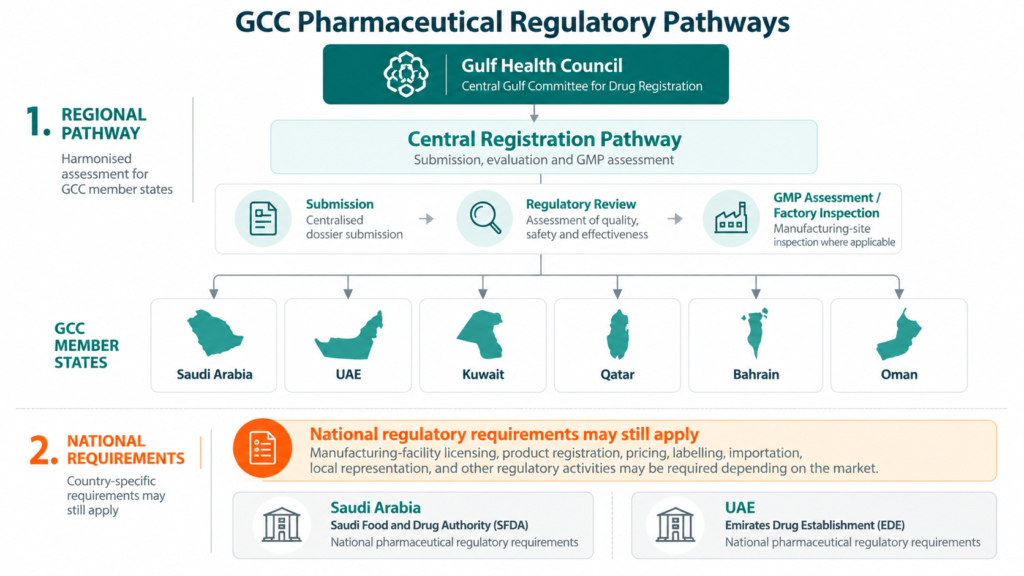
The six Gulf countries (Saudi Arabia, UAE, Qatar, Kuwait, Bahrain and Oman) have put in place a common system to harmonise parts of the drug registration process for manufacturers. The system is operated by the Gulf Health Council (GHC) in Riyadh and its Central Gulf Committee for Drug Registration.
The basic idea behind GCC central drug registration GMP rules is:
- The manufacturer sends a centralised registration dossier through the Gulf Health Council system rather than repeating the complete assessment separately across each participating market.
- GHC reviews the product for quality, safety, and effectiveness.
- A technical team can visit the manufacturing site to verify that it adheres to Good Manufacturing Practices and applicable international manufacturing standards.
- Once approved, the centralised pathway can reduce duplication in regulatory assessment across GCC member states.
- The centralised route operates alongside applicable national regulatory pathways. Companies targeting individual markets must also consider requirements of national authorities such as Saudi Arabia’s SFDA or the UAE’s Emirates Drug Establishment (EDE).
- Country-specific requirements relating to manufacturing-facility licensing, product registration, pricing, labelling, importation, local representation, or other regulatory activities may still apply depending on the market and regulatory pathway.
Core GMP Facility Requirements in the GCC
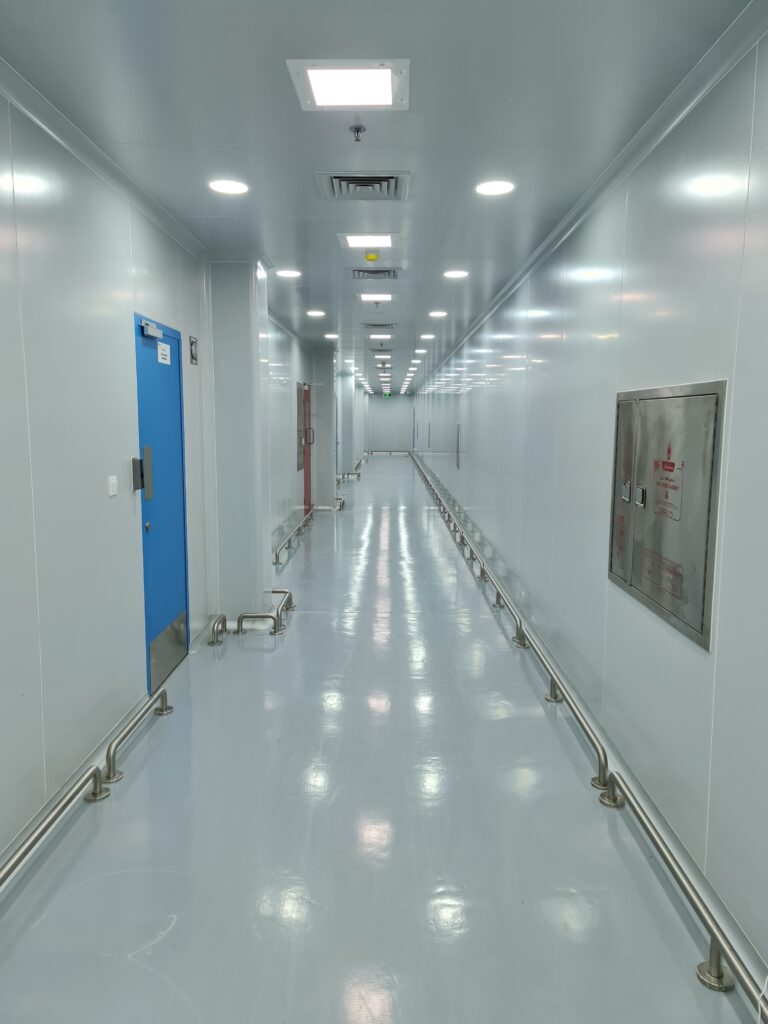
If it is a central system or a national system, the physical plant has to meet applicable GMP requirements established by the relevant regulatory authority. These are some of the core areas addressed during GMP assessment and inspection.
Building and Premises Design
The layout has to follow the logic of production, from raw material input to finished product output. Rooms should be arranged in such a way that materials and people move through controlled routes that minimize crossings and interactions that could create contamination, cross-contamination, or mix-up risks. Surfaces should be smooth, washable, and without crevices where dust or microbes can collect.
Cleanrooms and HVAC Systems
This is an area where first-time pharmaceutical facility projects can encounter significant challenges. Clean room validation for sterile products are classified according to defined airborne particle concentrations. Air handling systems must maintain airflow patterns and pressure relationships between rooms appropriate to the product, process, and contamination-control strategy. Temperature, humidity, and airflow should be monitored at a frequency appropriate to the process and qualified operating conditions, with alarms provided for critical parameters where excursions could affect product quality or contamination control.
Equipment and Utilities
Production machines need to be appropriately qualified before routine use and maintained in a qualified state, with requalification performed where required based on defined intervals, changes, periodic review, or quality risk assessment. Water systems, especially purified water and water for injection systems, also require their own qualification and periodic testing. Compressed air and other utilities that contact the product are also subject to GMP scrutiny.
Documentation and Quality Systems
Every GMP-relevant operation should have an approved written procedure, and each batch must have a record that the procedure was followed. Supporting quality documentation includes deviation reports, change controls, CAPA records, calibration records, training records, and qualification and validation documentation. Inspection activities typically include detailed review of these records, because documentation gaps can indicate weaknesses in the pharmaceutical quality system.
Personnel and Training
Training should be provided to staff in production areas to cover their role, and this training should be documented and refreshed on a regular basis. Gowning procedures for cleanroom entry, hygiene practices, and microbiology awareness where relevant to the operation all form part of the picture.
Saudi Arabia’s SFDA and Its GMP Framework
The Saudi Food and Drug Authority (SFDA) plays a central role in regulating pharmaceutical manufacturing and GMP compliance in Saudi Arabia. SFDA became the 56th PIC/S Participating Authority on 1 July 2023 following completion of the PIC/S accession assessment process. PIC/S supports international harmonisation of GMP inspection practices among participating authorities, strengthening alignment between participating inspectorates and internationally recognised GMP inspection principles.
This is important for manufacturers looking for a GCC pharmaceutical manufacturing footprint because SFDA’s regulatory framework requires evidence of GMP compliance and allows the authority to inspect manufacturing sites to verify implementation. A GMP certificate or previous inspection history does not automatically replace an SFDA inspection, so the applicable registration and inspection requirements should be confirmed for each manufacturing site.Saudi Food and Drug Authority
Steps to Get a Pharmaceutical Factory GCC-Ready
If you are starting from scratch or upgrading an old plant, here is a simple sequence to follow:
- First, define your product scope: Tablets, sterile injectables, biologics, and APIs all have different process, environmental-control, containment, and utility requirements, so this decision dictates much of what happens downstream.
- Design the facility to GMP flow: Get engineering involved early so the layout of the building, HVAC design, and flow of personnel and materials are consistent with GMP and contamination-control requirements from day one and not retrofitted later.
- Qualify utilities and equipment: Water systems, HVAC, and process equipment must undergo appropriate lifecycle qualification activities covering installation, operation, and performance requirements, as applicable, before routine GMP use.
- Build your quality system side by side: SOPs, batch records, training programmes, and other required quality documentation should be developed alongside facility delivery and be in place before routine GMP manufacturing begins.
- Conduct a GMP readiness assessment or mock inspection: A structured review against applicable SFDA, national regulatory, or PIC/S-aligned expectations is a good way to identify gaps before a regulatory inspection.
- File for registration: Decide whether the GCC centralised route or the applicable national registration pathway best fits your target markets and regulatory strategy. Gulf Health Council
Common Challenges Manufacturers Run Into
There are some recurring issues in GMP facility requirements for GCC projects:
- Cleanroom classifications or environmental-control requirements are selected without sufficient consideration of the actual product and process risk. This can cause redesign, rework, or qualification challenges downstream.
- Late-stage value engineering changes HVAC capacity, zoning, or control philosophy without adequately assessing the impact on qualified operating conditions.
- Documentation systems are created as an afterthought instead of being developed alongside the physical build and qualification programme.
- Teams assume there is one identical GCC standard for every market and overlook national regulatory nuances between Saudi Arabia, the UAE, and other member states.
- Integrating engineering and GMP requirements from the beginning can reduce many of these avoidable project risks. This is the type of work that Pharma Access specialises in, because GMP-driven facility design must consider regulatory expectations from the first drawing, not after construction is complete.
Why Early Engineering Input Matters

Many avoidable GMP readiness issues can originate during the design stage. In the first few weeks of a project, decisions are made about cleanroom classification, HVAC zoning, and material flow, and those decisions are expensive to reverse once construction has progressed. This is precisely the step that Pharma Access works with pharmaceutical manufacturers on, developing facility designs, cleanroom layouts, HVAC and utility strategies, and validation approaches around the compliance requirements against which the plant will ultimately be qualified and inspected. Addressing these details before construction starts can reduce redesign, rework, and qualification challenges ahead of regulatory inspection.
And for companies deciding whether to build greenfield or upgrade an existing site, Pharma Access also provides support for commissioning, qualification and validation (CQV) work – where design requirements, system performance, and applicable GMP requirements are verified and documented against the completed facility and installed systems.
A Few Final Thoughts
The GMP requirements of the GCC for pharmaceutical manufacturing are not one fixed checklist. These are systems that combine a regional registration system through the GHC with national oversight by bodies such as Saudi Arabia’s SFDA and the UAE’s EDE, supported by internationally recognised GMP principles and the specific requirements adopted by each national authority. Get the facility design, documentation, and training right from the start, and you create a stronger foundation for qualification, regulatory inspection, facility licensing, and ongoing GMP compliance. World Health Organization
Frequently Asked Questions
What is the difference between GCC-DR and national drug registration?
GCC central registration is a harmonised pathway operated through the Gulf Health Council for the assessment and registration of pharmaceutical companies and products across participating GCC markets. National registration is handled through the relevant country authority, such as Saudi Arabia’s SFDA or the UAE’s EDE, and country-specific regulatory requirements may still apply.
Does every GCC country have the same GMP standard?
No. GCC cooperation provides harmonised elements of pharmaceutical registration and GMP oversight, but manufacturing-facility licensing, inspections, documentation requirements, and implementation remain subject to the applicable national regulatory authority. Requirements should therefore be assessed for each target market rather than assuming that one identical GMP framework applies throughout the GCC.
How long does GMP certification take for a new pharmaceutical facility in the GCC?
There is no single GCC-wide timeline. The duration depends on the relevant national authority, product and manufacturing scope, facility readiness, completion of qualification and validation activities, documentation status, inspection scheduling, and closure of any regulatory observations.
Can a foreign GMP certificate replace a physical inspection in Saudi Arabia?
Not automatically. A current GMP certificate and previous inspection history can form part of the manufacturer’s regulatory documentation, but SFDA retains authority to inspect manufacturing sites to verify GMP implementation. The applicable inspection requirements should therefore be confirmed for each site and regulatory pathway.
What causes the most GMP inspection failures in pharmaceutical factories?
Inspection observations can arise across the pharmaceutical quality system, premises, equipment, documentation, production, qualification and validation, utilities, personnel practices, and contamination-control systems. For example, SFDA’s published 2025 GMP inspection analysis identified quality management systems, premises, equipment, and documentation among the most frequently cited deficiency areas.