Water for Injection may seem like an easy thing to make. It is only water, after all. But WFI must meet stringent compendial requirements for chemical purity and bacterial endotoxins, together with tight microbiological control, because it is used in pharmaceutical applications where control of pyrogens and microbiological contamination is critical. It takes a good production system to get there, and for decades there was only one way to do it: distillation.
That is no longer the case. This guide gives plain language explanations of the methods of producing water for injection, including how distillation and membrane systems work, what changed in the regulations, and how to think through which approach fits a given facility.
What Makes WFI Different From Regular Purified Water
Systems that produce purified water reduce dissolved minerals and organic material to levels suitable for many pharmaceutical uses, but WFI must be of a higher standard. Compared with Purified Water, WFI is intended for higher-risk pharmaceutical applications and is subject to bacterial endotoxin requirements together with stringent microbiological control, in addition to applicable chemical-quality requirements.
For much of the history of the industry, distillation was the established approach for producing WFI. But that changed as membrane technology matured, and that changed the regulatory picture too.
The Regulatory Shift That Opened the Door to Membranes
Up until 2017, the European Pharmacopoeia monograph for Water for Injections required distillation as the production method. The United States and Japanese pharmacopoeias had permitted alternative purification approaches earlier, but Europe held out, with particular attention given to the microbial-control risks associated with non-distillation systems.
That changed in April 2017, when the European Pharmacopoeia revised its monograph on Water for Injections (0169) to allow production purification processes equivalent to distillation, including reverse osmosis combined with appropriate complementary techniques. This harmonised European rules with the US and Japanese pharmacopoeias, which had already accepted membrane-based approaches.
The alignment continued to widen. In 2020, membrane processes were recognised as an acceptable WFI production method in Annex 3 of WHO Technical Report Series 1025. In October 2025, the 2025 edition of the Chinese Pharmacopoeia came into force, further updating the pharmaceutical-water regulatory framework in China. Non-distillation WFI generation is now recognised across multiple major regulatory and pharmacopoeial frameworks, although applicable national requirements and product-specific regulatory commitments should always be confirmed for individual projects.USP–NF
How Distillation-Based WFI Works
Distillation removes contamination by converting water into vapour while non-volatile contaminants remain in the liquid phase. Proper vapour separation and control of entrained droplets help prevent contaminants, including bacterial endotoxins, from being carried into the distillate before the purified vapour is condensed back into WFI.
Two main distillation methods dominate WFI distillation systems today.
Multiple Effect Distillation (MED)
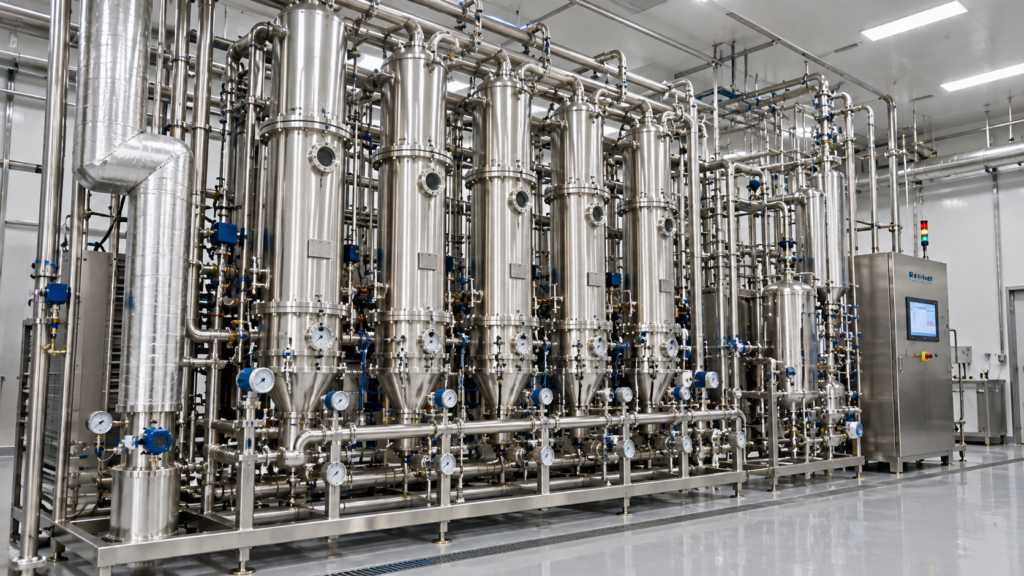
The multiple-effect distillation WFI systems comprise a series of evaporator “effects” connected in series. Plant steam heats the first effect, and vapour generated in one effect is then used as the heating medium for the next effect, typically operating at progressively lower pressure and temperature. The heat from each effect is recycled into the next so that the total energy required is reduced as heat is reused across the system.
MED systems need separate condensers with cooling water to complete the process, and they have fewer moving parts than mechanical alternatives, which usually means lower maintenance needs. Certain MED configurations can also integrate pure-steam generation, allowing some system designs to produce both WFI and pure steam from the same unit.
Vapour Compression (VC) Distillation
Vapour compression WFI systems take a different mechanical route. VC systems reduce dependence on external steam during normal operation by using mechanical compression to increase the pressure and temperature of vapour generated in the process and then reusing the compressed vapour as the heating medium for ongoing evaporation.
This design recycles latent heat internally, generally leading to lower energy consumption for VC systems compared to MED systems, because they require less external steam and can operate with lower cooling water demands. Depending on equipment configuration, VC systems can also provide flexibility in delivering WFI at different outlet temperatures, although the final storage and distribution temperature remains a separate system-design decision.
Multiple Effect vs Vapour Compression: A Quick Comparison
| Factor | Multiple Effect Distillation | Vapour Compression |
| Energy source | External steam | Mechanical compression |
| Heat reuse | Across sequential effects | Internal, recycled continuously |
| Cooling water needs | Higher | Lower |
| Moving parts | Fewer | More |
| Output temperature | Cooling may be required where lower-temperature WFI is needed | Can offer greater outlet-temperature flexibility depending on system configuration |
| Typical design consideration | Often attractive where reliable steam and cooling infrastructure already exist | Often attractive where reduced steam demand and internal heat recovery are priorities |
Neither approach is universally superior. The right choice depends on what utilities are already in a facility, what output capacity is needed, and whether energy demand, lifecycle cost, operating philosophy and WFI supply temperature are priorities.
How Membrane-Based WFI Systems Work
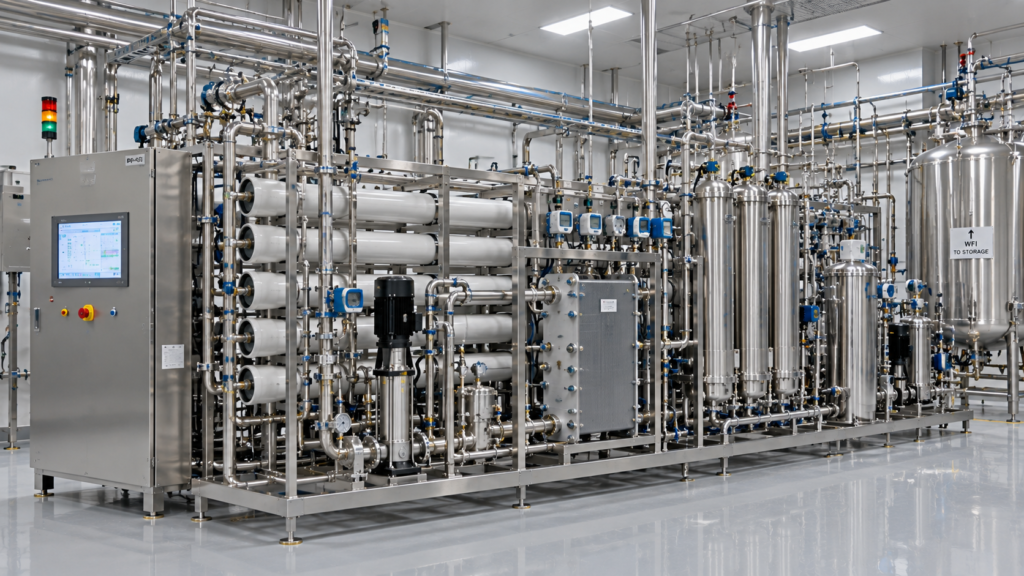
Membrane-based WFI production completely avoids phase change. These systems combine reverse osmosis with complementary purification technologies designed to control ionic, organic, microbial and endotoxin-related contaminants without converting water to steam and back.
The typical membrane-based WFI generation system stacks a number of stages together. The first step of purification is reverse osmosis, followed by further polishing steps such as electrodeionisation, ultrafiltration or nanofiltration. Each unit operation performs a specific purification function, and the validated combination of these stages allows the finished water to meet the applicable WFI requirements.
Membrane WFI can be generated without the high-temperature phase used in distillation and can therefore operate as a “cold” generation process, reducing the energy associated with evaporation. But this operating approach also places greater emphasis on biofilm prevention, hygienic design, membrane performance, sanitisation and microbiological monitoring. Storage, distribution and sanitisation temperatures are separate design decisions and may include hot-water sanitisation or other validated microbial-control strategies.United States Pharmacopeia
Comparing the Two Approaches
Cost
For long-term operation, the cost favours different methods depending on scale, system architecture and utility infrastructure. Membrane-based systems can reduce steam and cooling-water demand compared with multiple-effect distillation, but pretreatment, membrane stages, sanitisation strategy, membrane replacement, monitoring and redundancy must all be included when evaluating total cost of ownership. Vapour compression systems can also offer competitive lifecycle economics through internal heat recovery and lower external steam demand.
Energy Use
Membrane systems use less total energy for the generation step because they eliminate the energy-intensive evaporation process. Vapour compression is one of the distillation methods in which the latent heat is recycled mechanically rather than with a continuous supply of external steam. It uses significantly less energy from external thermal utilities than multiple-effect distillation in many system configurations.
Contamination Control
Distillation provides a strong purification barrier through phase separation, provided that the still, vapour-separation system and upstream water treatment are appropriately designed and controlled. Membrane systems are very dependent on the integrity of the membrane itself and the discipline of the sanitation schedule. A properly designed, validated and maintained membrane system can consistently produce WFI that meets applicable requirements, but particular attention must be given to biofilm prevention, sanitisation, hygienic design, membrane performance and ongoing microbiological monitoring.
Footprint and Facility Fit
Compared to a complete distillation system, membrane-based WFI systems generally require less space and can reduce infrastructure requirements in some applications, which allows facilities with limited space or phased expansion strategies to have a viable option for WFI production. Actual capital requirements depend on capacity, pretreatment, redundancy, sanitisation philosophy, automation and existing site utilities.
Read More: Cleaning Validation Limits in Pharma
Choosing the Right System for a Pharmaceutical Water System Design
A handful of practical questions that a pharmaceutical water system design decision should consider are:
- What utilities are available at the facility now? A site with reliable steam infrastructure may favour multiple-effect distillation, while a site that favours lower utility demand may favour vapour compression or membranes.
- How much floor space? Membrane systems also generally take up less physical space than a full distillation train.
- What volume and temperature do you want as the output? Required WFI flow rate, peak demand, turndown, storage philosophy and required supply temperature should be established before selecting the generation technology.
- What is the facility’s ability to monitor and sanitise? Membrane systems require a robust microbial-control strategy, and so facilities need to have staff and systems in place to manage that on an ongoing basis.
- How much will it cost to operate in the long term? Energy costs vary widely by region and even by facility, so it is more important to run your numbers against your actual local energy pricing rather than relying on general industry averages.
WFI Generation Is Only One Part of Pharmaceutical Water System Design
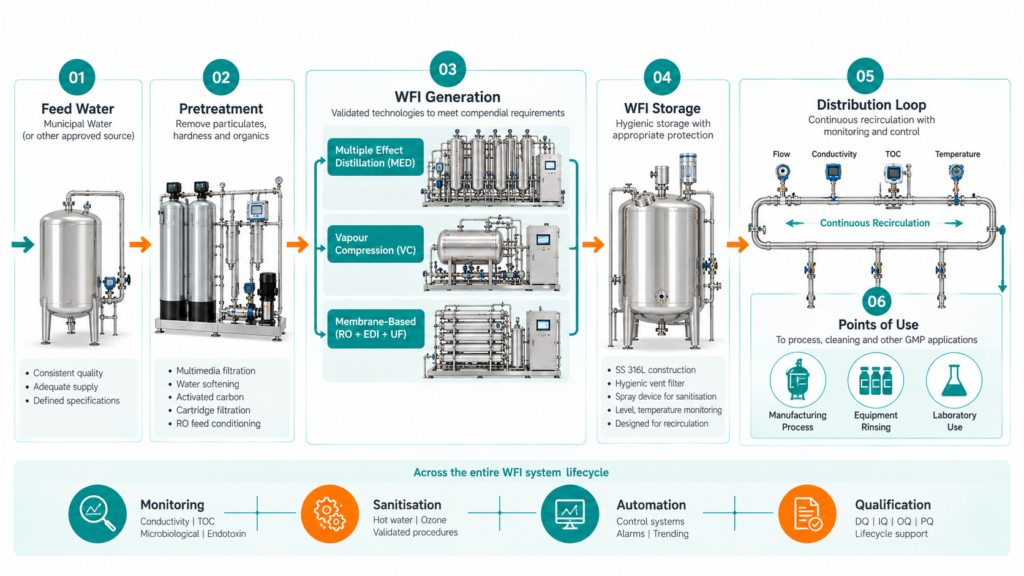
Selecting MED, vapour compression or a membrane-based system addresses only the generation stage. The complete pharmaceutical water system should be considered as an integrated chain covering feed-water quality, pretreatment, WFI generation, storage, distribution, points of use, sanitisation, monitoring and qualification.
Feed Water → Pretreatment → WFI Generation → Storage → Distribution Loop → Points of Use → Monitoring & Sanitisation
Engineering decisions around storage capacity, recirculation, hygienic piping, dead-leg control, utility loads, drainage, instrumentation, automation, redundancy and sanitisation strategy can have as much influence on long-term WFI performance as the choice of generation technology itself. These requirements should therefore be evaluated together during facility and utility design rather than as independent equipment decisions.
Getting the Water System Design Right From the Start
WFI generation should ideally be integrated into facility design from the outset. The utility loads, floor space, drainage, and water distribution loop should be designed in conjunction at the design stage, as retrofitting a distillation or membrane system into a building not designed for it usually requires costly rework.Pharma Access works with pharmaceutical manufacturers on facility and utility design that incorporates water system needs from the earliest planning stages, including layout, utility sizing and the qualification work needed to bring a WFI system into GMP-compliant operation.
A Few Final Thoughts
Indeed, the methods to produce water for injection have diversified over recent years, and the choice between distillation or membrane systems is no longer a firm regulatory requirement. Multiple-effect distillation and vapour compression each have their strengths in terms of reliability, energy consumption and output flexibility, whilst membrane-based systems have thermal-energy demand and often a smaller equipment footprint, together with greater dependence on an effective microbial-control strategy. According to the utilities, space and monitoring capacity of the facility, there isn’t one size-fits-all answer.US FDA
Frequently Asked Questions
Is membrane-based WFI now accepted everywhere, or only in some countries?
Acceptance of non-distillation WFI generation has expanded significantly. Major regulatory and pharmacopoeial frameworks now recognise validated alternatives to distillation, including membrane-based approaches. However, manufacturers should still verify the applicable national regulatory requirements, marketing-authorisation commitments and facility-specific requirements before selecting the generation technology.
Which is cheaper to operate: distillation or membrane-based WFI systems?
It is contingent upon the setup. Membrane systems can reduce steam and cooling-water demand compared with multiple-effect distillation, while vapour-compression distillation can also achieve competitive total lifecycle costs through internal heat recovery. The final comparison depends on capacity, pretreatment, utility prices, sanitisation strategy, maintenance and redundancy requirements.
Why did Europe require distillation for WFI for so long?
European regulators were concerned that non-distillation systems required robust control of microbial contamination, membrane performance and biofilm formation to ensure consistent WFI quality. These concerns contributed to the continued requirement for distillation until the European Pharmacopoeia revised the WFI monograph in 2017 to permit purification processes equivalent to distillation.
Does membrane-based WFI need more monitoring than distilled WFI?
Membrane-based WFI systems require particular attention to microbial trending, biofilm prevention, membrane performance, sanitisation and process monitoring because generation can occur without a high-temperature distillation step. Distilled WFI systems also require appropriate monitoring, and the final programme for either technology should be defined through the validated control strategy, system performance and risk assessment.
What is the main difference between multiple-effect distillation and vapour compression?
Multiple-effect distillation uses external steam passed through several evaporator effects, while vapour compression uses mechanical compression to recycle heat internally. Vapour compression is generally more energy efficient in terms of external thermal-energy demand and can provide greater flexibility in WFI outlet temperature depending on equipment configuration.