Pharma teams that have been running qualification and validation programmes under the same PIC/S recommendations for years are about to see a significant change in the guidance supporting Annex 15. PIC/S has made a major revision to its Recommendations on Qualification and Validation, PI 006-4, and it comes into effect on 1 October 2026. If your facility is preparing for PIC/S qualification and validation expectations in 2026, be it a new build, an expansion, or an upgrade to an existing plant, this document changes the level of practical guidance available to inspectors and industry.
This post will cover what actually changed with the PIC/S qualification and validation 2026 requirements, why it matters to your CQV programme, and what steps to take before the effective date. We’ll keep it practical and avoid dense regulatory language where possible.
What Is PIC/S Annex 15, and What Just Changed?
Annex 15 is the annex to the PIC/S and EU GMP Guide that sets out the basic principles of qualification and validation in pharmaceutical manufacture. Since its last major revision in 2015, it has remained relatively unchanged. Alongside Annex 15, there is a separate and more detailed recommendations document for inspectors and industry, PI 006. This document provides additional practical guidance in areas where PIC/S identified the need for more detail than Annex 15 provides.
That’s what just changed: that supporting recommendations document. PIC/S has approved a new version, PI 006-4, which supersedes PI 006-3 dated 25 September 2007. The new version takes effect on October 1, 2026, and is a substantial rewrite of the recommendations after nearly 20 years.
Meet PI 006-4: The New Recommendations Document
PI 006-4 is officially entitled PIC/S Recommendations on Qualification and Validation. It’s hard to see why the change is so important, unless you know what it’s replacing. The old PI 006-3 was one document containing individual recommendations covering the Validation Master Plan, installation and operational qualification, non-sterile process validation, and cleaning validation.
PI 006-4 substantially reorganises and expands that material within one updated document. It builds on the 2015 revision of Annex 15. It incorporates quality risk management principles throughout the qualification and validation lifecycle, rather than treating risk assessment as a separate add-on step.
PI 006-4 Significant Additions:
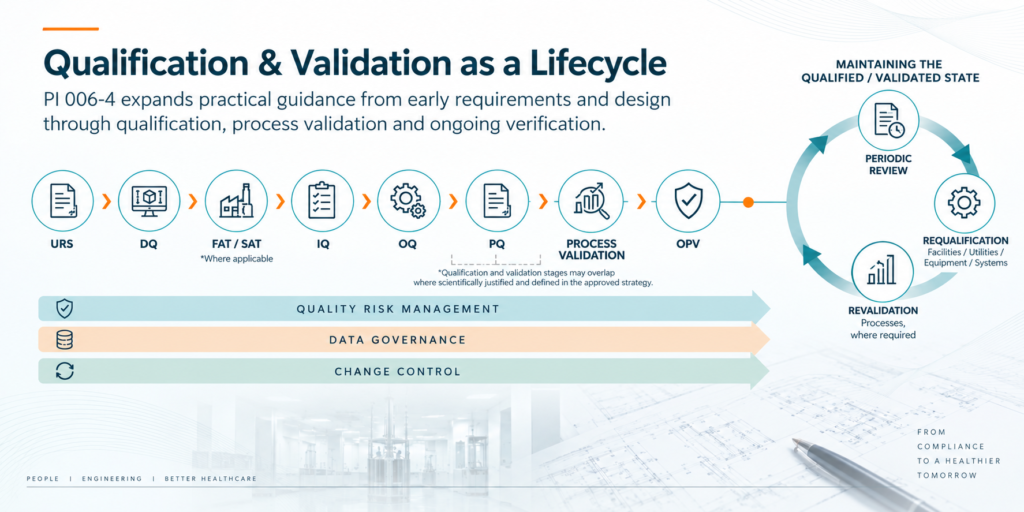
Some additions are notable for covering ground the old guidance barely touched:
- Prequalification stages including the User Requirements Specification (URS), Design Qualification (DQ), Factory Acceptance Testing (FAT) and Site Acceptance Testing (SAT), giving teams more detailed guidance on the planning and verification work that happens before formal IQ, OQ and PQ.
- Performance qualification in more detail than the older documents provided.
- Ongoing (or Continued) Process Verification (OPV), extending process monitoring beyond initial validation and across the commercial product lifecycle.
- Continuous Process Verification (CPV), which PI 006-4 addresses as an alternative approach to initial process validation where appropriate process understanding and control support its use.
- Transport verification, a gap many facilities have previously filled in an ad hoc way.
- Packaging validation now has its own dedicated coverage, specifically for solid dose products.
- Utility qualification, providing more detailed expectations for supporting utilities such as pharmaceutical water, HVAC and process gases.
- Validation of test methods, with high-level guidance on method validation and verification rather than detailed analytical-method-validation requirements.
The principles in the document apply to the manufacture of active pharmaceutical ingredients, intermediates and finished dosage forms.
Other PI 006-4 Areas CQV Teams Should Not Overlook
PI 006-4 also places explicit emphasis on data governance throughout qualification and validation and requires data-integrity considerations to be addressed within qualification and validation activities. It includes dedicated coverage of requalification and states that retrospective validation is no longer considered an acceptable approach to process validation. The document also clarifies that validation of GMP-impacting computerised systems remains covered by PIC/S GMP Annex 11 rather than PI 006-4 itself.
Why This Matters for Qualification and Validation Pharma Teams
It is worth clarifying what PI 006-4 is and isn’t. PIC/S refers to it as a guidance and training resource for GMP inspectors and the pharmaceutical industry, rather than the Annex 15 GMP text itself. Annex 15 continues to set out the underlying GMP principles for qualification and validation, while PI 006-4 provides additional practical guidance on how those principles can be applied.
That difference does matter in the field. Just because a facility has validation documentation doesn’t mean that it still stands up to current expectations. The underlying Annex 15 text has not been revised through PI 006-4, but PI 006-4 places much more explicit emphasis on areas such as documented ongoing process verification, supporting utility qualification, data governance and lifecycle control.
What This Means for Your Validation Master Plan
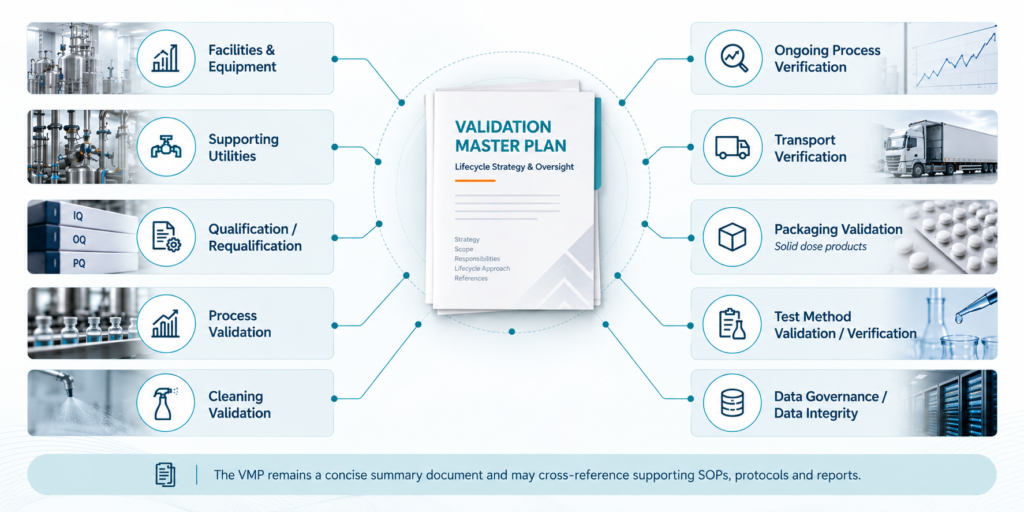
At the centre of the expanded scope of PI 006-4 is the validation master plan. The older guidance combined VMP requirements with installation and operational qualification without its recommendation, and many facilities perceived this master plan as a static document written once and visited only occasionally.
With the new guidance, this master plan should reflect the full lifecycle perspective that PI 006-4 brings, including qualification, requalification, process validation, ongoing process verification and revalidation activities. Thus, facilities will have to re-examine and revise their VMP to ensure that applicable supporting utilities, qualification and validation activities, requalification requirements and ongoing process verification are appropriately identified or cross-referenced rather than unnecessarily duplicated within the VMP itself.
Importantly, PI 006-4 describes the VMP as a summary document that should remain brief, concise and clear and may refer to existing policies, SOPs, validation protocols and reports.
Impact on Pharma Facility Qualification Timelines
Expanded qualification and validation expectations usually mean additional review and documentation, and documentation takes time to build and review. Facilities planning a pharma facility qualification programme with a completion date around or beyond October 2026 should plan for the additional scope now rather than waiting until an inspection highlights a gap.
This is particularly important for ongoing projects. Facilities that are in the middle of IQ and OQ activities developed against the older recommendations may need to revisit their CQV strategy and protocols to confirm traceability back to the URS and DQ and to ensure supporting-utility qualification is adequately addressed. The approach to ongoing process verification should then be established following initial process validation as part of lifecycle control.
Brownfield Pharma Upgrades Under the New Guidance
There’s a particular wrinkle with this transition for brownfield pharma upgrades. This type of upgrade must reconcile existing qualification and validation status with new expectations, all while production often continues in adjacent areas of the facility, unlike a greenfield project starting with a blank master plan.
Brownfield projects usually have more live interfaces and overlapping disciplines than a similar greenfield build. The plan needs to address the existing structure, ongoing operations, and changed validation and qualification expectations at the same time.
PI 006-4 specifically calls for qualification and validation planning to consider risks to adjacent or connected operations, as well as risks associated with shared facilities, shared equipment, shared utilities and common HVAC systems. These considerations are particularly relevant to brownfield projects where qualification work may occur alongside ongoing GMP operations.
Once a facility starts to map its brownfield upgrade against the expanded utility qualification and ongoing verification expectations of PI 006-4, common challenges include ageing HVAC systems, limited utility capacity, and gaps in existing qualification documentation. A team that has done this kind of transition before knows where to look for these gaps early, rather than during an inspection.
Know More : Pharmaceutical Inspection Co-operation Scheme
Steps to Prepare Before the October 2026 Deadline
Here is a practical sequence facilities can use to prepare:
- Re-evaluate your current master plan: Map where it already covers qualification, requalification, ongoing process verification, supporting utilities and other applicable PI 006-4 activities, and where there are gaps.
- Review existing qualification processes: If you have any projects not yet complete, check that IQ, OQ and PQ activities remain appropriately linked to the URS and DQ and reflect the applicable recommendations in PI 006-4.
- Review utility qualification documents: Expectations for supporting utilities such as HVAC, pharmaceutical water and process gases are now addressed in greater detail, so make sure your qualification strategy and records are aligned.
- Assess Packaging and Transport Verification Gaps: These are areas now given dedicated coverage in PI 006-4, with the packaging-validation section specifically addressing solid dose products.
- Review validation and verification records for test methods: PI 006-4 provides high-level expectations for these activities while recognising that detailed analytical-method-validation guidance exists elsewhere.
- Train quality and validation personnel on PI 006-4: Your team should be familiar with the structure and terminology of the document and understand how its recommendations supplement Annex 15.
Why Work with Experienced CQV Services
Managing this transition internally is possible, but it requires coordinated review across quality, validation, engineering and operations. Experienced CQV services can help translate regulatory updates such as PI 006-4 into practical changes to strategies, protocols and qualification activities rather than treating the update simply as a documentation exercise.This is just as important for pharmaceutical CQV work on a new facility as it is for a mid-project upgrade trying to align with the updated recommendations before project completion.
At Pharma Access, our CQV team is involved in greenfield builds, brownfield upgrades, and ongoing qualification projects, covering the entire spectrum from master plan development to IQ, OQ, and PQ execution. Since our engineering and CQV teams begin with the same design intent, validation protocols remain tied to the actual reasoning behind facility decisions, rather than being retrofitted later.
Wrapping Up
Although PI 006-4 does not itself revise Annex 15, it significantly expands the practical recommendations available for implementing qualification and validation across the lifecycle. Facilities that update their master plan, review in-progress protocols, and address applicable utility, packaging, transport and ongoing-verification gaps well before October 2026 will be in a much stronger position than those scrambling to catch up after the effective date passes.
Know More : Pharmaceutical Inspection Co-operation Scheme
Frequently Asked Questions
What is PI 006-4, and how is it different from Annex 15?
PI 006-4 is a detailed recommendations document and guidance resource for GMP inspectors and industry. Annex 15 sets out the underlying qualification and validation principles within the PIC/S GMP Guide, while PI 006-4 provides additional practical guidance in areas where PIC/S has identified the need for greater detail.
When does PI 006-4 take effect?
PI 006-4 becomes effective 1 October 2026. Facilities should plan to review their VMP, CQV strategies and applicable qualification and validation activities against the expanded recommendations by that date.
Does PI 006-4 apply to API manufacturers or only finished dosage forms?
The principles apply to active pharmaceutical ingredient manufacturing, intermediates and finished dosage forms. However, some individual sections have a narrower scope; for example, the packaging-validation section specifically addresses solid dose products.
How does this affect brownfield pharma upgrades already in progress?
Any brownfield project currently underway should compare its existing qualification protocols to the expectations in the new document, particularly supporting-utility qualification, risks to adjacent and shared operations, and ongoing process verification, before completing validation work associated with the upgrade.
Do I need to rewrite my entire validation master plan?
Not necessarily a rewrite, but most facilities should review their VMP to ensure that the qualification and validation lifecycle, requalification, ongoing process verification, supporting utilities and other applicable activities are appropriately covered or cross-referenced. PI 006-4 specifically states that the VMP should be a brief, concise summary document and may refer to other controlled documents rather than repeating their content.