Research cut-off date: 14 July 2026
Primary jurisdiction: United States
Fiscal-year period reviewed: 1 April 2026 to 31 March 2027
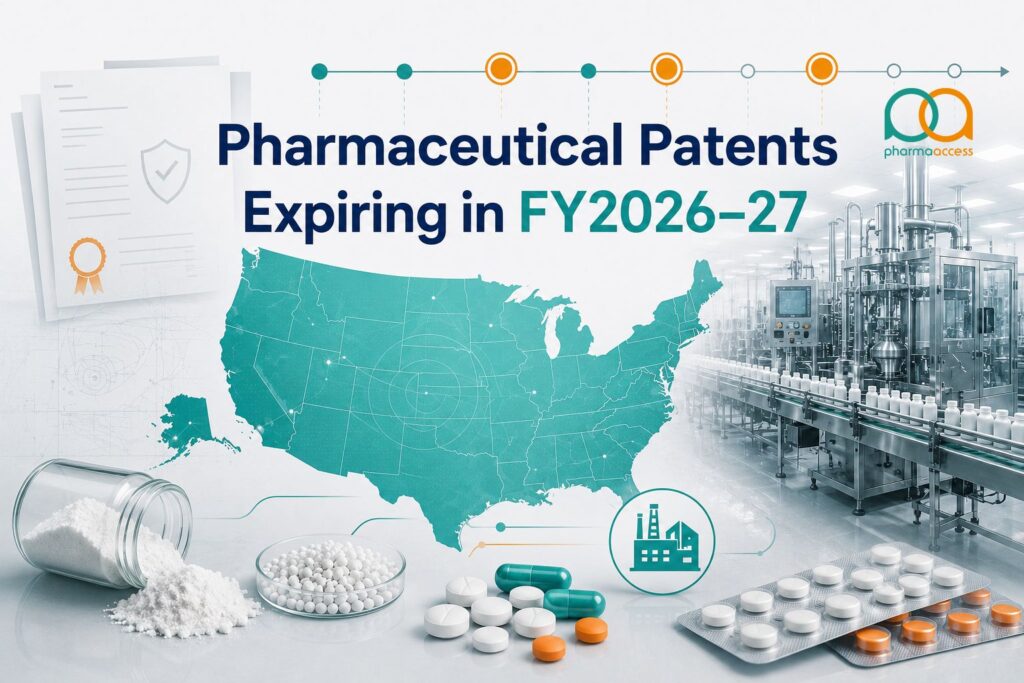
Pharmaceutical patent expiries in FY2026–27 may help generic manufacturers, API producers, CDMOs and facility owners identify products for further evaluation. However, a patent date should not be treated as a confirmed generic-launch date.
A pharmaceutical product may be protected by multiple patents covering the active ingredient, formulation, crystal form, manufacturing process, dosage regimen, indication or delivery device. Regulatory exclusivity, pediatric exclusivity, patent-term extensions, litigation, settlements and first-applicant exclusivity may also affect commercial entry.
For manufacturers, patent screening is therefore only the starting point. A viable programme must also consider regulatory approval, API availability, formulation development, process complexity, containment, equipment lead times, capacity, technology transfer, validation and GMP infrastructure.
Pharma Access supports pharmaceutical companies in translating a verified product strategy into practical manufacturing requirements. This may involve assessing an existing facility, adding a new production line, expanding a brownfield site or developing a greenfield plant.
Looking for verified patent and regulatory references without reading the full article? Jump straight to the Source Register.
Understanding Patent Expiry and Loss of Exclusivity
Patent expiry is the end of one patent in a defined jurisdiction. It does not necessarily mean that all protection for the product has ended.
Regulatory exclusivity is separate from patent protection and may prevent competing applications from being submitted or approved for a defined period. Loss of exclusivity, or LOE, is a broader commercial term that may refer to the end of a key patent, regulatory exclusivity, pediatric exclusivity, a settlement date or the expected start of generic competition.
The FDA Orange Book identifies approved drug products together with associated U.S. patent and regulatory-exclusivity information. Even when one listed patent expires, market entry may still depend on later patents, litigation, settlement terms, ANDA status, labelling strategy and 180-day exclusivity.
Pharmaceutical Products Facing Patent Milestones in FY2026–27
Eliquis — Apixaban
Eliquis is an oral anticoagulant marketed by Bristol Myers Squibb and Pfizer. An FDA tentative-approval letter identifies U.S. Patent 6,967,208 with an expiry date of 21 November 2026, while another listed patent continues to 24 February 2031.
Bristol Myers Squibb identifies 2028 as its estimated minimum U.S. market-exclusivity date and states that certain settled generic companies may launch in 2028, subject to additional challenges. The November 2026 date should therefore be treated as one patent milestone, not the end of all U.S. protection.
For manufacturers, apixaban may still be relevant to API and oral-solid-dose capacity planning. Investment decisions should be linked to the target jurisdiction, legal pathway, regulatory status, supply strategy and expected entry arrangements.
Ibrance — Palbociclib
Ibrance is an oral CDK4/6 inhibitor marketed by Pfizer. Pfizer reported that a U.S. patent-term extension moved the expiry of RE47,739 to 5 March 2027. FDA records also identify later patents and potential 180-day generic exclusivity.
March 2027 is therefore a significant patent milestone rather than an uncontested product-level LOE date.
From an engineering perspective, palbociclib may require potent-compound controls, including contained dispensing and transfer, local exhaust ventilation, dust extraction, pressure control, equipment containment, campaign manufacturing, cleaning validation and controlled waste handling.
Trintellix — Vortioxetine
Trintellix is an immediate-release oral antidepressant marketed in the United States by Takeda. U.S. Patent 7,144,884 reached its identified expiry date on 17 June 2026, while FDA records continue to reference other patents, litigation and potential shared 180-day exclusivity.
A manufacturing assessment should review API solid-state characteristics, particle-size distribution, blend and content uniformity, dissolution, coating, stability, packaging and analytical-method transfer. Where an existing OSD plant is proposed, available dispensing, compression, coating, packaging and laboratory capacity should also be evaluated.
Rexulti — Brexpiprazole
Rexulti is an oral antipsychotic marketed by Otsuka with Lundbeck. FDA records identify four patents that expired on 12 April 2026, but later patents continue through December 2028 and October 2032.
For the reviewed Apotex ANDA, FDA stated that final approval could not be granted before 23 December 2028 based on the applicant’s certifications unless another legal or regulatory basis supported earlier approval.
Rexulti demonstrates why the expiry of several patents on one date cannot be treated as a complete LOE assessment.
Gilotrif — Afatinib
Gilotrif is an oral oncology medicine marketed by Boehringer Ingelheim. FDA records identify RE43,431 through 13 July 2026, while other patents continue beyond that date. The reviewed application received tentative approval, reinforcing the difference between technical regulatory acceptability and permission for commercial marketing.
A manufacturing programme may require potent API handling, HVAC segregation, differential-pressure control, contained transfer, equipment cleanability, cleaning limits, waste management and strong analytical capability.
Symproic — Naldemedine
Symproic is an oral treatment for opioid-induced constipation. Current U.S. ownership and commercial arrangements are more complex than a simple originator-versus-generic description. FDA records identify BioDelivery Sciences International as the NDA applicant, while Collegium states that it licenses U.S. commercialization rights from Shionogi.
A proposed 5 October 2026 date should not be published as a product-level U.S. LOE date until the current Orange Book patent stack, litigation position and any settlement or licensed-entry arrangements are reconfirmed.
Products Close to, but Outside, FY2026–27
Januvia and Janumet — Sitagliptin Products
For U.S. Januvia tablets, FDA records identify U.S. Patent 7,326,708 through 24 May 2027, after the end of FY2026–27. Immediate-release Janumet records include the same date and another patent through January 2029.
Januvia, Janumet and Janumet XR are separate products and applications and should not be combined into a single expiry date. They may still be relevant to medium-term planning for API sourcing, fixed-dose-combination development, high-volume compression, coating, packaging and analytical capacity.
Uptravi — Selexipag
Johnson & Johnson identifies pediatric exclusivity for U.S. Patent 7,205,302 through 30 April 2027 and lists additional patents extending into 2030, 2031 and 2037. The April 2027 date is outside FY2026–27 and is not the end of all U.S. protection.
Products Removed from the 2026 Opportunity Set
Erleada should not be presented as a March 2027 overall LOE opportunity because Johnson & Johnson identifies 2030 as the U.S. composition-of-matter patent expiry year and lists later patents.
Imbruvica should also be excluded from a straightforward 2026 opportunity list. Johnson & Johnson identifies 2028 as the U.S. composition-of-matter patent expiry year.
Sprycel is not awaiting initial U.S. generic entry; Bristol Myers Squibb reports that generic versions have entered the United States, European Union and Japan.
Saphris is also not a new first-entry opportunity arising from an October 2026 patent date because FDA approved an asenapine sublingual-tablet ANDA in 2018.
What the FY2026–27 Patent Landscape Means for Manufacturers
Patent milestones can support early portfolio screening, but manufacturing decisions should follow legal, regulatory, technical and engineering verification.
Legal and Regulatory Verification
Before committing engineering expenditure, companies should confirm the intended jurisdiction, current patent records, remaining formulation and method-of-use patents, patent-term or pediatric extensions, regulatory exclusivity, ANDA status, Paragraph III or IV certifications, label carve-outs, 180-day exclusivity, litigation, settlements and licensed-entry arrangements.
Engineering teams may use this information to develop schedules, but freedom to operate and commercial-launch risk should be assessed by qualified legal and regulatory advisers.
API, Formulation and Containment Readiness
The technical assessment should confirm that the API and finished product can be developed, scaled and transferred reproducibly. Key questions include route scalability, starting-material availability, impurity control, solid-state properties, particle size, dissolution, bioequivalence, analytical transfer, stability, packaging and cleaning limits.
For oncology or low-dose oral products, containment should be based on product-specific toxicological and occupational-exposure assessments. The resulting strategy may affect dispensing, closed transfer, local exhaust ventilation, dust extraction, room pressures, equipment segregation, campaign planning, cleaning validation and waste handling.
Capacity, Utilities and Technology Transfer
Capacity planning should consider commercial demand, batch size, campaign length, utilisation, changeover time, yield, packaging throughput, laboratory capacity, warehousing, maintenance access and future expansion.
Utility loads should be calculated from the actual equipment sequence and production strategy. Depending on the process, requirements may include purified water, process gases, compressed air, steam, chilled water, HVAC utilities, electrical systems, BMS, EMS and process automation.
Technology transfer must connect formulation and process knowledge with the receiving site’s equipment, utilities, automation, procedures and quality systems. Equipment-gap assessments, engineering batches, analytical transfer, cleaning development, registration batches, process qualification and continued verification should be planned early.
How Pharma Access Supports Patent-Driven Manufacturing Plans
Once a product opportunity has been independently verified, Pharma Access can assess whether it fits within an existing facility or requires a dedicated line, brownfield expansion or greenfield project.
The assessment may cover:
Feasibility and Project Planning
- Facility feasibility and capacity assessments
- Production-volume and expansion planning
- Brownfield and greenfield project evaluation
Pharmaceutical Engineering and Process Design
- Pharmaceutical facility engineering design
- Process-flow and production-layout development
- Personnel and material movement planning
- GMP-facility integration
Equipment, Cleanrooms and Utility Systems
- Modular cleanroom design and accessories
- HVAC, mechanical, electrical and piping engineering
- Clean and black utility-system design
Procurement, Construction and Installation
- Procurement strategy and vendor coordination
- Construction planning and site execution
- Equipment and system installation
- Site Acceptance Testing
Commissioning, Qualification and Validation
- Commissioning and qualification planning
- Facility, utility and equipment validation
- CQV documentation and execution support
Project Management and EPCMV Delivery
- Integrated project and schedule management
- Engineering, procurement and construction coordination
- EPCMV project-delivery support
- Brownfield expansion and operational-site coordination
Pharma Access can then support engineering design, equipment planning, vendor coordination, construction, installation, Site Acceptance Testing, commissioning, qualification, validation and project management.
For brownfield projects, the strategy may also address phased execution, temporary routes, tie-in planning, HVAC shutdowns, construction controls and protection of adjacent GMP operations.
This integrated approach connects a verified product strategy with realistic capital requirements, engineering deliverables and execution schedules. Pharma Access does not provide patent opinions, predict court decisions or guarantee generic entry. Its role is to develop practical, compliant and scalable manufacturing infrastructure after the legal, regulatory and commercial pathway has been established.
Why Choose Pharma Access?
Preparing for a generic or pharmaceutical manufacturing opportunity requires more than identifying a molecule and patent date. The facility must reflect the process, product characteristics, containment requirements, production volume, target markets and long-term operating strategy.
Pharma Access provides integrated pharmaceutical engineering and turnkey project-delivery support across feasibility, process and equipment planning, cleanrooms, HVAC, utilities, automation, construction, installation, CQV, project management and EPCMV delivery.
Whether the project involves an OSD line, potent oncology facility, API unit, sterile production or biotechnology infrastructure, Pharma Access helps translate manufacturing requirements into an executable engineering and project-delivery plan.
Planning capacity for a new generic, API or pharmaceutical product? Connect with Pharma Access to evaluate process, facility, equipment, containment, utility and CQV requirements before major project decisions are finalised.
The patent and exclusivity information in this article is provided for general industry awareness and is based on publicly available information reviewed as of 14 July 2026. Patent status, litigation, regulatory exclusivity and market-entry timelines may change and vary by jurisdiction, formulation, dosage form, indication and product. Companies should complete independent legal, regulatory and commercial due diligence before making manufacturing or investment decisions.
Source Register
Frequently Asked Questions
Which pharmaceutical patents are expected to expire in 2026?
Selected U.S. milestones include an Eliquis patent on 21 November, a Trintellix patent on 17 June, four Rexulti patents on 12 April and a Gilotrif patent on 13 July. These are individual patent dates, not confirmed product-level LOE dates.
Does patent expiry allow immediate generic entry?
No. Other patents, regulatory exclusivity, litigation, settlements, tentative approval, 180-day exclusivity or labelling issues may still delay entry. Manufacturing readiness, stability, bioequivalence and cGMP compliance may also affect launch timing.
How early should capacity planning begin?
Planning should begin early enough to complete feasibility, development, equipment selection, procurement, facility work, technology transfer, CQV and regulatory batches before the intended commercial date. The schedule depends on dosage form, containment needs, existing infrastructure and equipment lead times.
Why is CQV important when adding a manufacturing line?
CQV provides documented evidence that facilities, utilities, equipment and systems are installed and operate as intended. Considering CQV during design allows user requirements, design reviews, vendor documentation, FAT, SAT, IQ and OQ activities to be developed as one coordinated programme.