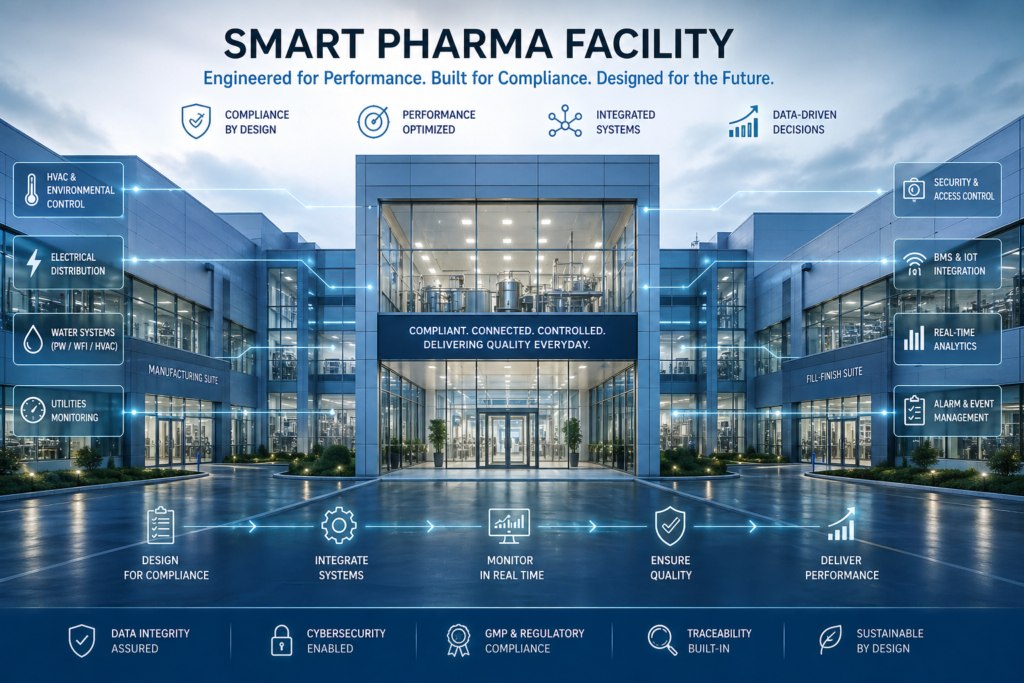
Today’s pharma facilities aren’t meant to be stagnant operations. They’re highly controlled, data-driven environments powered by data and made up of several interconnected systems working together to ensure product quality, regulatory compliance (cGMP, US FDA, EU GMP), and operational efficiency.
HVAC performance. Energy management. Environmental monitoring. To operate at their best, these systems require visibility and control in real time.
That’s where an integrated Building Management System (BMS) can help.
A modern building management system does more than monitor your facility. Maintain validated operating conditions, enable data-driven decision-making, reduce operational risk, and ensure repeatable, compliant performance.
The Shift Toward Smart Pharma Facilities
HVAC, utilities and environmental monitoring systems are used to function in silos. While they got the job done, inefficiencies existed and visibility was low.
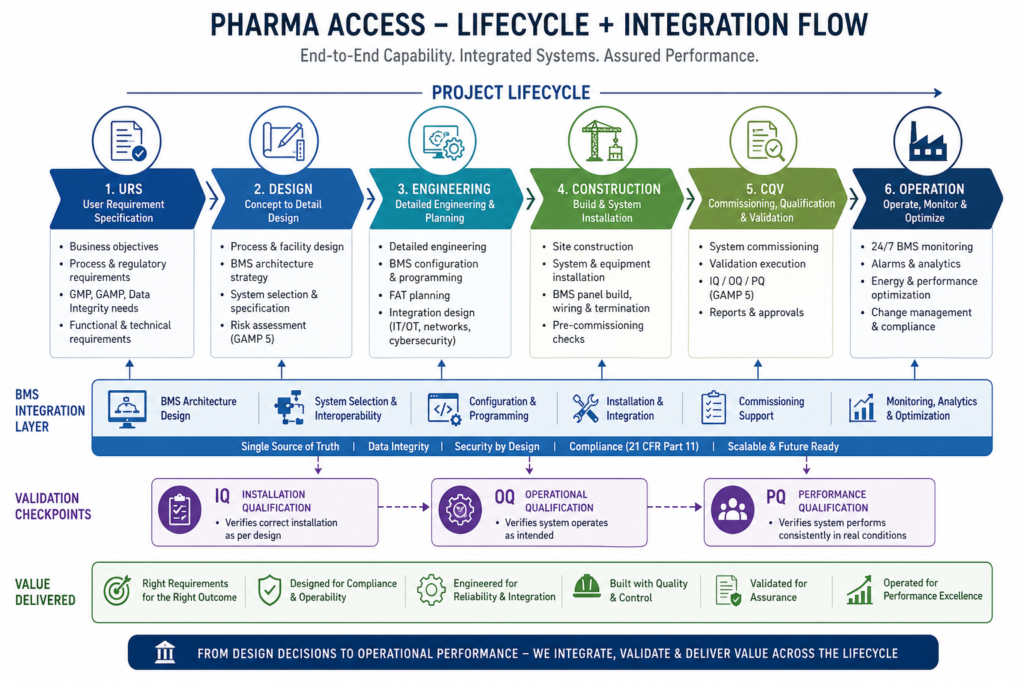
Pharmaceutical facilities are transitioning to systems that allow information to flow freely between platforms.
This shift is driven by the need to:
- Maintain tighter environmental control across classified cleanroom zones (Grade A/B/C/D)
- Improve energy efficiency
- Reduce manual intervention
- Strengthen compliance and data integrity
An integrated BMS acts as the central layer that connects and manages these systems in real time.
Where Integration Makes the Biggest Difference
The real value of a BMS is not just in monitoring systems, but in how it connects them through centralized control logic, alarm management, and inter-system coordination.
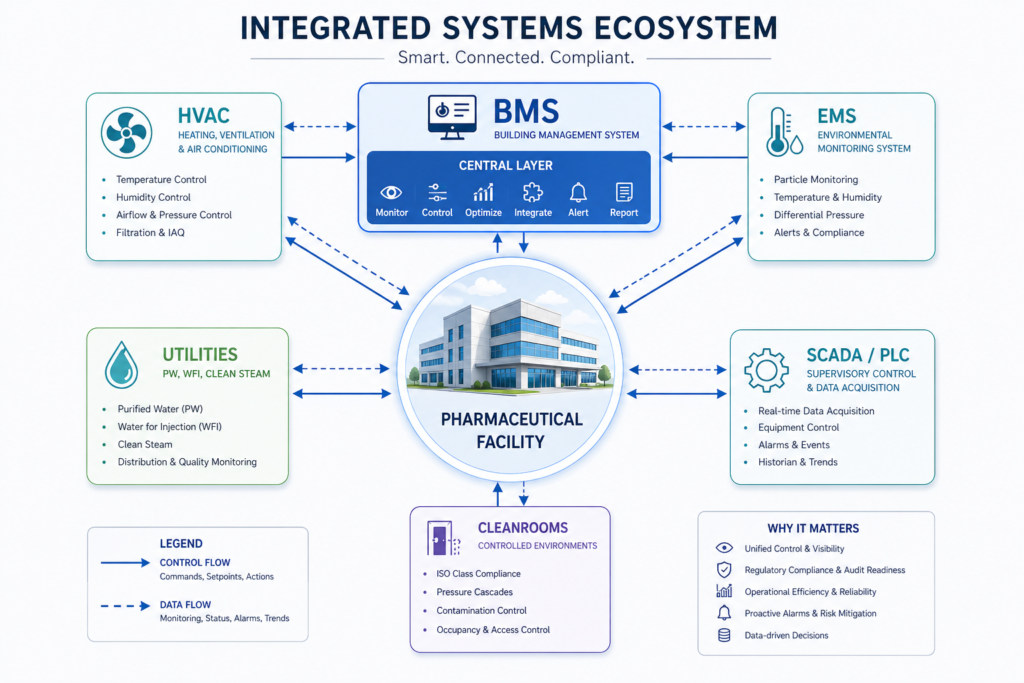
Bringing HVAC Under Central Control
HVAC systems are among the most critical components in pharmaceutical facilities. They directly influence cleanroom conditions, product quality, and compliance.
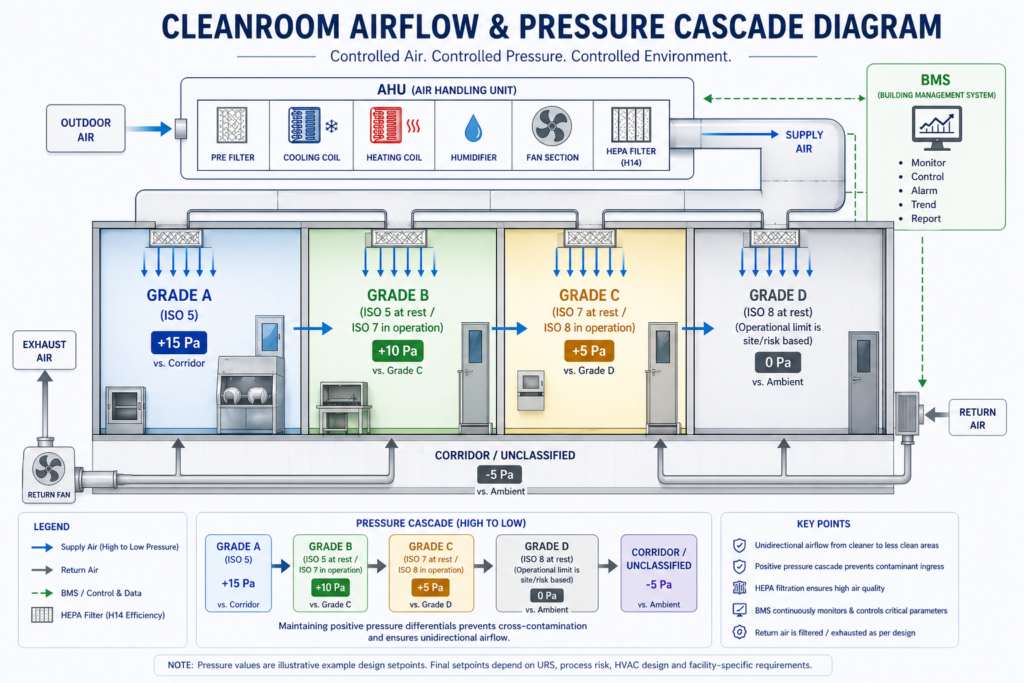
When integrated with a building management system, HVAC teams gain:
- Real-time visibility into temperature, humidity, and pressure along with air changes per hour (ACH) and airflow performance
- Immediate alerts for deviations
- Better control over airflow and environmental conditions
For any HVAC design engineer, designing systems that integrate seamlessly with BMS is now a key requirement.
From Reactive to Predictive Operations
Without integration, facilities often operate reactively, responding to issues after they occur.
With BMS integration, facilities can shift toward data-driven and condition-based operations, with potential for predictive maintenance when integrated with advanced analytics systems (EMS/SCADA/IoT platforms).
This means:
- Identifying trends before they become problems
- Scheduling maintenance proactively
- Reducing unplanned downtime
This level of insight significantly improves operational efficiency.
Improving Compliance Through Data Integrity
In regulated environments, data integrity is critical.
An integrated BMS ensures:
- Continuous monitoring and recording of environmental parameters
- Secure data storage with audit trails
- Easy access to historical data during audits
For HVAC consultants and compliance teams, this reduces the effort required to demonstrate regulatory adherence.
Designing Facilities with BMS in Mind
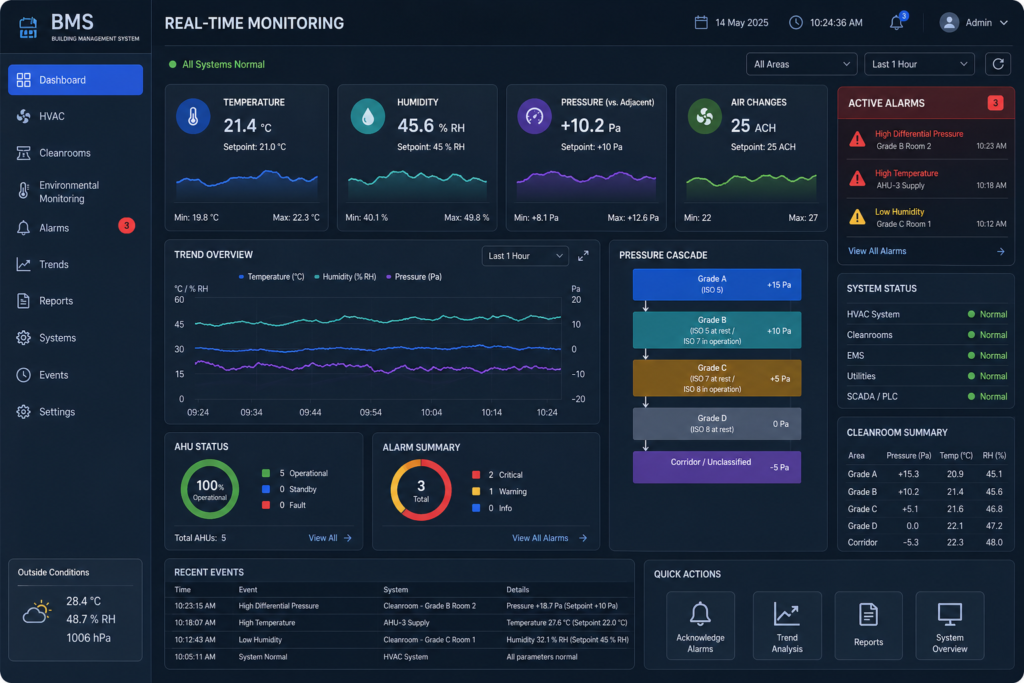
One of the biggest mistakes in facility design is treating BMS as an add-on rather than an integrated system.
To fully leverage its benefits, BMS must be considered during the design stage as part of the overall automation and control architecture (PLC/SCADA/BMS hierarchy)
This involves:
- Aligning HVAC design with BMS requirements
- Ensuring compatibility with sensors and control systems across utilities, cleanrooms, and process areas
- Planning data flow and system architecture early to support validation and integration
When BMS is integrated from the beginning, facilities operate more efficiently and require fewer adjustments later.
The Role of HVAC in Smart Facilities
HVAC systems form the backbone of controlled environments.
In smart facilities, their role expands beyond maintaining conditions to becoming part of a fully integrated contamination control and environmental management system.
A well-integrated HVAC system:
- Responds dynamically to process requirements
- Maintains stable environmental conditions
- Optimizes energy consumption
This is why collaboration between HVAC design engineers and automation teams is critical during the design phase.
Breaking the Silos in Facility Operations
One of the biggest limitations of traditional facilities is the lack of coordination between systems.
HVAC, utilities, and monitoring systems often operate in isolation, leading to inefficiencies and delayed responses.
An integrated BMS eliminates these silos by:
- Connecting all critical systems into a single platform
- Providing centralized control and visibility across facility operations
- Enabling faster and more informed decision-making
This integration transforms how facilities are operated and managed.
Delivering Smarter, More Efficient Facilities
Smart pharmaceutical facilities are not defined by the number of systems they have, but by how well those systems work together.
To achieve this, engineering teams must:
- Design systems with integration in mind
- Align HVAC, automation, and monitoring strategies
- Ensure scalability for future expansion
- Focus on both compliance and operational efficiency through validated systems and lifecycle planning
This approach creates facilities that are not only compliant but also optimized for performance.
How Pharma Access Approaches Smart Facility Design
At Pharma Access, facility design goes beyond individual systems. We focus on how systems interact to deliver validated, reliable, and efficient performance across the facility lifecycle (design to CQV to operation).
By integrating building management system HVAC solutions with advanced engineering and execution, we design facilities that offer:
- Real-time control and monitoring
- Improved compliance readiness
- Enhanced operational efficiency
This ensures that facilities are not only built for today but are ready for future demands.
Conclusion
Constructing intelligent pharmaceutical buildings takes more than technology. It takes integration.
An efficient BMS ties your HVAC, utilities, and monitoring systems together into one platform for greater control, efficiency, and compliance while supporting validated and audit-ready operations.
Intelligent control is the new standard for pharmaceutical manufacturing.
FAQs
1. What is a Building Management System (BMS)?
It is a system that monitors and controls building operations such as HVAC, lighting, and utilities through centralized automation and control architecture
2. How does BMS support HVAC systems?
It provides real-time monitoring, control, and optimization of environmental conditions.
3. Why is BMS important in pharma facilities?
It ensures compliance, improves efficiency, and enhances data integrity.
4. What role do HVAC engineers play in BMS integration?
They design systems that can be effectively controlled and monitored through BMS while meeting GMP and cleanroom requirements.
5. Can BMS improve energy efficiency?
Yes, by optimizing system performance and reducing unnecessary energy consumption without compromising compliance or environmental control