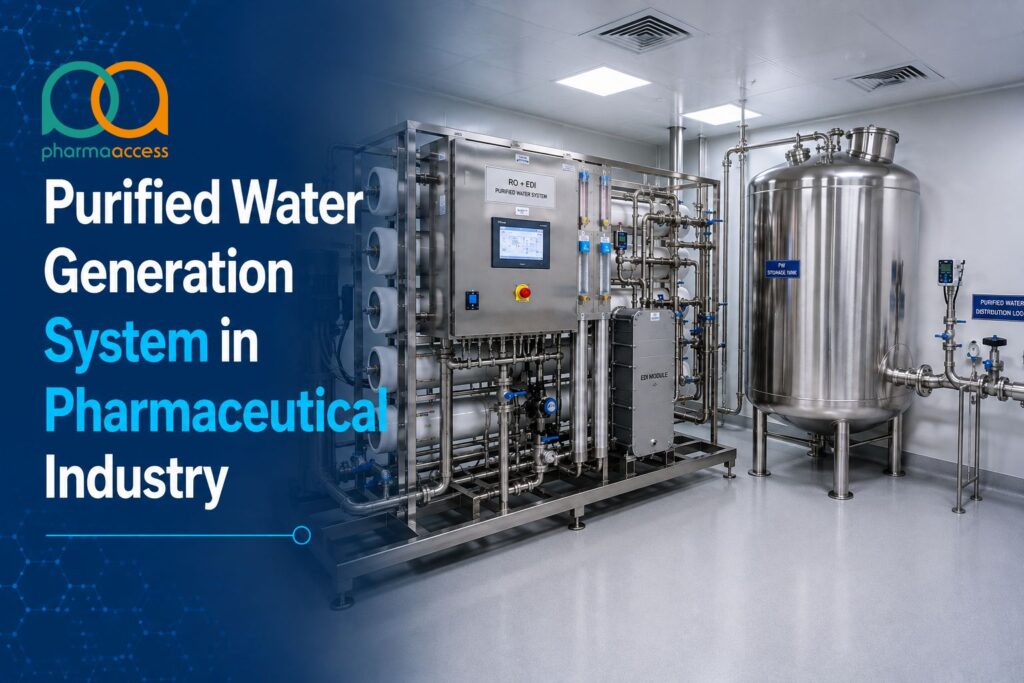
Water is used throughout pharma manufacturing. It goes into formulations, cleans equipment, and rinses containers before they ever touch a product. Because of that, a purified water generation system in pharmaceutical industry settings is not a side utility. It is a quality-critical utility that requires careful design, qualification, monitoring, and control.
This post breaks down the common types of purified water systems, how they work, and how to pick the right setup for your facility. We will keep things simple and skip the deep engineering jargon where we can.
What Counts as Purified Water in Pharma?
Purified water is water treated to remove dissolved solids, organic matter, and microorganisms until it meets pharmacopeial standards. Pharmacopeias such as USP, Ph. Eur., and IP establish requirements and guidance for pharmaceutical water quality. For USP Purified Water, chemical attributes such as conductivity and Total Organic Carbon (TOC) are compendial requirements, while microbiological quality is addressed through appropriate monitoring and system-specific control rather than a microbial limit within the Purified Water monograph itself.
Here is why that matters. Ordinary tap or ground water carries suspended solids, dissolved salts, organic compounds, and microbes that can throw off a formulation or fail a batch release test. A pharmaceutical facility generally uses water meeting applicable drinking-water requirements as the minimum feedwater for Purified Water generation, with further treatment applied to achieve the required pharmaceutical water quality.
The Two-Stage Approach: Pretreatment and Final Purification
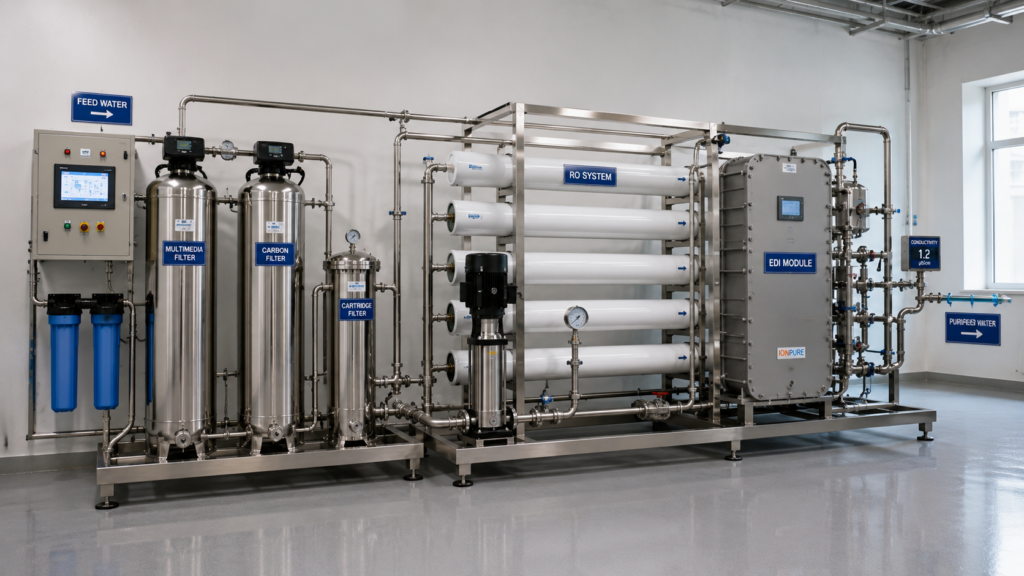
Most purified water generation trains can be understood through two main treatment stages, and understanding this split makes the rest of this guide easier to follow. After generation, storage, distribution, sanitization, and monitoring become equally important for maintaining the required water quality up to the point of use.
Stage 1: Pretreatment
Pretreatment removes the large stuff first, so it does not damage sensitive equipment downstream. This stage may include multi-media filters, activated carbon filters, and water softeners to strip out particles, chlorine, and hardness before the water moves any further. The actual pretreatment sequence depends on feedwater quality and the requirements of the downstream purification system.
Stage 2: Final Purification (Polishing)
The final treatment stage, sometimes called polishing, brings the water down to the target purity level often through reverse osmosis followed by electrodeionization where appropriate to further lower conductivity before storage. Additional steps such as UV treatment or ultrafiltration may be added depending on what the facility needs.
Common Types of Purified Water Generation Systems
Here are the main system types you will run into in pharma manufacturing.
1. Reverse Osmosis (RO) System
RO uses pressure to push water through a semipermeable membrane, rejecting a high proportion of dissolved salts, many organic contaminants, particulates, and microorganisms. It is often the workhorse of a purified water system because it can substantially reduce multiple contaminant classes in a single treatment stage.
2. Deionization (DI) System
DI systems pull ions out of water using resin beds charged to attract dissolved minerals. On their own, DI systems may be used within qualified pharmaceutical water-treatment trains, although they are often combined with other purification technologies rather than relied upon as the only treatment barrier.
3. Electrodeionization (EDI) System
EDI combines ion-exchange resins with ion selective membrane and electric current to continuously remove dissolved ions without the chemical regeneration that older DI systems needed. An EDI module usually sits right after the reverse osmosis stage, where it removes residual ionic contaminants from RO permeate to help achieve the required conductivity. This is a big reason RO+EDI has become a common configuration in modern pharmaceutical Purified Water systems.
4. Distillation System
Distillation boils water and collects the condensed steam, leaving contaminants behind. It remains a well-established technology for Water for Injection (WFI) production. Current pharmacopeial frameworks also permit appropriately designed and qualified non-distillation purification processes for WFI production.
5. Ultrafiltration (UF) System
UF uses a membrane process designed primarily to retain microorganisms, colloids, macromolecules, and, in appropriately designed applications, reduce endotoxin burden rather than remove dissolved ions. It is often added at the end of a system when additional microbial, colloidal, or endotoxin control is required. It is not primarily a conductivity-polishing technology, and TOC measurement should not be treated as a substitute for microbiological or endotoxin control.
6. Hybrid Systems (RO + EDI)
Hybrid systems combining reverse osmosis and electrodeionization are widely used to achieve pharmaceutical Purified Water quality, with RO+EDI offering continuous ionic polishing without routine chemical regeneration of conventional ion-exchange resin beds. If you are specifying a new system today, this is often one of the configurations evaluated first, although the final treatment sequence should always depend on feedwater quality, required water quality, capacity, sanitization strategy, and operating requirements.
Purified Water vs. Water for Injection (WFI)
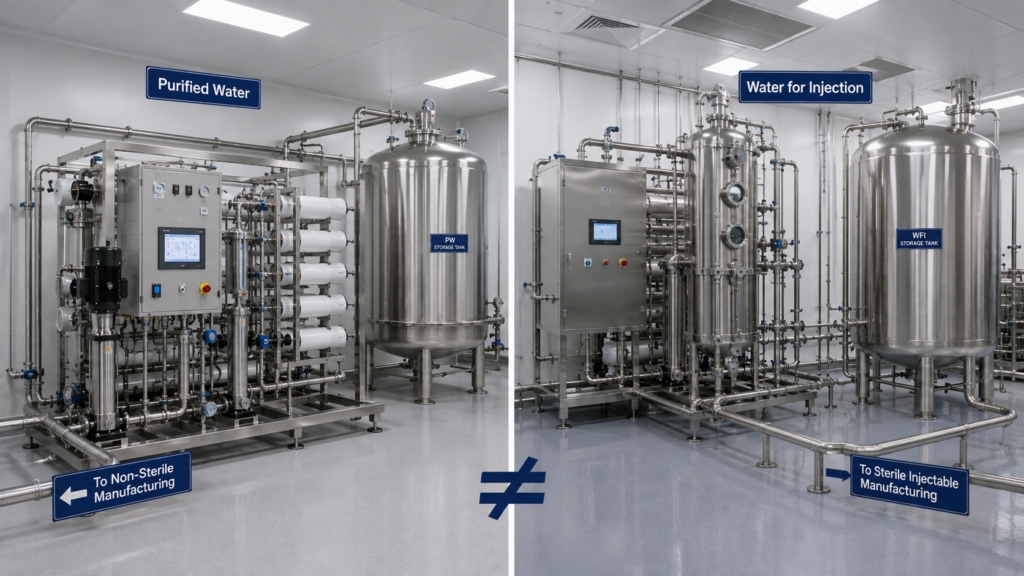
A quick point of confusion worth clearing up: purified water and WFI are not the same thing. Purified water is commonly used for non-parenteral formulations, equipment cleaning, and other applications where PW is the specified grade, while WFI is required for applications such as the manufacture of injectable products and specified final-rinse operations associated with injectable product-contact equipment and components. WFI also includes a bacterial endotoxin requirement and requires an appropriate microbiological control strategy. Choosing the right system depends heavily on which one your product line actually needs.
How HVAC Ties Into Water System Performance
A purified water system does not operate in isolation. The room housing it, along with the surrounding manufacturing areas, depends on properly functioning HVAC to control temperature, humidity, and other environmental conditions required for equipment, instruments, and manufacturing operations. HVAC supports the operating environment around the utility system, although water quality itself is primarily controlled through hygienic system design, circulation, sanitization, storage, and distribution.
This is where HVAC validation in pharmaceutical industry projects becomes relevant. HVAC qualification may include, as appropriate, design qualification (DQ), installation qualification (IQ), operational qualification (OQ), and performance qualification (PQ). Testing during this process may cover air changes per hour, airflow pattern and velocity, pressure differentials, temperature and humidity, filter leak testing, and particle counts, with the scope determined based on the facility, application, and risk assessment.
Poor HVAC control in a classified or controlled manufacturing area can undermine the environmental conditions required by the process. However, maintaining Purified Water quality still depends primarily on the design and operation of the water generation, storage, and distribution system rather than HVAC alone.
Monitoring and Control: The Role of a Building Management System
Modern pharma facilities do not run water and HVAC systems on manual checks alone. A pharmaceutical water system is commonly monitored and controlled through dedicated automation such as PLC/HMI or SCADA architecture, while BMS or EMS platforms may integrate selected facility and utility information depending on the overall control philosophy.
A well-set-up automation and monitoring architecture gives your team real-time visibility into pressure, temperature, water-system parameters, operating status, and system alarms, so problems get caught before they turn into a failed batch or a finding during inspection. Where appropriate, selected water-system status and alarms may also be integrated into the facility BMS or supervisory platform, reducing the need for operators to rely on separate systems for basic utility visibility.
Choosing the Right System for Your Facility
A few questions can help narrow down which purified water generation system in pharmaceutical industry settings fits your operation:
- What is your feed water quality? Hard, high-mineral water needs heavier pretreatment before RO.
- What product types do you manufacture? Non-parenteral products commonly use Purified Water where it is the specified grade, while injectable formulations typically require WFI for formulation and certain final-rinse applications.
- What is your daily water demand? Higher volumes influence generator capacity, redundancy, storage volume, and lifecycle economics, but technology selection must still begin with the required water grade and quality specification.
- What are your TOC and conductivity targets? Conductivity requirements influence technologies such as RO and EDI, while UV, UF, or other treatment steps may be selected for specific organic, microbial, or endotoxin-control objectives depending on the system design.
- How will you sanitize the system? Hot water sanitizable skids reduce chemical use but need membranes, EDI modules, seals, instrumentation, and other system components rated for that heat.
Why Facility Design Matters as Much as Equipment Choice
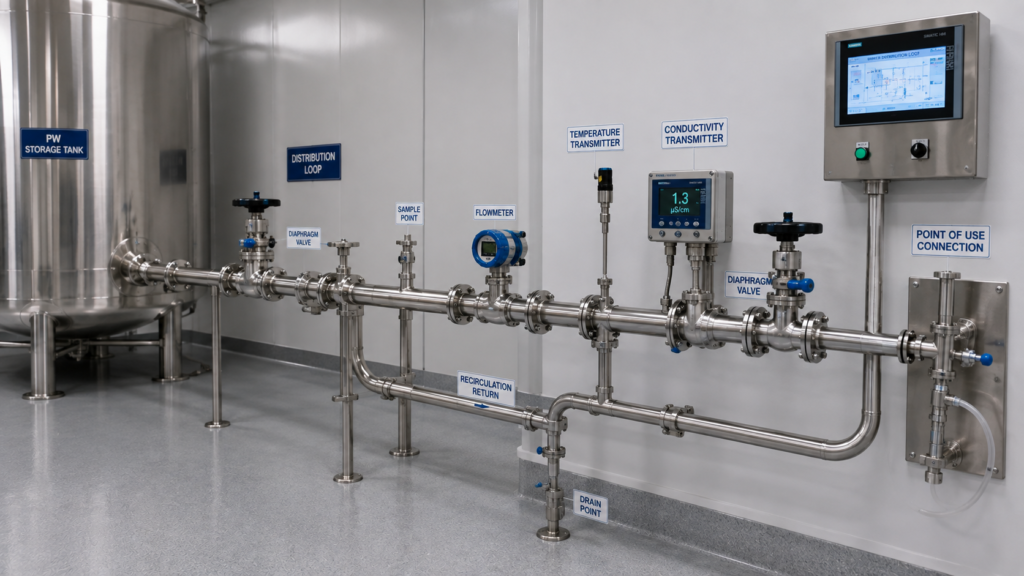
Buying the right skid is only part of the job. Piping layout, storage tank design, and distribution loop configuration all affect whether purified water stays within spec between the generation point and the point of use. A poorly designed loop can allow stagnant conditions that encourage microbial proliferation, even with a solid generation system upstream. Hygienic design therefore also considers factors such as dead-leg minimization, drainability, appropriate tank design, circulation, sanitization, sampling points, and monitoring.
This is where working with experienced pharmaceutical utility engineers and consultants pays off. At Pharma Access, our engineering design team handles mechanical and utility system design, including water and HVAC systems, as part of full facility projects across India and other markets. We look at generation, storage, distribution, and the supporting facility systems as coordinated engineering packages instead of isolated design scopes, helping reduce the coordination gaps that can cause rework later. You can see more about how we approach clean utility systems, including Purified Water and WFI, on the Pharma Access Clean & Black Utilities.
Wrapping Up
There is no single “best” purified water system for every pharma facility. RO+EDI is a widely used configuration for pharmaceutical Purified Water generation, while WFI can be produced through distillation or appropriately designed and qualified non-distillation processes where permitted by the applicable pharmacopeial and regulatory framework. What matters most is matching the system to your feed water, your product line, and your validation plan, then backing it with hygienic storage and distribution, an appropriate sanitization strategy, monitoring, and integration with the wider facility utility and control systems.
FAQs
What is the most common purified water system used in pharma today?
RO combined with EDI is one of the commonly used configurations for modern pharmaceutical Purified Water systems. It removes most contaminants through the RO stage and then uses electrodeionization to remove residual ionic contamination and achieve the required conductivity without routine chemical regeneration of conventional DI resin beds.
What is the difference between purified water and Water for Injection (WFI)?
Purified water supports applications such as non-parenteral formulations and cleaning where PW is the specified grade. WFI is used for applications including injectable-product manufacture and specified final-rinse operations and includes a bacterial endotoxin requirement.
How often should a purified water system be validated?
Most facilities qualify the system before routine use through defined lifecycle activities that include IQ, OQ, and PQ as applicable, followed by ongoing monitoring, trending, maintenance, change control, periodic review, and risk-based requalification where required. There is no single universal requalification interval that applies to every pharmaceutical water system.
Does HVAC really affect purified water quality?
Indirectly, yes. HVAC maintains appropriate environmental conditions around equipment and manufacturing areas, but Purified Water quality is primarily maintained through hygienic water-system design, circulation, sanitization, storage, distribution, and monitoring.
Can one system handle both purified water and WFI needs?
A facility may share elements of upstream feedwater or pretreatment infrastructure, but PW and WFI generation, storage, distribution, sanitization, and monitoring strategies must be designed according to their respective quality requirements and intended applications. The final system architecture should therefore be established through process requirements, applicable pharmacopoeias, and a documented risk-based design approach.