Data Integrity in Pharmaceutical Documentation in Egypt

Data Integrity in Pharmaceutical Documentation in Egypt

Why Documentation Quality Defines Every Pharma Operation in Egypt

Egypt’s pharmaceutical industry was valued at USD 6.5 billion in 2024, and is expected to reach USD 13.8 billion by 2033 growing at a compound annual growth rate of 8.74%. With more than 147 export markets importing Egyptian pharmaceuticals, Egypt is home to Africa’s largest pharmaceutical market by volume and the Middle East & Africa’s second-largest pharmaceutical market by value.

Fueling that level of production starts with one often-overlooked element: data integrity in pharmaceutical documentation. Every batch produced, every test performed, every deviation justified, and every decision made needs to be documented on paper or electronically for regulators to review, audit, and rely upon.

When documentation is poor, it doesn’t just result in regulatory compliance issues. It can result in compromised product safety. For Egyptian manufacturers scrambling to meet WHO-GMP standards, Egyptian Drug Authority (EDA) regulations, and stringent regulatory requirements from export partners in Europe, the United States, and throughout MENA, faulty data management can take your business from growth opportunity to serious regulatory, operational, and commercial risk.

Here’s a look at what data integrity in a pharma documentation plant means and why it’s a critical issue for manufacturers in Egypt right now.

The ALCOA Framework: The Global Standard

What Data Integrity Actually Means in Pharmaceutical Documentation

The ALCOA Framework: The Global Standard

Underlying data integrity in the pharmaceutical manufacturing industry is the ALCOA/ALCOA+ framework, which is reflected across major regulatory expectations, including FDA 21 CFR Parts 11, 210 and 211, UK MHRA’s GxP Data Integrity Guidance, WHO TRS 1033 Annex 4, and EU GMP Annex 11. Egypt’s Drug Authority also aligns its regulatory direction with WHO-GMP expectations and has applied for PIC/S pre-accession.

ALCOA Principles include: 

  • Attributable – who performed a task, date/time stamp and the system they worked in must be identified.
  • Legible – records can be read for their entire retention period.
  • Contemporaneous – data should be recorded at the time of activity
  • Original – first recorded entry is the official record. Copies of the records should be able to be traced back to the original.
  • Accurate – records should be factual, nothing should be omitted, added or changed

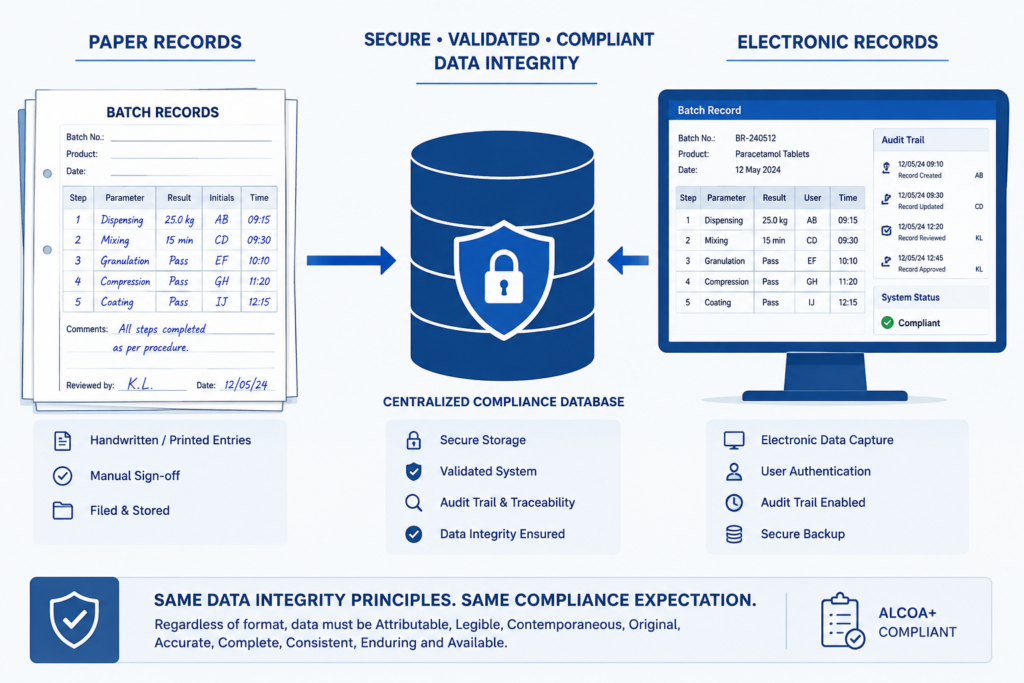
Later interpretations of regulations have expanded ALCOA to include Complete, Consistent, Enduring, and Available(ALCOA+).WHO TRS 1033 Annex 4 guideline on Data Integrity, ALCOA+ expectations apply to paper records, electronic records, and hybrid systems involved in routine pharmaceutical manufacturing operations.

Why does this apply to Egypt? Major data integrity violations observed during inspections, missing audit trails, overwriting original entries, backdating records, unrestricted access to electronic files are just some examples of the FDA’s warning letters seen worldwide. Any company exporting out of Egypt to a regulated market will be held to those same standards. Any manufacturer looking to export their products should be looking at documentation standards from a readiness-to-export perspective instead of an administrative expense.
Paper Records and Electronic Systems: Different Tools, Same Standard

Paper Records and Electronic Systems: Different Tools, Same Standard

Egypt’s pharma industry is host to manufacturers who are at various stages of their digitisation journey. Some manufacturers are working with paper batch records; some have implemented LIMS or EBR systems. Whether records are maintained on paper or electronically, manufacturers are still held accountable for data integrity. Moving from paper to electronic systems doesn’t eliminate the requirement, it shifts how the requirement is satisfied.

  1. Primary controls for paper batch records include: 
  2. Documentation is completed in permanent ink at the time of performance
  3. Errors are single line crossed out, initialed and dated, not erased
  4. Lines are used to block unused spaces 
  5. Records are stored in a controlled, access limited environment

Technical requirements for electronic systems are defined by 21 CFR Part 11 and EU Annex 11: validated systems, audit trails enabled/reviewed, role-based access controls, use of electronic signatures where appropriate, time-stamped entries that cannot be edited without an accompanying reason-for-change.

Per WHO’s guidance, transitioning from paper-based to computerized records, or vice versa, does not remove data integrity responsibilities. Controls should follow the data. 

Why Egypt’s Regulatory Environment Is Raising the Bar on Documentation

The EDA and GMP Compliance in Egypt

The Egyptian Drug Authority (EDA), Egypt’s lead pharmaceutical regulator formed in 2019, is responsible for pharmaceutical manufacturing regulations, product registration requirements, and import regulations. Egypt’s regulatory system has reached WHO Maturity Level 3 for medicines regulation, showing progress toward a stable and integrated regulatory system. 

The EDA enforces GMP expectations as part of the factory licensing and registration of pharmaceutical products. Egyptian Drug Authority inspections specifically evaluate manufacturing facilities for GMP compliance. If discrepancies are found the EDA has the right to suspend or cancel the manufacturing license. The market authorisation holder is responsible for ensuring that manufacturing and distribution activities remain compliant with applicable GMP/GDP expectations as well. 

Pharma Turnkey Solutions in Egypt were valued at USD 447 million in 2024. Local drug manufacture was initially primarily for the Egyptian market, but the Egyptian Government’s local-content requirements have shifted towards higher-value markets like oncology and biologics. Manufacturers wanting to export to especially Europe, the United States and regulated African countries must satisfy the documentation requirements of those regulators in addition to Egypt’s EDA. As such ALCOA+ compliance in documentation is required commercially by export dependent manufacturers.

What Inspectors Look for in Pharmaceutical Documentation

If the inspection is being conducted by EDA inspectors, WHO officials, or regulatory officials from another country performing a pre-approval or surveillance inspection at an Egyptian facility, you can expect the following documentation to be reviewed:

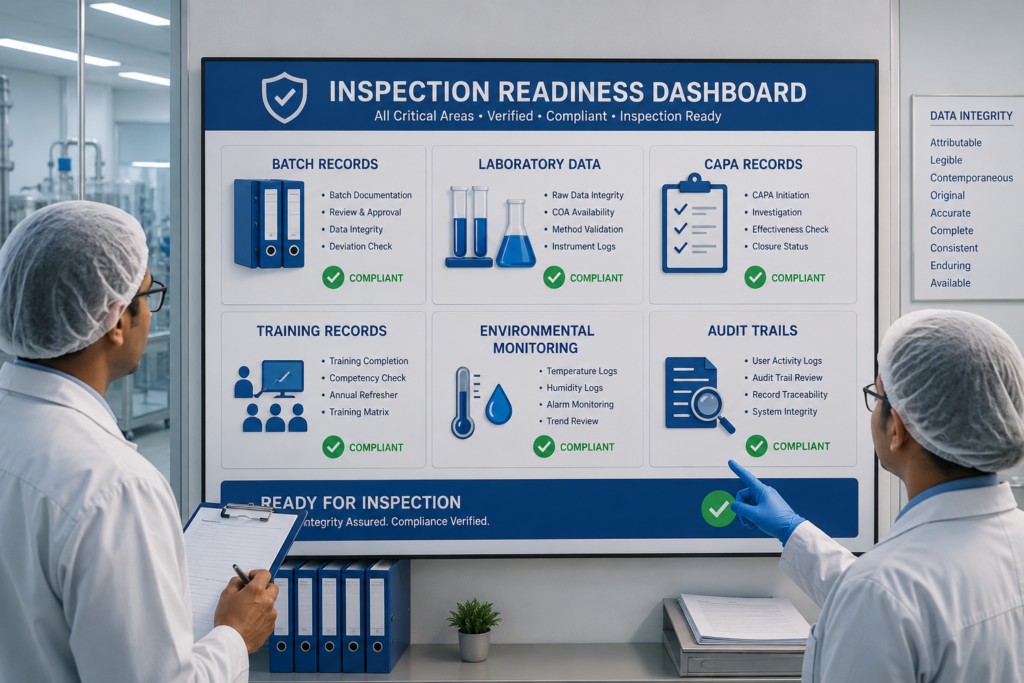
  • Batch Records – Each step in the manufacturing process should be recorded in real time. Reviewers will be looking for entries that are completed contemporaneously, corrections that are made according to procedure, and review signatures completed prior to product release. Backdated batch records are one of the most common sources of Data Integrity observations worldwide.
  • Laboratory Records – Raw data generated by instruments such as chromatographs, spectrometers, and environmental monitoring devices should be archived in its original form. If the data is transferred between computers – i.e. from the instrument to a LIMS – the process should be validated, and the audit trail should indicate that no values were altered during the transfer.
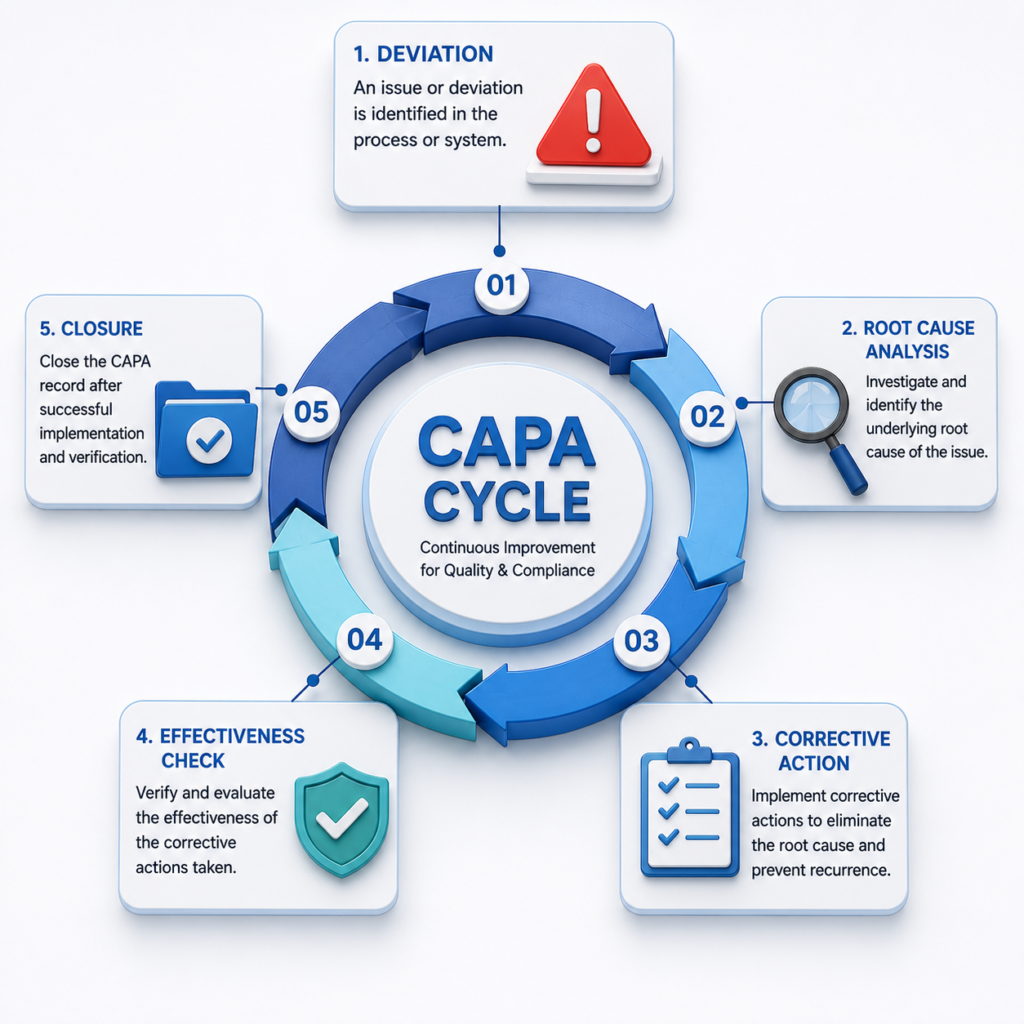
  • Deviation / CAPA Records – If an issue occurs during the manufacturing process, the investigation should be documented. The root cause, corrective actions implemented, verification of effectiveness, and timeliness should all be reviewed by inspectors. Incomplete CAPA documentation is a top repeated observation in pharmaceutical inspections around the world.
  • Environmental Monitoring Records – Temperature, humidity, and particulate levels from cleanroom areas should be trending, and any excursions should be investigated. Missing environmental monitoring data or excursions that were not investigated will raise questions from the inspection team.
  • Training Records – Every individual who performs GMP activities should have up-to-date training records related to their job responsibilities. Incomplete training records, outdated training records, and training that does not relate to the employee’s job responsibilities are commonly cited by inspectors.

Data Integrity and Facility Design: They Are Connected

One of the more hidden correlations in pharma manufacturing is between facility design and data integrity compliance. Badly designed facilities breed data integrity hazards no quality management system can fully mitigate.

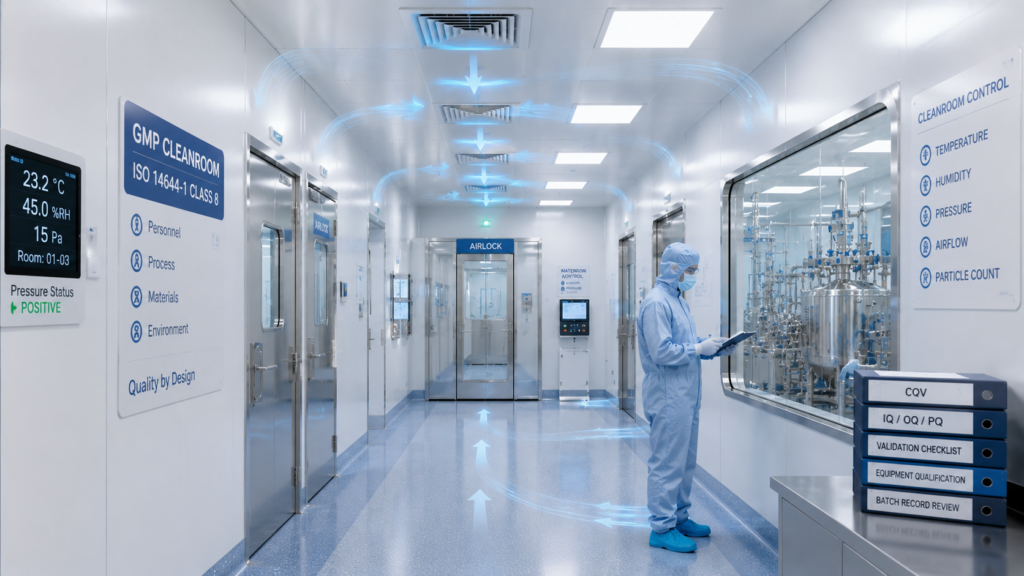
Consider how that looks from an inspector’s standpoint. A manufacturing facility where employees can traffic through cleanroom areas without properly designed airlocks, door interlocks, pressure cascades, and HEPA-filtered HVAC systems may increase the risk of excursions leading to deviations. Deviations lead to investigations. Repeat investigations because the root cause was a facility design issue and not an operational one means your CAPA is clogged with repeated observations and your quality management system is deemed ineffective by inspectors.

An entirely different documentation landscape exists for facilities designed and built to GMP from the start. Validated HVAC systems, properly classified cleanrooms, managed material and personnel flows, and qualified utility systems put you in a position where your documentation can actually do its job: accurately record a controlled process. 

Connecting facility engineering to documentation quality is critical for pharmaceutical turnkey solutions for Egypt-based manufacturers. When your plant is built correctly, your documentation will reflect a controlled process. When your plant has gaps in the design, your documentation will be filled with repeated problems and unresolved investigations.

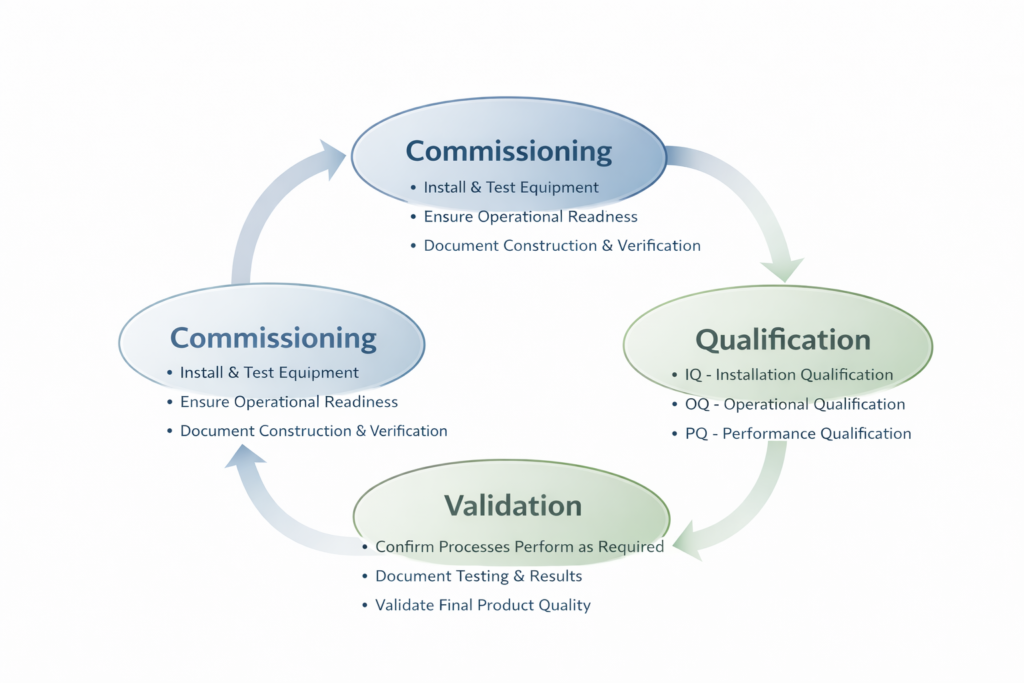
With 25+ years of experience on over 100 pharma facility projects in 18 countries, Pharma Access specializes in linking engineering design, commissioning, qualification, and validation into one seamless delivery model. Pharmaceutical consulting companies in Egypt often see similar patterns – as facility design quality increases, so does documentation quality. Approaching design from a CQV standpoint where qualification documentation is considered during the very first phase of engineering will yield a facility where batch records, environmental monitoring, and equipment logs are backed by validated, compliant systems.

Turnkey solutions for pharmaceutical companies manufacturing in Egypt face unique challenges when it comes to integrating their facility engineering with documentation and quality systems. For these companies, that is where GMP consultants in Egypt can provide the greatest value. Pharma Access’ turnkey solution includes both the physical facility itself, cleanroom design, HVAC, MEP, utilities qualification – and the quality and documentation frameworks required to support manufacturing operations day one.
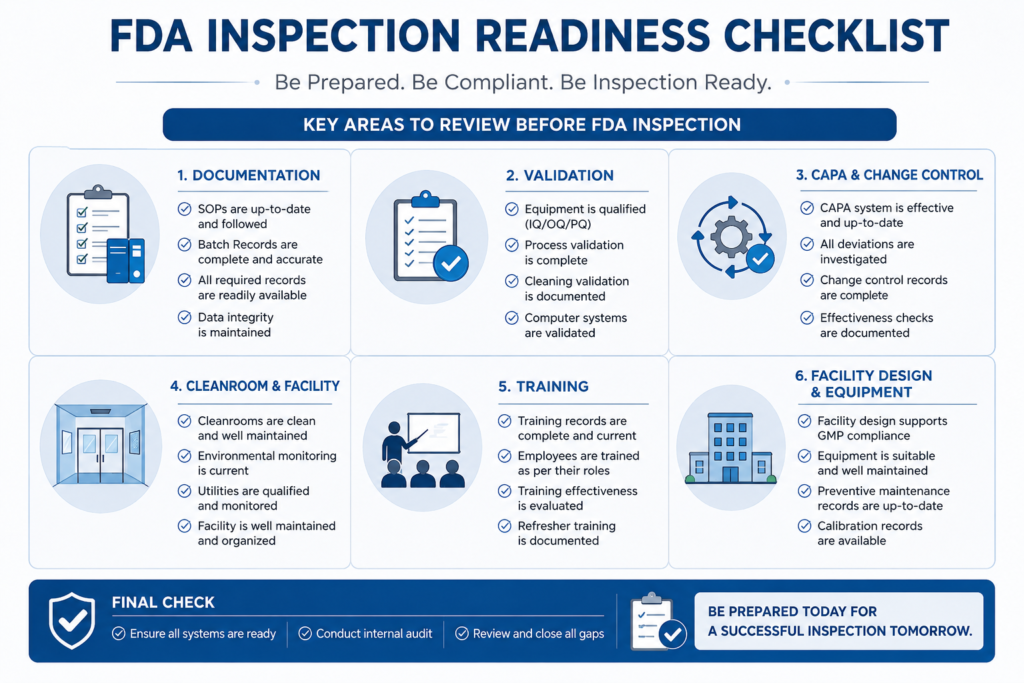
inspection-style checklist

Building a Data Integrity Culture: What Manufacturers Need to Do

  • Data Integrity is NOT just a documentation issue. It’s a culture issue. Highlights from the WHO guidance on data integrity: many systemic weaknesses identified during inspections are linked to production pressure overriding quality requirements, inadequate quality-unit resources, and lack of management accountability for data governance.
  • Here’s a great checklist for any Egyptian manufacturer who wants to shore up their Data Integrity:
  • Document EVERYTHING that touches critical data –raw material testing, in-process controls, release testing – how is the data captured, recorded, transferred, stored? Where are the hybrid (paper/electronic) handoffs? 
  • Validate ALL computerized systems – are audit trails turned on and being reviewed? Are access controls appropriate to the role? Are time sources locked and synchronized? Is system validation up-to-date?
  • Evaluate your CAPA program – are root cause analyses being performed? Are effectiveness verifications confirmed AND recorded upon completion of corrective actions?
  • Train employees on DOCUMENTATION as well as GMP topics. Personnel who understand the WHY of data integrity are more likely to practice it correctly than employees who are simply told what’s expected of them. . 
  • Perform mock inspections – use an inspection-style checklist aligned with EDA, WHO-GMP, and international regulatory expectations when reviewing documentation. While there are numerous benefits to performing mock inspections, the gaps you identify cost you NOTHING to fix. The same gaps found during an actual inspection can cost a facility its ability to export.

FAQs: Data Integrity and Pharmaceutical Documentation in Egypt

Q1: What is data integrity and why does it matter for Egyptian pharmaceutical manufacturers? 

Data integrity means that pharmaceutical records are complete, accurate, consistent, and traceable throughout their lifecycle. For Egyptian manufacturers, it matters because the EDA, WHO-GMP, and foreign regulators all require it as a condition of manufacturing authorisation and export approval. Failures in data integrity can result in product recalls, facility licence suspension, or loss of access to regulated export markets.

Q2: What are the ALCOA+ principles and how do they apply in Egypt? 

ALCOA+ stands for Attributable, Legible, Contemporaneous, Original, Accurate, plus Complete, Consistent, Enduring, and Available. These principles define the quality requirements for all pharmaceutical records whether paper or electronic.. The WHO TRS 1033 Annex 4 guideline on data integrity ALCOA+ as the expected standard for GMP-compliant documentation in any manufacturing environment.

Q3: How do pharmaceutical turnkey projects Egypt support data integrity compliance? 

A well-designed pharmaceutical plant reduces the documentation burden created by design deficiencies. When HVAC, cleanroom classification, utilities, and equipment are validated correctly from the start, environmental monitoring records, batch records, and equipment logs reflect a controlled process. Pharma turnkey solutions Egypt that include CQV-integrated design planning produce facilities where the documentation environment supports compliance from day one.

Q4: What are the most common data integrity failures found during pharmaceutical inspections in Egypt? 

Common documentation failures identified during inspections of Egyptian and regional pharmaceutical facilities include batch records completed after the event, audit trails disabled or not reviewed in electronic systems, CAPA investigations closed without effectiveness verification, laboratory raw data not retained in original form, and training records that do not match the activities personnel perform.

Q5: How should an Egyptian pharmaceutical manufacturer prepare for a WHO or EDA data integrity inspection? 

Map all critical data flows from generation to storage. Verify that electronic systems have validated audit trails and access controls. Review CAPA closure documentation for completeness. Conduct a mock documentation inspection. Ensure that all personnel involved in GMP activities have current, role-specific training records. Working with pharma consultants Egypt who have direct experience of WHO-GMP and EDA inspection expectations can identify gaps before they become inspection findings.
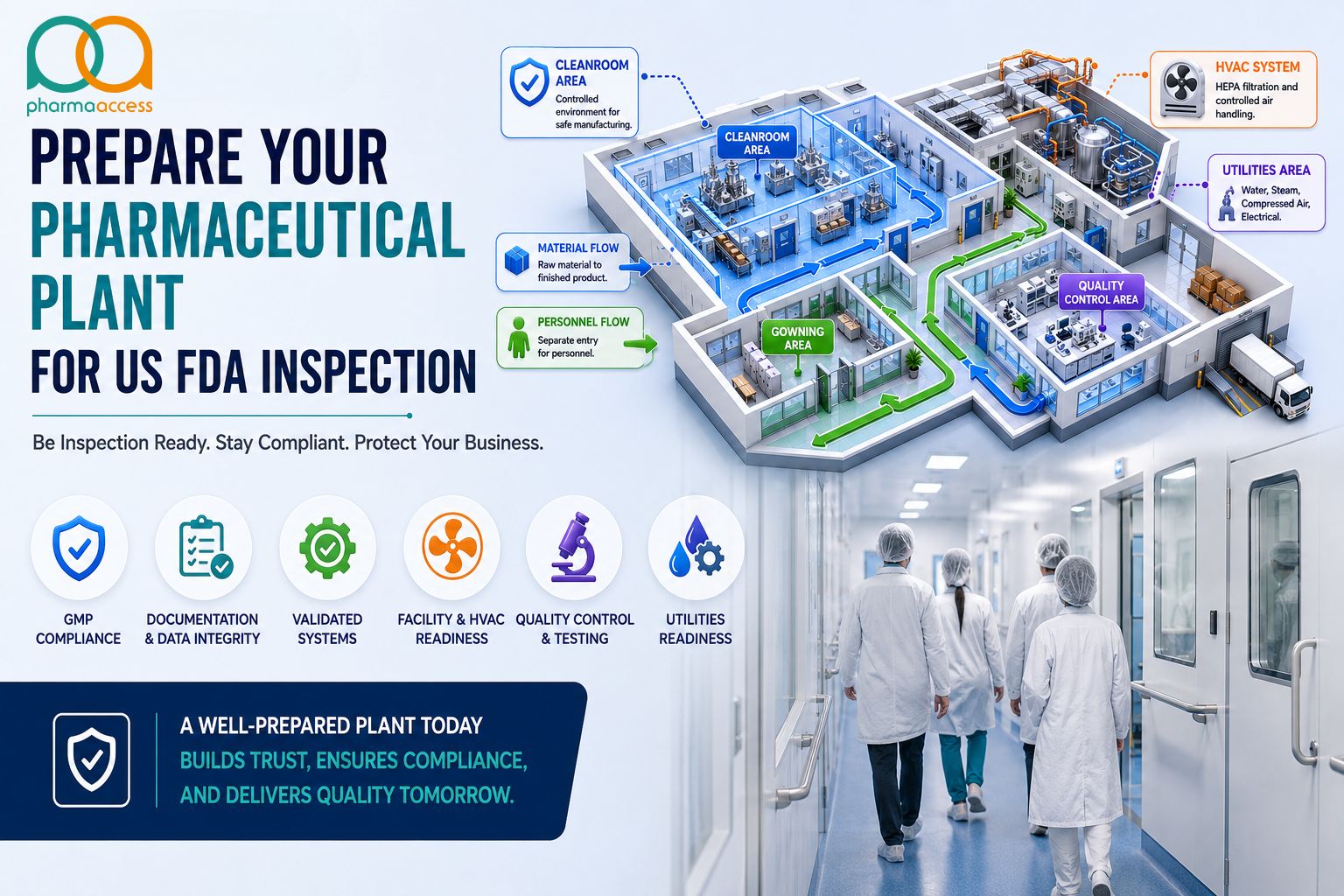
How to Prepare Your Pharmaceutical Plant for US FDA Inspection

Pharmaceutical Plant for US FDA Inspection

Why FDA Inspection Readiness Matters for Pharmaceutical Facilities 

In FY2024, FDA reported 972 drug quality assurance inspections and issued 105 human drug quality-related warning letters. If you run a pharmaceutical manufacturing plant that exports to the US, a warning letter isn’t just bureaucratic red tape. Your warning letter will be posted publicly on the FDA’s website. Partners, investors, and customers will be able to read it as soon as it’s posted. Products can be held up at the border. Approvals can take months or years to revive.

The good news is that most failures are predictable. FDA Form 483 observations (the written list of findings an investigator shares with you at the end of an inspection) repeat year after year. Data integrity failures, inadequate CAPA systems, lack of process validation, and poor record keeping account for most enforcement actions. They are engineering/system failures, unavoidable surprises.

Here is your step-by-step guide to preparing your pharmaceutical manufacturing facility for a US FDA inspection, written for those who want to build inspection readiness into daily operations, not just prepare at the last minute.

Understand What FDA Inspectors Are Actually Looking For

Step 1: Understand What FDA Inspectors Are Actually Looking For

Before we discuss how to prepare for an inspection, let’s review what the agency is looking at. FDA inspections of pharmaceutical manufacturing facilities will primarily involve those aspects covered in 21 CFR Parts 210 and 211. Those regulations codify the current Good Manufacturing Practices for finished pharmaceuticals in the US. Common FDA inspection types include:

  • Surveillance inspections – routine risk-based inspections that cover all areas including quality, production, facilities/equipment, materials, packaging/labeling, and laboratory controls
  • Pre-Approval Inspections (PAI) – occur when a company submits an ANDA or NDA for a new product allowing FDA to verify that the facility can in fact manufacture the product they describe
  • For-cause – inspections initiated based on complaints, adverse events, or product defects
  • Follow-up inspections – conducted after a 483 or warning letter is issued to confirm the facility completed corrective actions

The FDA has increased focus on data integrity, supply chain compliance, and risk-based oversight, and in 2025 announced expanded use of unannounced inspections for foreign manufacturing facilities. Audits now include both on-site reviews and remote data verification. Plus, with the agency utilizing risk-based tools and available compliance information to identify potential areas of concern, your records should be clean and complete at all times, not just when you know a visit is coming. can be unannounced, especially for domestic facilities and increasingly for foreign facilities.

We’ll review each of these areas individually. 

Step 2: Lock Down Your Documentation and Data Integrity

Documentation issues remain one of the most common and repeated areas of concern in cGMP inspections and are a chronic violation seen in pharmaceutical plant maintenance. The FDA is clear on their stance: If it wasn’t written down, it didn’t happen.

What does that mean for your facility?

Batch records are complete, accurate and traceable for every single lot produced

Laboratory data is original, unchanged, and preserved with audit trails – particularly with the use of electronic data

CAPA records clearly note root cause analysis, details of the corrective action implemented, timing, and proof that the action was effective

Written procedure deviations are reported and justified in real time

Electronic records and signatures comply with 21 CFR Part 11 validation requirements. Your systems should prevent unauthorized edits and should have full audit trails. When inspectors come, they will be looking for validation that your electronic records cannot be altered and are login restricted with tamper evident audit trails. Paper work arounds for partially automated systems are a big red flag.

If you are still using paper batch records, make validating an electronic batch record system your goal. If paper and electronic records are used together, controls should be clearly defined so there is one reliable, complete, and traceable source of truth. 

Validate Your Facility, Equipment, and Utilities

Step 3: Validate Your Facility, Equipment, and Utilities

Process validation is among the frequently observed areas in FDA inspection findings and warning letters. Validation deficiencies continue to appear in FDA enforcement trends and inspection observations.

What does validation look like in a pharma plant? Validation is the collection of documented evidence that your processes, equipment, and utilities operate within set limits. Make sure the following is validated prior to your FDA inspection:

Manufacturing processes: Process Performance Qualification (PPQ) batches should prove your process consistently manufactures products that meet all specifications. This is described in the FDA’s 2011 Process Validation Guidance as part of the process qualification stage within the lifecycle approach and is typically covered during preapproval inspections.

Cleaning processes: All equipment must be cleaned and maintained to “prevent contamination.” Per 21 CFR 211.67, your cleaning validation should prove cleaning methods reduce residues to acceptable levels AND that those levels are scientifically justified. Poorly executed cleaning validation typically results in some of the most severe 483 observations.

Critical utilities: WFI, clean steam, compressed air, nitrogen… all require complete qualification through IQ, OQ, PQ, or equivalent documented qualification approaches based on system risk and intended use. The FDA will verify that your utilities have been qualified, that continued monitoring is performed, and that excursions are investigated and recorded.

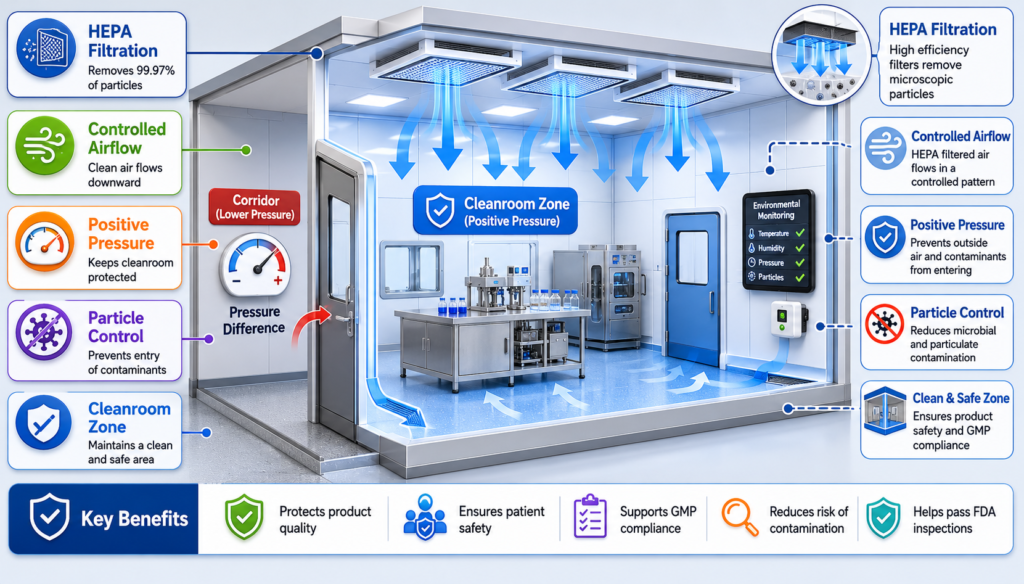
HVAC systems: HVAC systems should support contamination control, adequate ventilation, air filtration, temperature, humidity, and pressure control where required. Per 21 CFR 211.42 and 211.46, validation of HVAC includes qualification of HEPA filter integrity, airflow velocity, room pressure differentials, temperature/humidity control, and ISO cleanroom classification particle counts. Qualification should be performed during initial setup and reverified periodically based on cleanroom classification, risk, internal SOPs, and applicable standards. Any pharmaceutical facility that cannot produce a complete HVAC qualification package will receive observations during an inspection.

Analytical methods: Every laboratory method must be validated or verified as suitable for its intended use, depending on whether the method is compendial, non-compendial, or modified. 21 CFR Parts 211.160 through 211.194 state that method validation records should be available for all analytical methods used to assess raw materials, in-process materials, and finished goods.

This is where experienced pharma plant consultants add value. Validation planning, protocol writing, execution oversight, and summary report drafting leave room for the subject matter experts. 

Step 4: Build a Functional Quality Management System

Failure modes in quality systems such as quality unit lapses, CAPA management, and deviation management continue to comprise a large percentage of FDA enforcement letters. The quality unit needs to be truly empowered. Release or rejection of a product by the quality unit must stand.

What does a working quality management system look like when your plant passes FDA inspection?

  • Standard Operating Procedures are created, approved, and followed. Each procedure is version controlled and outdated procedures are not available in the plant.
  • Deviations are timely investigated, corrective actions and root causes are documented, and CAPA plans are created with defined action items, responsible parties and due dates.
  • CAPAs are validated to ensure they were effective at correcting the root cause issue – not just checking a box.
  • Change control includes all changes to processes, equipment, facilities or documentation and includes a risk assessment before implementation.
  • Internal audits are conducted on a scheduled program and assessed by risk. Audit corrections are tracked to closure.

The FDA is now evaluating CAPA systems not only on presence but also effectiveness. A CAPA that re-opens due to failure on follow-up is a clear indication that your CAPA governance system may need stronger root cause analysis and effectiveness checks. 

Prepare Your Facility Infrastructure for Physical Inspection

Step 5: Prepare Your Facility Infrastructure for Physical Inspection

Your plant’s physical condition includes buildings, facilities and equipment covered by 21 CFR Parts 211.42 through 211.68. FDA inspectors will walk around your facility. They will observe cleanroom conditions and review equipment maintenance logs, calibration tags, pest control reports, and environmental monitoring trends.

Ensure the following before any FDA inspector walks through your door:

Cleanrooms should be classified and monitored. Ensure ISO classification data, environmental monitoring reports and trend analyses are up-to-date. Document any microbial excursions and investigations.

Ensure all equipment is calibrated and maintained according to written schedules. Calibration stickers should be up-to-date. Out-of-calibration instruments found during production can lead to serious observations.

Personnel flow and material flow should prevent cross contamination. Ensure gowning procedures are written and being followed. FDA inspectors will observe gowning procedures during their facility walk-around.

Maintenance of pest control, waste disposal and facility cleaning should be documented.

Turnkey plants designed and built to cGMP from day one are much more likely to pass physical inspection than facilities converted over time through additions and upgrades. Pharmaceutical facility engineering where cleanroom layout, HVAC systems, utility routing, personnel flow and material flow are designed together produces better inspection readiness than builds constructed in steps over time.

Pharma Access, a turnkey pharma plant consulting firm with over 25+ years of experience in 120+ projects across 18 countries designs pharmaceutical facilities where CQV-focused engineering is incorporated into each stage of the project. The result: Qualification documentation becomes an expected product of the design process rather than something cobbled together at the last minute before an inspection. 

Step 6: Train Your People and Run a Mock Inspection

Training is not only mandated by 21 CFR 211.25(a) where personnel must have the education, training, and experience needed to perform their assigned functions and training must be documented, it’s also an observation the FDA continually cites if staff aren’t trained. Staff that are not trained are one of the biggest causes for 483s.

However, above and beyond the regulatory requirement there are things your staff should know when the FDA shows up at your door. At a minimum, every company should:

Designate an inspection coordinator to walk the investigator around and call for documents

Prepare all department managers on potential questions the inspectors may have and how to answer them clearly and correctly

Conduct a mock inspection 6-12 months before an expected PAI window, major approval milestone, or as part of an annual inspection readiness program using the FDA’s Compliance Program Guidance Manual as your template

Correct all observations found during mock inspection

When conducting a mock inspection you will find holes in documentation, training, following through on CAPAs, and facility issues that you didn’t know existed because nobody inside the company looks at things like the FDA will. 

Why the Pharma Plant Setup Matters as Much as the Preparation

Thinking about inspection readiness should start before your plant is built. A facility designed with cGMP compliance in mind from the beginning will always be easier to inspect. Plan for HVAC qualification paths, match cleanroom classifications to product types, size and route utility systems with qualification in mind, and design material flows that prevent cross-contamination.

This is the logical reason to work with a team of pharma plant setup consultants from day one of your project. Engineering decisions and regulatory outcomes should be designed in parallel so that the qualification documentation created during construction is used as the foundation for your inspection readiness, rather than an afterthought project completed six months before the FDA walks through your doors.

Pharma Access provides complete pharma plant services from concept design through commissioning, qualification and validation. Our services cover the full range of pharma product types including sterile injectables, biotech, oral solid dosage, API, and biopharma plant operations. Visit Pharma Access to learn more about our pharma plant setup services and how we work with companies building or upgrading pharma manufacturing facilities. 

FAQs

Q1: How much notice does the FDA give before a pharmaceutical plant inspection? 

The FDA conducts most pharmaceutical facility inspections without advance notice. Routine surveillancemay arrive unannounced, and FDA has also announced expanded use of unannounced inspections for foreign manufacturing facilities. Pre-approval inspections may follow a drug application submission with some timing predictability, but companies should maintain inspection-ready conditions continuously rather than preparing only when an inspection is expected.

Q2: What are the most common reasons pharmaceutical plants fail FDA inspections? 

The most frequent causes of FDA 483 observations and warning letters in pharmaceutical facilities are data integrity failures, weak CAPA systems, inadequate process and equipment validation, poor contamination control, and incomplete laboratory records. These issues consistently drive the majority of enforcement actions year over year.

Q3: What does a pharma plant setup consultant do to support FDA inspection readiness? 

A pharma plant setup consultant helps companies design facilities to cGMP standards, develop qualification and validation protocols, author SOPs and batch record templates, perform mock inspections, and remediate gaps found during audits. The best consultants align engineering decisions with regulatory requirements from the earliest stages of facility design.

Q4: What is a Pre-Approval Inspection and when does the FDA conduct one? 

A Pre-Approval Inspection (PAI) is conducted by the FDA after a company submits a new drug application (NDA) or abbreviated new drug application (ANDA). Inspectors verify that the manufacturing facility named in the application can actually produce the product as described, and that all submitted data is accurate. Facilities named for the first time in an application are prioritised for PAI.

Q5: How does facility design affect pharmaceutical plant FDA inspection outcomes? 

Facilities designed with cGMP compliance as a starting requirement where HVAC qualification, cleanroom classification, material flow, and utility systems are planned together produce better inspection outcomes than converted or retrospectively upgraded buildings. A turnkey pharma plant built with CQV-focused engineering generates qualification documentation during construction that directly supports inspection readiness.
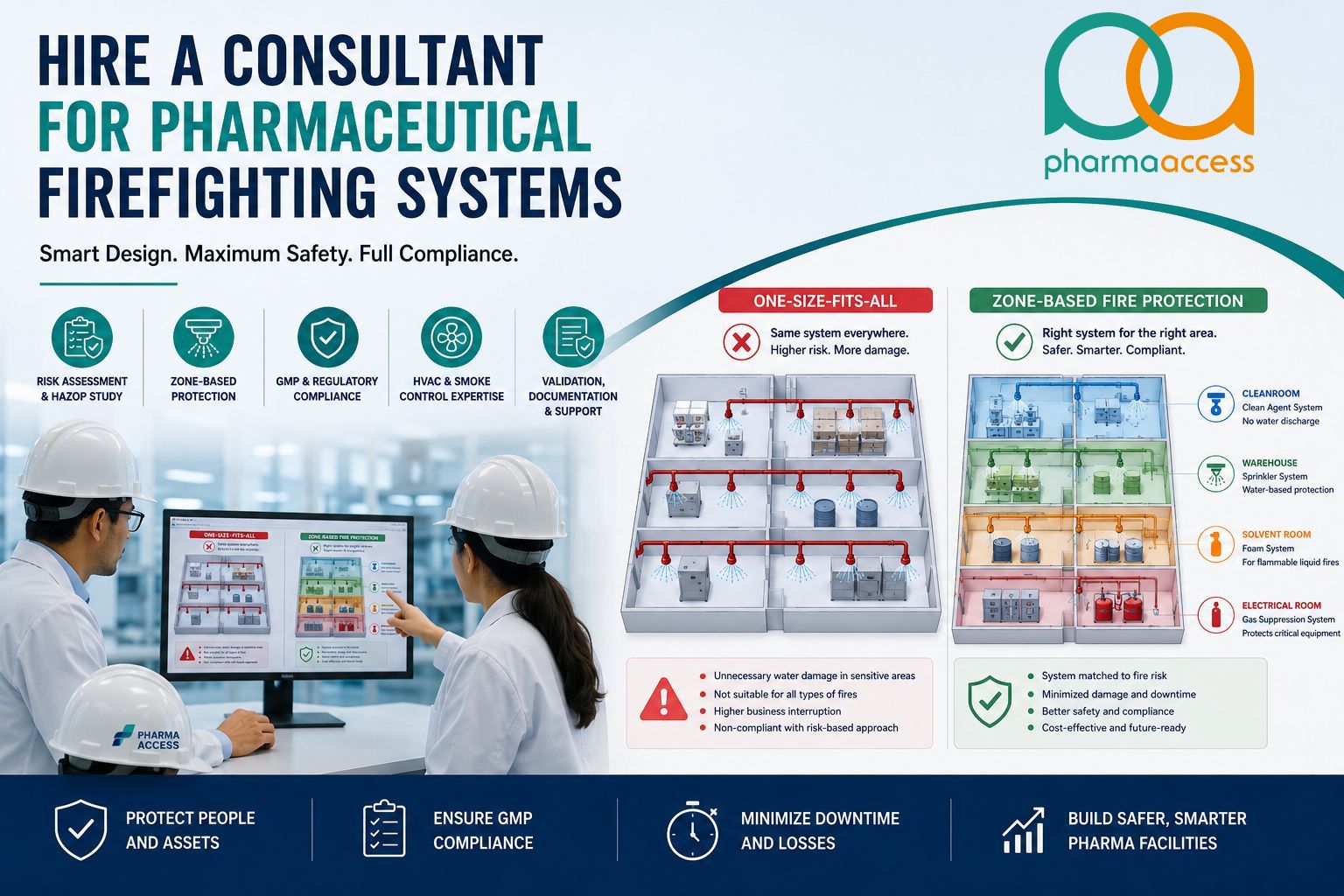
Why Hire a Consultant for Pharmaceutical Firefighting Systems?

Hire a Consultant for Pharmaceutical Firefighting Systems

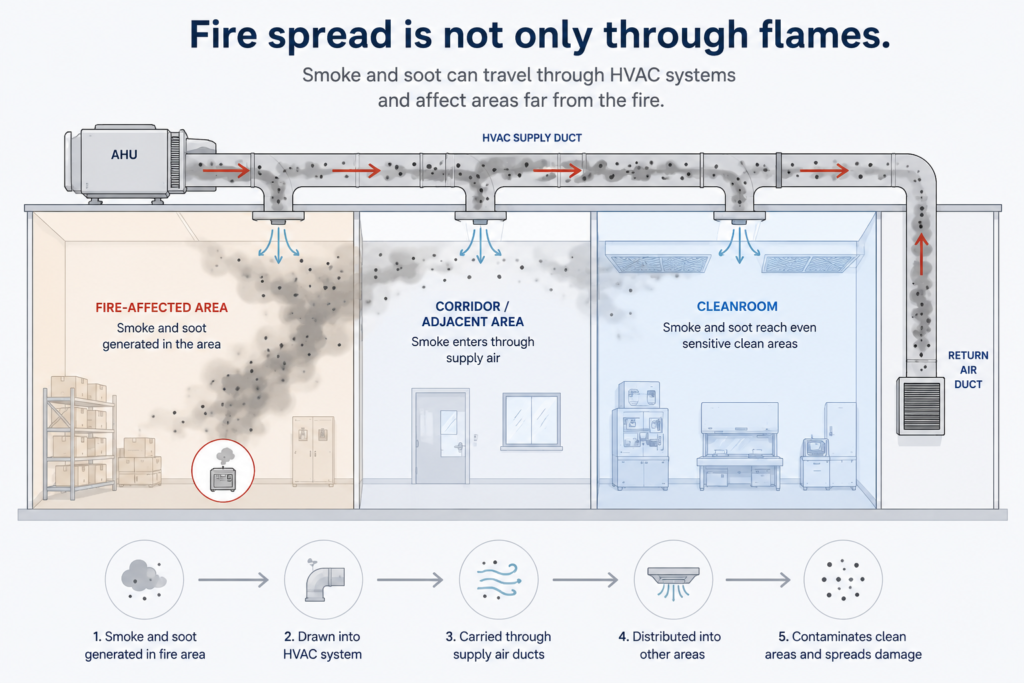
A fire at a pharmaceutical plant is more than a disaster. It’s also a GMP event, involving incident reporting, investigations, regulatory expectations, and production shutdowns. And if it occurs in a cleanroom facility, the impact can extend beyond the area where the fire started. Soot, smoke, water discharge, and contamination can affect controlled areas even where flames never reach.

In recent pharmaceutical manufacturing incidents, production at affected facilities has come to a halt for extended periods while damage, contamination, and equipment safety were assessed. Which means impacting supply chains and losing revenue.

Sounds extreme? These incidents aren’t outliers. They’re the result of fire protection being treated as a construction item instead of what it actually is: a discipline of safety engineering design. 

Bring in a consultant who specializes in pharma firefighting systems, and you improve planning, compliance, and risk control from the design stage itself. Here’s why that matters, and what a specialized consultant does that a general contractor can’t.

Hire a Consultant for Pharmaceutical Firefighting Systems

Pharmaceutical Fire Hazards Are Unlike Any Other Industry

To explain what a consultant contributes, first consider what makes pharma fire risk unique.

Pharma facilities use and produce flammable solvents such as ethanol, rubbing alcohol and acetone. Many processes produce combustible dust when blending powders. Electrical equipment running high voltages is common on production lines. Sterile manufacturing areas maintain tight pressure differentials. When fire occurs in any of these areas, it does not remain only a fire event. Fires can cause explosion risks in solvent or gas-handling areas, spread soot through HVAC ducts into cleanrooms, and expose workers to toxic hazards.

One uncontrolled fire can quickly affect other areas of the plant and turn into catastrophic secondary events. Stockpiles of flammable liquids and combustible solids present fire risks that need to be carefully engineered, not just fought after the fact.

A pharma firefighting system design consultant knows these unique risks. A standard building contractor may not have the same depth of GMP, cleanroom, and process-safety understanding. 

Reason 1: They Start with a HAZOP Study and Fire Risk Assessment

The foundation for any pharma fire protection approach should be a fire risk assessment based on formal hazard analysis. Comprehensive fire risk assessment is the bedrock of fire safety design for pharma manufacturing facilities. Pharmaceutical engineering service providers conduct HAZOP studies, fire risk assessments, area classification reviews, and risk mapping prior to finalizing the plant layout. Hazop Study, Hazard and operability study is a structured and systematic examination of a process design by a multidisciplinary team to identify how deviations from the design intent can occur. 

HAZOP identifies where and how fire hazards can occur, what consequences the hazards present, and what design changes or protective layers will eliminate or control them. Taking the time to identify these factors upfront through a structured methodology during your Hazop studies will allow you to properly protect your products and people. Pharmaceutical fire safety consulting companies champion this process from start, before the first sprinkler head is selected. Sequence is important. Trying to bolt fire protection onto a completed design is costly, sometimes structurally impossible, and often leaves gaps in protection.

Fire Protection System Design Must Match the Hazard Zone

Reason 2: Fire Protection System Design Must Match the Hazard Zone

The number one mistake made during pharma facility fire design is using a blanket approach for suppression. Commercial buildings come standard with water sprinklers. In pharma manufacturing, fire sprinklers may do more damage than the fire if they are applied without considering the room classification, equipment sensitivity, and contamination impact.

Why? Imagine a fire in an ISO Class 7 cleanroom, formerly referred to as Class 10,000. Sprinklers dump water everywhere contaminating the cleanroom and destroying costly equipment. The space must be recertified before production can resume, taking upwards of a year. Clean agent suppression systems leave no water residue and may be suitable for selected critical areas when designed with proper alarms, discharge controls, room integrity checks, and personnel safety provisions. This type of system is much better suited to certain cleanrooms, electrical rooms, and critical equipment areas.

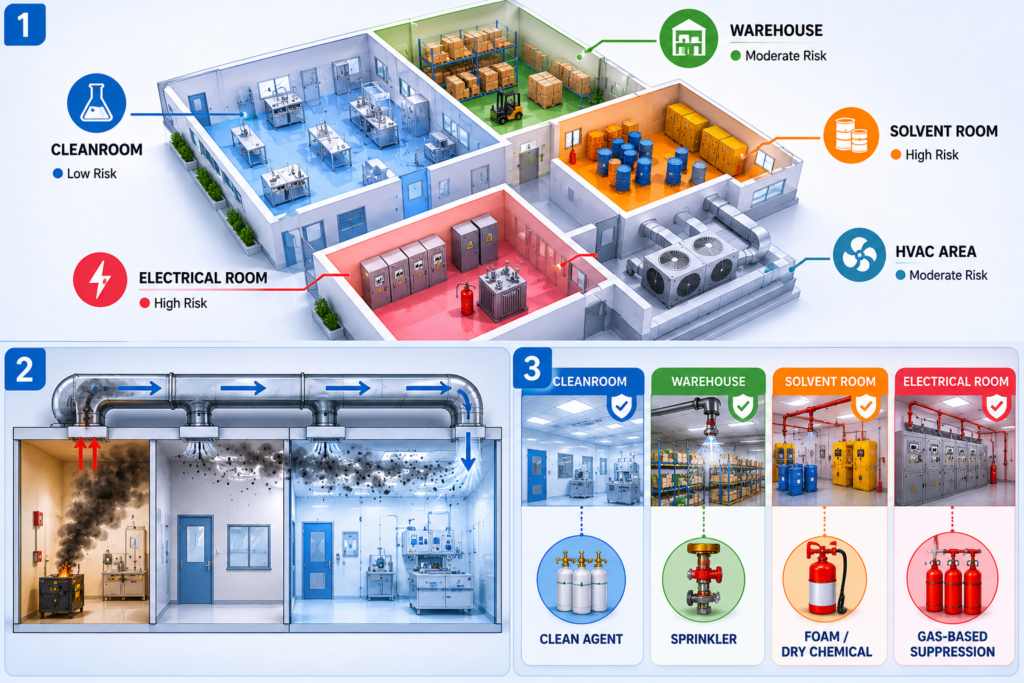
Sprinkler design is zone by zone when working with a fire protection system pharma consultant. Warehouses and general production areas may require  water-based wet pipe sprinklers. Clean rooms, electrical rooms, and critical equipment may require  clean agents or inert gas systems. Rooms storing large amounts of solvents may require  foam-based systems. Each design decision is based on that room’s hazard classification, not a one-size-fits-all method.

Here is the breakout by zone: 

Warehouses and Raw Material Storage Areas Wet pipe sprinklers installed per NFPA 13, with hazard classification confirmed based on stored material, storage height, packaging type, and local fire-code requirements.

Clean Rooms and Sterile Manufacturing Areas Clean agent fire suppression systems such as Inergen or FK-5-1-12, where suitable and where personnel safety, room integrity, and GMP impact are properly evaluated.

Solvent Storage and Dispensing Rooms Explosion-proof fittings, independent ventilation, and foam-based suppression or dry chemical

Electrical Rooms and HVAC Plant Machinery Gas-based suppression systems may help protect sensitive equipment while supporting safe evacuation when correctly designed and approved.

Reason 3: Fire Safety and GMP Compliance Must Coexist

This is where fire systems cause many problems. Fire detection, suppression heads, alarm panels and evacuation routes impact the GMP classification of your pharma space. Improper design results in compliance gaps that auditors will catch during inspection.

Fire safety should never compromise GMP requirements. A trusted pharma consultancy will coordinate fire engineering with validation, qualification and quality documentation. Evacuation routes must meet compliance standards, and fire detectors should be certified for cleanroom compatibility.

In other words, your fire safety system designer should be knowledgeable about both. They should know that equipment installed in classified areas must support ISO 14644 cleanroom requirements and GMP contamination-control expectations. They should know fire dampers located within HVAC ductwork must be outlined in the facility’s master validation plan. They should know any modification to an approved sprinkler arrangement would require a Management of Change protocol.

A fire protection company unfamiliar with these regulations will design and install a system that passes code but fails to meet GMP requirements. Fire safety experts understand how to fulfill both criteria up front.

Fire Safety and GMP Compliance Must Coexist

Reason 4: They Know How to Protect HVAC Systems from Fire Spread

HVAC systems are often overlooked sources of fire and smoke damage within pharmaceutical facilities. Fire detection should be tied into HVAC shutdown systems to avoid recirculation of smoke. HVAC systems, electrical boxes, production lines, ceiling cavities and cleanroom filters all allow soot particles to distribute to areas remotely located from the fire. A design pharma consultant with experience in firefighting system design specifies fire dampers that automatically close upon fire detection signals. They will design detector placement throughout air handling units and ductwork and tie fire detection systems to HVAC controls so both systems react simultaneously. They also specify airflow patterns within the cleanroom to reduce the risk of vapor accumulation and support contamination control.

Pharma fire safety starts with an understanding of how HVAC validation systems flow under GMP environments. This is not left up to the individual who only knows how fire safety should work with commercial HVAC systems.

Reason 5: They Prepare Your Documentation for Regulatory Inspection

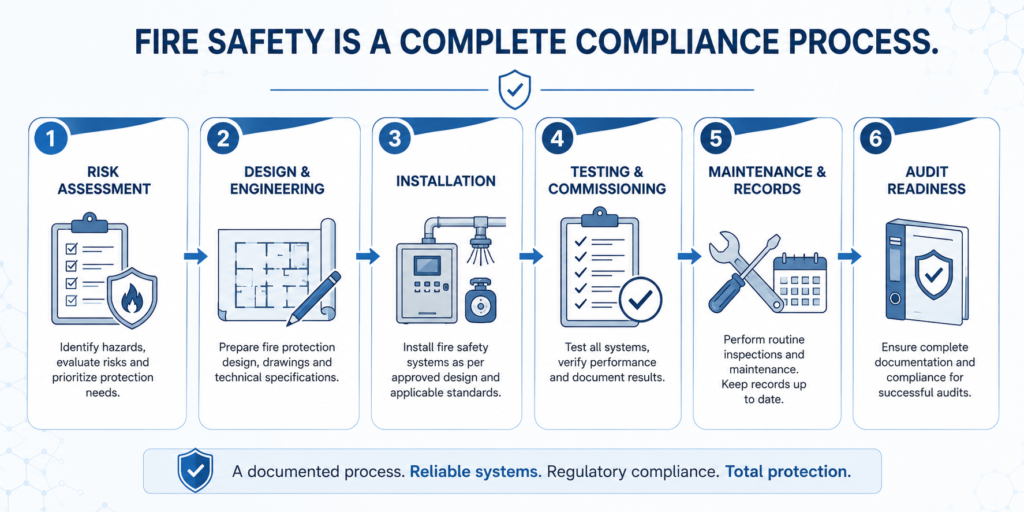
Fire protection paperwork may be reviewed during GMP audits, safety inspections, insurance audits, internal compliance reviews, and statutory inspections. Auditors want to see fire risk assessments, system design drawings, installation qualification data, preventive maintenance schedules, operator training records, drill records, etc. Many companies have periodic third-party audits to help ensure compliance and insurance approval. Pharma consulting engineers can assist pharmaceutical manufacturers with preparing for fire protection audits and regulatory inspections. Insurance carriers are raising the bar as well. 

Fires can put you out of business for months – or longer. No revenue. Missed supply commitments. Insurance companies are requiring more documented proof that risk has been assessed and that fire suppression systems have been appropriately applied to the hazard classifications within each area. A consultant who specializes in fire protection for pharmaceutical facilities can provide the technical documentation necessary to pass fire system reviews by both sets of auditors. This may include DBRs, HAZOP, zone classifications, system specs, as-built drawings, testing records, maintenance schedules, and validation-support documents.

Reason 6: They Add Value on Both Greenfield and Brownfield Projects

New builds present the cleanest slate. When working with a pharma safety system design consultant on a greenfield project, they come on board during conceptual design, influence plant layout to minimize fire spread potential, and work fire protection into the mechanical, electrical, and civil design up front. With greenfield projects, you have the ability to plan fire safety into every system from day one.

That’s not to say brownfield projects – adding to or expanding an existing plant – aren’t critical. They’re just more complicated. Many brownfield plants can benefit from phased upgrades, zoning remediation, and sophisticated fire detection thanks to the expertise of a consultant. A consultant can evaluate what exists on-site, pinpoint any gaps against today’s standards and GMP needs, and recommend a phased plan for upgrades that keeps your plant up and running while the work is being performed.

Whether your project is new build or brownfield, Pharma Access can help. As a turnkey pharmaceutical engineering partner with more than two decades of experience across 18+ countries, the Pharma Access team provides fire and life safety system design as part of a comprehensive facility design and construction methodology. Fire protection is coordinated with HVAC, MEP, cleanroom, and process design, rather than bolted on as a separate subcontract.

What Happens When You Skip the Specialist

The business case for a pharma firefighting system consultant is clear when you consider the alternative. When a fire burns at a pharmaceutical company, the facility doesn’t simply suffer property damage. Production grinds to a halt. The plant must go through the time and expense of GMP recertification. There may be regulatory alerts or customer contracts to consider, depending on how critical that manufacturer’s supply was to downstream markets. And reputationally, a fire can permanently harm a manufacturer’s position in the market.

It’s far less expensive to build good facilities, train employees, and install quality systems from day one. And that’s just as true for fire safety as it is for any other element of GMP.

If you’re a pharmaceutical company building a new facility or auditing fire protection adequacy in your current operation, don’t ask if you should consult with a firefighting system specialist. Ask how soon you can involve one in your project.

The answer should always be: as soon as possible.

FAQs: Hiring a Pharmaceutical Firefighting System Consultant

Q1: What does a pharma firefighting system consultant actually do? 

A pharma firefighting system consultant conducts fire risk assessments, leads or reviews HAZOP studies, designs suppression and detection systems matched to each hazard zone, ensures GMP compliance is maintained, and produces all documentation needed for regulatory inspection and insurance review. Their work covers both new facilities and upgrades to existing plants.

Q2: How is pharmaceutical fire safety different from standard industrial fire protection? 

Pharmaceutical plants use flammable solvents, generate combustible dust, and operate sterile cleanroom environments where even water discharge from sprinklers can cause contamination and require cleaning, investigation, requalification, and GMP recertification before production resumes. This means suppression systems, detection placement, and HVAC integration must all be engineered specifically for pharmaceutical conditions, not adapted from standard industrial or commercial building codes.

Q3: Can a general fire protection contractor handle pharmaceutical facility design? 

A general fire protection contractor can produce a code-compliant installation, but they typically lack the GMP knowledge needed to integrate fire systems with cleanroom classification, validation documentation, and regulatory inspection requirements. A pharmaceutical fire safety consultant bridges both disciplines and ensures the design meets fire codes and GMP standards simultaneously.

Q4: When in a project should a pharma fire safety consultant be brought in?

The earlier, the better. On a new build, a pharma firefighting system consultant should be engaged at the conceptual design stage, before plant layout is finalized. This allows fire risk to shape layout decisions, not just be accommodated within them. For brownfield upgrades, bringing a consultant in before construction documents are issued allows phased plans that minimize production disruption.

Q5: What standards govern fire protection system design in pharmaceutical facilities?

The main references include NFPA 13 (sprinkler systems), NFPA 30 (flammable and combustible liquids), NFPA 45 (laboratories using chemicals), NFPA 101 (life safety), ASTM E84 (surface burning characteristics of building materials), and WHO GMP guidelines. Local statutory fire codes and national GMP regulations issued by bodies such as CDSCO, FDA, or EMA take precedence where they differ from international standards.

Who Delivers Leading Pharmaceutical Facility Design Solutions for Modern Pharma Plants?

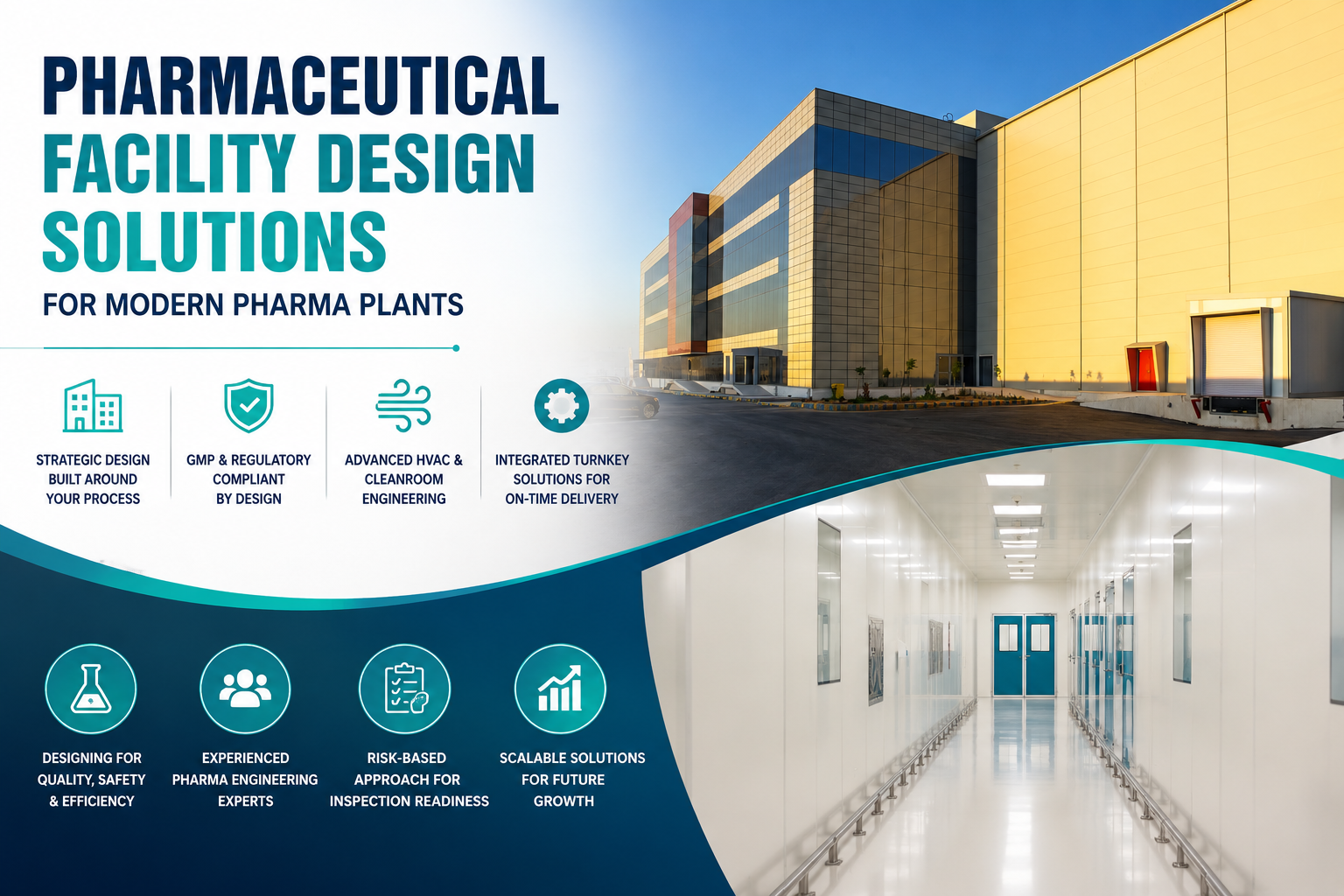
Pharmaceutical Facility Design Solutions for Modern Pharma Plants

The Standard for Modern Pharma Facilities Has Changed

In 2024, the worldwide pharmaceutical manufacturing market was valued at around $589 billion. By 2033, that number is expected to continue growing significantly, driven by expanding pharmaceutical capacity, biologics, and regulated manufacturing demand. Investors are pouring money into reimagining how pharmaceutical manufacturing facilities are built and what they look like.

Between 2024 and 2030, several leading pharmaceutical manufacturers have announced large-scale investments in manufacturing expansion, fill-finish capacity, biologics, and advanced production infrastructure.

The massive influx of capital raises an important question. Who can actually deliver the pharmaceutical facility design solutions required to build and operate modern pharma manufacturing facilities that meet today’s technical, regulatory and operational demands? What separates those who help manufacturers remain inspection-ready from day one?

Let’s take an objective look at what sets the best pharmaceutical facility design companies apart, and what every pharmaceutical manufacturer should look for in a design partner. 

What Modern Pharmaceutical Facility Design Actually Requires

Starting with the Product, Not the Building

One of the most common mistakes in designing a pharmaceutical plant is to focus on the building itself as the centerpiece of design. The facility should be built around the process, and the process is driven by the product.

Sterile injectables require an entirely different facility design than oral solid dosages. Biotech manufacturing, such as monoclonal antibodies, requires strict contamination-control and process-specific design considerations that are not the same as those used in tablet plants. And API synthesis plants need unique chemical handling facilities, fume extraction systems, and waste treatment systems that oral dosage forms do not.

World-class pharma plant design services will start with a User Requirement Specification (URS) that translates the product type, dosage form, process, batch size, and target markets into a master list of facility requirements prior to any layout drawings being created. Every subsequent design decision from room classification to HVAC loads to material flow to utility routing to equipment footprint can be traced back to the requirements created from that URS.

Pharma engineering services that do not take the time to develop this foundation may create facilities that look compliant on paper but become difficult to operate consistently in practice: contamination excursions, failed EM tests, inadequate containment, or undersized utility systems. 

Cleanroom Design as an Engineering Discipline

Cleanrooms are often classified under ISO 14644-1. This standard gives specifications for Class 1 through Class 9 cleanrooms based on the number of particles permitted per cubic meter of air. Regulatory frameworks such as EU GMP Annex 1 and FDA cGMP expectations add requirements beyond particle classification, especially for sterile pharmaceutical manufacturing environments. These include: microbiological levels, pressure relationships, growing standards and environmental monitoring frequencies.

Simply stated, classification of the cleanroom dictates:

  • The number of air changes per hour required to maintain the desired cleanliness level, based on process risk, occupancy, recovery time, and heat load
  • Filtration (HEPA H14, 99.995% at MPL) meets most needs for ISO Class 5 through ISO Class 8 rooms)
  • Pressure relationship to other areas through a designed pressure cascade that supports contamination control
  • Hard surface finishes that are smooth, non-shedding, resistant to chemicals & cleaning agents and are easily cleaned
  • Airlocks when entering or exiting areas of different ISO class

Over-classifying cleanrooms can add significant capital and operating cost. Opting for a lower cleanroom rating can result in failure to meet regulations. Cleanroom design isn’t guessing at the ISO rating that a room should be based on an iso classification chart. It should be based on what the process can actually tolerate. This means knowing your process and your products. 

HVAC: The System That Makes or Breaks Everything Else

HVAC systems in pharmaceutical manufacturing facilities are not “building services.” They are process-critical systems that answer the question of whether a cleanroom can maintain its classification; whether temperature and humidity conditions are stable enough to ensure product quality; and whether pressure differentials between adjacent “cleanrooms” or “zones” stay within validated limits 100% of the time. Pharmaceutical cleanrooms can use significantly more energy than typical commercial buildings, and HVAC systems account for over 50% of the electricity consumed. 

Qualification of HVAC systems including HEPA filter integrity testing, air flow volume and velocity mapping, room pressure differential confirmations, temperature and humidity control and monitoring, and ISO particle counts should be performed, documented, and approved before any manufacturing activity begins, and trended at scheduled intervals throughout product manufacture. While 21 CFR 211.42 does not prescribe a specific HVAC qualification protocol, it requires facilities to be designed and operated to prevent contamination and mix-ups. In practice, this makes HVAC design, qualification, monitoring, and documentation critical parts of GMP compliance. 

When inspectors review HVAC systems, they specifically look for HVAC validation records, environmental monitoring trends, and HVAC deviation investigations. Sites that cannot provide a complete HVAC qualification dossier may face regulatory observations or delays during approval. 

Pharma engineering services groups tasked with designing HVAC systems for drug manufacturing facilities should understand the regulations and qualification process as well as the operating parameters: energy costs, required redundancies, maintenance access, and future expansion. 

What Separates Strong Pharma Facility Design Companies from the Rest

Compliance Embedded from Day One

The single biggest factor when choosing between pharma facility design firms is whether they view regulatory compliance as a design input or design output. When compliance is treated as an output, facilities may face late-stage documentation gaps, redesign work, and qualification challenges.

When compliance is treated as an input, every decision—room layout, routing of utilities, machine and equipment placement, specification of surfaces, and sizing of airlocks—is made with one question in mind: does this support the qualification process and the inspection outcome the manufacturer needs? Qualification documentation created throughout engineering and construction becomes your inspection ready foundation, rather than a separate project done in panic weeks before the FDA shows up.

This is known in the industry as commissioning, qualification and validation focused design or CQV for short. CQV requirements are designed into the engineering so that the physical facility and documentation package are developed hand in hand. 

Quality by Design Applied to the Facility

ICH Q8(R2) defines Quality by Design (QbD) as an approach to pharmaceutical development where the quality of the product is built into the design of the product and its manufacturing process. Although ICH Q8(R2) focuses on pharmaceutical development, the same principle is highly relevant to facility design.

When QbD principles are applied to facility engineering, the critical quality attributes (attributes of the manufactured product that must be maintained to ensure product safety and efficacy) are linked to facility design decisions that control them. Air classification, pressure differentials, temperature control ranges, and contamination barrier designs are selected and documented based on the risks to product quality, rather than because they were included in the last facility your designer worked on.

Facility design solutions that start with QbD create facilities that are easier to validate, easier to operate within specification, and stand up better to regulatory scrutiny because there is a clearly documented reason for every decision that relates back to product quality. 

The Turnkey Advantage: Coordinated Delivery Across All Disciplines

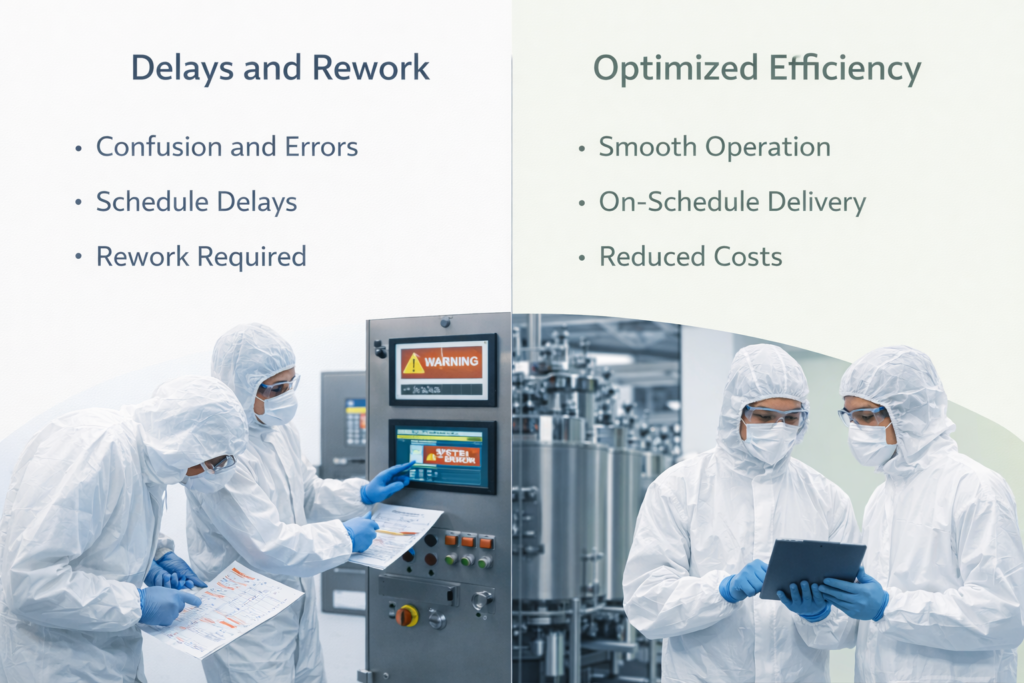
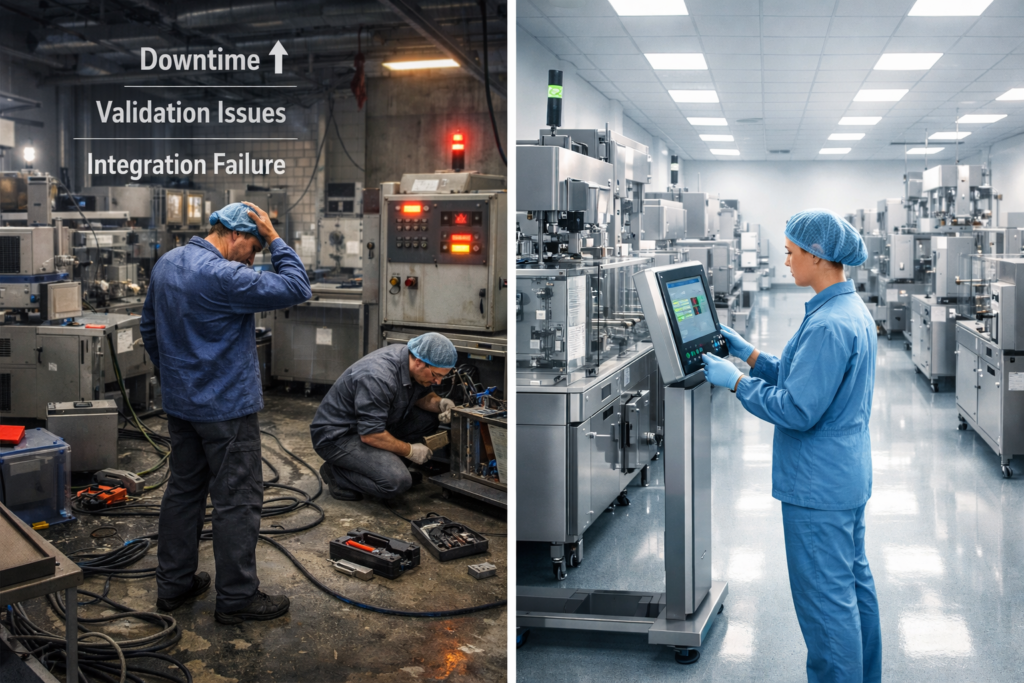
Conventional pharma plant construction divides the scope among an architect, process engineer, MEP contractor, equipment supplier, validation team. They each design from their scope, hand off to the next player, and may not always carry full accountability for how their discipline interfaces with the others. The consequence is mismatched interfaces, rework, validation delays, and schedule headaches.

Turnkey solutions bring unity to the project by placing responsibility under one delivery partner. Design, procurement, construction, installation, commissioning, qualification, and validation are executed under one coordinated plan. Integration of process engineering, cleanroom design, HVAC, electrical, utilities, and automation is coordinated from the start in the engineering stage, preventing delays and conflicts during construction and validation.

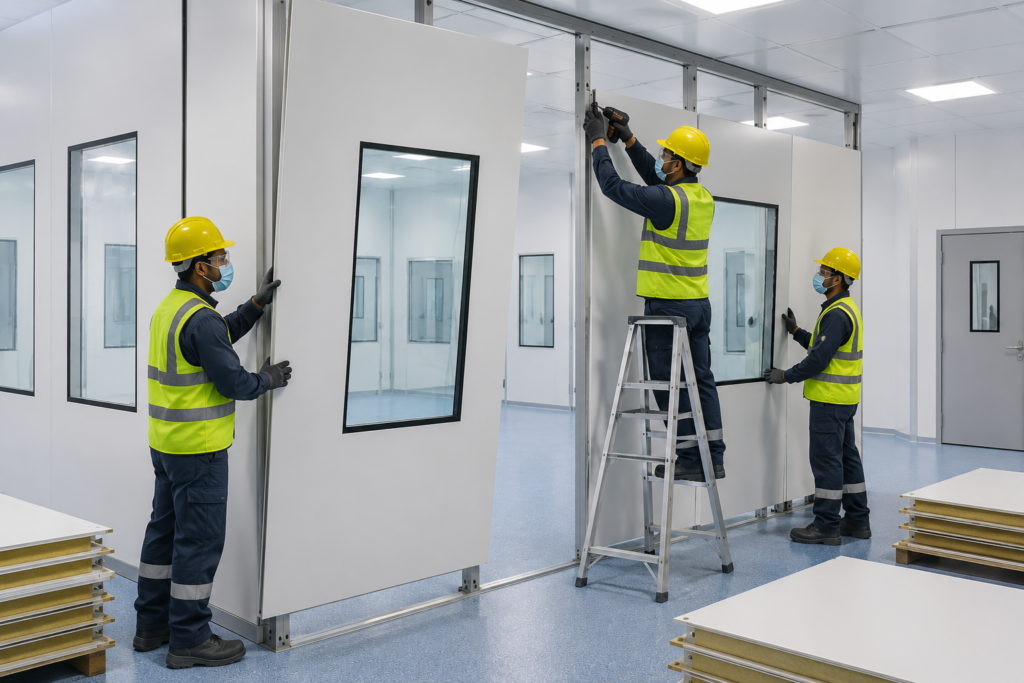
The advantages turn into tangible value. Prefabricated cleanroom systems and modular construction methods can reduce on-site work by shifting fabrication, integration, and quality checks into a controlled factory environment. Turnkey partners who use well-planned modular approaches can help shorten project timelines when site readiness, regulatory scope, and engineering coordination are aligned. When speed to market is a pharmaceutical manufacturer’s need to meet competitive or regulatory demands for new capacity, every month matters. 

What to Look For in a Pharmaceutical Facility Design Partner

ENGINEERING – what differentiates a true pharmaceutical facility design partner from your run-of-the-mill engineering firm that “does pharma work”:

  • Experience with multiple dosage forms: Cross-pollination between projects for sterile injectable facilities, biotech plants, oral solid dosage facilities and API facilities breeds a knowledge base that narrow-focused specialists will never match. Lessons learned from contamination control in a biotech suite will influence your airlock designs in an OSD facility. Experience with utility systems in an API plant will define the envelope of what can be achieved when designing a future sterile expansion project.
  • Design that incorporates CQV: Your qualification documentation should be a designed deliverable, not something your engineers “figure out” later. Inquire specifically if the design engineers and qualification specialists are working together from the URS stage forward.
  • International regulatory knowledge: A facility designed to meet regulatory requirements in one country will face hurdles when seeking approvals in the US, EU, or any regulated market outside their native region. FDA 21 CFR Parts 210 & 211, EU GMP Annex 1, WHO-GMP, PIC/S…they are all written differently, yet each contains unique facility design expectations that should be addressed during engineering.
  • Prefabrication expertise: The capability to build cleanroom modules, utility skids, and process equipment off-site while civil and structural work is performed on-site is a project delivery expertise that translates into tangible schedule and cost savings.

Pharma Access is that unique combination of skills applied to pharmaceutical facilities. “We’ve been around for 25 years, completed over 100 projects and have facilities in 18 countries,” says Mr. Shams Parvaz, MD and CEO of Pharma Access. “We provide full engineering design, procurement, construction, installation, commissioning, qualification and validation. 
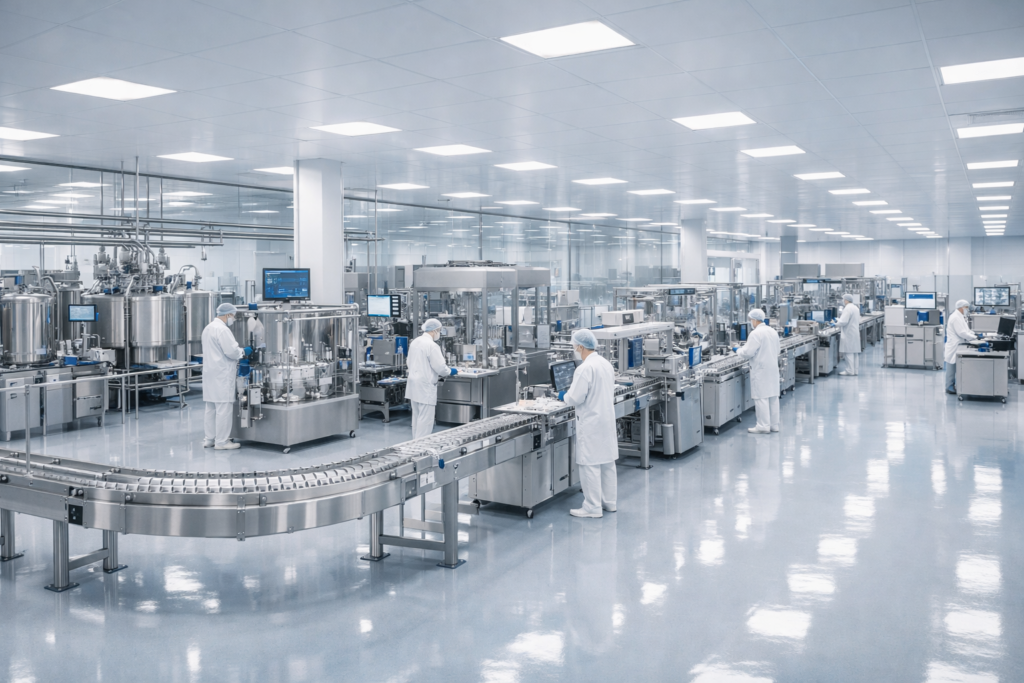
We do it all.” Pharma Access’ experience includes biotechnology facilities, sterile manufacturing facilities, oral solid dosage (OSD) facilities, oral liquid dosage (OLD) facilities, and API facilities. Across these manufacturing formats, Pharma Access brings integrated design-and-build experience for complex pharmaceutical environments.

Pharma Access has now combined that turnkey expertise with prefabricated construction methods through their Modular Mobile Facility (MMF) platform. The MMF platform allows Pharma Access to apply the efficiencies of factory controlled construction to drastically reduce on-site assembly time while limiting CO2 emissions and maximizing the engineering required for GMP compliance.

FAQs: Pharmaceutical Facility Design Solutions

Q1: What is included in pharmaceutical facility design solutions? 

Pharmaceutical facility design solutions cover the full scope of engineering required to deliver a GMP-compliant manufacturing plant. This includes process design, cleanroom layout and classification, HVAC and MEP systems design, utility systems such as water for injection, clean steam, purified water, and compressed air where applicable, civil and structural design, automation and building management systems, and commissioning, qualification, and validation planning and execution.

Q2: How do pharma facility design companies decide what cleanroom classification a room needs? 

Cleanroom classification is determined by the product being manufactured and the operations taking place in the room. Sterile fill/finish operations typically require ISO Class 5 environments at the point of critical operation, supported by appropriate background classifications depending on the process and regulatory expectation. . Support areas may be classified at ISO Class 7 or ISO Class 8. The design firm works from the User Requirement Specification to map each room’s function to the appropriate ISO 14644-1 class, then designs HVAC, filtration, and monitoring systems to maintain that class.

Q3: What is a turnkey pharmaceutical plant solution and how does it differ from conventional project delivery? 

A turnkey pharmaceutical plant solution places complete project responsibility design, procurement, construction, qualification, and validation with a single partner. Conventional delivery splits these responsibilities across multiple contractors. The turnkey model eliminates interface risk between disciplines, produces more consistent documentation, and typically delivers faster completion timelines with better alignment between facility design and regulatory requirements.

Q4: How does cleanroom design for pharmaceuticals differ from cleanroom design in other industries? 

Pharmaceutical cleanroom design must meet both ISO 14644-1 particle classification standards and GMP regulatory requirements covering microbiological limits, pressure differentials, environmental monitoring, gowning procedures, and qualification documentation. The FDA and EU GMP authorities inspect these systems and review qualification records. Non-pharmaceutical cleanrooms are typically focused more heavily on particle control, while pharmaceutical cleanrooms must also address product safety, contamination control, patient risk, and GMP documentation.

Q5: Why does HVAC design matter so much in pharmaceutical plant design services? 

HVAC systems directly determine whether a cleanroom holds its ISO classification, whether temperature and humidity conditions protect product stability, and whether pressure differentials between zones prevent contamination migration. HVAC qualification is a key GMP expectation linked to contamination control and facility performance, and HVAC records are reviewed in FDA inspections. An undersized, poorly designed, or inadequately qualified HVAC system can render an otherwise compliant facility unable to pass inspection.

Challenges in Setting Up Pharmaceutical Plants in Saudi Arabia

pharmaceutical plants in Saudi Arabia

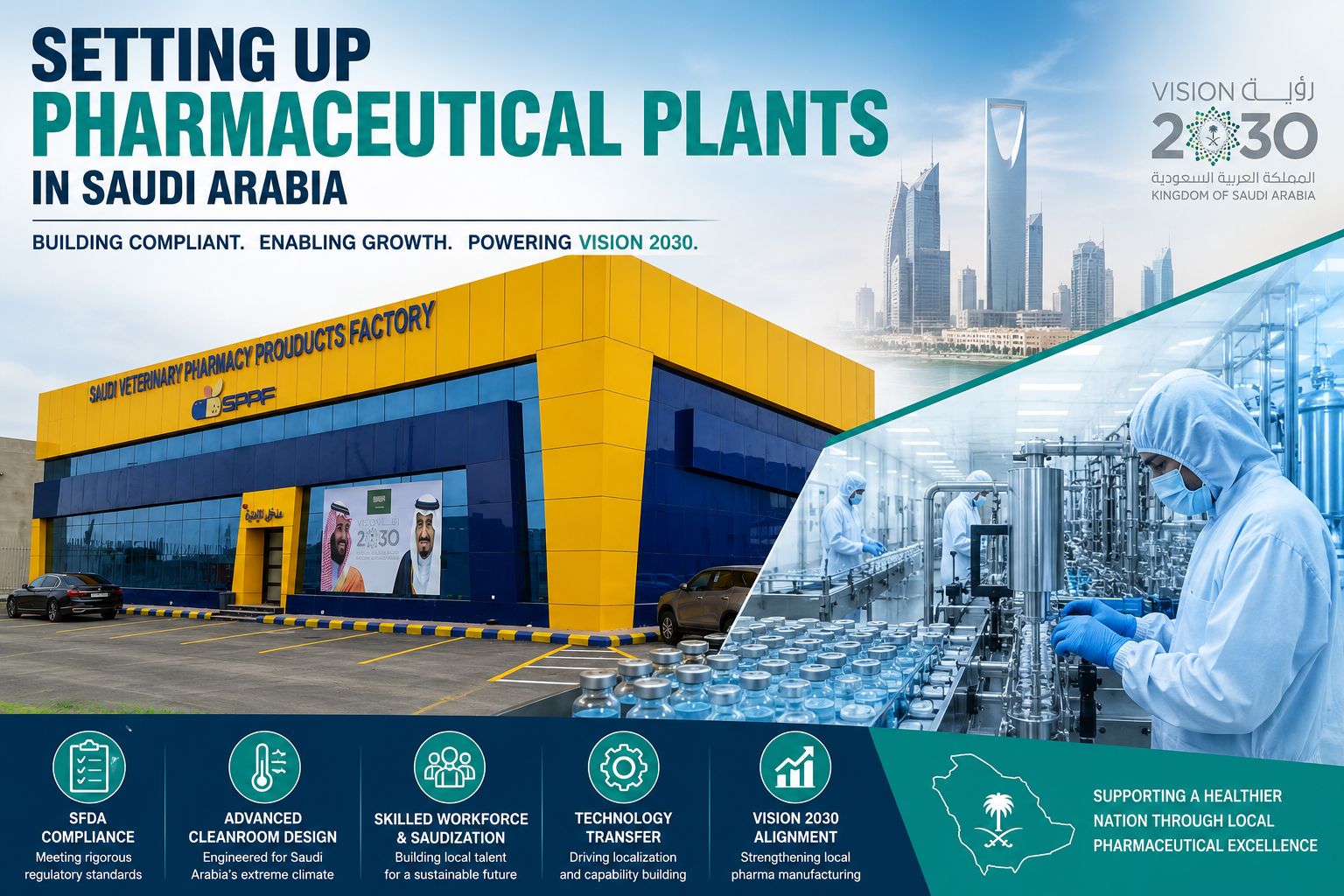
Saudi Arabia boasts the largest pharmaceutical market in the Middle East and North Africa region. Despite this, the Kingdom imports most of its medicines. All that is set to change – Vision 2030 is striving to localize pharmaceutical production. Saudi Arabia wants to increase local pharmaceutical manufacturing from an estimated 20% to 40% of the market supply. To support local production, the Kingdom allocated USD 65 billion to improve its healthcare system.

This signals a significant and urgent opportunity for business. However, there are some significant and urgent challenges any business will face when constructing a pharmaceutical plant in Saudi Arabia. Here are some things to know beforehand. 

SFDA Compliance Is Demanding

The Regulatory Hurdle: SFDA Compliance Is Demanding

The first hurdle that greets any plant developer is the Saudi Food and Drug Authority (SFDA). Created in 2003 it regulates drug registration, pricing, manufacturing licenses, facility inspections and key stages of the pharmaceutical value chain, from API production to distribution. Manufacturers must adhere to GMP rules based on WHO and PIC/S guidance. The SFDA will perform its own inspections as needed but may accept certification by another trusted regulatory body. Drug registration is completed through the Drug Registration System via the Common Technical Document (CTD) format and follows ICH guidelines. Products cannot be sold without valid approval from the SFDA.

This is typically the step that creates delays for many projects. The approval process is lengthy if you’re submitting a new product or generic to enter the market for the first time. Requirements for API manufacture are extensive and variations between Saudi local norms vs. international expectations create gaps that slow down product approval timing.

As of January 2025, SFDA has made new economic evaluation requirements  applicable. Full economic evaluations were enforced starting July of 2025. Essentially this requires manufacturers to produce clinical and economic data relevant to the Saudi population in support of your submission. This factor alone significantly increases both cost and timing for getting a new build facility ready for market.

The easiest way to overcome these challenges is by partnering with knowledgeable pharma GMP consulting experts in Saudi Arabia at the outset of your project, not after construction has completed.

Cleanroom Design in a Desert Climate

Cleanroom Design in a Desert Climate

Pharma manufacturing by its nature is conducted in highly controlled environments. Oral solid dosage, sterile injectable and biologics cleanrooms run precise temperature, humidity and particulate controls 24/7.

That’s easy to say, but Saudi Arabia is hot, with summer temperatures often reaching above 45°C and windy. Sand and dust are a year-round contamination concern. HVAC engineers building pharmaceutical facilities in Saudi Arabia have some of the toughest make-up air conditions in the world. They are managing extreme heat, dust exposure, and demanding outdoor air conditions while trying to maintain ISO room pressurization, air change per hour (ACH) rates and temperature ranges.

There are pharmaceutical specific manufacturing districts being built by MODON (Saudi Authority for Industrial Cities and Technology Zones) with full infrastructure; cleanroom facilities, QA labs, warehousing designed to support international GMP expectations. The MEP design and engineering of these facilities is up to the individual project teams.

Specification of the correct cleanroom materials, AHUs and redundant systems should be engineered by a team with experience in the region. region-specific HVAC, filtration, and GMP design expertise.

Sourcing Qualified Contractors and Skilled Workforce

Saudi Arabia enforces a Saudization mandate (locally known as Nitaqat), which specifies minimum percentages of Saudi nationals that make up the workforce of any company. Pharmaceutical manufacturing requires specialist knowledge at all levels, from process engineers and validation specialists down to QC analysts and cleanroom technicians. The challenge of finding qualified Saudi nationals to staff these roles is very real, and programs to train people up will take time.

Similarly, recruiting and keeping international pharma engineers with experience in plant setup projects is not without its challenges of work visas, expat housing, and project timelines.

The local contractor market for pharma-ready construction is also somewhat shallow compared to seasoned manufacturing destinations like India or Europe. While there are vendors familiar with cleanroom panel systems, pharma HVAC specs, GMP documentation requirements, etc., picking the right ones and managing the supply chain demands competent project management from teams with pharma-sector experience.

Partnering with a Saudi Arabia-focused pharma turnkey solutions provider early, before the process of contractor selection begins, allows the project team to qualify local vendors, determine gap areas, and plan for technology transfer where necessary.

Sourcing Qualified Contractors and Skilled Workforce

Technology Transfer and Local Content Requirements

Vision 2030 doesn’t just want pharmaceutical plants constructed in Saudi Arabia. Vision 2030 wants technology transfer, localization of capabilities, and contributions to long-term national self-sufficiency. This places tremendous pressure on foreign investors and international manufacturers to shape joint ventures, training programs, and procurements through local suppliers.

The National Unified Procurement Company, or NUPCO, has been a dominating force in the Saudi Pharma supply chain since 2009. The government conglomerate currently holds procurement sway over much of the public sector. Finding product pipeline alignment with NUPCO’s procurement needs is a strategic move that should be decided upon well before your plant is registered, not after.

Technology transfer considerations for biologics and vaccine manufacturers will be even more nuanced. The domestic manufacturing capability for biologics within the Kingdom is currently still developing compared with mature global manufacturing hubs. Vision 2030 has publicly made this sector a target for growth. The KSA has taken action through the launch of the Saudi Vaccine and Biologics Manufacturing Company, as well as international partnerships with CDMOs. Investors looking to break into this sector should expect a longer timeline and more intricate technical transfer process.

Infrastructure and Site Selection Constraints

Site selection is typically driven by the availability of land. Facility viability is impacted by reliable water sources, stable power grids, logistical access and access to cold-chain infrastructure. Saudi Arabia has several industrial cities with robust infrastructure, logistical network and municipality utilities supported by MODON. Sudair, around 120 kilometres north of Riyadh is one such city. It is emerging as an important location for pharma-grade manufacturing facilities.

The timeline to market for a vaccine or injectable manufacturing plant in Saudi Arabia is generally between 24-36 months. This includes time to select a site, complete design, construct and validate the facility. Each step in the process has its own potential setbacks be it delayed regulatory approval, construction delays, or commissioning delays of machinery and equipment. These setbacks are cumulative and impact the total project costs as well as time to revenue.

Pharma turnkey solution contracts are becoming more popular in Saudi Arabia. This methodology uses one team to design, procure, construct and commission the facility under one contract.

GMP Documentation and Validation

GMP Documentation and Validation

Constructing a pharma plant is only part of the equation. Before that first production batch rolls off line at a Saudi plant, the facility itself must pass SFDA GMP inspection, and every process system from HVAC to water for injection to process equipment must be qualified and validated according to defined criteria and procedures.

The SFDA has been enhancing its pharmacovigilance capabilities in recent years, as well as putting into place risk-based inspection frameworks. It has also increased the number of GMP inspectors qualified to inspect both local and foreign facilities. The country became a member of the Pharmaceutical Inspection Co-operation Scheme, or PIC/S, in 2023, strengthening alignment with international inspection standards.

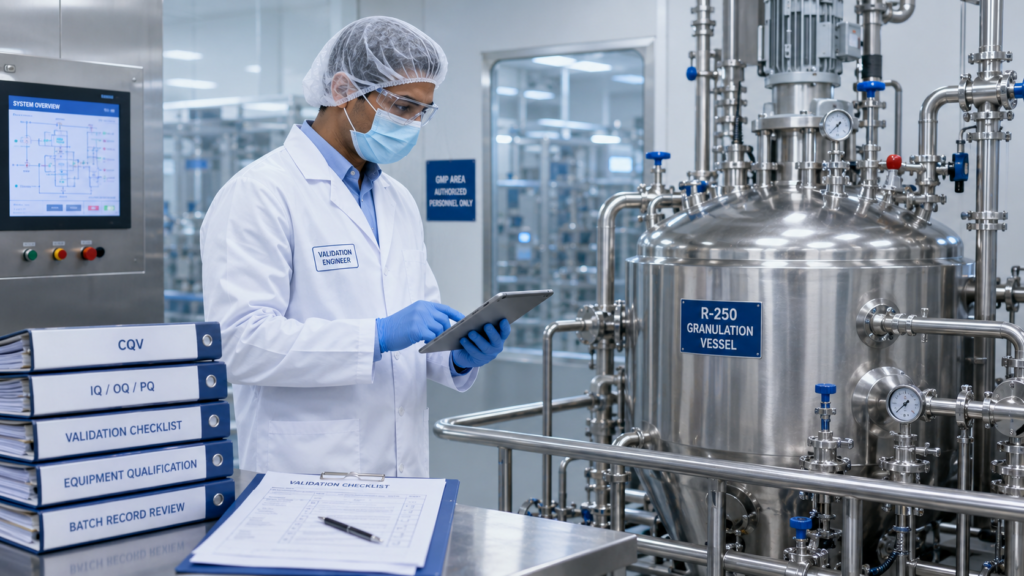
That means documentation requirements are increasing. URSs, FAT, IQ, OQ, and PQ protocols must all be created, executed, and archived in a manner that passes SFDA muster. Incomplete documentation is one of the most frequent causes for inspection delays.

Pharma Access (pharmaaccess.net) provides Commissioning, Qualification, and Validation (CQV) as part of its portfolio of pharma turnkey engineering services. Incorporating that knowledge into the project plan from day one eliminates the expensive remediation that comes from approaching validation as a step to be considered at the end of construction.

Bringing It Together: What Successful Projects Have in Common

Projects that are delivered on time and pass SFDA inspection “right of first review” tend to have a couple things in common. They hire pharma consulting Saudi Arabia and pharmaceutical engineering services Saudi Arabia early. They select pharma turnkey solutions partners with actual GMP facility experience in-country. They approach regulatory strategy, cleanroom design, and workforce development as integrated efforts.

Pharma Access has 25+ years of experience completing projects in 18+ countries, including experience in the MENA region. With experts in Pharma engineering design, design/build, project management, and CQV, Pharma Access has what it takes to assist your company’s next pharmaceutical manufacturing investment in Saudi Arabia.

There is a real opportunity in Saudi Arabia. So are the challenges that must be addressed with the right expertise. However, with the right team advising you day one, the difference between a streamlined project versus one that costs you time and money becomes self-evident.

FAQs

Q1: What regulatory approval is needed to manufacture pharmaceuticals in Saudi Arabia? 

Any pharmaceutical manufacturer operating in Saudi Arabia must obtain a manufacturing license from the Saudi Food and Drug Authority (SFDA). Products must also be registered using the CTD format through the SFDA’s Drug Registration System. Manufacturers must meet GMP guidelines based on WHO and PIC/S standards, and be prepared for SFDA facility inspections before and after commercial operations begin.

Q2: How long does it take to set up a pharmaceutical manufacturing facility in Saudi Arabia? 

A typical pharmaceutical manufacturing facility in Saudi Arabia, from site acquisition through design, construction, and validation, takes approximately two to three years to complete. Biologics and sterile injectable facilities may take longer due to greater technical complexity and more demanding qualification requirements. Early planning and experienced project teams reduce the risk of delays.

Q3: What are the cleanroom design challenges specific to Saudi Arabia? 

Saudi Arabia’s extreme summer heat and persistent desert dust create demanding conditions for cleanroom HVAC systems. Air handling units must maintain GMP-compliant temperature, humidity, and pressure conditions while working against outdoor ambient temperatures exceeding 45°C. Redundant systems and robust filter management are not optional in this climate.

Q4: Does Vision 2030 offer any benefits for pharmaceutical manufacturers in Saudi Arabia? 

Vision 2030 supports pharmaceutical manufacturers through incentives including streamlined approvals for locally produced products, tax and customs exemptions in some cases, and access to MODON-administered industrial zones with purpose-built GMP infrastructure. The program actively encourages technology transfer, joint ventures, and local workforce development, creating a range of partnership opportunities for international manufacturers.

Q5: Why should I use a pharma turnkey solutions partner for a Saudi Arabia project? 

A pharma turnkey solutions Saudi Arabia partner manages engineering design, procurement, construction, and commissioning as one coordinated effort. This reduces interface risk between contractors, keeps documentation aligned with SFDA requirements throughout the project, and brings specialized GMP and cleanroom design experience that generalist construction firms do not have. It also puts responsibility for delivery on one accountable team.

Pharmaceutical Industry Growth in Iraq: Opportunities for Manufacturing & Facility Development

Pharmaceutical Industry Growth in Iraq

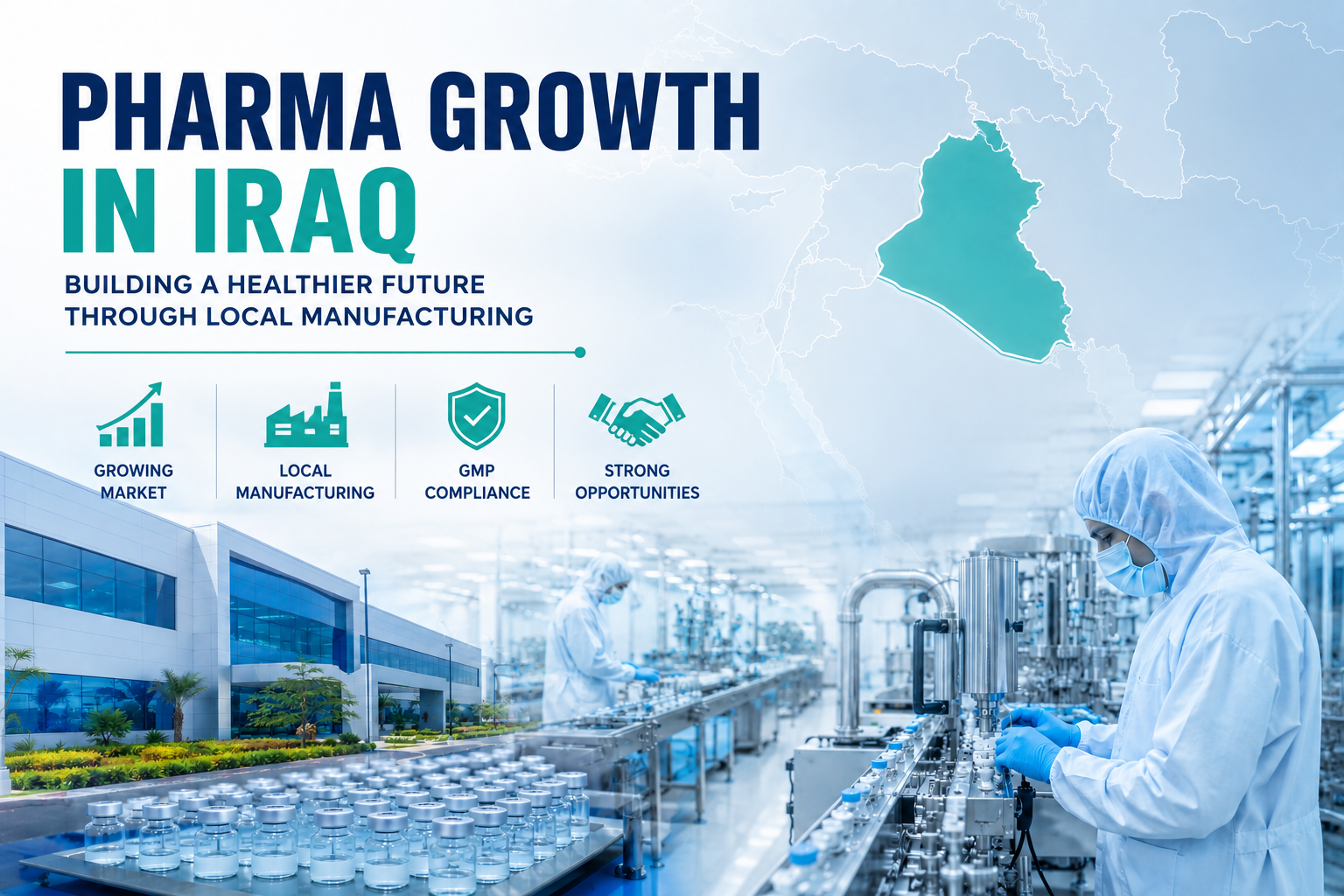
Iraq is emerging as one of the region’s important pharmaceutical growth opportunities. As recently as 1989, Iraq was spending more on healthcare than Saudi Arabia, Turkey, and Egypt combined. Years of war, sanctions, and instability have reduced that industry. Today, new policies, investment, and rising healthcare demand are bringing focus back to local pharmaceutical production. With local production struggling to keep pace with demand, the shortfall is driving genuine opportunity for manufacturers and turnkey developers who are willing to enter the market now.

Let’s take a look at what the numbers say and what they could mean for your company’s pharma turnkey solutions in Iraq.

Market: Size, Growth, and a Chronic Import Problem

The Market: Size, Growth, and a Chronic Import Problem

Iraq’s pharmaceutical market is growing, with estimates varying depending on whether official, private, and informal sales channels are included. Publicly cited figures place the market in the multi-billion-dollar range, showing strong demand for medicines across the country.

The drivers of demand are evident. a population of around 46 million and a young demographic profile, Iraq is one of the youngest countries in the Middle East. As more citizens take up residence in urban areas, non-communicable diseases such as diabetes, hypertension, cardiovascular disease, and cancer are on the rise. According to the World Health Organization (WHO), more than 70% of all deaths in Iraq are attributable to non-communicable diseases and the increasing burden of chronic illness is fueling demand for long-term medicines and advanced therapies.

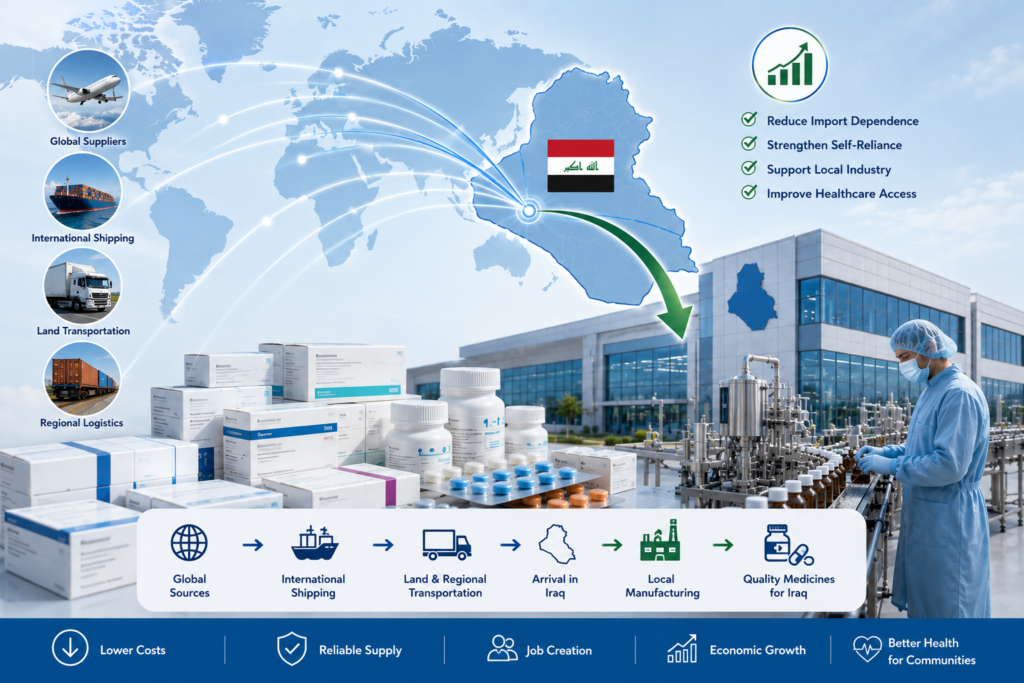
The issue: domestic production currently satisfies only a small percentage of this demand. Foreign markets supply the majority of medicines used in Iraq, with India, Jordan, Iran, and Turkey among the top exporters to Iraq. 

This dependence on imported medicines is exactly what Iraqi policymakers are now trying to reduce. For pharmaceutical manufacturers and turnkey project partners, this creates a clear opportunity to support local production. 

Government Policy: Why the Timing Is Right

Iraqi policy makers have gone beyond statements of support for local pharmaceutical production. At the government level, new decisions and incentives are encouraging both the expansion of existing pharma projects and the development of new factories.

These incentives include support for investors, easier financing options, and faster processes for companies bringing in technology and manufacturing know-how from outside Iraq.

Recent factory openings also show that this policy direction is becoming visible on the ground. The Mustaqbal pharmaceutical factory, for example, has been reported to have the capacity to produce hundreds of drug varieties, eye-drop solutions, and ampoules every year. It focuses on essential medicines and cancer treatment.

The government has also spoken about increasing procurement contracts for locally made medicines. This shows a clear push toward building a stronger domestic pharmaceutical manufacturing base.

There is a strong opportunity for investment. Companies that enter early, with the right facility design and compliance planning, are likely to be better positioned as the market develops.

The Regulatory Framework: What Manufacturers Need to Know

The Regulatory Framework: What Manufacturers Need to Know

For manufacturers planning to build a pharmaceutical facility in Iraq, understanding the regulatory environment is essential. At the federal level, pharmaceutical policy is regulated by the Ministry of Health, which houses several technical units such as KIMADIA, State Company for Medicine Importation and Marketing.

KIMADIA affects manufacturers in two main ways. First, it is central to public-sector procurement and medicine importation. Second, it is closely connected to the system through which medicines are supplied to government healthcare institutions. 

Registration of a manufacturing facility in Iraq requires a certificate of GMP. The easiest approval to obtain is that of a foreign GMP certificate issued by one of a handful of international reference agencies. The United States FDA, the European Medicines Agency, and the WHO are some agencies whose inspections will allow fast track registration in Iraq. This status enables manufacturers to receive temporary registration and an import license within roughly 30 days upon submission of 7 necessary documents.

Iraq’s pharmaceutical regulations follow WHO and ICH established GMP.For investors, this means the facility must be planned properly from the beginning. The building layout, manufacturing equipment process, clean areas, staff movement, production flow, and documentation all need to support safe and reliable medicine production.

As a general concern, manufacturers in Iraq have spoken about paperwork delays, raw material import challenges, payment delays in the public sector, and difficulty importing certain active ingredients. These are practical realities that every pharma project must plan for before construction begins.

The Manufacturing Gap: Where the Opportunities Are

Looking at this by therapeutic category: 

Tablets/Capsules represent one of the most accessible near-term manufacturing opportunities. Generic drug manufacturing capability continues to expand, subsidized by the government, and has far fewer regulatory hurdles than sterile or biologic production facilities.

However, it still requires proper planning, clean production areas, controlled processes, and strong quality systems. Even simple medicines must be produced in facilities that are safe, organized, and inspection-ready.

Sterile injectables and ampoules continue to be an important focus area for the government. The decision to include ampoule production in new local facilities shows that Iraq is looking to strengthen domestic capacity in this category.

These products require higher levels of cleanliness, control, and expertise, which makes experienced facility planning even more important.

Cancer/Specialty have become a fast-growing segment. Despite announcing their intentions to fulfill locally the pharmaceutical needs for chronic and cancer diseases by mid-2025, the government continues to incentivize new facility construction to reach this goal.

APIs & Bulk APIs are a longer-term opportunity that are beginning to see regional interest. Iraq included importing, processing, and manufacturing APIs through regional partnerships as part of their identified opportunity set.

Within each of these segments, building out a fully GMP-compliant facility is the entry point for participation. Turnkey pharma construction allows investors to move from planning to production with one experienced team managing the complete journey.

The Infrastructure Challenge: Why Turnkey Delivery Matters

The Infrastructure Challenge: Why Turnkey Delivery Matters

Constructing a pharmaceutical plant that meets GMP standards in Iraq isn’t easy. Site infrastructure will vary by region. The availability of utilities such as water, power, wastewater runoffs must be evaluated on a case by case basis. There are only so many construction contractors who have worked with pharma grade specifications.

This is where the pharmaceutical plant turnkey services Iraq concept shines. A turnkey partner brings design, advanced engineering solutions, procurement, construction, installation, commissioning, qualification, and validation under one coordinated team. 

Instead of multiple vendors working separately, one team takes responsibility for the complete project. This reduces delays, avoids gaps between contractors, and helps keep the facility aligned with regulatory expectations from the start.

Cleanroom design, air handling, utility planning, equipment layout, material movement, and staff movement must all work together. When these elements are planned properly, the facility becomes easier to operate, easier to inspect, and better prepared for long-term production.

Designing and building the facility in line with WHO-GMP or EU-GMP expectations improves inspection readiness and strengthens the company’s ability to compete for public-sector tenders, private-market supply, and future export opportunities.

Pharma Access has completed pharmaceutical turnkey projects across 18 countries with over 25 years of experience, including projects throughout the MENA region. Our integrated approach includes engineering design and build, procurement and supplies, construction and installation, commissioning, qualification, and validation. 

This is the kind of experience pharmaceutical turnkey projects in Iraq require, especially for investors entering a market where specialized pharma construction knowledge is still developing.

What Investors Are Getting Right

Successful entrants into pharmaceutical manufacturing Iraq have a couple of things in common.

They establish relationships with local partners and scientific offices early. Pharmaceutical companies looking to register and sell products in Iraq must do so through Iraqi scientific offices that are registered with the relevant authorities. Building these relationships while the facility is still being planned, rather than after construction is complete, can save valuable time.

They align their product plans with public-sector needs. When manufacturers understand what the country needs most, they can make better decisions about which medicines to produce.

They build to international GMP standards from the start. Cutting corners on things like cleanroom classification, HVAC design, or documentation during construction means you’ll be paying twice when those items need to be addressed prior to registration or export.

And they approach pharma turnkey projects in Iraq as a project management challenge, not merely a construction agreement. The difference between a facility that passes GMP inspection on first attempt and one that does not will invariably come down to project execution.

FAQs: Pharmaceutical Manufacturing Investment in Iraq

Q1: What is the current size of Iraq’s pharmaceutical market and how fast is it growing? 

Iraq’s pharmaceutical market is valued in the multi-billion-dollar range, with demand continuing to grow. The market is supported by a large population, rising healthcare needs, and government focus on local medicine production.Despite this scale, Iraq still relies heavily on imported medicines. This creates a strong opportunity for domestic manufacturers who can produce quality medicines locally.

Q2: What GMP requirements apply to pharmaceutical manufacturing facilities in Iraq? 

Iraq’s Ministry of Health requires manufacturing sites to comply with GMP guidelines aligned with WHO and ICH standards. Companies must hold a recognized GMP certificate, preferably from the US FDA, EMA, or equivalent agencies, for smooth registration. GMP audits cover facility design, equipment qualification, environmental controls, cleanroom standards where applicable, and personnel training. All documentation must meet the Ministry’s requirements for ongoing compliance.

Q3: How does KIMADIA affect pharmaceutical manufacturing investment in Iraq? 

KIMADIA plays an important role in Iraq’s public-sector medicine supply. It is central to government procurement and medicine importation.For manufacturers, this means that understanding KIMADIA’s priorities can help align production with actual public-sector demand. Strong documentation, reliable quality systems, and GMP-ready facilities can improve a company’s position in the market.

Q4: What product categories offer the best manufacturing opportunities in Iraq right now? 

Oral solid dosage generics, sterile injectables, ampoules, and specialty therapies for cancer and chronic disease are the strongest near-term opportunities. These categories match Iraq’s healthcare needs and the government’s focus on reducing import dependence. APIs and bulk ingredients may become a longer-term opportunity as local manufacturing develops further.

Q5: Why should a pharmaceutical manufacturer use a turnkey solutions partner for an Iraq project? 

A pharma turnkey solutions partner manages the complete project from design to production readiness.

This means one experienced team handles facility planning, engineering, cleanroom requirements, procurement, construction, installation, commissioning, qualification, and validation.This reduces coordination issues, keeps the project aligned with quality requirements, and helps investors move faster from decision-making to a production-ready facility.

For a market like Iraq, where pharma manufacturing infrastructure is still developing, turnkey expertise can make the difference between a delayed project and a facility that is ready for inspection and operation.

Pharmaceutical Procurement Consulting: Optimizing Equipment and Vendor Selection

Smarter Pharma Procurement

Pharma projects continue to get bigger, faster, and more complex. Though engineering and construction often steal the spotlight, one aspect of pharma projects makes or breaks schedule adherence: procurement.

Procurement in today’s pharmaceutical project isn’t just about buying equipment or selecting vendors. Procurement plays a vital role in managing costs, keeping to your timeline, staying compliant with cGMP and global regulatory expectations, and realizing project success.

Pharmaceutical procurement consulting can help. Done right, procurement weaves your technical needs, vendor capabilities, regulatory compliance expectations, and project schedule into a seamless and executable plan aligned with facility engineering.

CQV Lifecysle

The Hidden Impact of Procurement Decisions

Procurement decisions are often made early in the project lifecycle, but their impact is felt much later during installation, integration, and qualification.

A misaligned procurement strategy can lead to:

  • Delays due to late or incomplete equipment delivery
  • Compatibility issues between equipment, clean utilities (PW/WFI), HVAC systems, and automation architecture.
  • Increased rework during installation and commissioning and qualification
  • Challenges in meeting compliance and validation requirements

These issues are rarely caused by a single decision. They are usually the result of fragmented procurement planning.

Moving Beyond Traditional Procurement Approaches

In many projects, procurement is treated as a transactional activity. Vendors are selected based on cost, availability, or previous relationships, with limited alignment to engineering and project requirements.

However, pharmaceutical projects require a more integrated approach. Modern pharma procurement consulting focuses on aligning procurement with:

  • Engineering design and process requirements
  • Project timelines and sequencing
  • Compliance and validation strategies
  • Long-term operational performance

This shift transforms procurement from a support function into a core driver of project success.

Where Procurement Strategy Creates the Most Value

The real value of procurement lies not just in cost savings, but in how effectively it supports engineering execution, compliance readiness, and lifecycle performance.

Equipment Selection with Context

Selecting equipment is not just about technical specifications. It requires understanding how the equipment fits within the broader facility design.

Key considerations include:

  • Alignment with process requirements and batch sizes
  • Compatibility with utilities and automation systems
  • Ease of installation, operation, and maintenance
  • Readiness for FAT, SAT, and downstream CQV activities

Well-informed procurement decisions ensure that equipment integrates smoothly into the facility.

Vendor evaluation matrix

Vendor Evaluation Beyond Pricing

Choosing the right vendor is as important as selecting the right equipment. Instead of focusing solely on cost, effective procurement evaluates:

  • Technical expertise and industry experience
  • Ability to meet project timelines, FAT commitments, and delivery schedules
  • Quality of documentation and compliance support
  • After-sales service and long-term reliability

Strong vendor partnerships reduce project risk and improve execution quality, and support compliance throughout the facility lifecycle.

Timeline alignment

Timeline Alignment and Risk Reduction

Procurement plays a critical role in maintaining project timelines. Delays in equipment delivery or incomplete documentation can disrupt installation,commissioning and qualification schedules.

A structured procurement approach helps:

  • Align delivery timelines with construction and installation phases
  • Integrate FAT, SAT, and documentation review milestones into the project schedule
  • Identify potential risks early
  • Ensure readiness for commissioning and CQV activities

This alignment is essential for effective project management in pharmaceutical projects.

Compliance and Documentation Readiness

In pharmaceutical projects, procurement is closely linked to compliance.

Equipment and vendors must provide:

  • Complete and accurate GMP-compliant documentation
  • Support for validation activities including DQ, IQ, OQ, and PQ
  • Compliance with regulatory standards such as cGMP, FDA, and EU GMP

Procurement decisions that overlook these aspects often lead to delays during CQV.

Procurement as Part of Project Strategy

Procurement cannot operate in isolation. It must be integrated into the overall project strategy. This requires collaboration between:

  • Engineering teams defining technical requirements
  • Procurement teams managing vendor selection
  • Project management teams are overseeing timelines
  • Quality and CQV teams ensuring compliance and validation alignment

When these functions work together, procurement becomes a driver of efficiency rather than a source of risk.

integrated procurement

Why Fragmented Procurement Models Fall Short

Traditional procurement models often operate in silos, disconnected from engineering, CQV, and project execution. This leads to:

  • Misalignment between equipment and facility design
  • Reactive decision-making under timeline pressure
  • Increased coordination challenges during project installation, commissioning, and qualification

As pharmaceutical projects become more complex, these limitations become more pronounced. Integrated procurement approaches are now essential to ensure seamless project delivery.

Equipment Installed

Delivering Procurement Excellence from Day One

Optimizing procurement requires a structured and proactive approach. This includes:

  • Defining clear technical and compliance requirements early
  • Evaluating vendors based on capability, not just cost
  • Aligning procurement timelines with project schedules, FAT/SAT milestones, and CQV readiness
  • Ensuring documentation and validation readiness

When procurement is planned strategically, it reduces uncertainty and improves overall project performance.

How Pharma Access Approaches Procurement Consulting

Pharma Access views procurement as an extension of of engineering and project execution, not a standalone function.

With collaborative pharmaceutical procurement consulting and sourcing services, we work to ensure equipment specifications, vendor assessments, FAT/SAT planning, and project schedules are aligned with your engineering and regulatory needs.

Leveraging deep technical expertise and execution-focused thinking, we guide clients to mitigate risk, reduce cost inefficiencies, and deliver facilities that are ready for seamless commissioning and compliant operation.

Conclusion

Procurement is often an overlooked function within pharmaceutical projects. Yet its impact can be profound. 

It determines not only what gets purchased but also how quickly and successfully a facility is built, integrated, and commissioned.

Done right, procurement is a powerful enabler of efficiency, compliance, and on-time delivery.

In the new world of pharmaceutical project success, projects are not only engineered – they’re procured.

FAQs

1. What is pharmaceutical procurement consulting?

It involves optimizing equipment selection, vendor evaluation, and procurement strategies for pharmaceutical projects.

2. Why is procurement important in pharma projects?

It directly impacts cost, timelines, compliance, and project execution.

3. What factors should be considered in vendor selection?

Technical capability, experience, documentation quality, timeline reliability, and after-sales support.

4. How does procurement affect project timelines?

Delays in procurement can disrupt installation, commissioning, and qualification schedules.

5. What is the role of procurement in compliance?

Procurement ensures that equipment and vendors meet regulatory requirements and provide necessary documentation.


CQV in Pharma Projects: Commissioning, Qualification and Validation Explained

CQV in Pharma Projects

Today’s pharmaceutical projects are delivered under ever-increasing pressure. Requirements are mandated in shorter and shorter timelines. Designs are becoming more complex. Expectations from global regulatory agencies such as the US FDA and EU GMP are continuously increasing. Building the facility is just the beginning. The true test comes when you have to demonstrate that the facility will consistently operate safely and within regulatory expectations.

That’s where CQV pharma practices play an important role.

Commissioning, Qualification, and Validation bridge the gap between construction and compliant operations. Simply building a facility without a defined, lifecycle-driven CQV strategy will leave you struggling to achieve audit-ready operations.

off track

Where Most Projects Go Off Track

Many projects still treat CQV as a phase that begins after construction is complete. At first glance, this seems logical. Build the facility, install the systems, and then validate them. But in practice, this approach often leads to delays and inefficiencies.

As systems begin testing, gaps start to appear:

  • The equipment does not perform as expected
  • Documentation is incomplete or inconsistent
  • Integration issues emerge between systems
  • Compliance requirements were not fully considered during design

At this stage, every correction becomes more expensive and time-consuming. The issue is not CQV itself. It is when and how it is introduced into the project lifecycle.

What CQV Really Means in Practice

People tend to describe CQV as three distinct tasks. In reality, CQV is a lifecycle-driven, integrated process aligned with risk-based principles. Commissioning ensures that certain systems are installed properly and functioning correctly. Qualification confirms systems meet established requirements.  Validation ensures processes will reliably produce the expected result.

CQV activities work together to ensure that the facility is not just built, but is fully prepared for compliant and sustainable operations. These checkpoints have evolved with current CQV services. They are involved from the beginning of design and continue through project completion.

What is cqv

Breaking Down the CQV Lifecycle

Instead of viewing CQV as a single phase, it is more effective to understand how it evolves across the project lifecycle.

Commissioning: Proving Systems Work

Commissioning focuses on verifying that systems and equipment are installed and operating correctly.

This includes:

  • Verifying installation against design specifications
  • Testing system functionality
  • Ensuring utilities and equipment operate as expected

At this stage, the goal is to identify and resolve issues before formal qualification begins.

Qualification: Verifying Compliance

Qualification builds on commissioning by ensuring that systems meet regulatory, user, and operational requirements under GMP conditions.

This is typically divided into stages such as:

  • Installation Qualification (IQ), confirming systems are installed correctly
  • Operational Qualification (OQ), verifying that systems operate within defined limits and ranges
  • Performance Qualification (PQ), confirming consistent performance under actual operating conditions

Installation qualification is particularly critical, as it establishes the baseline for all subsequent validation activities.

Validation: Proving Consistent Performance

Validation focuses on process performance. It ensures that processes, utilities, and supporting systems can consistently produce results that meet predefined quality standards.

This includes:

  • Process validation
  • Cleaning validation
  • Ongoing process verification and monitoring

Validation is what ultimately demonstrates that the facility is ready for commercial production.

project validation

Why CQV Is More Than a Compliance Requirement

There is a common perception that CQV is only about meeting regulatory expectations. In reality, it plays a much broader role in project success.

When implemented effectively, CQV:

  • Reduces rework and late-stage corrections
  • Improves alignment between design, construction, and operations
  • Accelerates time to market
  • Enhances overall project predictability and audit readiness

Well-executed qualifications and validation processes are not just about compliance. They are about ensuring operational readiness.

The Shift Toward Integrated CQV Approaches

Traditional project models treat engineering, construction, and CQV as separate activities.

This separation often leads to:

  • Late identification of issues
  • Misalignment between design intent and operational requirements
  • Increased pressure during final project stages

Modern pharmaceutical projects are moving toward integrated CQV approaches.

In this model:

  • CQV teams are involved early during design and engineering phases
  • Documentation is developed in parallel with system design
  • Systems are evaluated continuously, not only at the end

This reduces risk and improves overall project outcomes.

Designing process

Designing with CQV in Mind

The most successful projects do not wait for CQV to begin. They design it.

This means:

  • Aligning system design with qualification validation requirements from the outset
  • Ensuring documentation is developed from the start
  • Considering validation needs during equipment selection and layout planning

When CQV is built into the design process, the transition from construction to operation becomes significantly smoother.

How Pharma Access Approaches CQV

Here at Pharma Access, we don’t view CQV as a separate phase of a project. We incorporate it throughout the project lifecycle.  By aligning engineering, execution, and CQV practices from day one, facilities are designed with qualification, validation, and compliance built in. This approach ensures stronger traceability, reduced compliance risk, minimized rework, and faster transition to validated operations.

conclusion

Conclusion

CQV is often treated as the last phase of your pharma project. But it’s actually the phase that validates if your facility is ready for business.

When treated as an afterthought, it leads to delays, inefficiencies, and compliance challenges. When implemented from the beginning, it ensures speed, regulatory alignment, and operational reliability. Done as an afterthought, it creates delays & frustrations. Done right from day one, it ensures speed, compliance, and reliability.

In today’s competitive pharma market, it’s not enough to just build factories. You have to demonstrate they run compliantly, day in and day out.

That’s where CQV comes in. 

FAQs

1. What is CQV in pharma?

CQV stands for Commissioning, Qualification, and Validation. It ensures that pharmaceutical facilities and systems are ready for compliant operations.

2. What is installation qualification (IQ)?

It verifies that equipment and systems are installed according to design specifications and requirements.

3. Why is CQV important in pharma projects?

It ensures compliance, reduces risks, and confirms that systems perform reliably before production begins.

4. What is the difference between qualification and validation?

Qualification verifies systems meet requirements, while validation ensures processes consistently deliver expected results.

5. When should CQV start in a project?

CQV should begin during the design phase to ensure alignment with regulatory expectations and to minimize downstream risks.

Pharmaceutical Process Equipment Selection: Key Factors for Efficient Manufacturing

Pharmaceutical Process Equipment Selection

Making medicine is no longer just about scale. It’s about delivering flexibility, precision, and consistency while adhering to increasingly stringent cGMP and global regulatory requirements. A lot rides on one decision: pharmaceutical process equipment selection. Equipment isn’t just there to perform a process. It impacts product quality, operating efficiencies, readiness to comply, and future scalability. The wrong equipment can bake inefficiencies into your facility for years to come. Equipment selection should be treated as a core engineering and design decision, not a downstream procurement activity.

When Equipment Selection Goes Wrong

In many projects, equipment is selected based on initial cost, vendor familiarity, or isolated process requirements. While this may seem efficient in the short term, it often creates long-term challenges across operations, validation, and compliance.

Facilities may experience:

  • Frequent process interruptions due to mismatched equipment capacity
  • Difficulties in cleaning, validation, and maintenance
  • Integration challenges with utilities and automation systems
  • Reduced operational flexibility when product requirements change

These issues are not always visible during installation. They emerge during operations, when the cost of correction is significantly higher.


Rethinking Equipment Selection in Modern Pharma Facilities

Effective design of modern facilities requires engineered equipment selection aligned with process and regulatory intent, not just adding more assets. Equipment selection needs to consider project goals around efficiency, compliance and flexibility.

That includes how the equipment works within the context of:

  • Process flow 
  • Plant layout 
  • Utilities 
  • Automation/data integrity 
  • Future manufacturing capacity 

Equipment selection should be part of your overall pharma engineering strategy, not a separate task.

equipment

Key Factors That Define the Right Equipment Choice

Selecting the right pharma manufacturing equipment requires balancing multiple considerations. These factors must work together to support both immediate production needs and long-term operational goals.

  • Process Compatibility and Performance

The first and most fundamental question is whether the equipment aligns with the intended process.

Equipment should:

  • Support required batch sizes and process conditions
  • Maintain consistency and repeatability
  • Deliver reliable performance under varying production demands

Mismatch at this level often leads to inefficiencies that cannot be corrected through adjustments later.

flexibility ability
  • Flexibility for Changing Production Needs

Pharmaceutical manufacturing is becoming increasingly dynamic especially with the rise of multi-product facilities and biologics.. Facilities must be able to adapt to new products, varying batch sizes, and evolving market demand.

Flexible equipment allows:

  • Faster changeovers between products
  • Scalability without major capital investment
  • Reduced downtime during transitions

Rigid systems may meet current requirements but limit future growth.

  • Ease of Cleaning and Validation

In regulated environments, equipment must be designed for compliance as much as performance.

Key considerations include:

  • Cleanability and hygienic design
  • Compatibility with cleaning and sterilization processes
  • Ease of validation and documentation

Equipment that is difficult to clean or validate can slow down operations and increase compliance risk and increase compliance risk under GMP guidelines.

system Integration
  • Integration with Facility and Utilities

Equipment does not operate independently. It must integrate seamlessly with the overall facility.

This includes:

  • Alignment with process flow and layout
  • Compatibility with utilities such as water, steam, and compressed air
  • Integration with automation and control systems

Poor integration often leads to operational inefficiencies and increased project complexity.

  • Automation and Data Integrity

Modern pharmaceutical facilities rely heavily on automation for both efficiency and compliance.

Equipment should support:

  • Data capture and monitoring
  • Integration with SCADA, BMS, and other systems
  • Audit trails and traceability

This ensures alignment with regulatory expectations and supports consistent operations.

  • Lifecycle Cost, Not Just Capital Cost

Focusing only on upfront cost often leads to higher expenses over the lifecycle of the facility.

A better approach considers:

  • Maintenance requirements
  • Energy consumption
  • Downtime and reliability
  • Spare parts availability

The goal is to select equipment that delivers value across its entire lifecycle.

  • Vendor Capability and Support

Equipment performance is also influenced by the capability of the vendor.

Important factors include:

  • Technical expertise and industry experience
  • After-sales support and service
  • Availability of documentation and compliance support

Strong vendor partnerships reduce risk and improve long-term reliability.

equipment selection

Equipment Selection and Manufacturing Efficiency

The right equipment selection has a direct impact on manufacturing efficiency.

When aligned correctly:

  • Processes run more consistently
  • Downtime is minimized
  • Changeovers are faster
  • Compliance requirements are easier to maintain

Efficiency is not achieved by adding more equipment. It is achieved by selecting the right equipment and integrating it effectively.

Why Traditional Selection Approaches Fall Short

Traditional approaches often treat equipment selection as a procurement-driven activity.

This leads to:

  • Decisions made without full visibility of the process and facility requirements
  • Limited coordination between engineering and operations teams
  • Challenges during installation, integration, and validation

As pharmaceutical projects become more complex, this approach is no longer sufficient. Integrated, engineering-led selection processes are essential for ensuring that equipment supports both compliance and efficiency.

Delivering the Right Equipment Strategy from Day One

To ensure optimal outcomes, equipment selection must be approached strategically.

Engineering teams should:

  • Evaluate equipment within the context of the full facility design
  • Align selection with process, utilities, and automation systems
  • Consider long-term operational and compliance requirements
  • Involve stakeholders across engineering, quality, and operations early

This approach reduces risk and ensures smoother project execution.

How Pharma Access Supports Equipment Selection

Equipment selection at Pharma Access is never made in isolation. It is part of the overall project plan. By combining pharma engineering expertise with execution experience, we ensure that process equipment aligns with process requirements, facility design, and global regulatory expectations. Helping clients realize efficient, scalable, and future-proof manufacturing.

conclusion

Conclusion

Choosing appropriate equipment is one of the most critical decisions during facility design. The impact reaches far beyond day-to-day operations and into overall facility performance. Strategic equipment selection and integration enable efficiency, compliance, and scalability. Success in today’s pharmaceutical manufacturing is measured by quality, not by how much equipment you have.

FAQs

1. What is pharmaceutical process equipment?

It refers to equipment used in manufacturing processes such as mixing, granulation, filtration, and packaging.

2. Why is equipment selection important in pharma manufacturing?

It directly impacts efficiency, product quality, compliance, and operational flexibility.

3. What factors should be considered when selecting equipment?

Process compatibility, flexibility, cleanability, integration, automation, lifecycle cost, and vendor support.

4. How does equipment impact manufacturing efficiency?

The right equipment reduces downtime, improves consistency, and enables faster changeovers.

5. What is the biggest mistake in equipment selection?

Focusing only on initial cost instead of long-term performance and integration.