Flexible Pharmaceutical Facility Design: Planning for Capacity Changes, New Modalities and Future Expansion

Flexible Pharmaceutical Facility Design

A pharmaceutical plant rarely remains exactly aligned with the assumptions made at concept design. Pipelines shift, volumes change, and a new modality can arrive with different containment, utility, and storage needs. Plants that cannot absorb those changes face costly retrofits while production waits.

This guide covers flexible pharmaceutical facility design from concept to expansion: layouts, expansion zones, spare utility capacity, HVAC zoning, multiproduct controls, equipment choices, and new modalities. One point first. No facility is flexible everywhere. The real job is deciding which elements to fix now and which to leave open. Here is how to decide.

Flexible Does Not Mean Free of Limits

Even in a flexible facility, some elements remain relatively fixed, such as structural constraints, primary HVAC infrastructure, electrical capacity, and main utility distribution. The goal is a facility that can change direction, change use, or expand without needless infrastructure changes or interruptions to ongoing operations.

That definition gives you a working rule. Define the backbone early and provide planned space, capacity, and interfaces for growth. Keep everything attached to the backbone easy to change.

ElementDecide early and build for growthKeep easy to change
BuildingStructural grid, floor loading, ceiling heights, expansion directionRoom partitions, door positions
HVACPlant space, main duct trunks, risers, zoning logicTerminal components and room-level controls, subject to the required change control and requalification
Clean utilitiesMain headers, plant room space, staged generationBranch lines, drops, utility panels
ElectricalIncoming supply, switchgear space, backup powerRoom distribution, equipment outlets
ProcessSuite size and grade strategyEquipment, skids, single-use assemblies
ControlsNetwork backbone and data structureRecipes, equipment configuration

Concept Design Decisions That Keep Options Open

Most flexibility is won or lost at concept design. After that, each change costs more. Teams need to think far enough ahead and test whether the available footprint can accommodate future expansion. Expanding inside the existing footprint may be preferable where feasible, which makes ceiling height and service-space planning important early. Clear heights should be established from equipment envelopes, HVAC validation and utility distribution, maintenance access, equipment movement, and defined future requirements.

Settle these items during concept design:

  1. Expansion direction: pick which side of the building or site grows, and keep it clear.
  2. Structural grid and floor loads: choose bays that suit several room sizes and heavy equipment.
  3. Ceiling height and service space: leave room for ducts, piping, and later additions.
  4. Utility routes: reserve corridors, risers, and plant room space for future growth.
  5. Flow strategy: fix the people, material, and waste paths so new suites plug into them.
  6. Grade strategy: identify where future room-use or classification changes may be feasible, and which areas should remain fixed.
  7. Hazard classification: check whether future solvents or flammable materials could change room ratings.
  8. Storage: plan cold, frozen, and cryogenic storage for products you do not make yet.
  9. Power and backup: plan incoming supply and backup power against defined future load scenarios.
  10. Capacity scenarios: write down base, growth, and new-modality cases in the design basis.

This list also drives pharmaceutical facility expansion planning later. A site that records its assumptions can test each future project against them.

Modular and Flexible Layouts
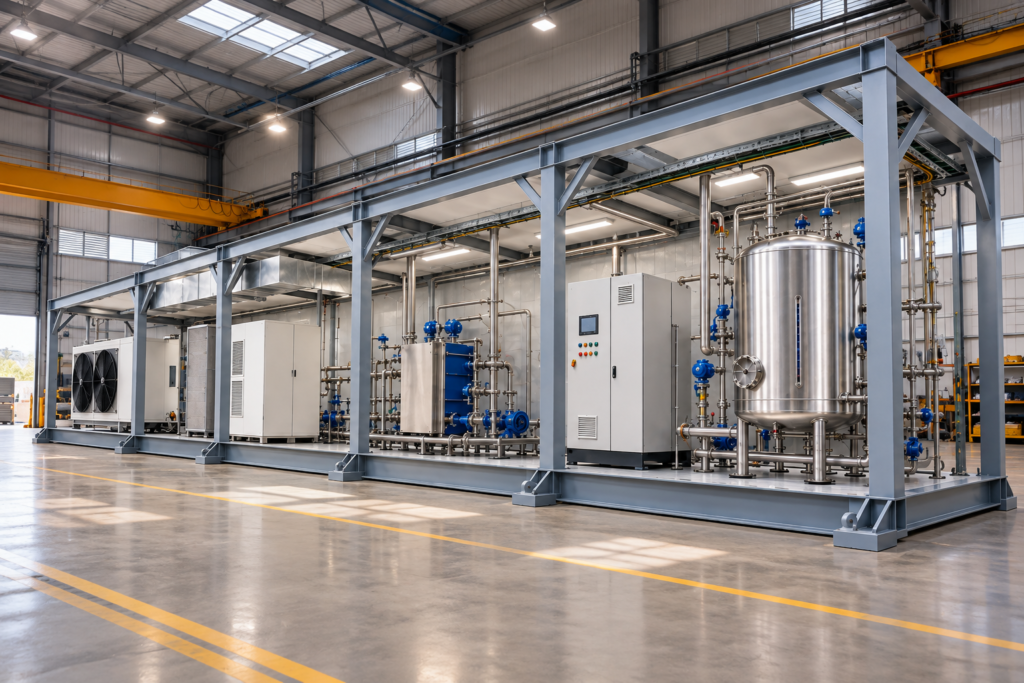
Several layout ideas help a flexible pharma manufacturing facility change without a rebuild.

  • Matrix of multi-use rooms: A flexible layout can use a matrix of multi-functional operating rooms designed to support different processes and operating scales without major changes to the overall layout. The rooms can run different processes at different scales without changing the layout. A utility floor above the operating core carries HVAC, utility access such as water for injection and air, and closed stainless-steel connections between areas.
  • Modular and podular construction: Panel-based modular construction prefabricates cleanroom panels and frames offsite for assembly on site. Podular construction builds a working cleanroom with its HVAC offsite and delivers it as a module. Modular designs can also support staged investment and allow capacity to be introduced in phases as manufacturing requirements evolve.
  • Suites built one at a time: Sites can also build an initial production suite and add flexible suites as products or capacity requirements advance. Building suites in phases allows lessons from each installation to inform later expansion and gives teams an opportunity to introduce new technology into subsequent phases. A related “empty bedroom” approach relied on disposables and skid-mounted equipment so a suite could take on different work.

Pharma Access’s Modular Mobile Facility (MMF) approach extends this principle by allowing a substantial portion of facility fabrication and systems integration to take place off-site while enabling works and other site activities progress in parallel. For future expansion, the value is strongest when structural interfaces, utility tie-ins, access routes, automation architecture, and qualification requirements are considered during concept design, allowing additional modular capacity to be integrated in planned phases with controlled impact on existing operations. Modularity does not remove the need for long-term facility planning; it makes early interface planning even more important.

Pharmaceutical Facility Expansion Planning: Zones, Phasing, and Spare Capacity

Expansion Zones

Reserve space for growth on purpose. Practical options include:

  • Shell space: build the envelope and main services for a future suite and fit it out later.
  • Convertible areas: identify rooms such as atrium or warehouse space that could become process space, and check ceiling height and structure.
  • Clear adjacent land or bays: keep the growth direction free of fixed obstacles such as plant rooms and roads.
  • Removable wall sections: plan a future opening where the new area will connect.
  • Modular expansion interfaces: define planned locations where future modules or prefabricated facility sections could connect, including structural interfaces, utility tie-ins, access routes, and control-system integration. 

Utility Spare Capacity

Future utility demand is generally easier to accommodate when plant space, distribution routes, and connection provisions are considered during initial design rather than retrofitted after the facility becomes operational. Core HVAC, clean utility, and electrical infrastructure are not flexible in the same way as process equipment, so future load scenarios should be considered early.

Treat spare capacity in layers:

  • Space and routes first: reserve plant room floor area, risers, and corridors.
  • Distribution next: size main headers, trunks, and switchgear against documented growth scenarios where justified, with planned connection points suitable for future expansion.
  • Generation last: add chillers, boilers, water generation, and similar plants in stages as load arrives.

Choose the spare allowance from your scenarios, not from a rule of thumb. Write the number and its reasoning into the design basis.

Future Utility Loads to Model

  • Purified water, water for injection, and clean steam
  • Chilled water, hot water, and HVAC heat rejection
  • Electrical load and emergency power
  • Compressed air, nitrogen, and other process gases
  • Ultra-low temperature and cryogenic storage
  • Effluent and waste streams

Ultra-low-temperature freezer installations can add significant HVAC load to their rooms while also increasing electrical and heat-rejection demand. A plant that has not modelled those loads can discover the constraint only after additional equipment or storage capacity is introduced.

HVAC Zoning That Survives Change
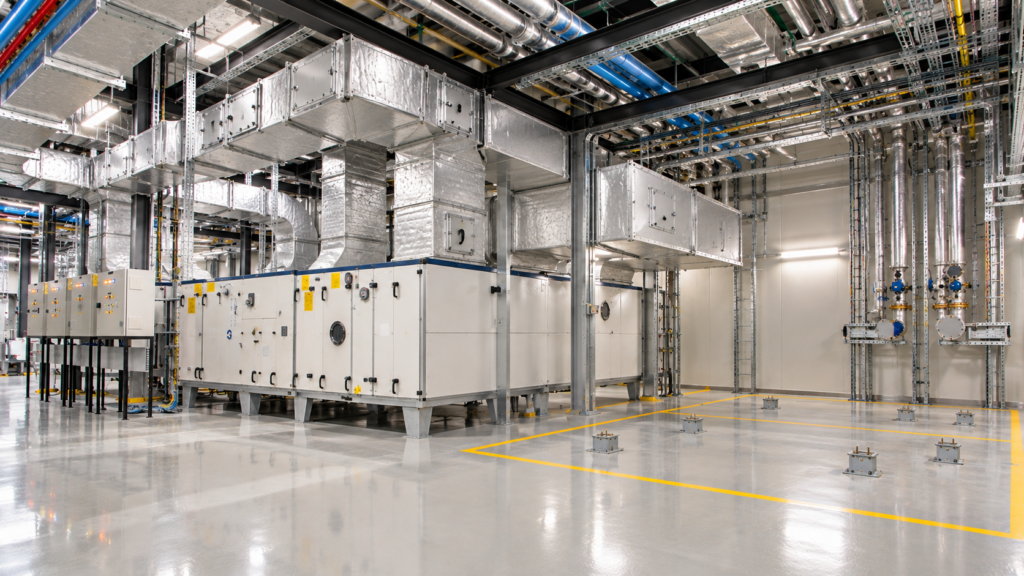
HVAC Zoning That Survives Change

HVAC drives many of the limits on a flexible design, so zone it with change in mind. Pharma Access lists HVAC system design, mechanical and utility system design, and modular clean room design among its disciplines, which shows how closely these topics sit together.

Use these design moves:

  • Zone by function and product: Define HVAC zoning according to cleanliness classification, process risk, containment requirements, and the contamination-control strategy. Dedicated or appropriately segregated air-handling should be provided where required by the process and risk assessment.
  • Allow independent control: Where appropriate, allow individual zones to shut down, set back, or be controlled without unnecessary impact on adjacent areas.
  • Reserve ductwork space: Leave risers, ceiling room, and plant space for added air handlers.
  • Design pressure relationships with future use in mind: Future room-use changes may require changes to pressure relationships, but these should be managed through risk assessment, change control, and appropriate requalification.
  • Plan filtration and airflow carefully: Filtration, airflow patterns, room pressure relationships, and air-system segregation are important elements of the contamination-control strategy and should be evaluated against the process risk.

Multiproduct Pharma Facility Design: Controlling Cross-Contamination

A multiproduct pharma facility design must keep one product away from the next. EU GMP expectations require cross-contamination risks to be controlled through appropriate technical and organisational measures, supported by Quality Risk Management and toxicological evaluation where applicable. Dedicated or segregated manufacturing areas may be required where the identified risks cannot be adequately controlled through shared arrangements.

Risk-based shared-facility approaches use Quality Risk Management principles and health-based exposure limits, including PDE or other scientifically justified exposure values, to support decisions on the controls required in shared manufacturing environments. For multi-modality facilities, segregation of operating areas may also form part of the overall contamination-control strategy.

Design tools that help include:

  • Separate or segregated suites, gowning areas, and airlocks were justified by product, biosafety, containment, or cross-contamination risk.
  • One-way flow for people, materials, and waste.
  • Closed processing and single-use assemblies, which cut open handling and cleaning burden.
  • Dedicated or segregated HVAC for higher-risk products.
  • Material and equipment transfer routes that do not cross clean paths.

For autologous cell therapy, the logistics risk grows. Patient-specific manufacturing requires robust chain-of-identity and chain-of-custody controls alongside the facility’s contamination-control and material-flow strategy.

Equipment Flexibility

Equipment choices decide how fast a room can change over.

For multi-process layouts, key planning topics include a rationalized equipment list, ease of equipment changeover, and standardized utility interface design. Single-use technology can support faster equipment changeover and connection where interfaces are standardized, while automation design should allow new equipment to integrate with the selected facility control architecture.

Practical choices include:

  • Skid-mounted and wheeled equipment with quick connections
  • Standard utility panels and connection types across rooms
  • Single-use assemblies where changeover speed matters most
  • Stainless equipment where volume and steady demand justify it
  • A control platform that accepts new equipment and recipes without a rebuild

The single-use and stainless decision belongs here. It shapes utility load, footprint, and the cleaning validation burden, so make it with the facility plan, not after it.

Planning for New Modalities

A new modality can break assumptions that held for decades. The table summarizes typical facility considerations that should be assessed during future-capacity planning.

ModalityWhat it asks of the facility
Monoclonal antibodies and proteinsBioreactor scale, downstream space, utility load
Cell and gene therapyVector or process platform, biosafety requirements, closed processing, segregation strategy, and chain-of-identity or chain-of-custody controls where applicable
mRNA and lipid nanoparticlesProcess-specific segregation, purification requirements, closed processing, solvent and hazardous-area considerations where applicable, and temperature-controlled storage appropriate to the process and materials

Different viral-vector and cell-therapy platforms can create different biosafety, containment, segregation, culture-volume, and equipment requirements. Biosafety requirements can also change layout.

mRNA and lipid nanoparticle manufacturing can involve multiple purification operations, solvent handling, and temperature-controlled storage requirements. Cleanroom background classification should be determined from the specific process, the degree of process closure, open aseptic manipulations, and the contamination-control strategy rather than assigning one universal cleanroom grade to the modality. 

Solvent use may also affect hazardous-area and electrical classification, while materials and products may require refrigerated, frozen, or cryogenic storage depending on the specific process.

So test every design against a few likely modalities. If a room cannot host a second process type with modest change, record that limit now.

Phased Expansion Without Stopping Production
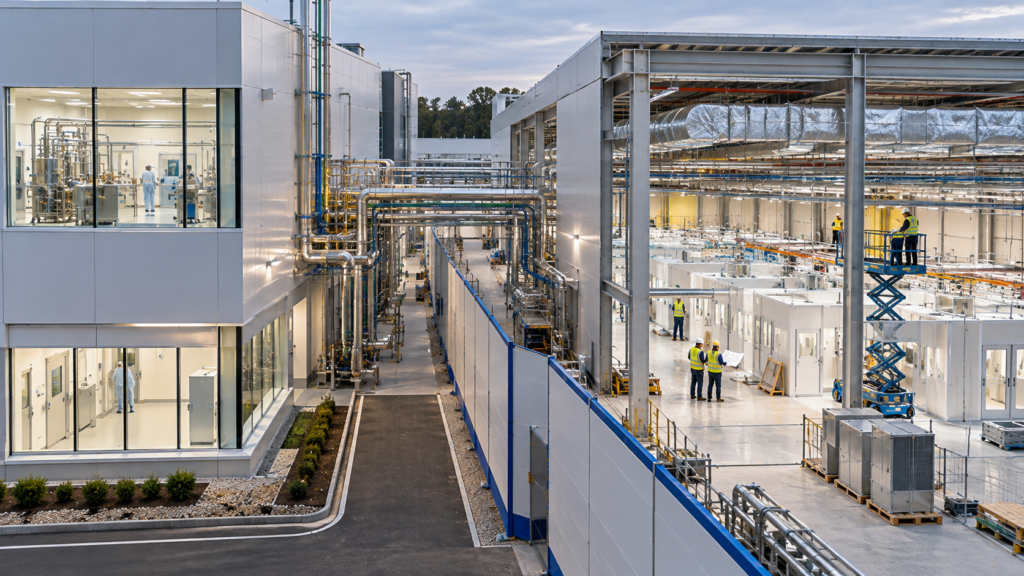
Phased Expansion Without Stopping Production

Expanding next to a running plant needs its own plan.

  • Isolate construction. Separate dust, vibration, and traffic from operating areas.
  • Plan tie-ins early. Place isolation valves and capped connections where new services will join.
  • Build stand-alone phases. Each phase should run and qualify on its own.
  • Consider overlap. Design-build can start construction when design is about 60 percent complete, according to Heil, which saves time but adds risk if late design changes arrive.
  • Plan qualification with design. Commissioning and qualification for each phase should start in the concept stage.

Pharma Access lists project management, construction and installation, and CQV among its capabilities. Those phases tend to overlap in an expansion, so plan them as one program.

Next Steps: Build Flexibility Into the Plan

  1. Write capacity and modality scenarios into the design basis.
  2. Decide which backbone elements to fix and which spaces, capacities, and interfaces should support defined future growth.
  3. Reserve expansion zones, routes, and plant space.
  4. Set spare utility capacity from the scenarios and record the reasoning.
  5. Zone HVAC by function, product, and containment need.
  6. Run a cross-contamination risk assessment for the products you expect.
  7. Standardize utility panels, connections, and control platforms across rooms.
  8. Plan phased construction and qualification before the first drawing set.

Frequently Asked Questions

What is flexible pharmaceutical facility design?

It is a design approach that lets a plant change capacity, products, or technology without major rework.Designers establish the long-life engineering backbone and provide appropriate space, capacity, and interfaces for defined future scenarios while keeping selected rooms, equipment, and connections adaptable.

Which decisions belong in concept design?

Expansion direction, structural grid, ceiling heights, utility routes, flow paths, grade strategy, storage needs, and power capacity. Changing these later is costly, so record them and the growth scenarios behind them in the design basis.

How much spare utility capacity should a plant have?

No single number fits every site. Reserve appropriate space and routes, size distribution against documented growth scenarios where justified, and add generation capacity in planned stages. Set the allowance from your capacity and modality scenarios and document the reasoning.

Can one facility make different modalities?

Sometimes. Multimodal designs use separate suites, controlled flows, closed systems, and zoned HVAC. Limits remain, such as biosafety level, solvent hazards, and storage needs, so assess each modality against the design before you commit.

How does a multiproduct facility control cross-contamination?

Through risk-based design. Teams use health-based exposure limits where applicable, segregated suites, separate gowning and airlocks, one-way flows, closed processing, and well-designed HVAC. Quality risk management guides how far each control must go.

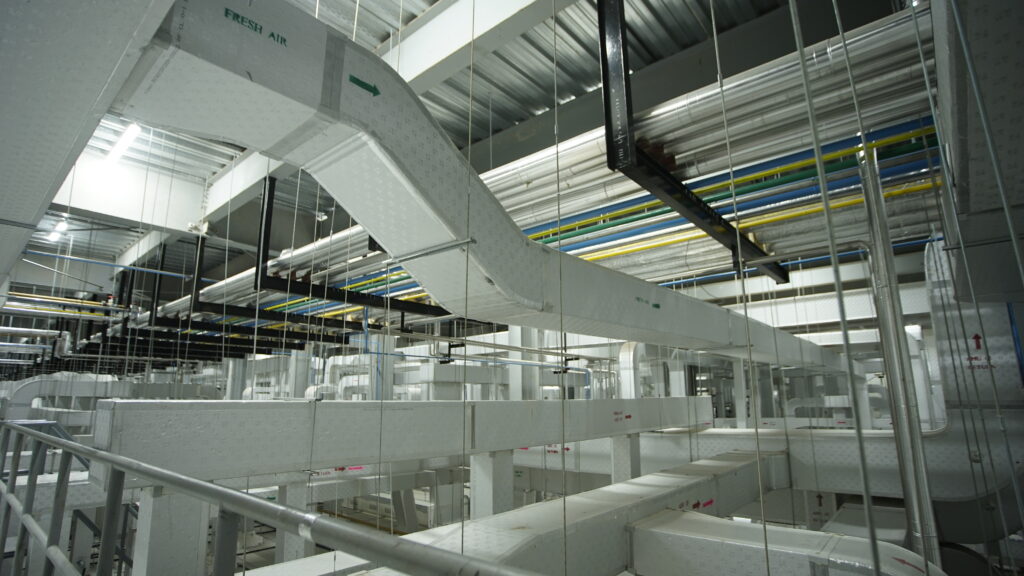
What Sets Pharmaceutical Facility CAPEX? 10 Decisions Made Before Construction

What Sets Pharmaceutical Facility CAPEX

Pharmaceutical facility CAPEX is heavily influenced before construction begins. A large share of the eventual cost is shaped earlier, in a handful of design choices that look small on a meeting agenda and large on a bill of quantities. Dosage form, cleanroom class, containment, air strategy, and utility redundancy can shape a large share of the budget before the first drawing goes to site.

Here is why that matters for cost control. You can negotiate unit rates later, but you cannot negotiate your way out of an oversized clean area. Let’s break it down.

Quick Answer: The 10 Decisions That Set Pharma Facility Cost

  1. Dosage form and product mix
  2. Capacity and batch size
  3. Cleanroom classification and extent
  4. Containment level
  5. HVAC zoning and air strategy
  6. Utility generation and redundancy
  7. Automation level
  8. Equipment specification and sourcing
  9. Materials and finishes
  10. Future expansion strategy

Design maturity sits behind all ten. The sections below cover each decision, then the contract, value engineering, and lifecycle cost.

The 10 Decisions Behind Pharma Facility Cost Drivers

The pharma facility planning cost drivers below are listed in the order most teams meet them. Early choices shape the later ones.

1. Dosage Form and Product Mix

Dosage form sets the room list, air classes, utilities, and validation scope. An oral solid dosage line, a sterile injectable line, and a biologics suite can require different facility configurations, environmental controls, utilities and qualification strategies. Pharma Access groups its project work into biotechnology, sterile manufacturing, oral solid dosage, oral liquid dosage, and API, which shows how different these categories are.

A sterile line usually carries more classified area, more utilities, and more qualification work than an oral solid line. Mixed product plans can add segregation rooms, dedicated equipment, and cleaning studies. Settle the product mix before you size anything else.

2. Capacity and Batch Size

Capacity sets room size, equipment size, and utility demand. Build too small and you pay for an expansion within a few years. Build too large and you tie up capital in idle space and idle plant.

Work from annual volume to batch size, shifts, and campaign pattern. Then balance the line so one machine does not cap the output of all the others. Write the design basis down and keep it under change control.

3. Cleanroom Classification and Extent

Cleanroom Classification and Extent

Classification changes cost because it influences the environmental control strategy. Tighter cleanliness requirements can require greater control of airflow, filtration, room pressure and recovery performance, all of which can raise cost. Supply and exhaust air systems are major cost items in a cleanroom, and the cost range depends on classification, airflow strategy, temperature control, pressurisation, and humidity needs. Temperature and relative humidity requirements can also be major cost drivers in cleanroom design and construction, not only classification.

Two questions save money. Which rooms truly expose products? And how tight do temperature and humidity need to be in each one? Apply classification according to process and contamination-control requirements, not automatically to the whole floor.

4. Containment Level

Containment adds airlocks, pressure cascades, dedicated air systems, and sometimes isolators. The challenge is finding a containment strategy that manages exposure risk at a reasonable lifecycle cost. Product protection and worker protection can require different pressure and airflow strategies.

Containment can also be localised at the machine. Localised containment such as isolators or downflow booths can reduce reliance on room-level containment in some applications, depending on product hazard, exposure risk and process design. Define the applicable exposure or containment requirement for each product before you design rooms, because a late upgrade means rebuilding walls and air systems.

5. HVAC Zoning and Air Strategy

HVAC deserves its own decision because it sets both CAPEX and running cost. Benchmarking studies consistently show cleanroom HVAC as a major share of total facility energy use. It can also represent a significant share of a GMP Annex facility’s utility cost.

Zoning is the lever. Appropriate air-handling zoning and control strategies may allow some areas to operate in reduced-airflow modes where this is justified by process risk and qualification. WHO’s HVAC guidance requires filtration, airflow direction and pressure differentials to be selected according to the product, process and level of protection required. Those decisions affect fan size, filter configuration, and duct sizing. Treat any air change reduction as a validated, risk-based decision, not a drawing-stage guess.

6. Utility Generation and Redundancy

Utility Generation and Redundancy

Utilities include water, steam, chilled water, compressed air, nitrogen, power, and effluent treatment. Plant size follows the load list, and the load list follows the earlier decisions. WHO’s guidance on water for pharmaceutical use covers which water grade suits which application and how to design, install, and operate the systems. Use it to avoid supplying a higher grade than a process needs.

Redundancy is a business decision. Duplicate pumps, standby chillers, and backup power cost money. A stopped water loop or failed cooling plant can cost a batch. List the loads that must stay on, such as classified-room HVAC, water circulation, cold storage, and controls, and protect those first.

7. Automation Level

Automation ranges from manual operation with local controls to integrated facility automation such as BMS/EMS and process or equipment automation such as PLC, SCADA, DCS or batch control. More automation raises CAPEX and validation scope. Less automation raises labour and error risk. Match the level to batch records, data integrity needs, and operator skill. Use a risk-based approach, as in ISPE’s GAMP 5 guidance for computerised systems, and avoid building a data system the site cannot support.

8. Equipment Specification and Sourcing

Equipment is a large share of CAPEX, and the user requirement specification controls it. A well-done front-end package lets the specification reflect real process conditions, such as validated flow rates, confirmed material compatibility, and defined utility connections. Vague specifications invite over-specified quotes or wrong machines.

Check more than price. Compare lead time, spare parts support, documentation quality, factory acceptance testing, and the utility loads each supplier states. A cheaper machine with a larger utility demand can raise plant cost elsewhere.

9. Materials and Finishes

Finishes in classified rooms must clean well and survive disinfectants. Pharma cleanrooms carry a higher cost per square foot because their surfaces, junctions and finishes must support cleanability, durability and contamination control. Wall panels, floors, doors, ceilings, and lighting all follow cleanability rules.

Do not apply cleanroom finishes everywhere. Offices, general stores, and plant rooms can use standard materials. Use the premium finish only where the process or the cleaning regime needs it.

10. Future Expansion

Future Expansion projects

Expansion planning costs little on paper and a lot later. Reserve floor area, plant space, electrical capacity, and pipe routes for phase two. Allow for future capacity in utility routes, tie-in points and switchgear where engineering designs and lifecycle analysis justify it, rather than automatically oversizing active systems. Pharma Access describes a Modular Mobile Facility concept on its website, an off-site delivery approach that can support phased growth or schedule acceleration where it suits the project.

Why Design Maturity Beats Unit Price

Teams often chase lower unit rates when they should chase a clearer design. Early work costs little and shapes the outcome. One ISPE article says concept and front-end design typically account for no more than 5 to 10 percent of total project cost, yet they define the outcome of everything else. A BioPharm International article says the first 5 to 15 percent of effort in scope development affects 75 to 90 percent of final cost.

Construction research points the same way. A Department of Energy guide linked a high level of front end planning to roughly 20 percent cost savings and 39 percent schedule savings. That is a cross-industry average, not a pharma promise. Estimate quality also improves with design maturity. ISPE’s project matrix places concept estimates at about plus or minus 30 percent and front-end design estimates at about plus or minus 10 percent.

Late change makes it worse. One study found design-error rework could add around 16 percent to original contract value in construction projects. Pharma construction cost rises fastest when drawings change after equipment is ordered and pipes are installed.

Pharma EPC Project Cost: Contract Choice Matters

The contract model spreads risk, and design maturity decides whether the model works. A fixed price EPC contract is a turnkey model where one contractor handles design, procurement, construction, and commissioning, and typically takes substantial cost and schedule risk under the agreed contract terms. Pharma EPC project cost may look certain on day one, but the price assumes a stable scope. One advisory firm lists design maturity that is fit for purpose and schedule among its tips for using lump sum EPC contracts.

The alternative has trade-offs too. Under cost reimbursable contracts, costs are not capped, so the final price varies and the owner needs strong cost management and oversight. Choose the model after you measure design maturity. A well-defined scope suits a fixed price. An evolving scope may suit a reimbursable or target-cost structure with appropriate incentives and risk allocation.

Pharmaceutical Facility Value Engineering: Where It Helps and Where It Backfires

Value engineering is not a cost cut. One public definition describes it as defining the required function and creating alternatives to provide that function at the lowest life-cycle cost. Pharmaceutical facility value engineering works when it removes cost that serves no function. It fails when it removes function.

Where it helps

  • Trimming classified area to where the process and contamination-control requirements justify it
  • Using standard finishes in non-GMP areas
  • Standardising equipment and spare parts across lines
  • Localising containment at the machine instead of building a larger suite
  • Combining utility generation where loads and risks allow
  • Reducing air change rates through a validated, risk-based study

Where it becomes false economy

  • Cutting redundancy on loads that must stay running
  • Downgrading HVAC controls or monitoring
  • Choosing finishes that fail under routine cleaning
  • Shrinking maintenance access or qualification space
  • Deleting spare plant capacity that expansion will need

Regulated sites carry extra risk. One commissioning firm warns that value engineering in life sciences can create hidden commissioning, validation, and compliance costs, because the systems on the table are rarely cosmetic. The same source says catching a problem at design costs almost nothing, while catching it after occupancy can mean a production hold, a deviation, or a regulatory finding. Record each accepted change and the reason, and ask quality and validation staff to review it.

Lifecycle Cost Pharmaceutical Facility: Look Past Handover

CAPEX is only the first bill. A lifecycle cost pharmaceutical facility view adds energy, maintenance, cleaning, requalification, and spare parts. HVAC can be a major running cost, as shown above. Fan power can represent a substantial share of cleanroom air-handling utility cost.

That changes some choices. A larger duct or a better fan can cost more at the start but lower energy use over its operating life. A cheap system with high pressure drop does the opposite. Compare options over a stated period, and include energy and maintenance, not purchase price alone.

How to Control Cost in a Pharma Turnkey Project

Pharmaceutical project cost control works best as a short sequence:

  1. Write the basis of design. Record products, volumes, classes, containment bands, and expansion plans.
  2. Challenge the room list. Remove classified areas that the process does not need.
  3. Set a cost range, then narrow it. Use wide ranges early and tighter ones as design matures.
  4. Freeze in stages. Lock process data and layout before major orders.
  5. Run value engineering with quality and validation staff. Document every accepted change.
  6. Control change. Require an impact check on cost, schedule, and qualification for every request.
  7. Compare lifecycle cost. Add energy and maintenance to every major option.

Common Mistakes to Avoid

  • Pricing the building before the product mix is settled
  • Classifying every room to the highest level “to be safe”
  • Treating containment as an afterthought
  • Cutting redundancy without a risk review
  • Buying equipment before utility loads are confirmed
  • Reviewing value engineering ideas without quality input

Next Steps

Start with the ten decisions. Write down your current answer to each, mark the weak ones, and close those before detailed design starts. Pharmaceutical products project cost control is easier when the weak spots show up on paper first. Pharma Access shares more facility-planning topics on its blog at the website.

Frequently Asked Questions

What are the biggest cost items in a pharmaceutical facility?

Cleanroom HVAC, process equipment, utilities, and finishes usually lead. Air systems rise with classification, temperature, and humidity needs. Dosage form and containment level decide how much classified area and special equipment the building needs.

How does cleanroom classification affect CAPEX?

Tighter cleanroom requirements can increase the level of control needed for airflow, filtration, pressure, recovery performance and environmental conditions. The exact air-change rate, filtration strategy and airflow pattern should be based on the process, contamination-control strategy and qualification requirements rather than classification alone. Limiting high classification to rooms and operations where it is technically justified is one of the strongest ways to hold CAPEX down.

Is value engineering safe in a GMP facility?

It can be, if quality and validation staff review each change and the team records the reason. Cutting redundancy, controls, or cleanable finishes often adds commissioning, validation, and operating cost later.

Why does design maturity matter for cost control?

Early design choices shape most of the final cost, and late changes trigger rework. Studies cited by ISPE, BioPharm International, and the U.S. Department of Energy tie better front-end work to lower cost and shorter schedules.

Should I choose a lump sum or reimbursable for a pharma EPC project?

It depends on design maturity. A well-defined scope generally suits a fixed price. An evolving scope may suit reimbursable or target-cost terms, depending on the project’s risk allocation. Reimbursable contracts leave more cost risk with the owner and need strong oversight.

Data Integrity by Design in Pharma: ALCOA+ Across Automation and GxP Systems

Data Integrity by Design in Pharma

In a pharma facility, someone will eventually look at every batch record, every sensor reading, and every operator signature and decide whether or not to trust it. That trust has a name in industry: data integrity. It’s the foundation of ALCOA+ pharma programmes, and it should not be added only after a system is already up and running. It has to be built in from the start, through every automated process and GxP-relevant system that touches your product.

This post walks through what ALCOA+ really means, how it relates to the regulations that support it, and what “designing for data integrity” looks like day-to-day across the automation and GxP systems that run a modern pharma facility.

What Is ALCOA+, and Why Does It Matter So Much?

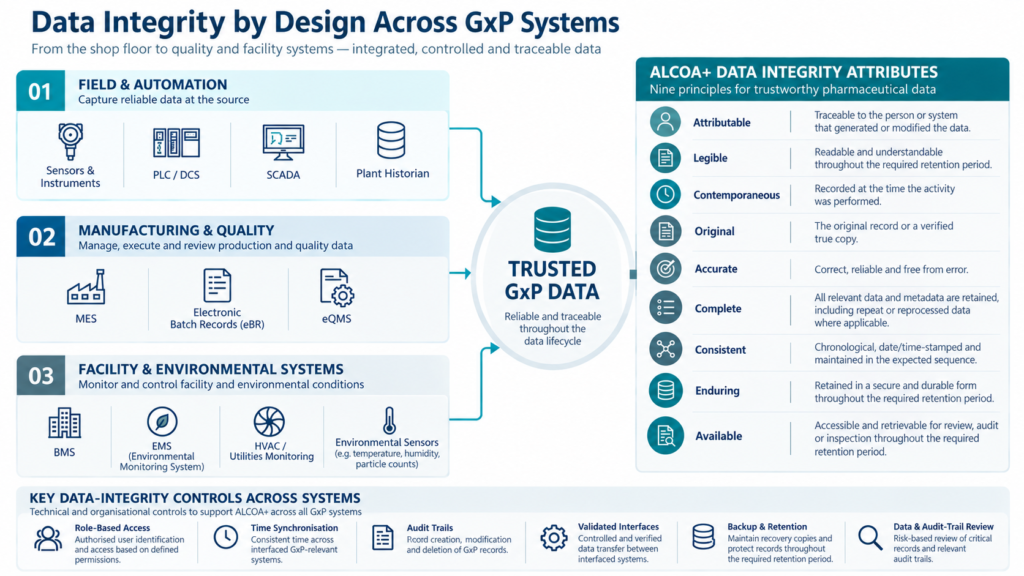
ALCOA is an acronym used across pharmaceutical data integrity guidance. It stood for Attributable, Legible, Contemporaneous, Original, and Accurate. As the industry developed, four additional attributes became widely recognised: Complete, Consistent, Enduring, and Available, giving us ALCOA+.

These underlying data-integrity principles are reflected across regulatory expectations and guidance from authorities including FDA, MHRA, WHO, PIC/S and within EU GMP requirements. ALCOA+ means that each data point on the ground at your facility must answer a simple set of questions: Who made the data? Is it readable? Was it captured at the time the activity was performed? Is it the original, unaltered capture? Is it accurate, complete, and available when needed throughout its required retention period?

In pharmaceuticals, the breakdown of data integrity is typically caused by a breach of one of the principles. A lost timestamp can undermine evidence that data was recorded contemporaneously. The Original and Complete attributes can be compromised by an overwritten value with no trace of the previously recorded information. This is not some theoretical fear. FDA guidance itself notes an increase in data integrity lapses identified during CGMP inspections. U.S. FDA

The Regulatory Backbone: 21 CFR Part 11, EU GMP Annex 11 and GAMP 5

ALCOA+ describes the attributes expected of trustworthy data. Regulations and industry guidance help translate those attributes into controls for the computerised systems that create, process and maintain it.

21 CFR Part 11 Requirements for Electronic GxP Records

21 CFR Part 11 pharma regulations detail the technical and procedural controls that applicable electronic records and electronic signatures must meet within its FDA-regulated scope. This includes audit trails that record the date and time of operator entries and actions that create, modify, or delete electronic records, protection of records throughout their retention period, and electronic signatures that are linked to one person and cannot be transferred to another. A system that meets Part 11 does not necessarily mean that all ALCOA+ expectations are automatically satisfied, and where electronic records fall within FDA-regulated predicate-rule requirements, Part 11 should be considered alongside the applicable GxP requirements.

EU GMP Annex 11 and Computerised Systems

For pharmaceutical operations subject to EU GMP, Annex 11 provides requirements for computerised systems used as part of GMP-regulated activities. It requires a risk-based approach across the system lifecycle, with appropriate validation, security, data management and controls based on the system’s impact on patient safety, data integrity and product quality.

GAMP 5 and Risk-Based Computerised System Validation

ISPE GAMP 5 takes a different approach. It does not simply prescribe a fixed list of record-keeping controls, but rather offers a framework for validating the computerised systems that create and maintain those records. GAMP 5 uses software categorisation as one input within a broader risk-based lifecycle approach, so a simple stand-alone instrument may require a different level of validation and assurance than a fully integrated manufacturing execution system, depending on intended use, GxP impact, complexity, novelty and risk. The goal is to apply proportionality to the validation effort based on the actual risk the system poses to patient safety and product quality, rather than applying the same level of assurance effort to every system.

Audit Trail Pharmaceutical Systems: The Evidence Behind Every Record

Audit Trail Pharmaceutical Systems: The Evidence Behind Every Record

If ALCOA+ is the standard and Part 11 and GAMP 5 are part of the regulatory and good-practice framework, the audit trail is where the evidence actually resides. An audit trail pharmaceutical system generates a secure, computer-generated, time-stamped record of relevant operator entries and actions that create, modify, or delete electronic records within the system.\

A good audit trail is more than an activity log. Every change is attributed to a specific user, the original value is retained along with any edit, and where an audit trail is required, it should be protected so normal users cannot amend or disable it. During an inspection, audit trails can be reviewed to assess whether GxP-relevant data has been created, changed, or deleted with appropriate traceability. Audit-trail functionality alone is not sufficient; relevant audit trails should also be reviewed at a frequency and depth defined through risk assessment.

How Automation Helps Pharma Manufacturers Build Data Integrity In

And this is where automation makes sense. To understand how automation supports pharma manufacturers in fulfilling those expectations, we need to understand what manual, paper-based processes can get wrong when they are not appropriately controlled. Manual and paper-based records can depend on timely and accurate human entry, while poorly controlled processes increase the risk of delayed recording, transcription errors, or incomplete traceability.

Several of these risks can be reduced by automated systems by design:

  1. Data collection at the point of activity rather than having someone transcribe a reading later, which goes a long way to supporting the contemporaneous and original principles.
  2. Implementing role-based access to allow only authorised personnel to create or modify certain records.
  3. Automatically generating secure audit trails where configured and required, so relevant changes are recorded with appropriate traceability.
  4. Standardising data formats and units, reducing transcription errors when values are manually moved between systems.
  5. It flags out-of-range results in real time, catching problems during production rather than days later in batch review.

Just because a system is digital doesn’t mean data integrity happens automatically. A digital system not properly validated and configured does not resolve the data integrity problem. It can simply move the risk to a different medium where certain integrity issues may be less visible. European Commission

MES and QMS in Pharma: Where Data Integrity Lives Day to Day

MES and QMS in Pharma: Where Data Integrity Lives Day to Day

On a production floor, MES and QMS can carry a significant part of the day-to-day data integrity workload. In pharma facilities, MES and QMS can be integrated to connect the line activity to the quality decisions that are made about it.

A Manufacturing Execution System (MES) digitises work instructions, supports manufacturing workflows and electronic batch records, and can capture process data from shop-floor automation, decreasing the human error inherent in paper-based batch records. Quality Management Systems (QMS) and electronic QMS platforms support the broader quality processes that surround manufacturing itself, including things like deviations, corrective actions, and document control.

When MES and QMS are properly integrated, a quality event on the production floor can be transferred directly into the quality system, reducing the need for someone to re-enter data and the workload and transcription errors involved with the two systems.

Below and alongside the MES layer, PLC, DCS, SCADA and plant historian systems can also generate, process and retain GxP-relevant manufacturing data. Their architecture, access controls, time synchronisation, interfaces and data-retention strategy therefore form an important part of data-integrity-by-design.

BMS EMS Pharma: Data Integrity Beyond the Production Floor

Data integrity isn’t limited to manufacturing records. Building Management Systems (BMS) and Environmental Monitoring Systems (EMS) for pharma generate their own continuous stream of facility and environmental data, some of which may be GxP-relevant and therefore requires appropriate data-integrity controls.

A BMS is a control and data recording facility for conditions such as HVAC performance, pressure differentials, and utility status. An EMS can monitor, collect and trend environmental parameters such as airborne particle counts, temperature, relative humidity and other defined conditions, while viable microbiological monitoring data may also be incorporated according to the facility’s environmental monitoring strategy and applicable GMP requirements. GxP-relevant records generated by both systems should be managed in accordance with applicable ALCOA+ and data-integrity expectations because demonstrating that required cleanroom conditions were maintained depends on trustworthy monitoring data. MHRA

Designing for Data Integrity, Not Inspecting for It

The underlying message is that data integrity is best when built into a facility’s systems from the outset, not added in response to a warning letter. Adding audit trails, role-based access, or proper validation documentation to a system once it is live is far more disruptive and costly than building those controls into the system during the design and commissioning phases.

Common Data Integrity Failures and How Design Prevents Them

Across facilities, several common problems appear when systems and processes have not been designed with data integrity in mind from the start:

  • Shared login credentials: Breaks attributability, because no one can prove who made an entry.
  • Manual transcription from: one system to another increases the risk of errors and can compromise traceability to the original data if appropriate verification controls are not in place.
  • Audit trails that are turned off or incomplete, often because the system was set up for convenience rather than compliance.
  • Inconsistent time sync between systems – makes it hard to prove that records were actually contemporaneous.
  • Insufficient planning of backup and recovery, risking the Enduring and Available attributes under ALCOA+.
  • All of these can reflect weaknesses in design, configuration, procedures and data governance, not an inevitable consequence of using electronic systems.

Why This Matters at the Facility Design Stage

To get this right, automation, MES, QMS, BMS, and EMS design need to be considered alongside facility layout and HVAC planning, not an afterthought once construction and installation is complete. The engineering teams at Pharma Access manage the automation and building system design (BMS, EMS, and process automation) as part of the same coordinated project that encompasses HVAC, cleanrooms, and utilities. Building data integrity controls from the start can reduce the need for costly retrofits when gaps are identified after a facility has entered operation. Learn more about our approach on the Pharma Access about.

Wrapping Up

Data integrity ALCOA+ Pharma work is not a checklist to be completed before an inspection. It’s a design principle that should inform the way every automated system, from a simple sensor to a complete manufacturing execution system, captures, stores, and protects data from the moment it is generated. Facilities that bake these expectations into their automation and GxP systems from day one spend far less time explaining gaps to an inspector later and far more time trusting the data their own systems produce.

FAQs

What does ALCOA+ stand for? 

ALCOA is an acronym for Attributable, Legible, Contemporaneous, Original, and Accurate. The “+” adds Complete, Consistent, Enduring, and Available to provide nine principles that define reliable data in a GxP environment.

How does 21 CFR Part 11 relate to ALCOA+? 

21 CFR Part 11 describes the technical and procedural controls, including audit trails and electronic signatures, for electronic records and electronic signatures that fall within its scope. Those controls support data integrity and the broader ALCOA+ principles but do not, by themselves, establish that every ALCOA+ expectation has been met.

What is the difference between MES and QMS in a pharma facility? 

MES captures and manages data from production activities and manufacturing workflows in real time. A QMS is responsible for quality processes like deviations, corrective actions, and document control. When appropriately integrated, the two can reduce manual re-entry and the associated risk of transcription errors.

Why do BMS and EMS systems need to meet data integrity standards too? 

These systems produce the environmental and facility data that demonstrates that a cleanroom or storage area was maintained under the conditions needed for GMP manufacturing. Where this data is GxP-relevant, its integrity and traceability need to be appropriately controlled because decisions about facility and product conditions may depend on it.

Can data integrity be added to a system after it is already running? 

It can, but it is far more disruptive and costly than building in controls such as audit trails, role-based access, and validation documentation at the beginning of a facility project.

Schedule M Compliance in 2026: Engineering Gaps Indian Pharma Plants Still Need to Address

Schedule M Compliance in 2026

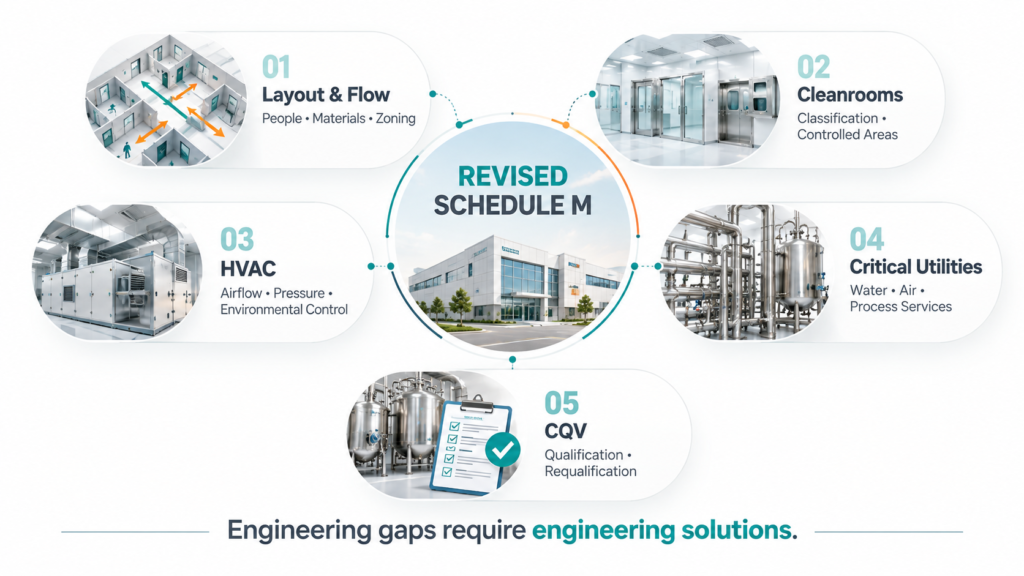
The revised Schedule M may have seemed like just a paperwork change for many Indian pharma manufacturers. Revise the SOPs. Train the quality team. Strengthen the documentation. Move on. That approach may address some of the requirements. It doesn’t address those sections that affect the actual building and engineering systems.

This post takes a look at the revised Schedule M requirements in India from an engineering perspective: what the rule expects from a facility’s layout, utilities, and cleanroom design, and where plants still fall short even after their paperwork is in order.

A Quick Recap of Where Things Stand

Schedule M forms part of the Drugs Rules, 1945, and sets out Good Manufacturing Practice requirements for pharmaceutical manufacturing in India. The revised version was notified through G.S.R. 922(E), dated 28 December 2023. The notification also updated references in the Drugs Rules from “Good Manufacturing Practices” to “Good Manufacturing Practices and Requirements of Premises, Plant, and Equipment for Pharmaceutical Products,” reinforcing the broader scope of the revised framework.

Large manufacturers with a turnover above INR 250 crore were required to comply from 29 June 2024. Manufacturers with turnover up to INR 250 crore were subsequently granted a conditional extension until 31 December 2025, subject to the requirements of G.S.R. 127(E). From 1 January 2026, revised Schedule M became effective for manufacturers in this category.

The revised rule is more closely aligned with contemporary WHO GMP requirements and broader international GMP expectations. It specifically includes structured Pharmaceutical Quality Systems (PQS), Product Quality Review (PQR), Quality Risk Management (QRM), and strengthened requirements for documentation, traceability and validated computerised systems. None of this is optional anymore, and none of this can be solved by documentation alone. Ministry of Health & Family Welfare

Why Engineering Gaps Are the Harder Problem

Why Engineering Gaps Are the Harder Problem

Training and templates can address documentation gaps. Construction requires time, money, and planning that many plants may not have budgeted for when the revised rule first came out. Construction and system modifications are what close physical engineering gaps.

Here’s the difference that counts. A written SOP for cleaning validation can be rewritten in a week. You can’t write a document that turns a cleanroom with inadequate airflow control, pressure relationships, or contamination-control design into a compliant environment. The building and engineering systems have to be altered.

This is the real risk of 2026 compliance, particularly for sites built ten or fifteen years ago under the older, less prescriptive version of Schedule M.

Where Pharmaceutical Plant Layout Design Falls Short

One of the areas revised Schedule M addresses directly is pharmaceutical plant layout, and that’s where older facilities tend to have the most trouble.

Material and Personnel Flow

The new rule calls for a facility layout that keeps people and materials moving throughout the building in a controlled, logical manner, with interactions managed in ways that minimise contamination and mix-up risks. Many older Indian plants were developed under different design expectations, with corridors and access points constrained by available space. Retrofitting a clean flow pattern into a building not designed for it often involves moving walls, relocating airlocks, or, in some cases, redesigning an entire wing.

Cleanroom Classification and Zoning

Cleanroom classification establishes the required level of airborne particulate cleanliness, while the associated GMP grade and process requirements influence air change rates, filtration, airflow, environmental control and gowning requirements for each zone in the plant. If a facility was built to an older classification strategy, the production and support areas may need to be reassessed and its air handling systems redesigned to match current process and classification requirements. That’s not a minor tweak. It may include changes to ductwork, filter housings, air distribution, monitoring systems and pressure relationships throughout the building.

Pharmaceutical Water and Critical Utilities

The amended standard sets out design, qualification and monitoring expectations for pharmaceutical water and other utilities that can affect product quality, including steam, gases, compressed air and HVAC where applicable. Existing utility distribution arrangements in older plants may not adequately address current contamination, capacity, monitoring or process requirements. One of the more difficult engineering challenges a brownfield project can face is modifying these systems without unnecessarily disrupting production.

The HVAC Problem Nobody Budgeted For

HVAC systems are a frequent topic of discussion regarding the revised Schedule M gaps and not without good reason. Legacy systems may not support the filtration, pressure relationships, airflow patterns, temperature/humidity control or contamination-control strategy required for the intended process and GMP grade. A plant may look acceptable during a visual inspection while performance data reveal gaps in environmental control.

Remediation may involve air balancing, control-system upgrades, additional monitoring, changes to filtration or ductwork, or replacement or augmentation of air handling units, depending on the gap identified. All of this has to be installed on a building that is often still running production. That combination of technical challenge and operational continuity is precisely why so many plants are behind schedule on this compliance item.

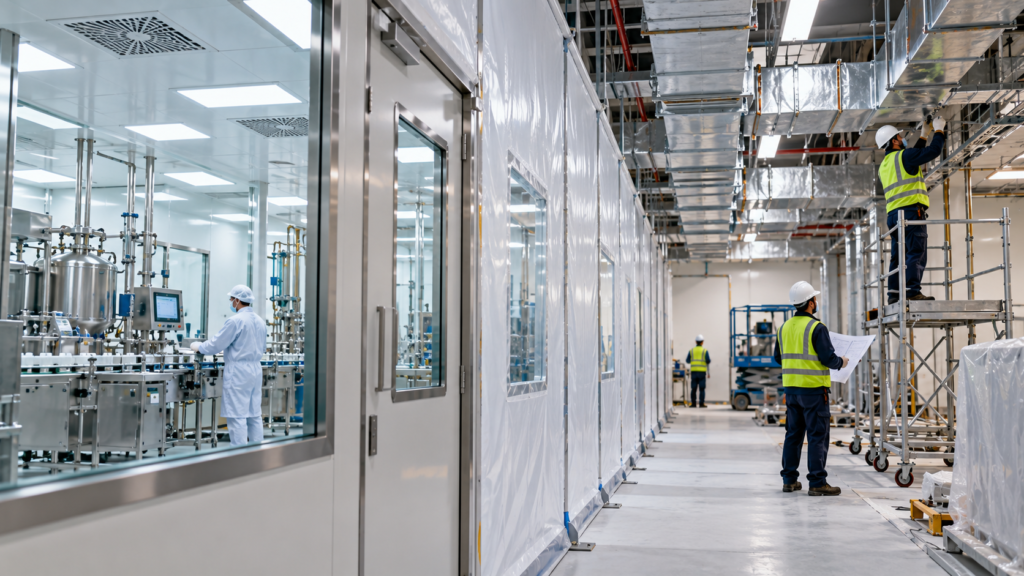
Brownfield Pharma Upgrades: A Different Kind of Project

Brownfield Pharma Upgrades: A Different Kind of Project

Upgrades to brownfield pharma sites are not just smaller, simpler versions of a new build. They face their own constraints that a greenfield project never has to deal with.

A brownfield project must deal with the fixed column grids, existing ceiling heights, and utility entry points that were there for a totally different process. In many cases, the facility also has to keep producing while construction is going on, so maintaining controlled separation during construction is an engineering challenge in itself, not just a compliance consideration.

There are a few things that distinguish a well-planned brownfield upgrade from a poorly executed one:

  • Complete facility audit before any design work begins. This means the building structure, current utility capacity, cleanroom classifications, and validation status must be checked before committing to a design.
  • Building in phases. By breaking the work into sections, only part of the plant is taken offline at a time, rather than the whole facility.
  • Physical separation of building and production spaces. Temporary barriers and designated construction access routes keep dust and foot traffic out of live manufacturing areas.
  • Utility hookups coordinated with scheduled shutdowns. Connections to shared power, water, or HVAC systems are made during approved shutdown windows, rather than being improvised during execution.
  • Documentation updated regularly during construction. Change control records and validation documents are updated as the work progresses, not stitched together after the fact.
  • Requalification before any area is returned to GMP use. When a section is complete, it goes through the applicable commissioning, qualification or requalification, validation and QA release activities before production can resume there.

Skipping any of these steps can make compliance gaps harder to close after the fact than they would have been if addressed during planning. Government of India / Press Information Bureau

What This Means for Plant Owners Right Now

If your facility has not yet done a formal gap assessment against the revised rule’s engineering requirements, now is the time to do it, rather than waiting for deficiencies to emerge during regulatory assessment.

The gap assessment should include:

  1. Current cleanroom classification vs. cleanroom classification your product lines actually need, where applicable
  2. HVAC performance data (pressure differentials, air change rates
  3. Utility design, capacity, distribution and segregation requirements for water, steam, and compressed air systems
  4. Material and personnel flow mapped to your current layout

Current validation and qualification status for all major systems

For manufacturers weighing whether to retrofit an existing facility or build a new one, that decision often boils down to timeline, budget, available utility capacity, and whether the existing site can technically support what the revised rule now expects. An engineering team experienced in both types of projects can clearly set out that comparison before construction decisions are locked in.

Pharma Access supports pharmaceutical manufacturers with this type of assessment, including facility layout, HVAC and cleanroom design, critical utilities and the CQV work required to upgrade an existing plant to current GMP requirements while managing production constraints. For plants that are at the outset of a complete renovation, Pharma Access also supports greenfield builds where the layout, utilities, and cleanroom zoning are designed to current requirements from the start.

A Few Final Thoughts

Revised Schedule M compliance is more than a documentation exercise. It speaks to the physical structure of a plant, from the way air flows through a cleanroom to how people and materials move throughout the building. Manufacturers that treat pharmaceutical plant layout design and HVAC upgrades as afterthoughts may face greater remediation pressure during inspection readiness. Getting ahead of the engineering requirements is particularly important for brownfield pharma upgrades, where early planning can make the difference between a manageable renovation and a rushed one.

Frequently Asked Questions

What is the deadline for revised Schedule M compliance in India? 

Revised Schedule M became effective for manufacturers with turnover above INR 250 crore from 29 June 2024. Manufacturers with turnover up to INR 250 crore were granted a conditional extension until 31 December 2025, with the revised requirements effective for this category from 1 January 2026.

Does revised Schedule M require physical changes to a pharma plant, or just documentation? 

Both. The rule requires structured quality systems and documentation, but it also has specific requirements for facility layout, cleanroom classification, HVAC design and qualification, and utility design that can require physical or system modifications where gaps are identified.

What is the difference between a brownfield and greenfield pharma project? 

Greenfield projects are new facilities developed without the physical and operational constraints of an existing manufacturing site. A brownfield project is an upgrade or expansion of an existing, often operational, facility, which requires working around fixed infrastructure and maintaining production continuity during construction.

Why do older pharma plants struggle with HVAC compliance under the revised rule? 

Older HVAC systems may struggle to achieve the filtration, pressure relationships, airflow control, temperature/humidity control or containment performance required for the intended process and GMP environment. Remediation may involve air balancing, controls and monitoring upgrades, filtration or ductwork changes, or replacement or augmentation of air handling units, which can be more complex in a facility that remains operational.

How does pharmaceutical plant layout design affect Schedule M compliance? 

The layout design determines the flow of material and people through a facility, the zoning and required cleanliness or GMP grade of applicable areas, and the control of contamination risk. A layout that has not been designed with these flows in mind often requires a large amount of redesign work to meet the current requirements.

GCC GMP Requirements for Pharmaceutical Manufacturing Facilities: A Plain-Language Guide

GCC GMP Requirements for Pharmaceutical Manufacturing Facilities

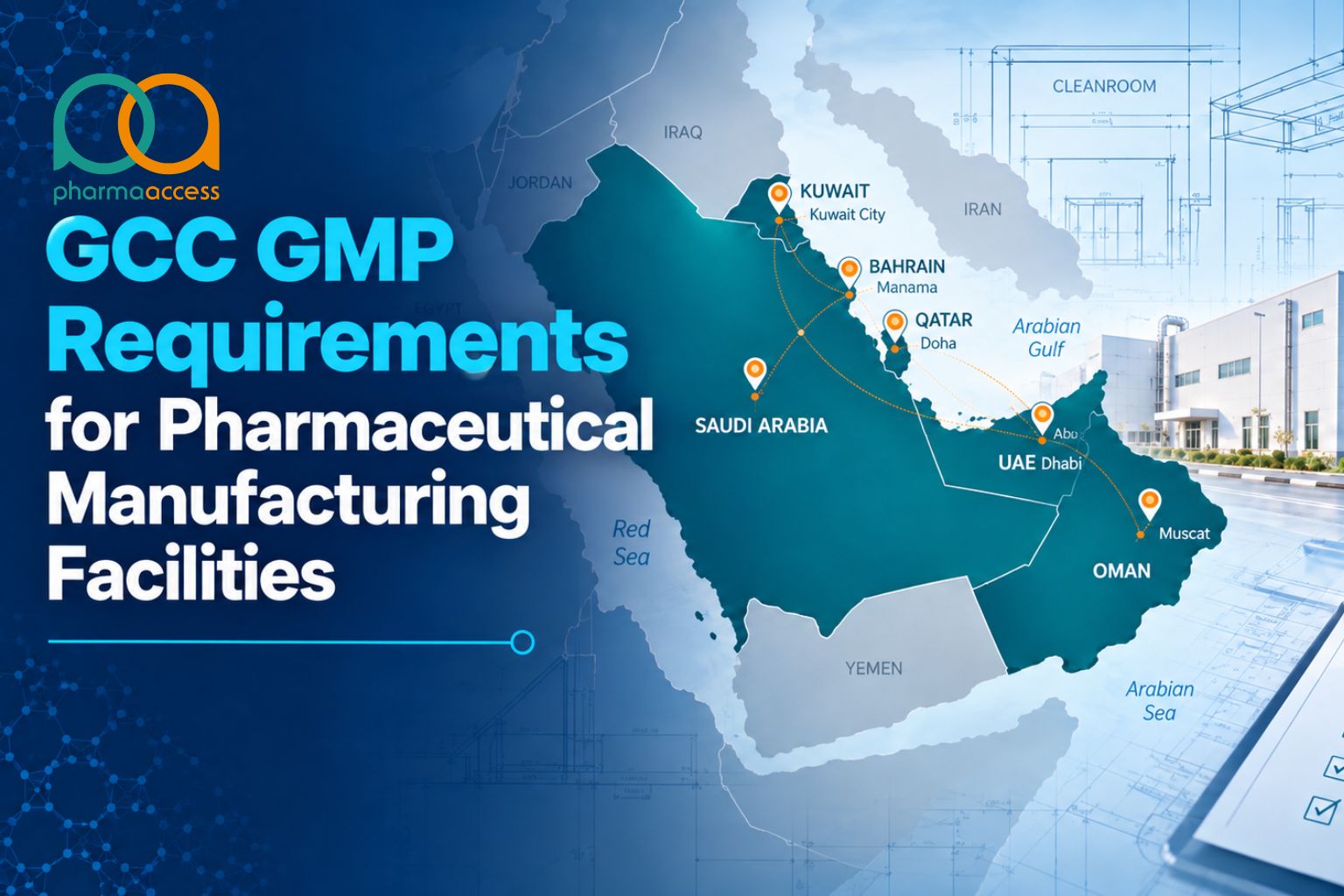
If you are building or upgrading a pharmaceutical plant in Saudi Arabia, the UAE, Qatar, Oman, Bahrain, or Kuwait, you’ve probably come across the term ‘GMP’ more times than you can count. It is what you hear on every registration form, every inspection report, and every conversation with regulators. But what does this mean for a factory floor?

This guide gives a simple-to-understand overview of the GCC GMP requirements for pharmaceutical manufacturing. No dense legal jargon, just the information you need before you design, build, or operate a plant in the Gulf region.

What GMP Actually Means for a Pharma Plant

Good Manufacturing Practice (GMP) is the part of pharmaceutical quality assurance that ensures medicines are consistently produced and controlled to the quality standards appropriate to their intended use. The point is simple: every batch of medicine should be consistently manufactured and controlled – with risks such as contamination, cross-contamination, mix-ups, and processing errors appropriately managed.

For a factory, this means just about everything:

  • Building layout
  • Composition of walls and floors
  • How air flows in production rooms
  • How the equipment is cleaned and calibrated
  • How records are kept
  • How staff are trained 

GMP is not simply a certification label applied to a building. It is a way of running the place, and regulators check it through documented evidence as well as actual manufacturing practices.

How the GCC Handles Drug Registration and GMP

How the GCC Handles Drug Registration and GMP

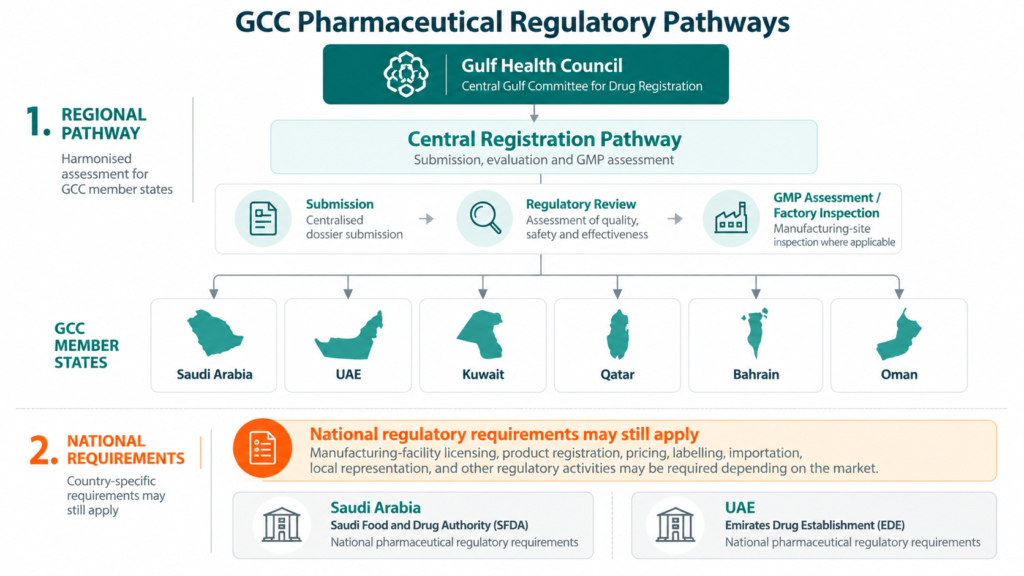
The six Gulf countries (Saudi Arabia, UAE, Qatar, Kuwait, Bahrain and Oman) have put in place a common system to harmonise parts of the drug registration process for manufacturers. The system is operated by the Gulf Health Council (GHC) in Riyadh and its Central Gulf Committee for Drug Registration.

The basic idea behind GCC central drug registration GMP rules is:

  • The manufacturer sends a centralised registration dossier through the Gulf Health Council system rather than repeating the complete assessment separately across each participating market.
  • GHC reviews the product for quality, safety, and effectiveness.
  • A technical team can visit the manufacturing site to verify that it adheres to Good Manufacturing Practices and applicable international manufacturing standards.
  • Once approved, the centralised pathway can reduce duplication in regulatory assessment across GCC member states.
  • The centralised route operates alongside applicable national regulatory pathways. Companies targeting individual markets must also consider requirements of national authorities such as Saudi Arabia’s SFDA or the UAE’s Emirates Drug Establishment (EDE).
  • Country-specific requirements relating to manufacturing-facility licensing, product registration, pricing, labelling, importation, local representation, or other regulatory activities may still apply depending on the market and regulatory pathway.

Core GMP Facility Requirements in the GCC

Core GMP Facility Requirements in the GCC

If it is a central system or a national system, the physical plant has to meet applicable GMP requirements established by the relevant regulatory authority. These are some of the core areas addressed during GMP assessment and inspection.

Building and Premises Design

The layout has to follow the logic of production, from raw material input to finished product output. Rooms should be arranged in such a way that materials and people move through controlled routes that minimize crossings and interactions that could create contamination, cross-contamination, or mix-up risks. Surfaces should be smooth, washable, and without crevices where dust or microbes can collect.

Cleanrooms and HVAC Systems

This is an area where first-time pharmaceutical facility projects can encounter significant challenges. Clean room validation  for sterile products are classified according to defined airborne particle concentrations. Air handling systems must maintain airflow patterns and pressure relationships between rooms appropriate to the product, process, and contamination-control strategy. Temperature, humidity, and airflow should be monitored at a frequency appropriate to the process and qualified operating conditions, with alarms provided for critical parameters where excursions could affect product quality or contamination control.

Equipment and Utilities

Production machines need to be appropriately qualified before routine use and maintained in a qualified state, with requalification performed where required based on defined intervals, changes, periodic review, or quality risk assessment. Water systems, especially purified water and water for injection systems, also require their own qualification and periodic testing. Compressed air and other utilities that contact the product are also subject to GMP scrutiny.

Documentation and Quality Systems

Every GMP-relevant operation should have an approved written procedure, and each batch must have a record that the procedure was followed. Supporting quality documentation includes deviation reports, change controls, CAPA records, calibration records, training records, and qualification and validation documentation. Inspection activities typically include detailed review of these records, because documentation gaps can indicate weaknesses in the pharmaceutical quality system.

Personnel and Training

Training should be provided to staff in production areas to cover their role, and this training should be documented and refreshed on a regular basis. Gowning procedures for cleanroom entry, hygiene practices, and microbiology awareness where relevant to the operation all form part of the picture.

Saudi Arabia’s SFDA and Its GMP Framework

The Saudi Food and Drug Authority (SFDA) plays a central role in regulating pharmaceutical manufacturing and GMP compliance in Saudi Arabia. SFDA became the 56th PIC/S Participating Authority on 1 July 2023 following completion of the PIC/S accession assessment process. PIC/S supports international harmonisation of GMP inspection practices among participating authorities, strengthening alignment between participating inspectorates and internationally recognised GMP inspection principles.

This is important for manufacturers looking for a GCC pharmaceutical manufacturing footprint because SFDA’s regulatory framework requires evidence of GMP compliance and allows the authority to inspect manufacturing sites to verify implementation. A GMP certificate or previous inspection history does not automatically replace an SFDA inspection, so the applicable registration and inspection requirements should be confirmed for each manufacturing site.Saudi Food and Drug Authority

Steps to Get a Pharmaceutical Factory GCC-Ready

If you are starting from scratch or upgrading an old plant, here is a simple sequence to follow:

  1. First, define your product scope: Tablets, sterile injectables, biologics, and APIs all have different process, environmental-control, containment, and utility requirements, so this decision dictates much of what happens downstream.
  2. Design the facility to GMP flow: Get engineering involved early so the layout of the building, HVAC design, and flow of personnel and materials are consistent with GMP and contamination-control requirements from day one and not retrofitted later.
  3. Qualify utilities and equipment: Water systems, HVAC, and process equipment must undergo appropriate lifecycle qualification activities covering installation, operation, and performance requirements, as applicable, before routine GMP use.
  4. Build your quality system side by side: SOPs, batch records, training programmes, and other required quality documentation should be developed alongside facility delivery and be in place before routine GMP manufacturing begins.
  5. Conduct a GMP readiness assessment or mock inspection: A structured review against applicable SFDA, national regulatory, or PIC/S-aligned expectations is a good way to identify gaps before a regulatory inspection.
  6. File for registration: Decide whether the GCC centralised route or the applicable national registration pathway best fits your target markets and regulatory strategy. Gulf Health Council

Common Challenges Manufacturers Run Into

There are some recurring issues in GMP facility requirements for GCC projects:

  1. Cleanroom classifications or environmental-control requirements are selected without sufficient consideration of the actual product and process risk. This can cause redesign, rework, or qualification challenges downstream.
  2. Late-stage value engineering changes HVAC capacity, zoning, or control philosophy without adequately assessing the impact on qualified operating conditions.
  3. Documentation systems are created as an afterthought instead of being developed alongside the physical build and qualification programme.
  4. Teams assume there is one identical GCC standard for every market and overlook national regulatory nuances between Saudi Arabia, the UAE, and other member states.
  5. Integrating engineering and GMP requirements from the beginning can reduce many of these avoidable project risks. This is the type of work that Pharma Access specialises in, because GMP-driven facility design must consider regulatory expectations from the first drawing, not after construction is complete.

Why Early Engineering Input Matters

Why Early Engineering Input Matters

Many avoidable GMP readiness issues can originate during the design stage. In the first few weeks of a project, decisions are made about cleanroom classification, HVAC zoning, and material flow, and those decisions are expensive to reverse once construction has progressed. This is precisely the step that Pharma Access works with pharmaceutical manufacturers on, developing facility designs, cleanroom layouts, HVAC and utility strategies, and validation approaches around the compliance requirements against which the plant will ultimately be qualified and inspected. Addressing these details before construction starts can reduce redesign, rework, and qualification challenges ahead of regulatory inspection.

And for companies deciding whether to build greenfield or upgrade an existing site, Pharma Access also provides support for commissioning, qualification and validation (CQV) work – where design requirements, system performance, and applicable GMP requirements are verified and documented against the completed facility and installed systems.

A Few Final Thoughts

The GMP requirements of the GCC for pharmaceutical manufacturing are not one fixed checklist. These are systems that combine a regional registration system through the GHC with national oversight by bodies such as Saudi Arabia’s SFDA and the UAE’s EDE, supported by internationally recognised GMP principles and the specific requirements adopted by each national authority. Get the facility design, documentation, and training right from the start, and you create a stronger foundation for qualification, regulatory inspection, facility licensing, and ongoing GMP compliance. World Health Organization

Frequently Asked Questions

What is the difference between GCC-DR and national drug registration? 

GCC central registration is a harmonised pathway operated through the Gulf Health Council for the assessment and registration of pharmaceutical companies and products across participating GCC markets. National registration is handled through the relevant country authority, such as Saudi Arabia’s SFDA or the UAE’s EDE, and country-specific regulatory requirements may still apply.

Does every GCC country have the same GMP standard? 

No. GCC cooperation provides harmonised elements of pharmaceutical registration and GMP oversight, but manufacturing-facility licensing, inspections, documentation requirements, and implementation remain subject to the applicable national regulatory authority. Requirements should therefore be assessed for each target market rather than assuming that one identical GMP framework applies throughout the GCC.

How long does GMP certification take for a new pharmaceutical facility in the GCC? 

There is no single GCC-wide timeline. The duration depends on the relevant national authority, product and manufacturing scope, facility readiness, completion of qualification and validation activities, documentation status, inspection scheduling, and closure of any regulatory observations.

Can a foreign GMP certificate replace a physical inspection in Saudi Arabia? 

Not automatically. A current GMP certificate and previous inspection history can form part of the manufacturer’s regulatory documentation, but SFDA retains authority to inspect manufacturing sites to verify GMP implementation. The applicable inspection requirements should therefore be confirmed for each site and regulatory pathway.

What causes the most GMP inspection failures in pharmaceutical factories?

Inspection observations can arise across the pharmaceutical quality system, premises, equipment, documentation, production, qualification and validation, utilities, personnel practices, and contamination-control systems. For example, SFDA’s published 2025 GMP inspection analysis identified quality management systems, premises, equipment, and documentation among the most frequently cited deficiency areas.

Cold Chain Warehouse Design for Biologics & Vaccines: A Practical Guide

Cold Chain Warehouse Design for Biologics & Vaccines

A biologic or vaccine can be affected if it is kept outside its approved temperature range, and there is often no visible sign that a temperature excursion has affected product quality. This is the core problem that pharmaceutical cold chain warehouse design needs to address. It is not just a warehouse for boxes but part of the product quality and storage-control strategy itself.

This guide takes you through the real elements of designing a compliant cold storage facility from layout and HVAC pharma industry decisions to the temperature mapping work that proves the design holds up.

Why Cold Chain Warehouse Design Is Different

A typical warehouse is measured by the amount of volume it can move and store. But a pharmaceutical cold chain warehouse is measured by something narrower and less forgiving: whether products throughout the qualified storage volume remain within their specified storage conditions.

The most typical range for pharma cold storage design is 2°C to 8°C, which is widely used for many vaccines and temperature-sensitive pharmaceutical products. Some products need stricter controls. Some may require frozen storage, while others may require ultra-cold storage, depending on the approved product requirements. Each of these bands has its own equipment, insulation, and monitoring needs, and often a single warehouse needs to support more than one of them at a time.European Commission

The Regulatory Backbone: GDP

Good Distribution Practice (GDP) provides the regulatory framework that applies to the storage, handling and movement of pharmaceutical products through the supply chain. GDP warehouse design should provide for appropriate temperature monitoring, calibrated sensors traceable to a recognised standard, and alarm systems that can alert responsible personnel when excursions occur. EU GDP requires environmental monitoring equipment to be calibrated at defined intervals, with calibration traceable to national or international standards, and requires appropriate alarm systems for excursions from predefined storage conditions.

GDP typically expects a few things from a warehouse:

  • Qualified and monitored storage areas, not only cooled
  • Written procedures for what to do in case of a temperature excursion
  • Records retained in accordance with applicable regulatory and national retention requirements
  • Qualified storage zones that are clearly defined, with segregation applied where storage conditions, product status or risk require it

None of this is by accident. It has to be designed into the facility and then proven through testing before the building is occupied.

Main Elements of Pharmaceutical Cold Chain Warehouse Design

Zoning and Layout

Zoning and Layout

Typically, a vaccine warehouse design calls for multiple temperature zones under one roof: ambient storage for products that do not require refrigeration, a 2-8°C pharmaceutical storage zone for many vaccines and temperature-sensitive pharmaceutical products, and sometimes a separate frozen or ultra-cold zone for specialty products. Each zone needs appropriate environmental control, defined monitoring points, and suitable physical separation so that the conditions in one zone do not adversely affect another.

Loading docks are a special consideration. Products can be particularly susceptible to temperature swings during receiving and shipping, so a well-designed facility may use airlock-style anterooms, dock shelters, rapid doors, temperature-controlled staging or other appropriate measures that restrict the amount of outside air reaching the cold zones when doors are opened.

HVAC and Refrigeration System Design

HVAC and Refrigeration System Design

The chilled zone is one of the most critical parts of the building to get right. For standard 2-8°C storage, refrigeration capacity and air distribution need to maintain the specified range throughout the qualified storage volume without creating localised hot or cold spots. Supply-air temperature and airflow rates should therefore be determined from room loads, racking configuration, door-opening patterns, product sensitivity and qualification requirements rather than from a single fixed design value.

The airflow pattern is as important as the setpoint. The selected supply and return arrangement, combined with controlled airflow, should promote even temperature distribution throughout the storage area rather than creating pockets that are warmer or colder than the rest of the room.

This change is important because pharmaceutical guidance focuses on demonstrating temperature uniformity and identifying areas affected by cooling coils, cold-air streams, heat sources or air-distribution problems rather than prescribing one universal supply-air temperature or airflow arrangement.

Backup Power and Redundancy

A prolonged power outage or refrigeration failure can put temperature-sensitive pharmaceutical products at risk. Good facilities consider backup power, appropriate refrigeration redundancy and battery-backed monitoring systems based on the facility’s risk assessment, and the design should consider how long the building can maintain its temperature range in the event of total power loss.

Temperature Monitoring, Alarms and BMS/EMS Integration

Cold chain performance depends not only on refrigeration but also on how environmental conditions are monitored, recorded and escalated. Monitoring locations should be established using temperature-mapping and qualification results, with calibrated sensors positioned at representative or worst-case locations as appropriate.

Where BMS or EMS platforms are used, their monitoring functions, alarm handling, data retention, backup arrangements and qualification requirements should be clearly defined as part of the facility design and quality strategy.

WHO guidance recommends temperature monitoring devices in temperature-controlled rooms, cold rooms and freezer rooms, with sensors positioned where the greatest temperature variability is expected. It also recommends high- and low-temperature alarms and states that automated, continuous monitoring is preferable.

Temperature Mapping: Proving the Design Works

Temperature Mapping: Proving the Design Works

One part of the job is building a warehouse to specification. Pharmaceutical warehouse temperature mapping is the study that demonstrates the finished facility actually does maintain the specified temperature conditions throughout the qualified storage volume, not just at the thermostat.

A typical mapping study goes as follows:

  1. Scope definition: From the main storage areas to the cold rooms, freezers, quarantine areas, receiving or loading bays, define the spaces in which temperature-sensitive products are stored or handled.
  2. Install calibrated sensors throughout the space: The number and location of sensors are based on the risk involved and the size and layout of the warehouse, rather than a fixed grid. Sensor placement should be justified considering shelving, racking, room geometry and known airflow patterns.
  3. Conduct the study under representative conditions: For warehouses and other ambient storage areas, WHO guidance typically recommends a minimum of seven consecutive days; for cold rooms and freezer rooms that are not critically affected by ambient temperature variations, the study may run for 24 to 72 hours, or longer if justified. Door-opening or power-failure challenges should be included where required by the approved qualification protocol and risk assessment.
  4. Consider seasonal conditions: Where storage areas are affected by seasonal temperature variations, mapping may be needed during the warmest and coldest conditions. WHO guidance notes that two-season mapping is typically not necessary for cold rooms and freezer rooms.
  5. Find hot spots and cold spots: Mapping results are used to identify suitable permanent monitoring locations, including areas that experience temperature extremes or represent worst-case conditions. EU GDP similarly states that monitoring equipment should be positioned according to mapping results in areas experiencing extremes of fluctuation.
  6. Document everything: The final report should state whether the study met the acceptance criteria and identify the locations of hot and cold spots and any HVAC adjustments that are a result of the findings.
  7. Re-mapping is not a one-off occurrence either: The frequency should be based on the monitoring strategy and risk assessment, with WHO giving every three years as one example of periodic mapping, and it should be repeated sooner if the warehouse layout changes, refrigeration or temperature-control systems are modified, storage patterns change materially, or monitoring data indicates unexplained variability.

    Know More : World Health Organization

Common Design Mistakes to Avoid

In cold chain warehouse projects that end up in compliance trouble, these patterns show up again and again:

  • Making loading docks an afterthought. This is where excursions are more likely to occur because products may be exposed to changing external conditions, and it is difficult to rectify airlock, dock shelter or staging-area shortcomings after construction has progressed.
  • Refrigeration capacity is undersized for future growth. Future storage demand can increase or change, and a system designed only for current volume may have limited ability to expand without a costly retrofit.
  • Relying only on manual temperature logs. Automated, continuous tracking provides faster excursion detection, consistent data capture and audit-ready records, while manual monitoring depends more heavily on human intervention. WHO guidance states that automated and continuous monitoring is preferable and offers reliability advantages compared with manual measurement.
  • Skipping seasonal considerations where they are relevant. If an area is affected by seasonal temperature variation and the mapping study is carried out only under mild conditions, the study may not demonstrate how the space performs under the relevant seasonal extremes.
  • Using refrigeration equipment that has not been qualified for its intended use. Suitable equipment must be correctly installed, operated and appropriately qualified to demonstrate that the required storage conditions can be maintained under defined operating conditions. EU GDP requires key equipment and processes to be qualified and/or validated before commencing use, with scope based on documented risk assessment.

Designing for Biologics

The use of biologics makes the design of cold chain warehouses more complicated. Many are more sensitive to temperature excursions than traditional small-molecule drugs, and some require specialised handling for freeze-sensitive formulations, where dropping below the labelled range, even briefly, can be just as damaging as running too warm. In addition to standard vaccines, a biologic facility requires monitoring systems sensitive enough to detect either type of excursion and staff trained to respond according to approved excursion procedures and product-specific stability information.

Bringing It Together at the Design Stage

The performance of a cold chain is strongly influenced at the design stage and should not rely on procedures alone to compensate for engineering design gaps later. Zoning, HVAC and refrigeration capacity, backup power, monitoring infrastructure and control systems need to be designed in concert: a weakness in any one of them can compromise the others. 

Pharma Access partners with pharmaceutical manufacturers on facility design to include these requirements from the outset, including cold storage zoning, HVAC and utility design,BMS/EMS and monitoring integration,  and the CQV work necessary to take a facility through qualification and temperature mapping before it goes live.

If you are a manufacturer thinking about building a new cold storage facility or expanding an existing one, you should consider current and projected storage volumes, the number of temperature zones required, and the level of redundancy appropriate to the product risk, operational continuity requirements and facility strategy.

A Few Final Thoughts

Pharmaceutical cold chain warehouse design isn’t just refrigeration with some added paperwork. It demands meticulous zoning, HVAC engineering within a defined temperature range, and a mapping process that demonstrates the completed building does in fact perform as designed. When these elements are addressed from the start, ongoing GDP compliance becomes more manageable than trying to correct engineering gaps in a facility that was not designed around cold chain requirements.

Frequently Asked Questions

What temperature range do most vaccines and biologics need in storage? 

2°C to 8°C is a common storage range for many vaccines and temperature-sensitive pharmaceutical products. However, storage requirements are product-specific, and some vaccines and biologics require frozen or ultra-cold conditions according to their approved labelling and stability requirements.

How often does a pharmaceutical warehouse need temperature mapping? 

Temperature mapping should be completed before a new temperature-controlled storage area is released for use. Subsequent mapping should be based on the monitoring strategy and risk assessment and should also be repeated following significant changes to the facility, temperature-control equipment or storage arrangement. WHO identifies every three years as an example of a possible periodic interval rather than as a universal requirement.

What is the difference between GMP and GDP for cold chain storage? 

GMP primarily governs pharmaceutical manufacturing and includes controls for storage activities associated with a manufacturing operation, while GDP focuses on maintaining medicinal-product quality throughout storage and distribution in the supply chain. Depending on the function of the facility and the applicable jurisdiction, a pharmaceutical cold storage warehouse may therefore need to satisfy GMP requirements, GDP requirements, or both.

Why are loading docks a common weak point in cold chain warehouses? 

Products are most vulnerable to temperature swings during receiving and shipping when the doors are open and outside air is coming in. Airlock-style anterooms or dock shelters are among the engineering measures that can help limit that exposure, together with appropriate staging, door-control and operating strategies, and it’s difficult to correct such design shortcomings after construction if they were not considered early.

Can an existing warehouse be retrofitted for pharmaceutical cold storage, or does it need to be purpose-built? 

Retrofitting is possible depending on the existing structure of the building, the capacity of the utilities, and the infrastructure of the HVAC system. A facility engineering assessment can determine if a retrofit meets GDP requirements or if a purpose-built facility makes more sense.

Water for Injection: Distillation vs Membrane Methods

Water for Injection: Distillation vs Membrane Methods

Water for Injection may seem like an easy thing to make. It is only water, after all. But WFI must meet stringent compendial requirements for chemical purity and bacterial endotoxins, together with tight microbiological control, because it is used in pharmaceutical applications where control of pyrogens and microbiological contamination is critical. It takes a good production system to get there, and for decades there was only one way to do it: distillation.

That is no longer the case. This guide gives plain language explanations of the methods of producing water for injection, including how distillation and membrane systems work, what changed in the regulations, and how to think through which approach fits a given facility.

What Makes WFI Different From Regular Purified Water

Systems that produce purified water reduce dissolved minerals and organic material to levels suitable for many pharmaceutical uses, but WFI must be of a higher standard. Compared with Purified Water, WFI is intended for higher-risk pharmaceutical applications and is subject to bacterial endotoxin requirements together with stringent microbiological control, in addition to applicable chemical-quality requirements.

For much of the history of the industry, distillation was the established approach for producing WFI. But that changed as membrane technology matured, and that changed the regulatory picture too.

The Regulatory Shift That Opened the Door to Membranes

Up until 2017, the European Pharmacopoeia monograph for Water for Injections required distillation as the production method. The United States and Japanese pharmacopoeias had permitted alternative purification approaches earlier, but Europe held out, with particular attention given to the microbial-control risks associated with non-distillation systems.

That changed in April 2017, when the European Pharmacopoeia revised its monograph on Water for Injections (0169) to allow production purification processes equivalent to distillation, including reverse osmosis combined with appropriate complementary techniques. This harmonised European rules with the US and Japanese pharmacopoeias, which had already accepted membrane-based approaches.

The alignment continued to widen. In 2020, membrane processes were recognised as an acceptable WFI production method in Annex 3 of WHO Technical Report Series 1025. In October 2025, the 2025 edition of the Chinese Pharmacopoeia came into force, further updating the pharmaceutical-water regulatory framework in China. Non-distillation WFI generation is now recognised across multiple major regulatory and pharmacopoeial frameworks, although applicable national requirements and product-specific regulatory commitments should always be confirmed for individual projects.USP–NF

How Distillation-Based WFI Works

Distillation removes contamination by converting water into vapour while non-volatile contaminants remain in the liquid phase. Proper vapour separation and control of entrained droplets help prevent contaminants, including bacterial endotoxins, from being carried into the distillate before the purified vapour is condensed back into WFI.

Two main distillation methods dominate WFI distillation systems today.

Multiple Effect Distillation (MED)

Multiple Effect Distillation (MED)

The multiple-effect distillation WFI systems comprise a series of evaporator “effects” connected in series. Plant steam heats the first effect, and vapour generated in one effect is then used as the heating medium for the next effect, typically operating at progressively lower pressure and temperature. The heat from each effect is recycled into the next so that the total energy required is reduced as heat is reused across the system.

MED systems need separate condensers with cooling water to complete the process, and they have fewer moving parts than mechanical alternatives, which usually means lower maintenance needs. Certain MED configurations can also integrate pure-steam generation, allowing some system designs to produce both WFI and pure steam from the same unit.

Vapour Compression (VC) Distillation

Vapour compression WFI systems take a different mechanical route. VC systems reduce dependence on external steam during normal operation by using mechanical compression to increase the pressure and temperature of vapour generated in the process and then reusing the compressed vapour as the heating medium for ongoing evaporation.

This design recycles latent heat internally, generally leading to lower energy consumption for VC systems compared to MED systems, because they require less external steam and can operate with lower cooling water demands. Depending on equipment configuration, VC systems can also provide flexibility in delivering WFI at different outlet temperatures, although the final storage and distribution temperature remains a separate system-design decision.

Multiple Effect vs Vapour Compression: A Quick Comparison

FactorMultiple Effect DistillationVapour Compression
Energy sourceExternal steamMechanical compression
Heat reuseAcross sequential effectsInternal, recycled continuously
Cooling water needsHigherLower
Moving partsFewerMore
Output temperatureCooling may be required where lower-temperature WFI is neededCan offer greater outlet-temperature flexibility depending on system configuration
Typical design considerationOften attractive where reliable steam and cooling infrastructure already existOften attractive where reduced steam demand and internal heat recovery are priorities

Neither approach is universally superior. The right choice depends on what utilities are already in a facility, what output capacity is needed, and whether energy demand, lifecycle cost, operating philosophy and WFI supply temperature are priorities.

How Membrane-Based WFI Systems Work

How Membrane-Based WFI Systems Work

Membrane-based WFI production completely avoids phase change. These systems combine reverse osmosis with complementary purification technologies designed to control ionic, organic, microbial and endotoxin-related contaminants without converting water to steam and back.

The typical membrane-based WFI generation system stacks a number of stages together. The first step of purification is reverse osmosis, followed by further polishing steps such as electrodeionisation, ultrafiltration or nanofiltration. Each unit operation performs a specific purification function, and the validated combination of these stages allows the finished water to meet the applicable WFI requirements.

Membrane WFI can be generated without the high-temperature phase used in distillation and can therefore operate as a “cold” generation process, reducing the energy associated with evaporation. But this operating approach also places greater emphasis on biofilm prevention, hygienic design, membrane performance, sanitisation and microbiological monitoring. Storage, distribution and sanitisation temperatures are separate design decisions and may include hot-water sanitisation or other validated microbial-control strategies.United States Pharmacopeia

Comparing the Two Approaches

Cost

For long-term operation, the cost favours different methods depending on scale, system architecture and utility infrastructure. Membrane-based systems can reduce steam and cooling-water demand compared with multiple-effect distillation, but pretreatment, membrane stages, sanitisation strategy, membrane replacement, monitoring and redundancy must all be included when evaluating total cost of ownership. Vapour compression systems can also offer competitive lifecycle economics through internal heat recovery and lower external steam demand.

Energy Use

Membrane systems use less total energy for the generation step because they eliminate the energy-intensive evaporation process. Vapour compression is one of the distillation methods in which the latent heat is recycled mechanically rather than with a continuous supply of external steam. It uses significantly less energy from external thermal utilities than multiple-effect distillation in many system configurations.

Contamination Control

Distillation provides a strong purification barrier through phase separation, provided that the still, vapour-separation system and upstream water treatment are appropriately designed and controlled. Membrane systems are very dependent on the integrity of the membrane itself and the discipline of the sanitation schedule. A properly designed, validated and maintained membrane system can consistently produce WFI that meets applicable requirements, but particular attention must be given to biofilm prevention, sanitisation, hygienic design, membrane performance and ongoing microbiological monitoring.

Footprint and Facility Fit

Compared to a complete distillation system, membrane-based WFI systems generally require less space and can reduce infrastructure requirements in some applications, which allows facilities with limited space or phased expansion strategies to have a viable option for WFI production. Actual capital requirements depend on capacity, pretreatment, redundancy, sanitisation philosophy, automation and existing site utilities.

Read More: Cleaning Validation Limits in Pharma

Choosing the Right System for a Pharmaceutical Water System Design

A handful of practical questions that a pharmaceutical water system design decision should consider are:

  1. What utilities are available at the facility now? A site with reliable steam infrastructure may favour multiple-effect distillation, while a site that favours lower utility demand may favour vapour compression or membranes.
  2. How much floor space? Membrane systems also generally take up less physical space than a full distillation train.
  3. What volume and temperature do you want as the output? Required WFI flow rate, peak demand, turndown, storage philosophy and required supply temperature should be established before selecting the generation technology.
  4. What is the facility’s ability to monitor and sanitise? Membrane systems require a robust microbial-control strategy, and so facilities need to have staff and systems in place to manage that on an ongoing basis.
  5. How much will it cost to operate in the long term? Energy costs vary widely by region and even by facility, so it is more important to run your numbers against your actual local energy pricing rather than relying on general industry averages.

WFI Generation Is Only One Part of Pharmaceutical Water System Design

WFI Generation Is Only One Part of Pharmaceutical Water System Design

Selecting MED, vapour compression or a membrane-based system addresses only the generation stage. The complete pharmaceutical water system should be considered as an integrated chain covering feed-water quality, pretreatment, WFI generation, storage, distribution, points of use, sanitisation, monitoring and qualification.

Feed Water → Pretreatment → WFI Generation → Storage → Distribution Loop → Points of Use → Monitoring & Sanitisation

Engineering decisions around storage capacity, recirculation, hygienic piping, dead-leg control, utility loads, drainage, instrumentation, automation, redundancy and sanitisation strategy can have as much influence on long-term WFI performance as the choice of generation technology itself. These requirements should therefore be evaluated together during facility and utility design rather than as independent equipment decisions.

Getting the Water System Design Right From the Start

WFI generation should ideally be integrated into facility design from the outset. The utility loads, floor space, drainage, and water distribution loop should be designed in conjunction at the design stage, as retrofitting a distillation or membrane system into a building not designed for it usually requires costly rework.Pharma Access works with pharmaceutical manufacturers on facility and utility design that incorporates water system needs from the earliest planning stages, including layout, utility sizing and the qualification work needed to bring a WFI system into GMP-compliant operation.

A Few Final Thoughts

Indeed, the methods to produce water for injection have diversified over recent years, and the choice between distillation or membrane systems is no longer a firm regulatory requirement. Multiple-effect distillation and vapour compression each have their strengths in terms of reliability, energy consumption and output flexibility, whilst membrane-based systems have thermal-energy demand and often a smaller equipment footprint, together with greater dependence on an effective microbial-control strategy. According to the utilities, space and monitoring capacity of the facility, there isn’t one size-fits-all answer.US FDA

Frequently Asked Questions

Is membrane-based WFI now accepted everywhere, or only in some countries? 

Acceptance of non-distillation WFI generation has expanded significantly. Major regulatory and pharmacopoeial frameworks now recognise validated alternatives to distillation, including membrane-based approaches. However, manufacturers should still verify the applicable national regulatory requirements, marketing-authorisation commitments and facility-specific requirements before selecting the generation technology.

Which is cheaper to operate: distillation or membrane-based WFI systems? 

It is contingent upon the setup. Membrane systems can reduce steam and cooling-water demand compared with multiple-effect distillation, while vapour-compression distillation can also achieve competitive total lifecycle costs through internal heat recovery. The final comparison depends on capacity, pretreatment, utility prices, sanitisation strategy, maintenance and redundancy requirements.

Why did Europe require distillation for WFI for so long? 

European regulators were concerned that non-distillation systems required robust control of microbial contamination, membrane performance and biofilm formation to ensure consistent WFI quality. These concerns contributed to the continued requirement for distillation until the European Pharmacopoeia revised the WFI monograph in 2017 to permit purification processes equivalent to distillation.

Does membrane-based WFI need more monitoring than distilled WFI? 

Membrane-based WFI systems require particular attention to microbial trending, biofilm prevention, membrane performance, sanitisation and process monitoring because generation can occur without a high-temperature distillation step. Distilled WFI systems also require appropriate monitoring, and the final programme for either technology should be defined through the validated control strategy, system performance and risk assessment.

What is the main difference between multiple-effect distillation and vapour compression? 

Multiple-effect distillation uses external steam passed through several evaporator effects, while vapour compression uses mechanical compression to recycle heat internally. Vapour compression is generally more energy efficient in terms of external thermal-energy demand and can provide greater flexibility in WFI outlet temperature depending on equipment configuration.

Cleaning Validation Limits in Pharma: HBEL, PDE and MACO Explained

Not so long ago, much of pharma cleaning validation was based on a simple rule of thumb: 10 ppm, or one-thousandth of the minimum therapeutic dose, and call it a day. The industry has since moved away from relying on these fixed criteria as the sole scientific basis for establishing cleaning limits. HBEL- and PDE-based science now provides the scientific foundation for establishing residue limits, particularly for products manufactured in shared facilities.

In this post, we’re going to peel back the layers of what HBEL and PDE actually mean, how they feed into the MACO calculation that determines your real-world cleaning limits, and what all of this means for facility design. We’ll keep things simple and avoid the heavy toxicology maths when we can.

Why Cleaning Validation Limits Changed

Cleaning validation is done to show that the equipment used to make one product does not pass significant residue on to the next product made on the same line. For decades, the industry has applied arbitrary cut-offs like the 10 ppm rule or the 1/1000th minimum therapeutic dose method. These were easy to use but were not based on the real toxicology of the substance in question and could just as easily overestimate the risk for one compound and underestimate it for another.

Regulatory expectations have moved away from relying on that approach alone. The EMA published its guideline on the setting of health-based exposure limits for shared facilities in 2014, and since then, PIC/S and WHO guidance has also incorporated science- and risk-based approaches to establishing health-based and carryover limits. That change is why HBEL and PDE are now central to the scientific basis used for establishing cleaning-validation limits in shared pharmaceutical facilities.

What Is HBEL Pharmaceutical Guidance Actually Asking For?

HBEL stands for Health-Based Exposure Limit. HBEL pharmaceutical guidance requires that for each relevant medicinal product or residue that may result in cross-contamination, a scientifically based exposure limit be determined for the specific toxicological profile of the compound in question, and not a general formula applied equally to all.

The usual way to get an HBEL is to first determine an appropriate toxicological point of departure, such as a NOAEL (No Observed Adverse Effect Level), where applicable, for the key toxicological effect of a substance, then apply appropriate adjustment factors to take into account the differences between the conditions of the test and real-life human exposure. And this is no trivial desk calculation. This requires real toxicological expertise, and the underlying data needs to be reassessed periodically and when relevant new safety information becomes available the life cycle of a product.

PDE Cleaning Validation: The Practical Output of HBEL

Once an HBEL has been established, it is set out in a defined, usable form.In pharmaceutical manufacturing, a commonly used form of HBEL is the Permitted Daily Exposure (PDE) value, while Acceptable Daily Exposure (ADE) is another term used within industry for a health-based exposure limit. The PDE cleaning validation work is limited to the Permitted Daily Exposure value, which is sometimes known as the Acceptable Daily Exposure (ADE) depending on the terminology a company prefers to use. The PDE is the maximum daily exposure to a residual substance that is considered to be without adverse health effects over a lifetime of exposure.

The PDE value is used by cleaning validation specialists for decision-making. It defines a health-based daily exposure value for the residual substance; it does not, by itself, define how much residue may remain on equipment. The PDE is subsequently used with manufacturing and dosing information to derive a carryover limit such as MACO.

From PDE to MACO: How the Numbers Actually Work

From PDE to MACO: How the Numbers Actually Work

This is where the science becomes a real cleaning limit a technician can test to. The pharma teams take the  PDE and relevant manufacturing parameters to calculate the Maximum Allowable Carryover, which represents the highest allowable residue level from one product that can carry over into the next product under the defined manufacturing scenario without exceeding the established health-based exposure limit.

Often the calculation is done with a version like this:

MACO = (PDE of prev product X smallest batch size of next product) / largest daily dose of next product

Put simply, the formula looks like this: Given a health-based exposure limit of the previous product residue and the maximum dose of the next product a patient could potentially receive in a day, what is the maximum residue that could theoretically remain on the equipment before exceeding the established health-based exposure threshold? Once MACO is established in terms of total mass, it is typically translated to more practical, testable numbers, such as mg/cm² of equipment surface or a concentration limit in a rinse sample. This conversion should account for factors such as shared product-contact surface area, sampling area, rinse volume and sampling recovery, as applicable.

MACO represents a calculated health-based carryover limit for a defined manufacturing scenario. Routine cleaning acceptance or alert limits may be established at lower levels based on process capability, validated cleaning performance and Quality Risk Management rather than routinely operating at the MACO boundary.

If the shared facility makes more than one dosage form (e.g., oral, topical, or ophthalmic products), then the PDE derivation must consider the relevant routes of patient exposure, and route-specific HBELs or scientifically justified route-to-route extrapolation may be required where appropriate for the MACO calculation. That science- and risk-based approach helps ensure that the selected exposure limit remains protective for the relevant route of patient exposure.European Medicines Agency (EMA)

HPAPI Cleaning Validation: Where the Stakes Get Higher

HPAPI Cleaning Validation: Where the Stakes Get Higher

With highly potent compounds, this science is nowhere more important. The margins for HPAPI cleaning validation are much tighter than for standard cleaning work because highly potent active pharmaceutical ingredients can cause harmful effects at very low levels of exposure. The PDE of an HPAPI might be in the microgram or even nanogram range, leaving little to no margin for error in the resultant MACO limit.

This narrower margin has direct implications for the way a facility is built and run. The stringency of the PDE and associated MACO values will directly impact decisions on HPAPI facility design, including dedicated vs. shared equipment, containment strategy, and cleaning method selection. The HPAPI facility design done right the first time means the containment strategy and the cleaning validation strategy are solved together and not added on to each other at a later stage. In some cases, an HBEL assessment combined with Quality Risk Management may demonstrate that shared equipment cannot provide adequate and reliable control of carryover for a specific compound, leading to dedicated equipment, segregated processing or other appropriate technical and organisational controls.

Cleaning Method Selection Follows the Numbers

The establishment of MACO limits directly impacts the selection of cleaning methods and the degree of validation required for a facility.

  • Manual cleaning may be acceptable where the cleaning process can be adequately controlled and validated, but generally demands careful consideration of operator variability and other factors influencing cleaning effectiveness.
  • Automated Clean-in-Place (CIP) systems provide more consistent and repeatable cleaning performance, and this can become particularly important where stringent cleaning limits must be consistently achieved.
  • Where an HBEL and cleaning-risk assessment indicates that shared equipment cannot reliably achieve the required carryover control, dedicated equipment or other appropriate measures may be required.
  • For verification techniques such as swab sampling and rinse sampling, the analytical method must have sufficient sensitivity for the acceptance limit being tested. Total Organic Carbon (TOC) may also be used as a representative, non-specific parameter where scientifically justified and sufficiently sensitive; very low residue limits may require an appropriately sensitive substance-specific analytical method.PIC/S GMP Guide

Brownfield Pharma Upgrades and Cleaning Validation

Brownfield Pharma Upgrades and Cleaning Validation

These limits are not just a new-build issue. Brownfield Pharma upgrades that add a new product to an existing shared facility must trigger a change-control and risk-based impact assessment of the existing HBEL, product/equipment matrix, MACO and cleaning-validation strategy for the products sharing that equipment, not only the new product being introduced. Adding a highly potent compound to a facility that was only handling conventional products can introduce a new worst-case product and significantly tighten the relevant product-to-product carryover limits, sometimes necessitating a switch to dedicated equipment or additional containment measures not originally part of the facility design.

This is one of the reasons why brownfield projects require careful upfront risk assessment prior to the start of construction. For example, a new product may have an HBEL and risk profile that, following Quality Risk Management, indicates a need for equipment dedication that the existing facility layout does not allow. Discovering this mid-project results in expensive redesign work that a thorough HBEL review at the planning stage would have caught early.

Building Cleaning Validation Into Facility Design From the Start

What this all shows most clearly is that cleaning validation is not something you figure out once you build a facility. HBEL, PDE, and MACO decisions influence the selection of equipment, the layout of rooms, and the containment approach long before the first validation protocol is written.

At Pharma Access, our engineering and CQV teams integrate approved cleaning-validation, containment and operational requirements into facility design from the concept stage, whether that’s specifying dedicated equipment for a highly potent product line or designing a shared facility layout that can support the CIP systems needed to hit tight MACO limits reliably. When these requirements are addressed correctly from the start, facilities can avoid expensive equipment changes and layout modifications that may otherwise arise when cleaning-validation gaps are identified after construction has begun. You can read more about our approach on the Pharma Access about page.

Wrapping Up

Modern cleaning validation approaches based on HBELs and PDEs are far beyond arbitrary rules of thumb. HBEL and PDE bring real toxicological science into the process, and the resulting MACO calculation provides facilities with a defensible, patient-safety-based carryover limit for a defined manufacturing scenario that they can validate against. But for very highly potent compounds and brownfield projects adding new products to shared equipment, getting the science right early in the design phase is typically more cost-effective than identifying a gap after construction is finished.World Health Organization (WHO)

FAQs

What is the difference between HBEL and PDE? 

HBEL is a more generic term for health-based exposure limits. PDE (Permitted Daily Exposure) is a type of health-based exposure limit derived through a structured scientific evaluation of pharmacological and toxicological data that defines a daily exposure considered unlikely to cause adverse health effects.

How is MACO calculated from a PDE value? 

A common formula is to multiply the PDE of the previous product by the smallest batch size of the next product and divide by the largest daily dose of the next product to give the maximum carryover in mass terms.

Why do HPAPIs need stricter cleaning validation limits? 

Highly potent compounds can cause adverse effects at very low levels of exposure. The PDE values of highly potent compounds are often very low. This results in a very strict MACO limit, leaving little margin of error in the methods of cleaning and detection.

Does adding a new product to an existing facility require redoing cleaning validation? 

Introducing a new product to shared equipment should trigger a documented change-control and risk-based assessment of its potential impact on the existing cleaning-validation programme. HBEL information, worst-case product selection, relevant MACO calculations and the existing cleaning strategy should be reviewed as applicable rather than assuming that one lowest limit automatically applies to the entire line.

Can shared equipment always be used if the MACO limit is met on paper? 

Not necessarily. While a calculated MACO limit may be technically achievable, the acceptability of shared equipment must also consider Quality Risk Management, cleanability, containment, equipment design, analytical capability and the ability of the validated cleaning process to consistently control carryover. Where adequate control cannot be demonstrated, dedicated equipment, segregation or other appropriate measures may be required.

UAE Pharmaceutical Manufacturing Requirements: EDE, GMP, and Facility Readiness Explained

UAE Pharmaceutical Manufacturing Facility

If you are considering setting up a pharmaceutical factory in the UAE, the regulatory framework has recently undergone a significant change. A number of pharmaceutical licensing and GMP oversight functions have transitioned from the Ministry of Health and Prevention (MOHAP) to the Emirates Drug Establishment (EDE). If your compliance plan is still written on the old structure, now is the time to update it.

This guide provides a practical overview of the UAE pharmaceutical manufacturing requirements. It explains who regulates what, what a factory needs to get licensed, and what GMP looks like on the ground.

Meet the Emirates Drug Establishment (EDE)

The Emirates Drug Establishment (EDE), the UAE’s independent federal authority for pharmaceuticals and medical devices, was established in September 2023 under Federal Decree-Law No. 28 of 2023. Its scope covers all medical and pharmaceutical products manufactured in the country, including medical devices and other medical-product categories within its statutory mandate.

A further regulatory shift followed. Federal Decree-Law No. 38 of 2024 entered into force on 2 January 2025, replacing the older Federal Law No. 8 of 2019. As part of the implementation of this transition, MOHAP announced the full transfer of 44 core services to EDE, together with the partial transfer of 13 additional services, including pharmaceutical-facility licensing functions. EDE now administers medical-product factory licensing and GMP certification through its regulatory services.

MOHAP still exists. It continues to retain specific pharmaceutical-sector responsibilities, including licensing medical professionals and pharmacists supporting EDE-licensed establishments, as well as certain controlled-medicine functions. Abu Dhabi also maintains its own Approved Drug List and processes for certain non-registered medicines within the local healthcare system through the Department of Health (DOH); these are distinct from the federal EDE manufacturing-licensing process. So a manufacturer operating across emirates may need to coordinate with federal and relevant local authorities depending on the project and market pathway, rather than dealing with only one authority.UAE Legislation

Why This Matters for Facility Planning

Why This Matters for Facility Planning

This is an important distinction during regulatory and facility planning. While pharmaceutical facility licensing and EU GMP approval in the UAE are processed at the federal level, specific healthcare-market requirements in Abu Dhabi are managed by the DOH. If your plant is in Dubai, you work with the EDE for manufacturing approval. Separate emirate-level requirements, such as industrial, environmental, municipality and Civil Defence approvals, may also form part of the overall project pathway. If your products are intended for specific Abu Dhabi healthcare channels, applicable DOH requirements become an additional local-market consideration.

This is not a sequence in which one approval leads automatically to the next. These are different regulatory and project-approval tracks and early planning saves a lot of back and forth later.

Core UAE Pharmaceutical Manufacturing Requirements

Core UAE Pharmaceutical Manufacturing Requirements

Whether you are setting up a new plant or expanding an existing one, the basic route to a pharmaceutical manufacturing licence in the UAE goes through a few stages.

Stage 1: Initial Approval and Site Planning

The applicant will provide company and site information for review before construction. This includes the ownership structure, corporate documents, project feasibility information and the documentation required for initial regulatory review. Current EDE requirements place the proposed pharmaceutical dosage forms and production lines under the subsequent construction and preparation stage rather than the initial-approval documentation.

Stage 2: Construction and Preparation

After the initial approval is obtained, the facility begins to build out the physical plant. Detailed engineering drawings, approval related to estimated water and electricity consumption where required, a list of the pharmaceutical forms and proposed production lines, the equipment and devices for each production, packaging, and sterilisation line where applicable, and an explanation of what the quality control laboratory needs to operate are required at this stage. Then, once these documents have been submitted and the relevant requirements fulfilled, the facility will be eligible to submit a GMP inspection request through EDE.

Stage 3: Final Licensing and GMP Certificate

The facility appoints appropriately qualified and licensed personnel to fill key positions, including production manager, quality assurance manager, and quality control manager, before final inspection. These positions require valid professional licences, with pharmacist and medical-professional licensing for the relevant roles handled through MOHAP. Personnel requirements for facilities limited to medical devices may differ from those applicable to pharmaceutical manufacturing facilities. After the inspection has been completed and the documents verified, the final licence and GMP certificate are issued after the facility has addressed the applicable requirements and inspection observations.

According to the current EDE service information, the government fee for final licensing of a pharmaceutical or medical device manufacturing facility is AED 50,000. EDE also currently lists an AED 100 application fee, AED 2,000 for engineering-plan approval and AED 3,000 for each final inspection. The separate GMP compliance certificate is currently listed at AED 2,000 per production line annually.

Stage 4: Renewal and Ongoing Compliance

In the UAE, a pharmaceutical factory licence must be renewed annually, and renewal is based on continued compliance with good manufacturing practices, confirmed through inspection. EDE states that requests to renew EDE-issued GMP certificates can be submitted approximately two months before expiry. Factory-licence renewal and GMP inspection therefore should not be treated as completely separate activities, because continued GMP compliance is part of the renewal requirements. This is not something to leave at the last minute, as failing to renew on time can have legal consequences.

What GMP Actually Covers Inside the Plant

UAE GMP certification requirements are not just paperwork exercises. Inspectors observe the real operation of the facility. 

There are a few areas that crop up again and again:

  • Facility layout and cleanliness. The building needs to be designed to allow materials and staff to pass through in a logical order, with appropriate segregation and controls to minimise contamination and cross-contamination risks.
  • Facilities and utilities. The equipment used for production and packaging must meet the set standards. Utilities that directly or indirectly affect product quality, including pharmaceutical water, HVAC and process gases where applicable, require appropriate qualification, monitoring and maintenance.
  • Documentation and quality system. Standard operating procedures, batch records, and deviation logs must exist and must match what is really happening on the floor.
  • Personnel trained. Production staff need role-specific training, and that training needs a paper trail.
  • Testing of products. Raw materials, in-process samples where applicable, and finished products should be tested against defined specifications.

This is nothing unique to the UAE. It is closely aligned with established international GMP principles, while manufacturers must also meet the specific UAE regulatory requirements applicable to their facility, products and processes.

How UAE Requirements Connect to GCC Drug Registration

It is rare that the UAE is the only market a manufacturer has in mind when building a plant in the UAE. A lot of companies are looking for broader GCC drug registration, so they use the UAE as a base to get to Saudi Arabia, Qatar, Oman, Bahrain, and Kuwait as well.

The UAE fits into this regional picture in two ways. First of all, a GMP certificate from the EDE can form part of the regulatory evidence supporting applications involving a UAE manufacturing site, but it does not by itself provide automatic regulatory approval in other GCC markets. The Gulf Health Council also operates a central drug-registration framework intended to harmonise registration of pharmaceutical companies and medicines across GCC member states. Secondly, UAE-based manufacturing can be a strategic entry point, thanks to the country’s logistics infrastructure and its position as a gateway to the wider Gulf market.

That said, Gulf Health Council central-registration requirements and country-specific regulatory requirements may still apply depending on the intended product and market pathway, so a UAE GMP certificate doesn’t automatically clear every hurdle elsewhere in the region.Emirates Drug Establishment

Common Mistakes Manufacturers Make

A handful of patterns are common enough to be worth mentioning:

  1. Treating EDE and DOH requirements as one combined approval process. They cover different regulatory responsibilities, and confusing their roles can create unnecessary delays.
  2. Finalising engineering drawings before confirming the intended dosage forms, production lines and manufacturing scope. Once construction drawings are locked in, changing the product mix can mean expensive rework.
  3. Under-scoping the quality control laboratory. EDE requires manufacturers to define the equipment needed for laboratory testing of raw materials, in-process materials and finished products. An inadequately planned QC laboratory can create gaps in inspection readiness.
  4. Waiting too long to renew. EDE allows requests to renew its GMP certificates approximately two months before expiry, while continued GMP compliance remains part of the factory-licence renewal process.
  5. Assuming old MOHAP processes are still applicable across the board. EDE now administers key manufacturing licensing and GMP services, so older guidance should be checked against the current EDE process before it is relied upon.

Getting the Facility Design Right the First Time

Much of the above delay can be traced back to decisions made before one wall is built. Getting the layout of the building, the cleanroom classification,where required by the product and process,  and the design of the utilities right at the drawing-board stage helps avoid the costly redesign work that rears up later when inspectors point out gaps. This is where Pharma Access comes in, working with pharmaceutical manufacturers at this very stage, designing facilities to meet GMP expectations from day one, rather than retrofitting compliance into a finished building.

Pharma Access also provides support for commissioning, qualification, and validation (CQV) work for projects that need assistance in linking engineering decisions to documented GMP requirements and inspection readiness. This is the stage at which a finished facility is tested against the approved requirements and intended operating conditions that support its qualified state and readiness for GMP manufacturing.

A Few Final Thoughts

The Emirates Drug Establishment is now the principal federal authority administering pharmaceutical manufacturing licensing and GMP certification in the UAE, MOHAP continues to perform specific responsibilities including professional licensing and certain controlled-medicine functions, and DOH Abu Dhabi has its own healthcare-market responsibilities within Abu Dhabi. 

To obtain a licence for a plant, the process includes initial approval, construction and preparation, GMP inspection and qualified-personnel readiness, final licensing with a GMP certificate, and then annual renewal. Build the facility with GMP expectations integrated into the design from day one, and the risk of late-stage redesign can be reduced while inspection readiness is strengthened.Department of Health

Frequently Asked Questions

What is the Emirates Drug Establishment (EDE), and how is it different from MOHAP? 

The EDE is the UAE’s federal authority for the regulation of pharmaceuticals and medical devices, established in 2023. As part of the regulatory transition implemented during 2025, MOHAP transferred 44 core services fully and 13 services partially to EDE. EDE now administers key services involving medical-product manufacturing facilities and GMP compliance, while MOHAP retains responsibilities including professional licensing and certain controlled-medicine functions.

How much does a pharmaceutical manufacturing licence cost in the UAE? 

According to current EDE service information, the final licensing fee for pharmaceutical or medical device manufacturing facilities is AED 50,000. EDE also currently lists an AED 100 application fee, AED 2,000 engineering-plan approval fee and AED 3,000 per final inspection. The GMP compliance certificate is listed separately at AED 2,000 per production line annually. Fees should always be reconfirmed with EDE before submission because regulatory charges can change.

How often does a UAE GMP certificate need renewal? 

A pharmaceutical factory licence is renewed annually, and EDE’s GMP compliance certificate is also issued annually. EDE states that a request to renew an EDE-issued GMP certificate can be submitted approximately two months before expiry. Continued GMP compliance is verified through inspection as part of the regulatory requirements.

Does a UAE GMP certificate work for registration in other GCC countries? 

Elsewhere in the GCC, a valid EDE GMP certificate may support the regulatory documentation for a UAE manufacturing site. The Gulf Health Council also operates a central registration framework for pharmaceutical companies and medicines. However, applicable central and country-specific regulatory requirements still need to be assessed for each target market, and a UAE GMP certificate does not provide automatic GCC-wide approval.

What documents does a manufacturing facility need before its GMP inspection? 

Facilities usually need to submit detailed engineering drawings, information on the proposed pharmaceutical forms and production lines, a list of equipment for production and packaging, details on the sterilisation line where applicable, and documentation on the quality control laboratory set-up before a GMP certification inspection is requested. Current EDE requirements also identify information related to estimated water and electricity consumption as part of the construction and preparation stage.